
Lesson
How do I make a house plan?
Objective:
- To learn how to take the dimensions of a house;
- To learn how to reduce the area on a scale.
- Teach them to make a plan of their own house according to the rules of making a plan.
Teacher’s Guide:
- Before proceeding with the lab work, review the safety rules by following the link:
- Topic Guide:
Ask students to bring the dimensions of their home 1 lesson in advance of the lab work. The student should measure the total length and width of their house, the length and width of each room using a measuring tape, and record the results in the lab workbook.
As an example, the dimensions of a 2-bedroom house are given:
- living room length – 6 meters, width – 5.5 meters;
- bedroom size: length – 6 meters, width – 3.5 meters;
- kitchen size: length – 5 meters, width – 4 meters;
- the size of the bathroom: length – 3,25 meters, width – 2,8 meters;
- size of the locker room: length – 2,8 meters, width – 1,75 meters;
- Corridor size: length – 5 meters, width – 2,2 meters.
4. Reference to the worksheet: worksheet
Theoretical part

Depending on the size and format in which it is drawn you can draw by increasing or decreasing the scale. To do this, use the second type of general drawing rule group in the standards “scales”.
Scale refers to the size drawn on the drawing and its relation to the actual existing size. Scales are divided into three: enlarged, reduced and actual, depending on the establishment and application of the standards. The word scale is not written on the drawing, only the capital letter of the word scale M is written instead.
The types of scales established by the national standard:
– scale of reduction:
М. 1:2; 1:2,5; 1:4; 1:5; 1:10; 1:15; 1:20; 1:25; 1:40; 1:50; 1:75; 1:100; 1:200;
1:400; 1:500; 1:800; 1:1000;
– scaling:
М. 2:1; 2,5:1; 4:1; 5:1; 10:1; 20:1; 40:1; 50:1; 100:1;
– actual scale: M 1: 1 applies.
These scales are mandatory in the preparation of all productions and construction drawings. In some cases, when designing large-scale productions, the following scales may be applied: M 1:2000; 1:5000; 1:10000; 1:25000; 1:50000.
The architectural plan of a house is part of the construction project. Besides floor plans of arrangement of rooms, passages, staircases, drawings and schemes of communications are also developed. For a square or rectangular room, first measure the length and then the width of the room. Then multiply the length and width. Length x Width = Area.
Practical part
Step 1.
You have measured the size of your house in meters. But you can’t draw that on paper, so you need to reduce the size. To do this, you need to properly upload the dimensions of your house to the plan. The scale shows how many times the area is reduced when you map the distance.
For example, if you convert 1 meter to a centimeter – 100 cm. The distance must be reduced 100 times on the sheet of paper. Therefore, our scale is 1: 100, representing 1 meter as 1 cm.
After each student has written down the dimensions of the rooms in their house, label the dimensions in Latin letters and convert the measurements in meters to centimeters on the scale. Assume that 1 m = 1 cm.
This project is an example of a 2-bedroom house that will be used to take the measurements and make a house plan.
- living room:
a = 6 m = 6 cm, b = 5.5 m = 5.5 cm;
- bedroom:
c = 6 m = 6 cm, d = 3.5 m = 3.5 cm;
- kitchen:
e = 5 m = 5 cm, f = 4 m = 4 cm;
- bathroom:
g = 3.25 m = 3.25 cm, h = 2.8 m = 2.8 cm;
- locker room:
i = 2.8 m = 2.8 cm, j = 1.75 m = 1.75 cm;
- corridor:
k = 5 m = 5 cm, e = 2.2 m = 2.2 cm.
Step 2.
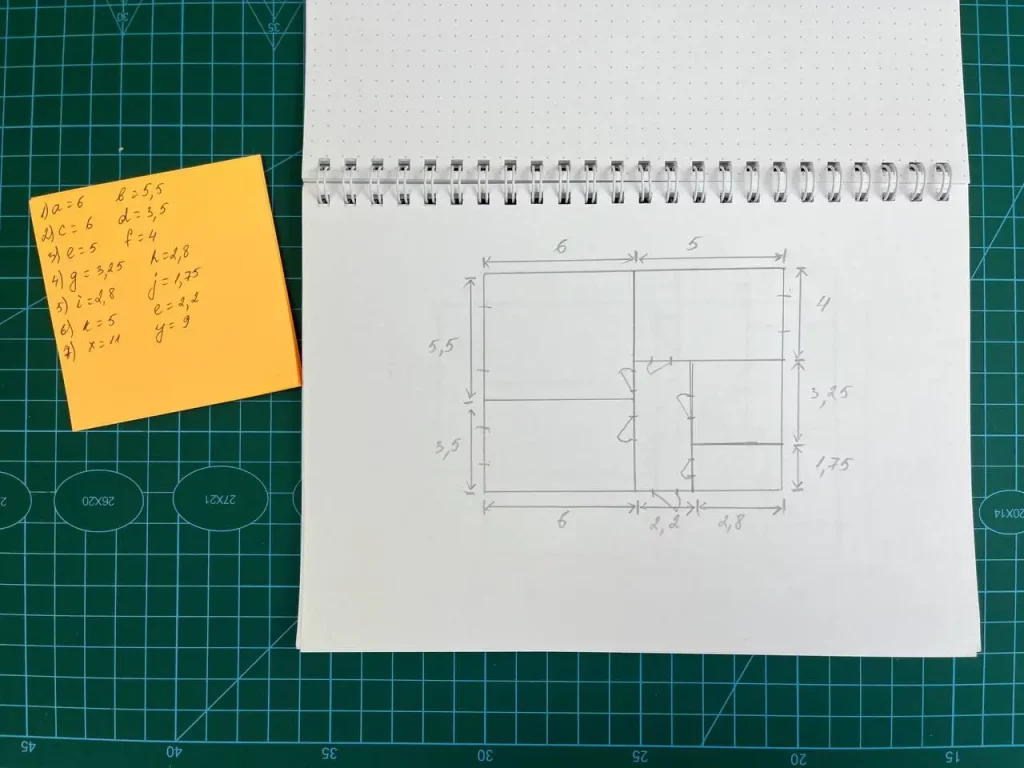
Start drawing a plan of your house. After drawing your house on a sheet of paper, draw a plan without any measurements on the arrangement of the rooms. Don’t forget to put the doors and windows of the rooms on the plan as well. Now write down the length and width of each room shown on this plan. Then calculate the total size of your house: length and width.
Using the example shown in the figure:
length: 6 cm + 5 cm = 6 cm +2.2 cm +2.8 cm = 11 cm;
width: 5.5 cm + 3.5 cm = 4 cm + 3.25 cm + 1.75 cm = 9 cm.
Step 3.
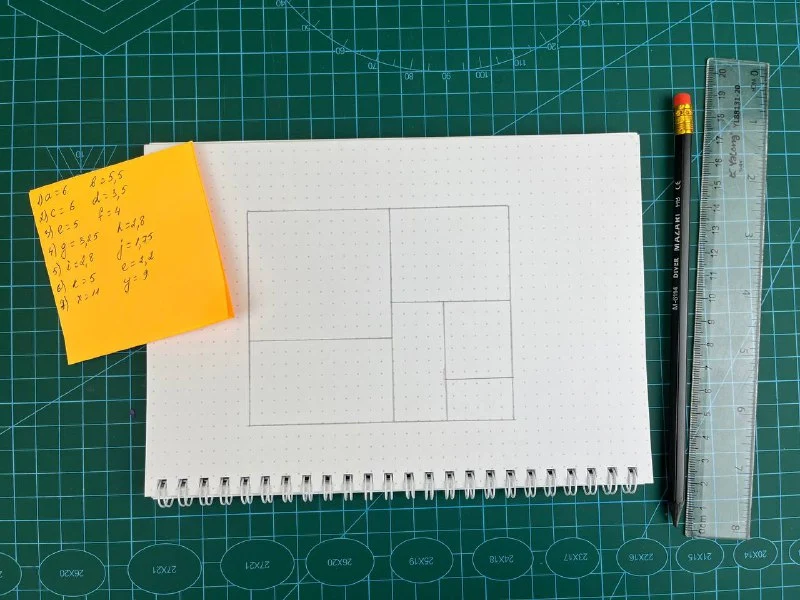
Look at this designed plan and construct a plan based on the actual dimensions of your rooms. It is best to build the overall outside of the house, for this you will use the values of the total length and width of the house. Then build the rooms inside the house according to your dimensions.
Step 4.
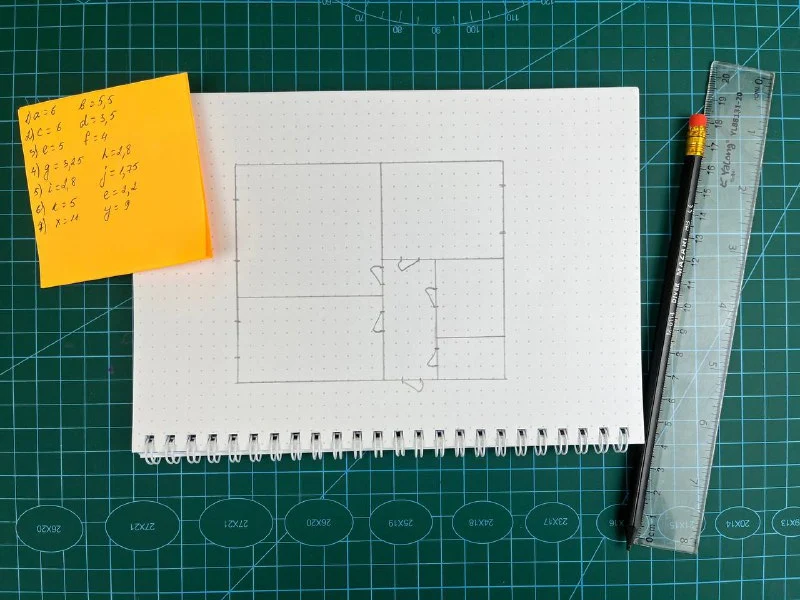
Mark where the doors and windows are located with special signs and note how they are positioned in your house when you draw them.
Step 5.
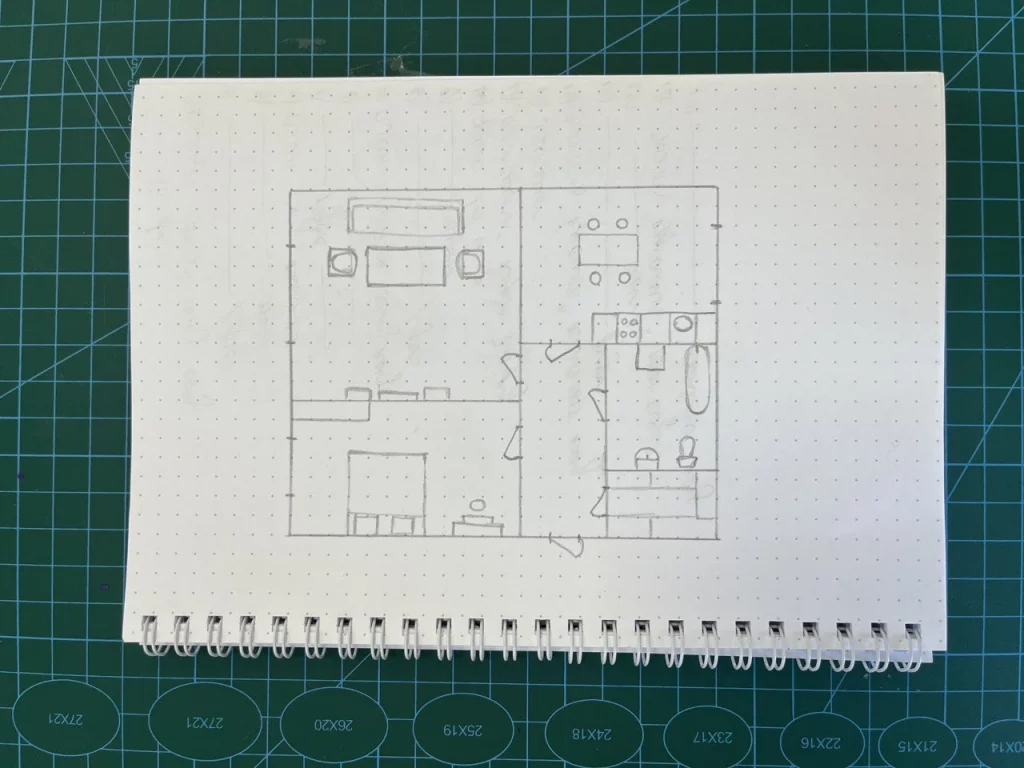
If you like, draw the furniture and appliances inside your house on the plan based on the location.
Step 6.
After you have drawn your house plan, calculate the total area of your houses and the area of each room.
- House area = length of house * width of house
- Room area = room length * room width
- S1 = area of the house =x*y=11*9=99
- S2 = living room area = a*b =6*5.5=33
- S3 = bedroom area =c*d=6*3.5=21
- S4 = kitchen area = e*f=5*4=20
- S5 = bathroom area =g*h=3.25*2.8=9.1
- S6 = locker room area =i*j=2.8*1.75=4.9
- S7 = corridor area =k*e=5*2.2=11
Step 7.
Answer the following questions and make conclusions:
- How do you get the size of the house?
- What is a scale?
- What do you need to know and consider when drawing a house plan?
- How do you calculate the area of the house?
- Is there a difference between the house plan you made and the actual picture of your house? How similar is it?
Conclusion
By doing this practical work, students learned how to take the size of a house, scale it down, and shoot it on a plan. He also honed his mathematical knowledge by calculating the area of the house.
After outlining the plan of the house, he was amazed at the complexities and quirks of drawing a general map, as well as the importance of accuracy in measurements. This knowledge will also make it easier for students to understand the map in the future.