
Lesson
Physical and chemical properties of substances
Objective:
- To teach to analyze the physical and chemical properties of substances;
- To teach to apply in life, knowing the properties of different objects.
Teacher’s Guide
- Before proceeding with the lab work, review the safety rules by following the link:
- Divide the students so that there are three students in each group.
- To download the worksheet, go to: worksheet
Theoretical Part
Substances have chemical and physical properties.
The physical property is that the nature of things does not change, that is, it remains unchanged after observation. Only the aggregate state and form change, and no new substance appears.
In a chemical property, one substance changes into another, a new substance is formed. Chemical properties are observed in a chemical reaction.
Properties of substances are signs that substances are different from each other:
- Hardness – the property of a material not to be deformed.
- Fluidity – the property of substances to change their shape easily.
- Plasticity – the ability to change its shape on impact.
- Density – the ratio of the mass of a body to the volume occupied by this body.
- Shine – the property of a surface to strongly reflect the light falling on it. Colorless – having no color (color). For example, water, glass, and air are colorless.
- Thermal conductivity is the property of a substance to transfer heat from more heated areas of the body to less heated areas.
- Electrical conductivity is the property of substances to conduct an electric current.
- Solubility is the ability of substances to dissolve in water.
Practical part

Step 1.
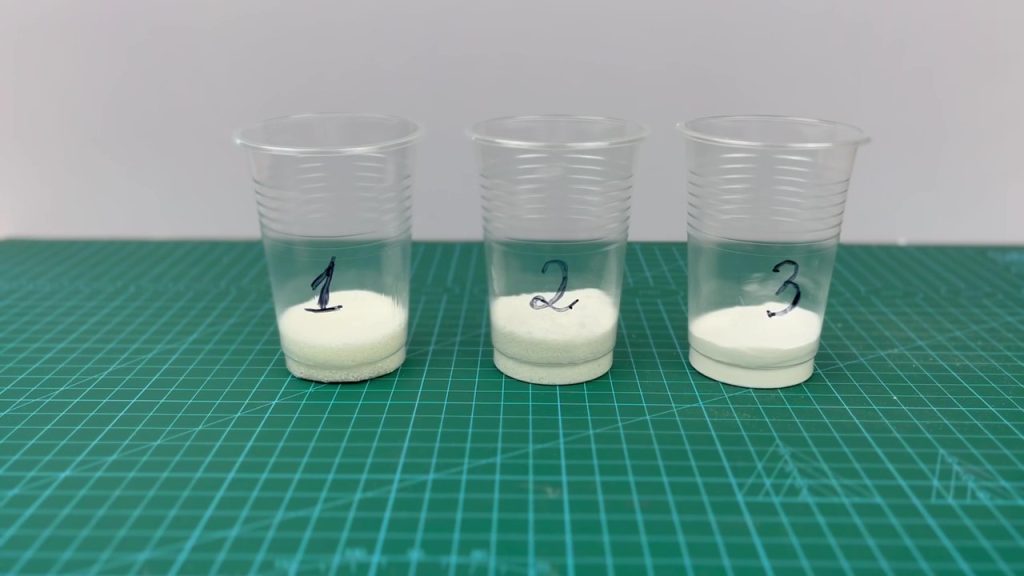
Place Sugar (№1), salt (№2), and baking soda (№3) in plastic cups and number the cups with a marker.
Step 2.
Examine the physical appearance of the substance: sugar, salt, baking soda.
Look at the substance. Write down your observations about its appearance, texture (crystal or powder), smell (you can touch them – it’s safe).
Step 3.
Dissolving it in water:
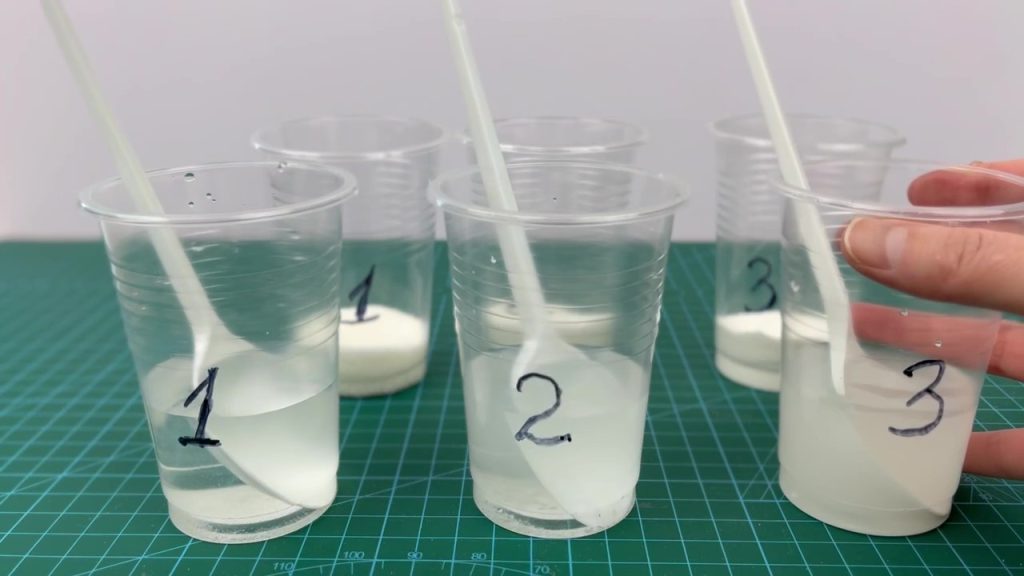
Number 1 to 3 plastic cups of 3 each and fill the same amount of water (about 100 ml). According to the number, put half a spoonful of sugar in the first cup, salt in the second and baking soda in the third. Stir the substance with a spoon to dissolve it. Calculate this experiment with a stopwatch to see which substance dissolves the fastest.
Step 4.
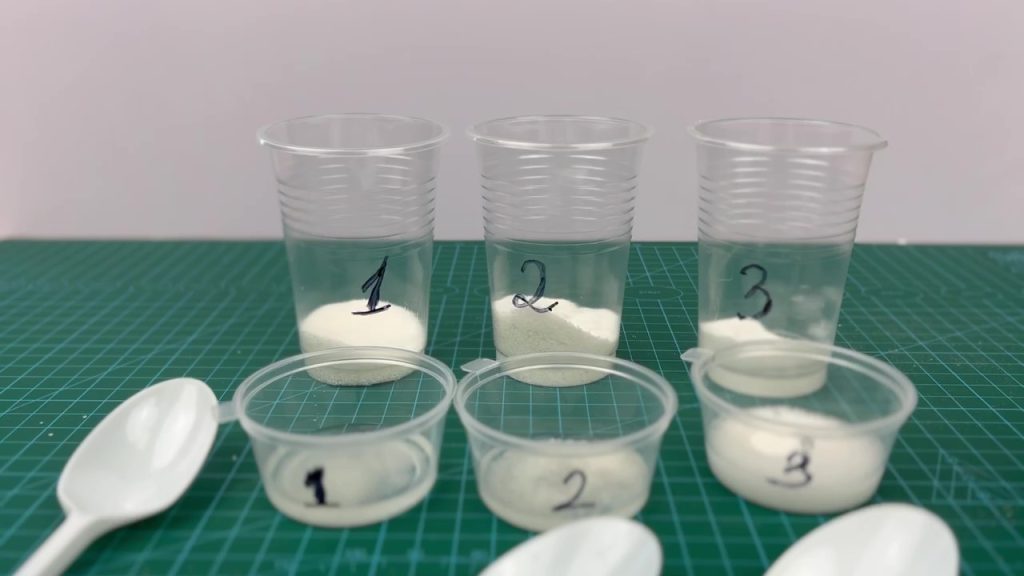
Interaction with vinegar: the experiment will depend on the reaction of sugar, salt and baking soda with vinegar. It is recommended that you wear the mask as a precaution.
Number the saucepans from 1 to 3. Put half a spoonful of sugar in the first cup, salt in the second and baking soda in the third according to the number. Pour one spoonful of vinegar into each saucer. Observe the process of interaction of each substance with the vinegar.
Step 5.
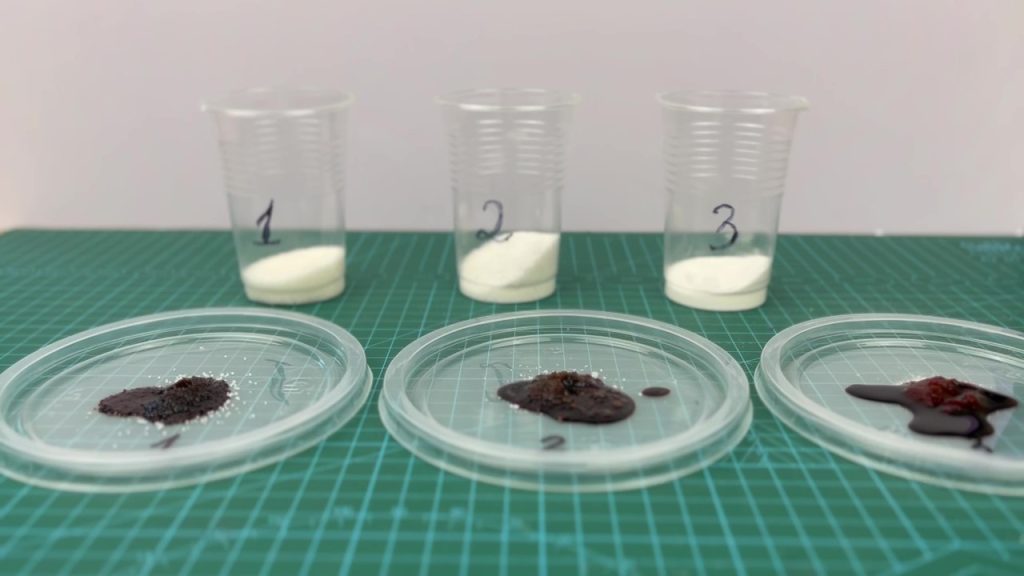
Interaction with iodine:
Place a small amount of sugar on a plastic plate. Drop 1-2 drops of iodine on the sugar. Repeat the same process for the other substances. Observe the process: what changes have occurred?
Step 6.
Fill in the table below in your notebook based on the experiment above.
| Substance | Physical type of the substance | Dissolution in water | Reaction with vinegar | Interaction with iodine |
| Sugar | ||||
| Salt | ||||
| Baking soda |
Step 7.
Answer the following questions by writing them down in your notebook and make conclusions:
- Name the same properties of the three substances.
- What properties distinguish each substance from the other two?
- What changes occurred when sugar, salt, and baking soda were mixed with different liquids?
- What thought did you come up with when you did your lab work?
Conclusion
In this hands – on activity, students learned about the physical and chemical properties of substances. This accumulated knowledge can be further expanded by conducting experiments with adults in their homes.