Lesson

Row method for measuring small bodies
Objective of the work
- To learn how to carry out series measurements.
- To be able to use the laboratory equipment during the activity
- Determine the dimensions of small bodies using the row measuring method.
Teacher’s guide
In the practical work the students work in a group.
The students should be familiar with the topic of physical measurements of different dimensions.
Before starting the practical work, introduce and provide the students with all the necessary materials.
Give the students a worksheet to complete the lab work. You can download the worksheet from the Worksheet link
Familiarise the students with the safety procedures:
Requirements for laboratory work for students
Laboratory works are carried out by students in the classroom under the direct supervision of the teacher and with strict adherence to health and safety requirements.
Laboratory work is accompanied by measurements and calculations. A report shall be prepared on the results of the work.
The report on the performance of laboratory work by the student shall contain:
- The name and number of the laboratory work;
- The name of the theme of laboratory work;
- The purpose of laboratory work;
- Brief description of the laboratory system (if any);
- The methods of measurement;
- The course of the laboratory work;
- Results of measurements and calculations (usually in the form of tables) with obligatory indication of the units of measurement;
- The results of the individual measurements; add a photo guide
- The results of processing the experimental data obtained with an estimate of the error of measurements;
- Graphs, charts, drawings;
- Basic calculation formulas with an indication of the quantities to be measured (all the alphabetic values included in the formulas must be explained);
- Calculation and detailed analysis of the results;
- Conclusions.
Provide this material (PBL rubrics) to students for assessment so that:
- Students understand in advance what criteria they need to prepare,
- Students will be able to assess their own peers accordingly.
Theoretical part
In your previous laboratory work, you measured a physical quantity – the volume of a liquid. You noticed that the value of the measured physical quantity was greater than the scale value of the measuring instrument. What should you do if you need to measure a very small value – the diameter of a wire, the thickness of paper, etc.? There are special instruments for measuring small bodies ( micrometer, caliper). However, when you are not interested in the size of a particular grain, pea or bead, but the average size of these objects, the method of series is used. Suppose you have a large number of identical bodies.
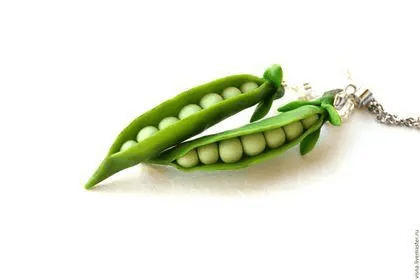
By measuring the length of a row of densely touching peas with an ordinary ruler and knowing their number, it is easy to calculate the diameter of a single pea. A similar method of rowing makes it possible to determine the average value of many physical quantities.
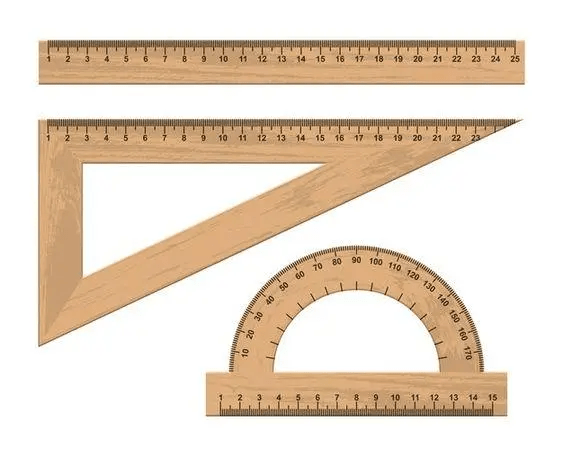
How do you measure a small body? For example, a grain of millet or the thickness of a thread. Take a ruler on one side and measure. Is it convenient? No. It is not possible to measure the size of small bodies, such as a grain of wheat, with a ruler. This is because the size of the millet is commensurate to the scale value of a ruler (usually 1 mm) and often even smaller. Such measurements require instruments with a smaller scale value, i.e. with greater accuracy. Nevertheless, if you have a couple of dozen grains, you can measure the average size (diameter) of these grains with a ruler. This method is called the row method.
Practical part
- Find the division value of a ruler
Step 1: Take any two marks that are closest to each other and have numbers next to them.
For example: in the figure they are 1 cm and 2 cm
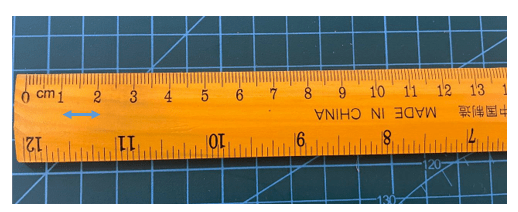
Step 2: Find the difference of these numbers. To do this, subtract the smaller number from the larger one.
2 cm – 1 cm = 1 cm
Step 3: Divide the resulting number by the number of small, non-numerical divisions between them. Recall that the number of divisions equals the number of spaces between the strokes (not the number of strokes).
In the figure there are 10 gaps between the 1 cm and 2 cm marks.
1 cm : 10 = 0.1 cm
Step 4: The result is the price per division on the scale of the ruler, which indicates how many cm or mm one smallest division corresponds to.
Important: Convert all measurements into mm. 1cm = 10 mm
Scale value of the ruler: 0.1 cm = 1 mm
Step 5: The error of the scale is half the scale value.
Error of the beaker: 0.5 mm
2. Determine the dimensions of small objects using a ruler
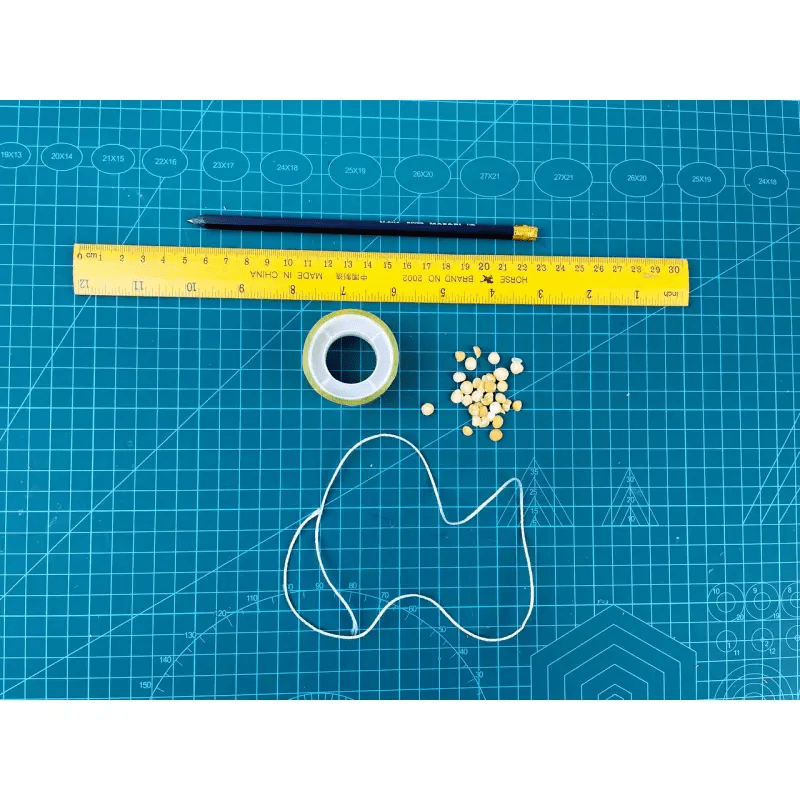
Before beginning your work, assemble all the required materials
- Ruler
- String
- Pencil
- Scotch tape
- Pea seeds
Step 1: Find the diameter – of the peas using a ruler
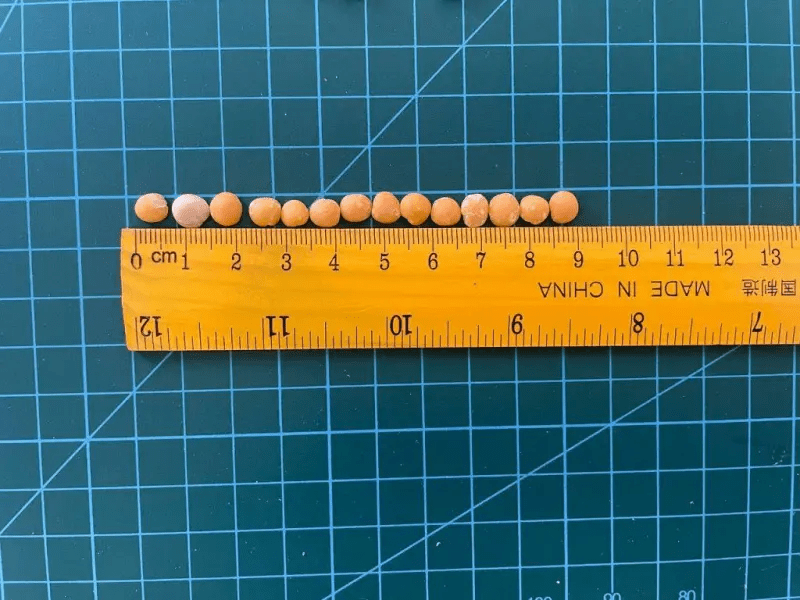
Lay out the pea grains along the scale of the ruler so that no gaps are left between them and determine the length of the row.
To find the length of the row we use the formula d = l/n
d – diameter of small body
l – row length
n – number of small bodies in the row
This is how we measure the length of the row of grains. The grains have the same diameter. Consequently, to get the diameter of a grain you have to divide the length of the row by the number of grains.
Calculations:
in the figure along the ruler number of grains: n = 14
row length: l = 9 cm = 90 mm
Divide the length of the row by the number of grains.
d = l/n ⇒ d = 90/14 = 6.4mm
Pea diameter : 6.4mm
Step 2: Find the thickness – using a ruler
Wrap any number of coils closely around the pencil. Tape the beginning and end of the thread to the pencil.
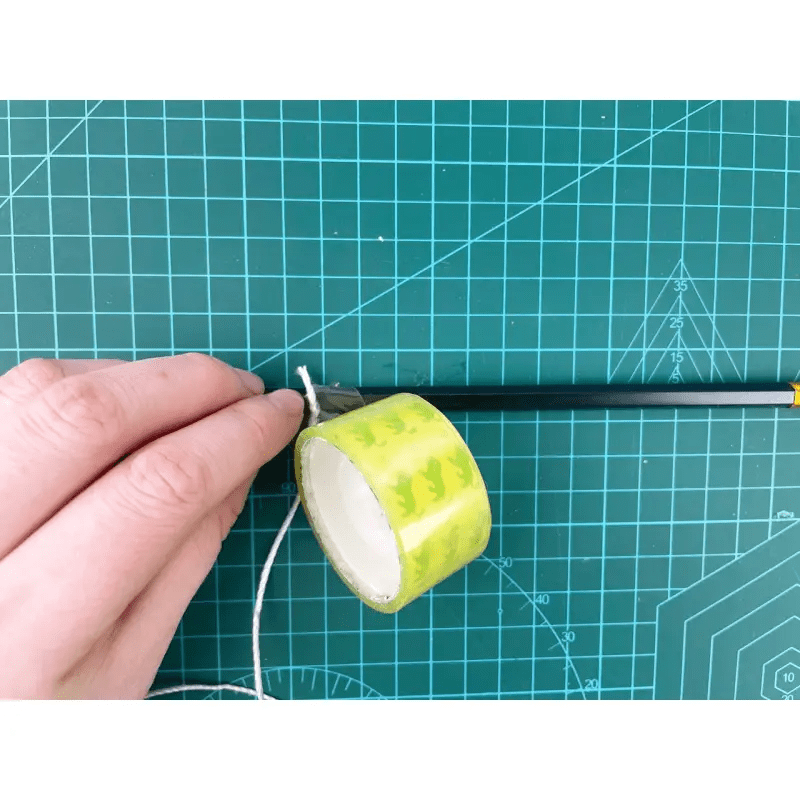
Step 3: Measure the length of the winding, then count the number of turns
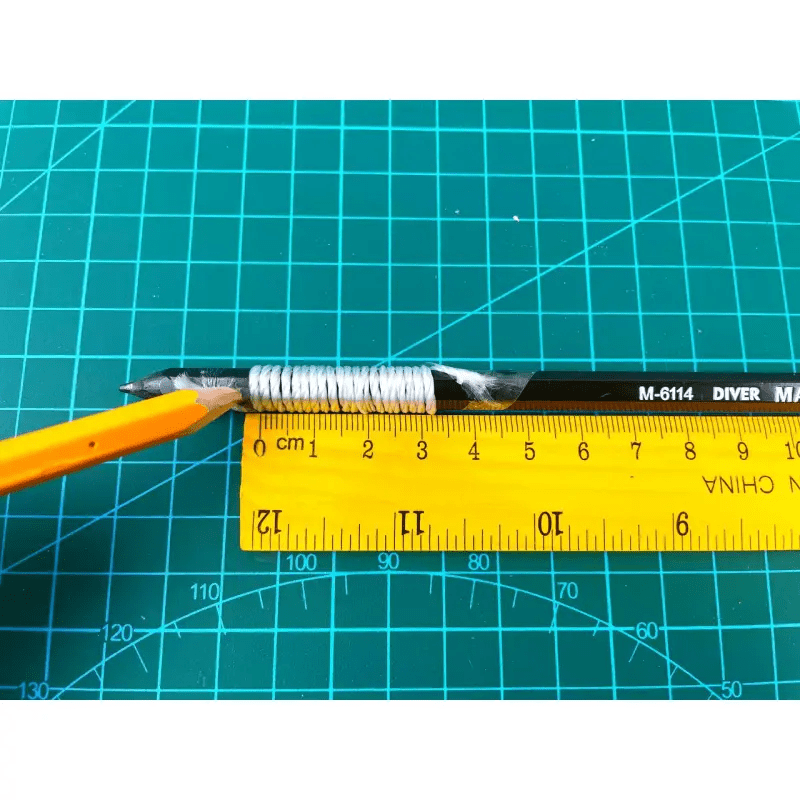
Calculations:
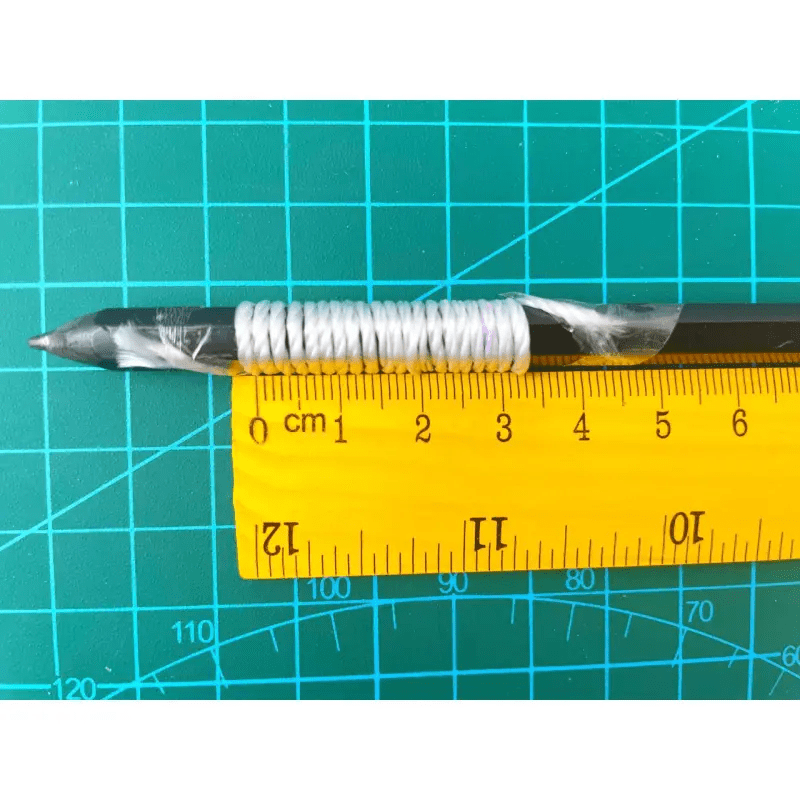
winding length: l = 3.2 cm = 32 mm
Number of windings: n = 20
Divide the winding length by the number of turns.
d = l/n ⇒ d = 32mm/20 = 1.6mm
Thread thickness: 1.6mm
Step 5: Record all the results in the table
| № of experiences | A measurable body | Row lengthl, mm | Number of small bodies in a rown, pc | Size of small bodiesd, mm | Error in diameter measurementΔd, mm |
| 1 | peas | 90 | 14 | 6,4 | 6,4 ± 0,5 |
| 2 | thread | 32 | 20 | 1,6 | 1,6 ± 0,5 |
Step 6: Draw conclusions by answering the questions:
1. What method was used to measure the dimensions of small bodies in the laboratory work.
2. What does the accuracy of measuring the dimensions of small bodies depend on when using this method.
3.Identify any other tools that you know for measuring small objects.
Conclusion
In this lab, students performed lab tasks and used a linear method to measure small objects. They learnt how to make a correct presentation of their lab work.