Week 3
Purpose in applying for a loan
The purpose of the loan is very important when applying for a loan from a lending institution. This is how the banking institution can determine exactly what the borrower needs the funds to be provided for. This makes it possible to assess the profitability and riskiness of providing funds to a particular person.
There are two categories of target loans:
- Consumer loans – granted to individuals;
- Loans for commercial activities, the recipients of which are legal entities – large companies or private entrepreneurs.
What are the purposes of consumer loans?
Consumer loans are aimed at meeting the personal needs of a particular borrower. They can be, for example, loans to buy an apartment, to make repairs, or to get an education. The most common purposes of consumer loans include:
- Purchase of a home in the primary or secondary real estate market;
- buying a car;
- higher education;
- repayment of credit obligations to other institutions;
- to pay for medical services;
- purchase of household appliances.
Purpose of loans for legal entities
Targeted commercial loans are often used to create businesses or expand and modernize existing facilities, so this category of loans is also called “development loans”. Among the main purposes of commercial loans are:
- The purchase of more modern machinery and equipment for the enterprise;
- purchase of goods and materials for production;
- renewal of fixed assets;
- paying salaries to workers;
- starting a business;
- construction of the enterprise.
Practical part.
This time, calculate the loan for a larger amount and for a longer term. This will determine what type of long term loan coverage is reasonable.
Determine the loan amount and repayment time. Take the annual interest rate of 10% or higher, because the loan will be 10% if it is covered by insurance, and even higher in other cases. You do the calculation for two types of payments: annuity and differential.
For example, the loan amount was calculated as 10,000,000₸ and the repayment period is 7 years. The interest rate is 15%.
Annuity payment.
Step 1.
Open the file created with the name “loan” in Microsoft Excel and add a new page.
Create a table like the one created in week 2 and enter the data (the amount you borrowed, the repayment time, and the interest rate) into it. Fill in the No. so that it corresponds to the number of months at the time you repay the loan.
Where:
S – loan amount, loan body;
i – interest rate;
N – payment period;
X – amount you pay each month;
P – interest amount;
M – repayment of the loan.

Step 2.
Calculate the amount you pay each month using the PLT function. To do this, select Formulas→Insert Function→ PMT.
Since the payment for the second month is the same as the payment for the first month, cell B7 equals B6. Use the auto-fill method starting in cell B7 because the payment amount in each month is the same.
Step 3.
S1=10,000,000₸ and the interest amount is calculated using the formula P1=S1*i/12. the reason for being i/12 you calculate the monthly interest rate through the annual interest rate.
You calculate the repaid portion of the loan through M=X+P, then M1=X1+P1.

Step 4.
To find S2, add M1 to S1: =C6+E6.
To find P2, S2 – multiply the remaining loan amount by the interest rate and divide by 12 months: =C7*$B$2/12.
And M2 will be equal to the sum of the monthly payment and the amount of interest: =B7+D7.
Highlight the S2-M2 interval and use the autofill method for all months.
Step 5.
Calculate the monthly payment amounts, interest amounts, and reimbursement amounts for the entire month using the autosum function in the formulas section.

Differential payment
Add a new page to the file created with the name “loan” in Microsoft Excel.
Create a table similar to the table created for the differential payment in week 2, and enter the data in it (the amount you borrowed, the repayment time, and the interest rate). Fill in the № so that it corresponds to the number of months at the time you repay the loan.

Step 2.
A – equal shares of the loan body equals the division of the loan body by the month in which you must repay the loan: =$B$1/$B$3. for all months, use the auto-complete method starting in cell B6.
S1=10.000.000₸.
And you calculate the interest amount using the formula P1=S1*i/12: =C6*$B$2/12
The amount you pay for the first month is calculated according to the formula X=A+R: =B6+D6

Step 3.
To calculate S2, subtract A1 from S1: =C6-B6. For the remaining months, use the autofill method, starting from cell C7.
Step 4.
To calculate the interest amount and the amount you pay each month, set P1 and X1 and calculate all months using the autocomplete method.
Step 5.
Calculate using the auto-sum function to find out how much interest you have to pay in total and the amount of monthly payments in the differential payment scheme. To do this, go to the empty cell at the bottom of the column where the interest amounts are calculated, and select the autosum function in the formula section. And do the same process with the monthly payment amounts as well.

Step 6.
Based on your calculations, compare annuity and differential payment schemes. Which payment system, in your opinion, is the most effective?
Presentation of projects (presentation)
After completing their project development, the students should present their finished timetable of activities.
Conclusion
The banking system plays an important role in the economy of every nation. Nowadays, almost the entire population uses banking services. Therefore, it is important to become familiar with the types of services a bank offers people and be able to apply them to their needs.
Through this project, the students expanded their financial knowledge. They were convinced by the fact that it is possible to get passive income by investing money in a deposit. And when applying for credits, it is necessary to consider not only interest rates, loan terms and other important conditions, but also the type of payment.
Assessment
PBL evaluation criteria:
Problem based learning (problem-oriented learning) is a learning method in which students acquire knowledge and skills by working on one project for 3 or 4 weeks to research and find an answer to a genuine, interesting and complex question, problem or challenge (then follow the PBL Rubrics link to the Rubrics).
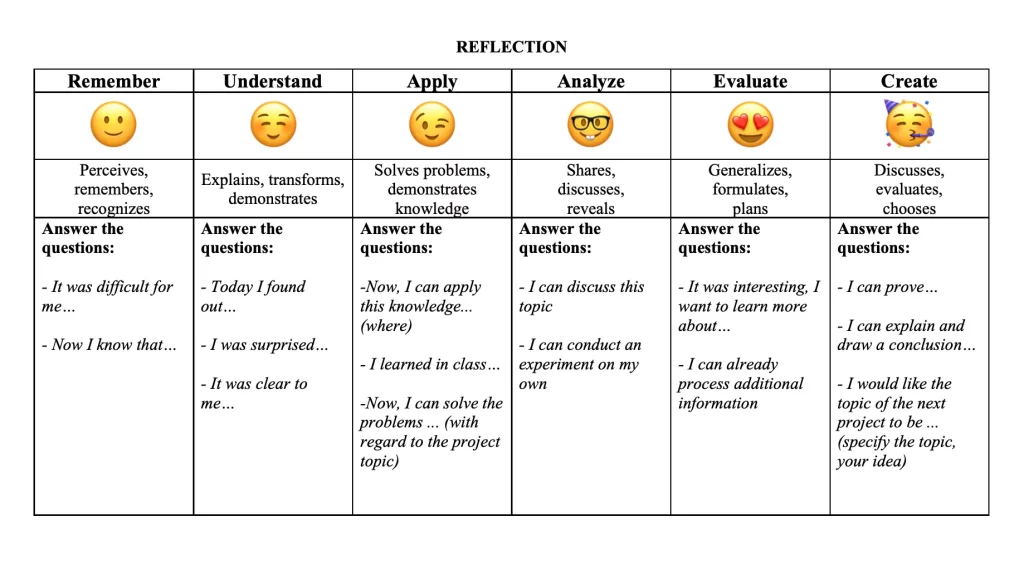
Reflection