
Task – 1

Division value, error and volume of liquid in a beaker
Objective
- To learn how to determine the volume of a body using a measuring cylinder (beaker).
- Know how to use the laboratory equipment during work
- Determine the divisional value of a unit
Teacher’s guide
In the practical work, the students work in a group.
The students should be familiar with the topics of physical quantities and their measurements/accuracy of measurements and calculations.
Before starting the practical work, familiarise and provide the students with all the necessary materials.
Give the students a worksheet to complete the lab work. You can download the worksheet from the Worksheet link:
Familiarise the students with safety procedures
Requirements for laboratory work for students
Laboratory works are carried out by students in the classroom under the direct supervision of the teacher and with strict adherence to health and safety requirements.
Laboratory work is accompanied by measurements and calculations. A report shall be prepared on the results of the work.
The report on the performance of laboratory work by the student shall contain:
- The name and number of the laboratory work;
- The name of the theme of laboratory work;
- The purpose of laboratory work;
- Brief description of the laboratory system (if any);
- The methods of measurement;
- The course of the laboratory work;
- Results of measurements and calculations (usually in the form of tables) with obligatory indication of the units of measurement;
- The results of the individual measurements; add a photo guide
- The results of processing the experimental data obtained with an estimate of the error of measurements;
- Graphs, charts, drawings;
- Basic calculation formulas with an indication of the quantities to be measured (all the alphabetic values included in the formulas must be explained);
- Calculation and detailed analysis of the results;
- Conclusions.
Provide this material (PBL rubrics) to students for assessment so that:
- Students understand in advance what criteria they need to prepare,
- Students will be able to assess their own peers accordingly.
Theoretical part
A beaker is a vessel with divisions for measuring the volume of liquids. It is used in medical, educational and industrial laboratories as well as at home. When using a beaker, as with any other graduated measuring container, it is important to accurately determine the divisional value. The divisional value indicates how many millilitres of liquid each mark on the scale represents. In the case of a beaker, this value helps calculate the uncertainty. And knowing the error, it is easy to determine the volume of liquid in the beaker.
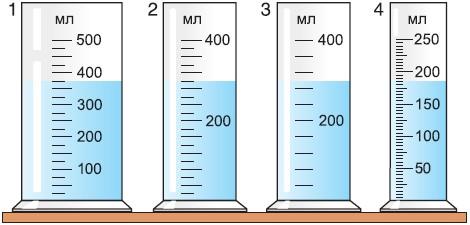
Practical part of the work
Determine the price of dividing the device
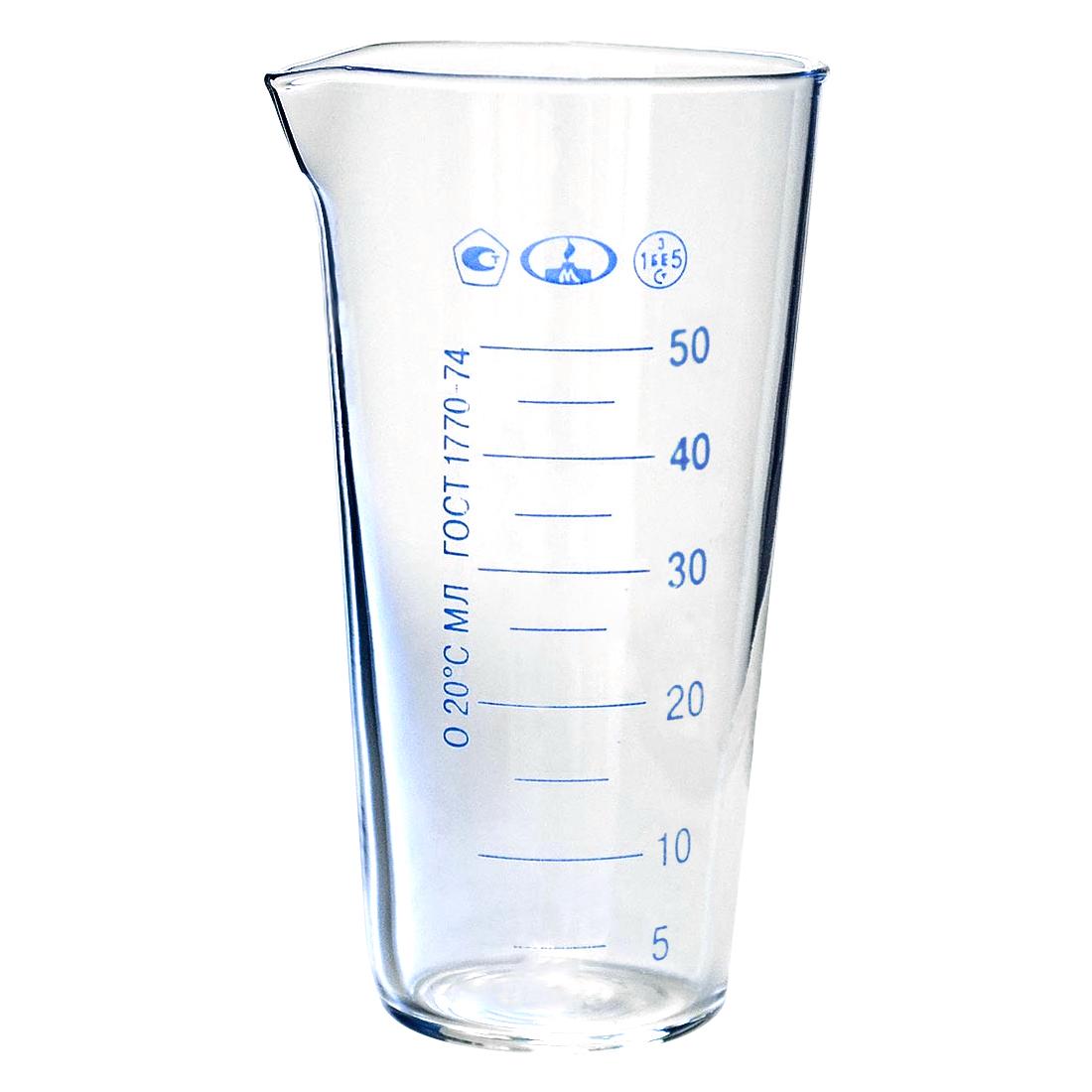
Any two adjacent digits on the beaker scale are helpful in determining the dividing price. The algorithm is as follows:
Step 1: Take any two marks closest to each other, next to which the numbers are indicated.
For example: in the figure it is 60ml and 40ml

Step 2: Find the difference of these numbers. To do this, subtract the smaller number from the larger one.
60 ml – 40 ml = 20 ml
Step 3: Divide the resulting number by the number of small, non-numerically marked divisions between them. Recall that the number of divisions equals the number of spaces between the strokes (not the number of strokes).
In the figure, there are 4 gaps between marks 60 and 40.
20ml : 4 = 5ml
Step 4: The resulting number is the dividing value of the beaker scale, which indicates how many milliliters correspond to one smallest division.
The divisional value of the beaker scale: 5 ml.
How to determine the error and the volume of the liquid
Step 5: The error of the instrument is half the scale value.
Uncertainty of the beaker: 2.5 ml.
Step 6: To determine the volume, take the nearest number from the upper limit of the liquid (in the figure it is 40 ml) and add the number of strokes (in the figure it is 2 strokes) by 5 ml:
V = 40 + 2 × 5 ml = 50 ml.
Step 7: Record the result of the measurement.
The volume of liquid in the beaker: V = 40 + 2 × 5ml = 50ml.
Taking into account the error: V = 50 ml ± 2.5 ml.
(40 ml is already under the liquid level, 2 divisions of 5 ml, plus error of measurement)
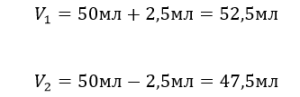
The “±” (plus or minus) sign in front of the error means that the actual value of the liquid volume may be 1 ml greater or less than the measured value.
That is to say
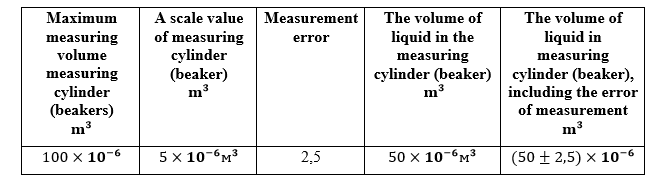
Step 8: Fill in these work results in the table.
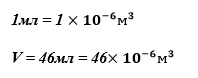
It is important that when you fill in the table all measurements are converted to the SI system
International System of Units (SI) (French: Le Système International d’Unités (SI)) – System of units for physical quantities, the modern version of the metric system.
The SI defines seven basic and derived units of physical quantities (hereafter referred to as “units”), as well as a set of prefixes. Standard abbreviations for units and rules for recording derived units are established.
For example
Step 9: Checklists for the defence
- What does it mean to measure a physical quantity?
- Types of measurement errors.
- Scale value of a measuring instrument. Instrument error.
- Absolute and relative errors of measurement.
- Rules for recording the result of a measurement in standard form.