
Lesson 1
Topic of the laboratory work: “Study of the local ecosystem”
The purpose of the work:
- Find out what environmental factors exist and how they affect wildlife
- Learn to distinguish between biotic and abiotic factors
- Learn to identify and even measure some factors
Teacher’s Guide:
- Tasks are performed in groups of 2-3 people
- When working with a mercury thermometer, care must be taken not to break it
Expected goals:
- Students understand how to determine humidity and soil pH
Worksheet:
Safety technique:
Description
Humidity is the amount of water vapor contained in the air. The higher the humidity, the more water vapor is contained in the air. High humidity means that the air is more saturated with water, which can have an effect on plants.
High humidity can be beneficial for plants, as it can help retain moisture in the soil and moisten the leaves of plants. This is especially important during hot and dry periods when plants may experience stress due to lack of water. However, if the humidity becomes too high, it can lead to the development of mold and other diseases that can damage plants.

Too low humidity can also negatively affect plants. In dry conditions, plants can experience stress due to lack of moisture and dry air, which can lead to drying of leaves and damage to plants. In such cases, it is useful to use humidifiers or other methods to increase indoor humidity.
Thus, maintaining optimal humidity is an important factor for the health and growth of plants, and can contribute to their prosperity.
List of necessary equipment
- Mercury thermometer to measure temperature outside
- Cotton wool or a piece of gauze
- Water
Practical part
1) Step into the shade or a place sheltered from direct sunlight 2) Hold the thermometer for 5 minutes without touching its head
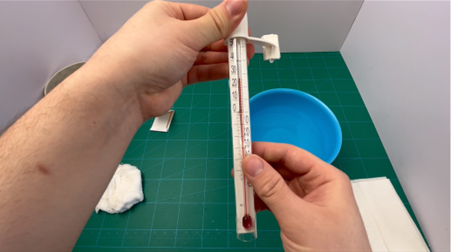
3) Record the temperature
4) Soak cotton wool or gauze in water and wrap its thermometer head
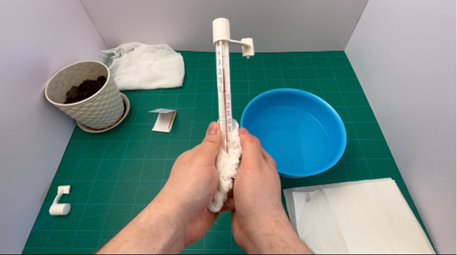
5) Wait 5 minutes
6) Record the temperature
7) Looking at Table 1, calculate the humidity of the air

Conclusion
In this laboratory work you learned how to determine air humidity and soil acidity
Rules for designing the laboratory work
The laboratory work should contain items in the following order:
- Laboratory work number
- Topic name
- Purpose of the work
- Hypothesis
- Brief description of the theoretical part
- Equipment
- Steps in the correct sequence
- Add a photo from the experiment (if you can’t insert a photo, you can add a picture)
- Give a brief description
- Write a brief discussion and explanation of the topic covered
- Write the conclusion of the work
- The workplace must be cleaned and put in order
Feedback