
Lesson
Objective:
- Understanding the rules for using household chemical products
- Identify the acidic environment of household cleaning products
- The effect of synthetic detergents on living organisms
Teacher’s guide:
1. Divide students into groups.
2. To download the worksheet, follow this link:
3. Before beginning lab work, familiarize yourself with the safety rules by following this link:
Theoretical part
Household chemistry is the science of how we use chemicals in our daily lives to care for ourselves, our homes, and the environment. A few basic aspects of household chemistry are:
- body cleansing detergents;
- dishwashing detergents;
- detergents for laundry;
- detergents for cleaning the home.
It is important to keep in mind that household chemicals should be used carefully and with instructions to minimize risks and maintain health and safety.
Practical part
Experiment №1. Fill in the table “chemical composition of washing powder” below.
| Composition | Ariel | Tide | Миф | Sarma | Чайка |
| Anionic surfactants | |||||
| Surfactants nonionic | |||||
| sulfates | |||||
| Phosphates | |||||
| Phosphonates | |||||
| Carbonates (soda ash) | |||||
| silicates | |||||
| Polycarboxylates | |||||
| Zeolites | |||||
| soap | |||||
| Enzymes | |||||
| Oxygenated bleach | |||||
| Optical brightener | |||||
| Defoamers | |||||
| Antiresorbents | |||||
| Flavoring additives and fragrances | |||||
| benzyl salicylate | |||||
| Hexyl Cinnamic aldehyde | |||||
| Linalool |
Experiment №2. Effect of synthetic detergents on living organisms
This experiment will determine how laundry detergent and dishwashing liquid affects the life history of cattail algae.
Step 1.
Pour equal amounts of water into three plastic cups.
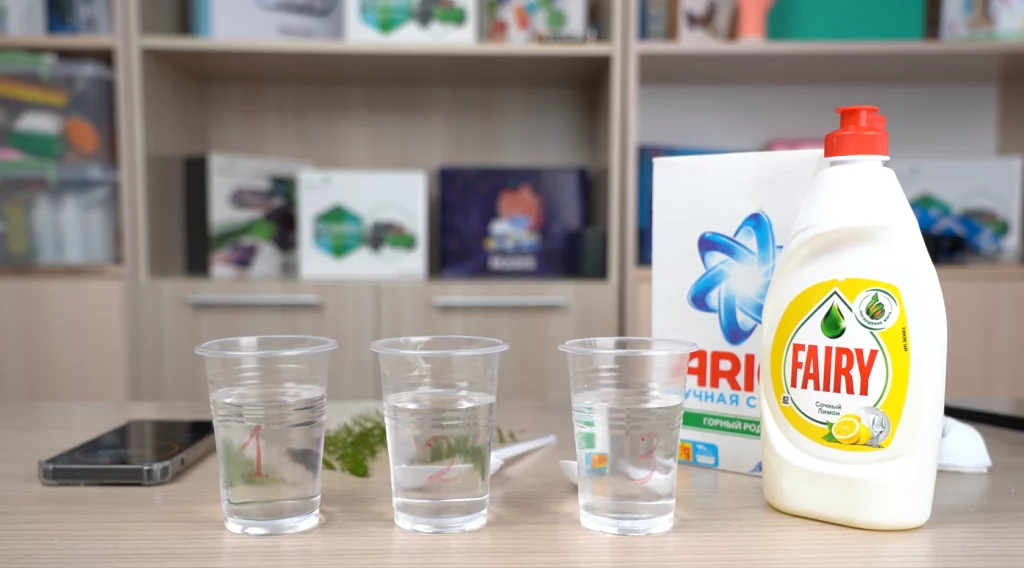
Step 2.
In the second cup, put 1 spoonful of laundry detergent and dissolve it.
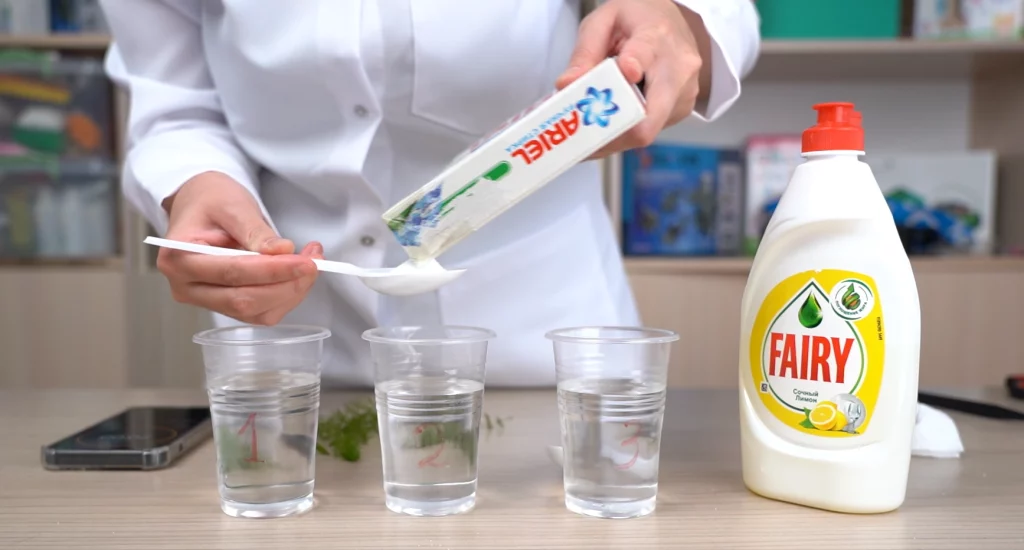
Step 3.
In the third cup, pour 1 spoon of dishwashing liquid and dissolve it.
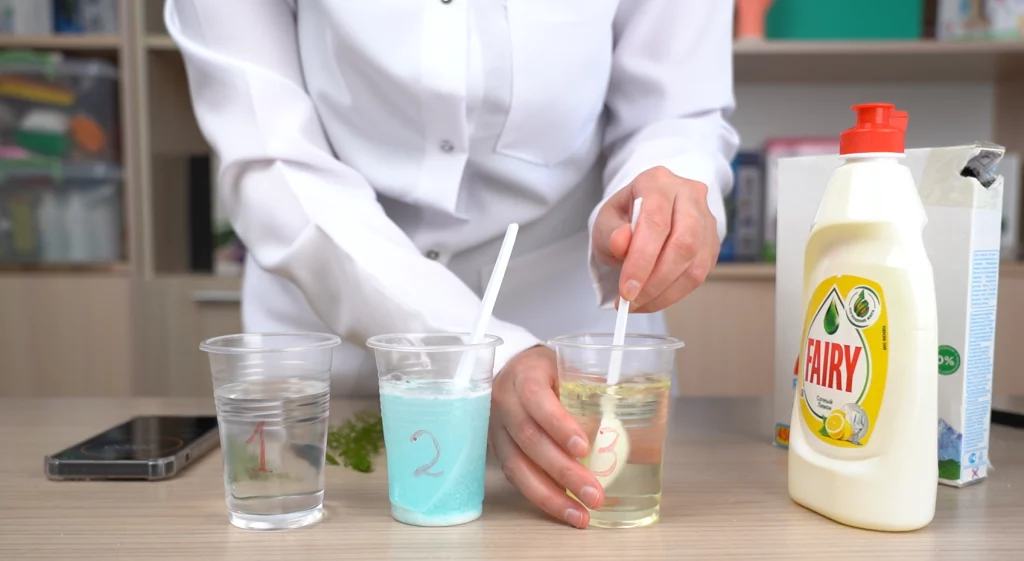
Step 4.
Place the hornwort algae in all three glasses. Leave the algae in the water for 20 minutes.
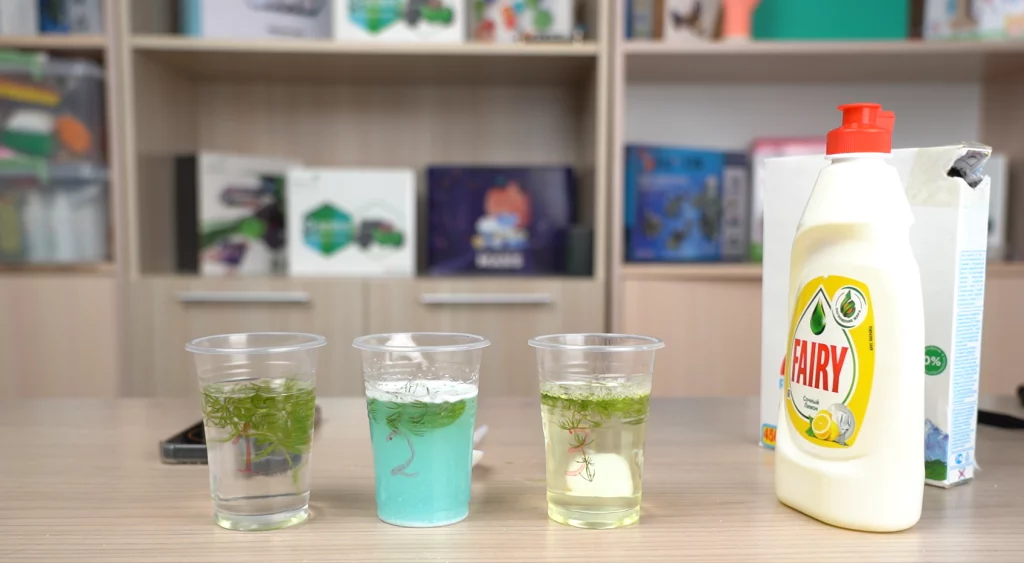
Step 5.
Observe the changes. After 20 minutes, record the observed changes on the worksheet.
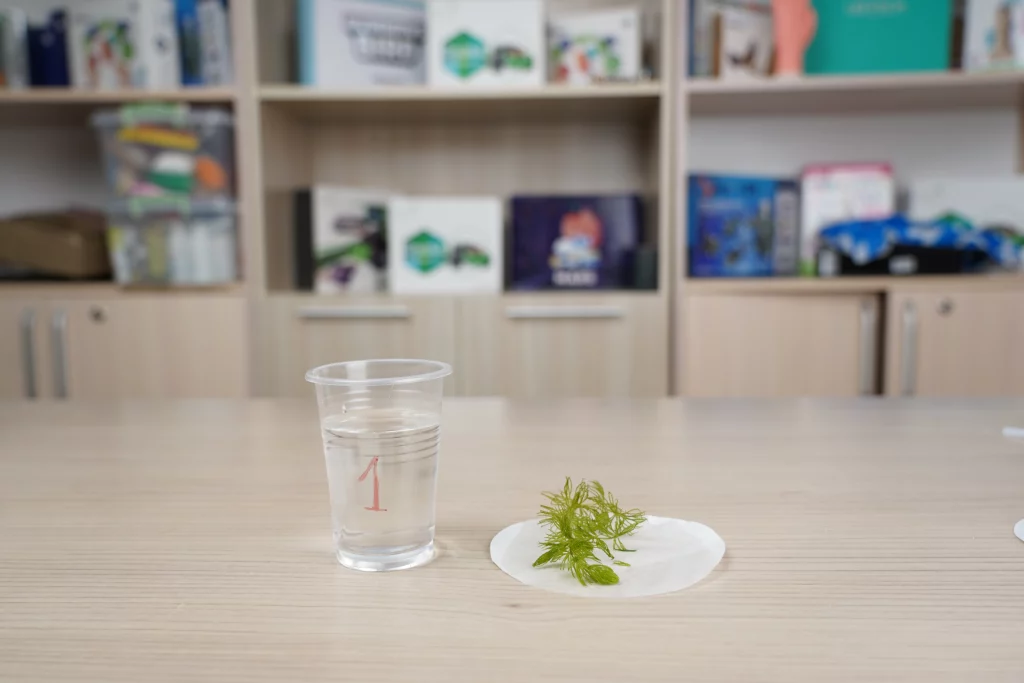
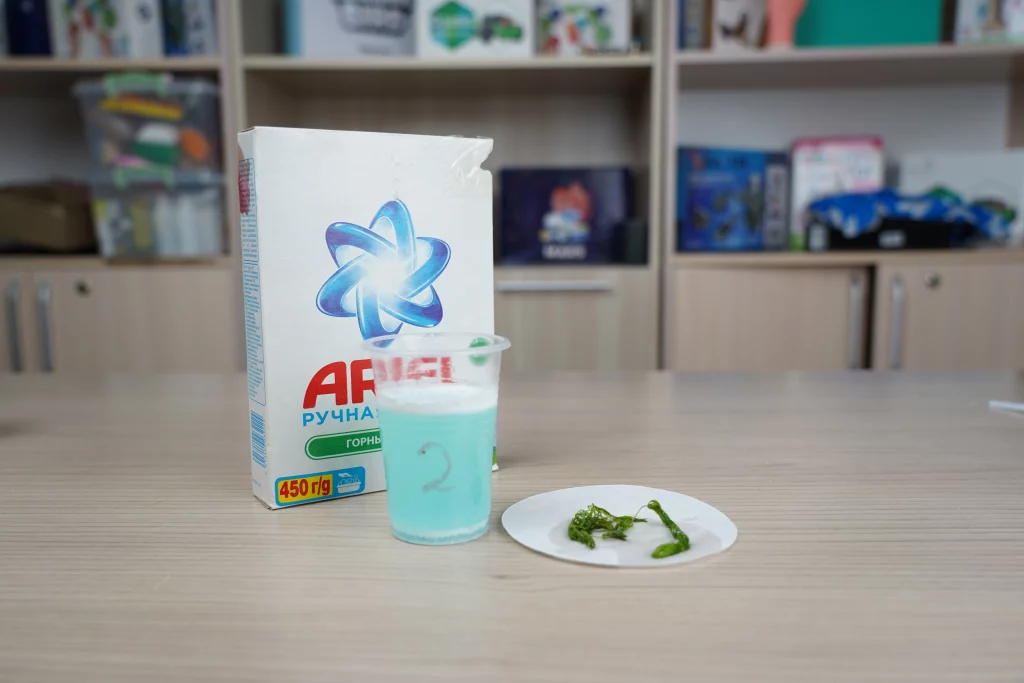
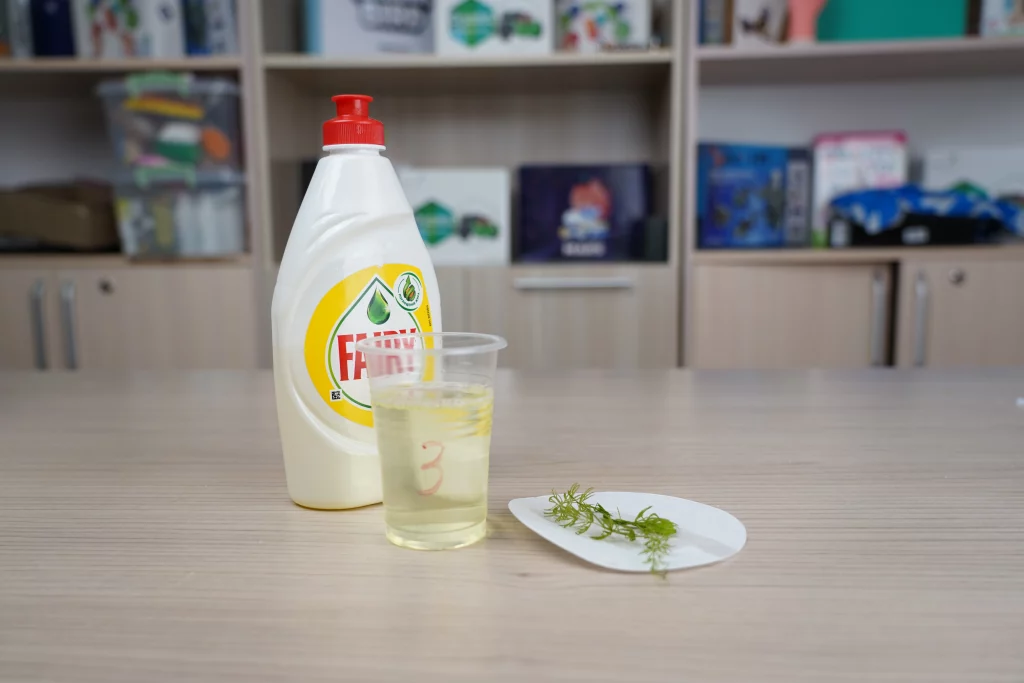
| 20 min | |||
| Indicators of comparison | pure water | water with washing powder | water with dishwashing liquid |
| color | |||
| shape | |||
| condition | |||
Experiment №3. Determining the pH of dishwashing liquids
You will measure the pH of the medium for various dishwashing liquids. The most appropriate pH for hand skin is 7. For dishwashing, a solution with a neutral pH close to 7 is generally recommended. If the pH of the solution deviates greatly from this value in the direction of acidity or alkalinity, it can affect the effectiveness of the dishwashing solution and even the safety of its use.
Step 6.
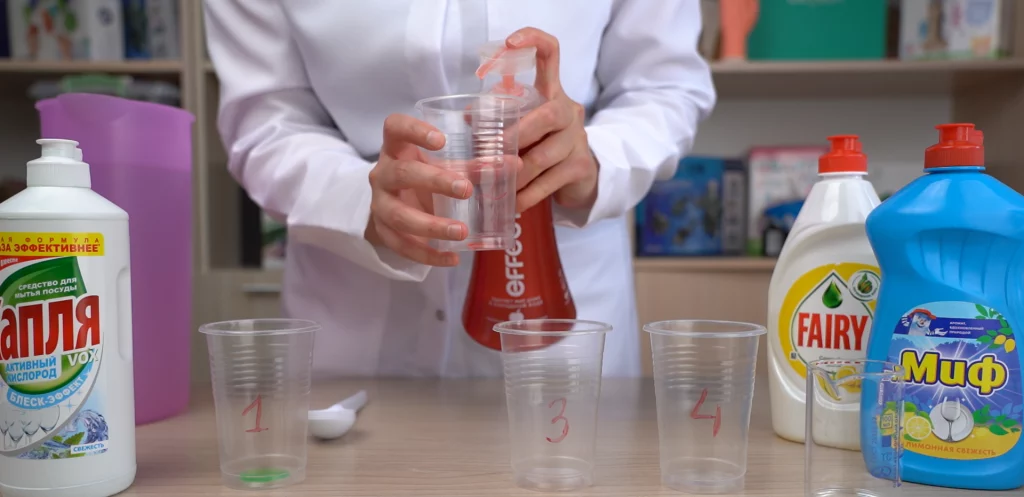
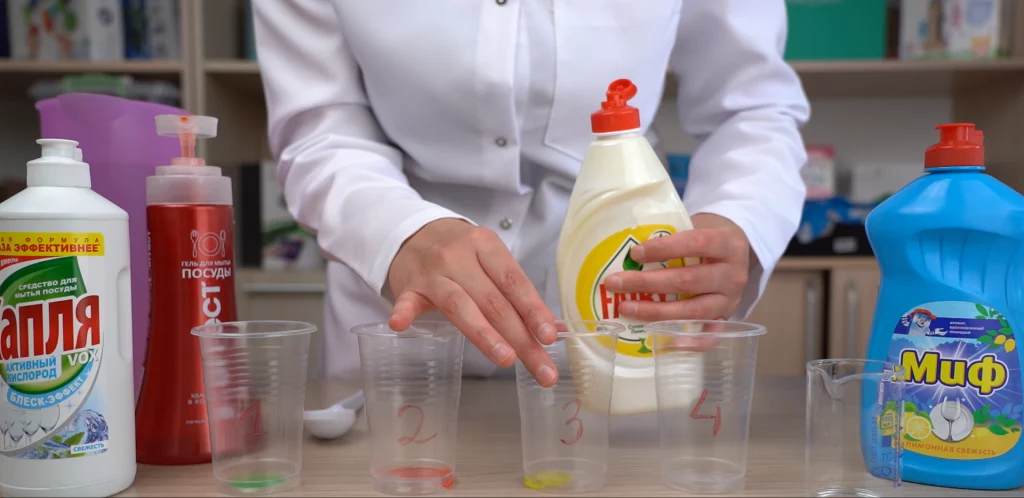
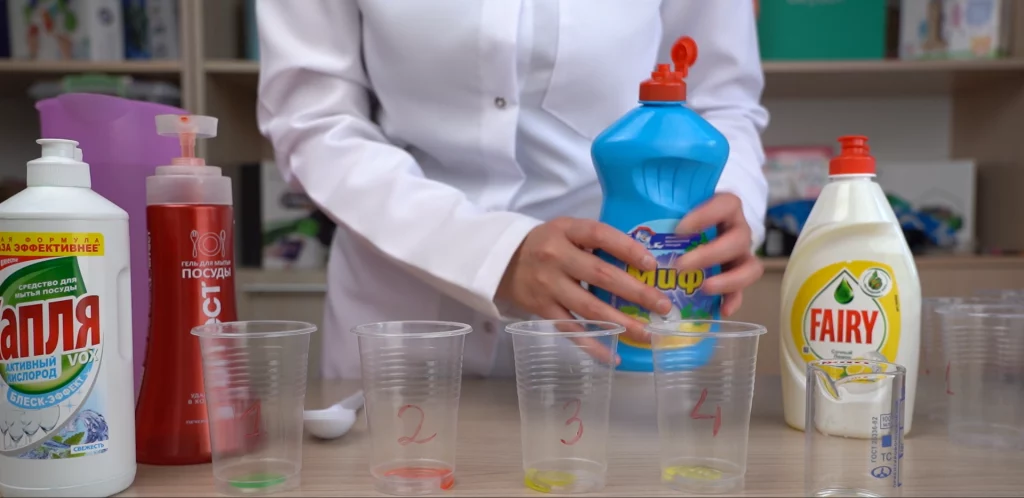
Number the 4 beakers. Pour a few drops of different dishwashing liquids into each beaker.
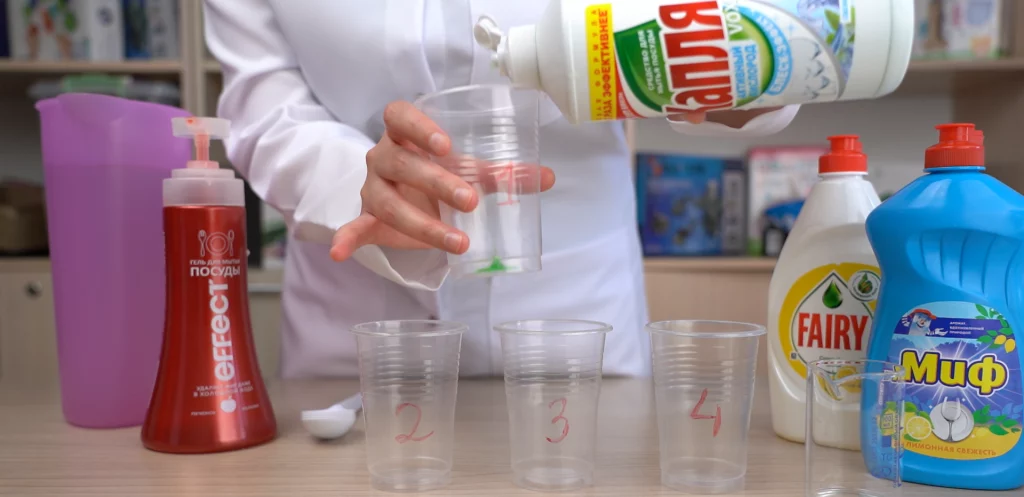
Step 7.
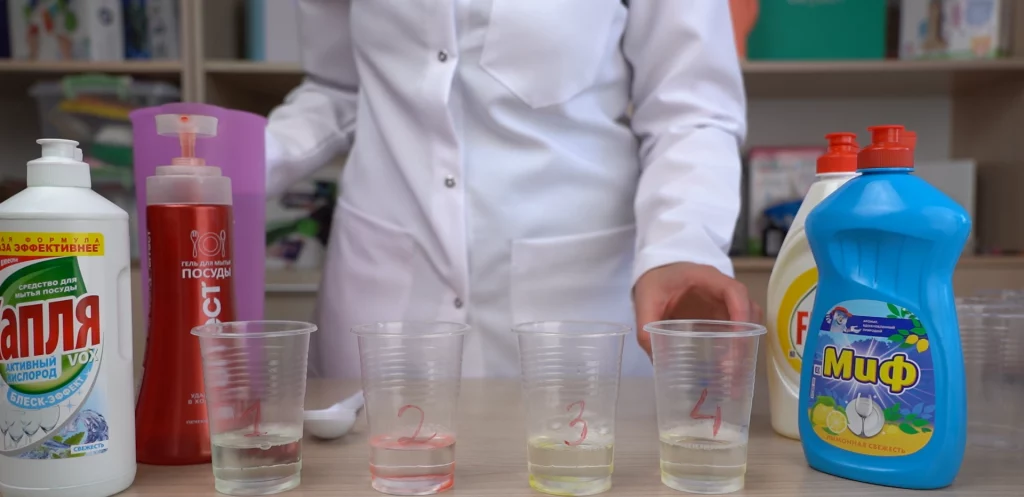
Fill the glasses with a small amount of water and thoroughly stir the dishwashing solution into the water until it is completely dissolved.
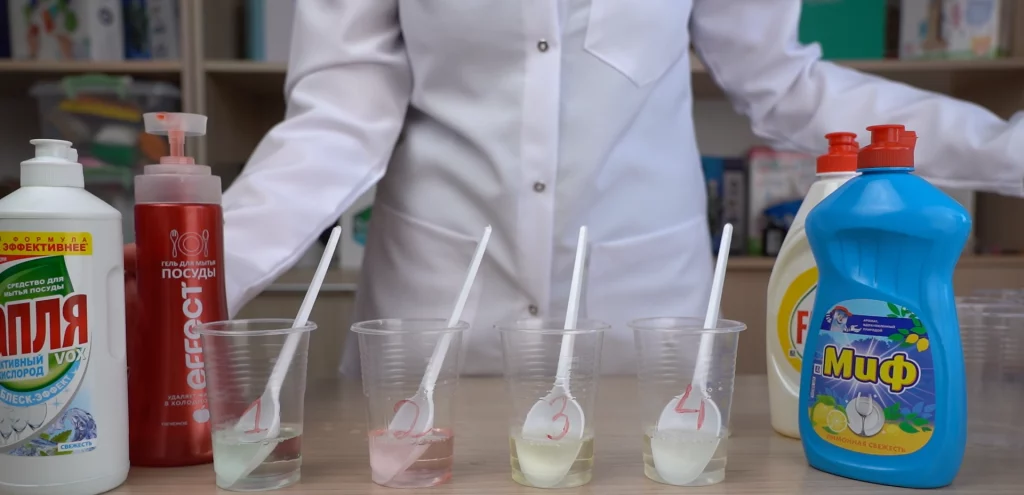
Step 8.
Check the pH by placing indicator strips in the beakers for a few seconds.
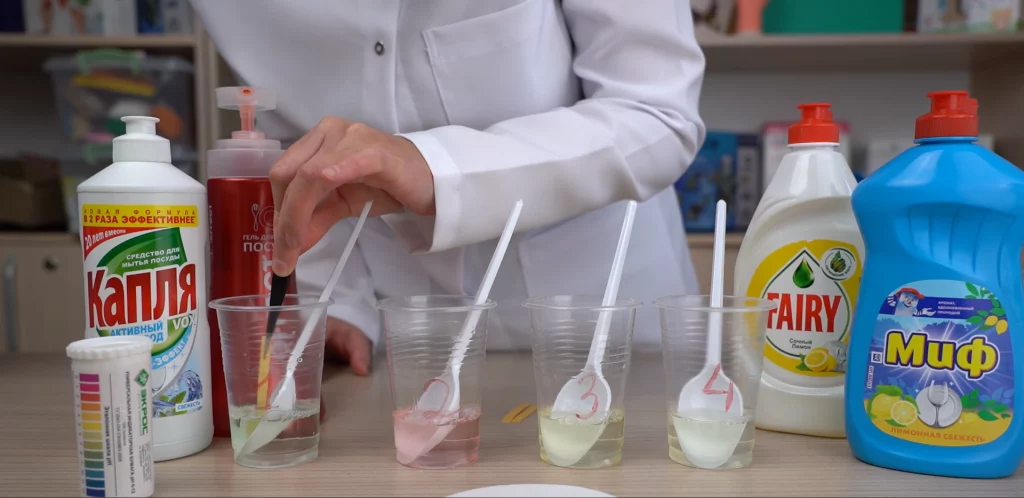
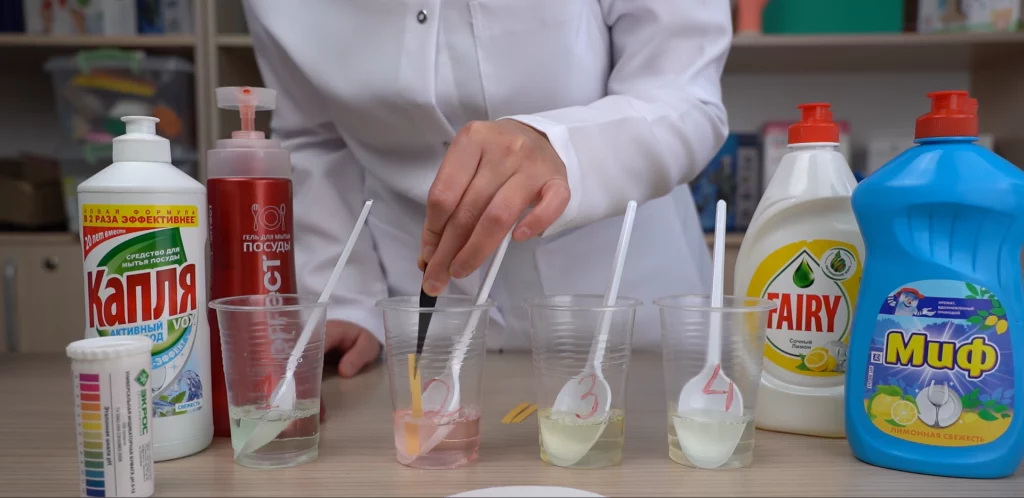
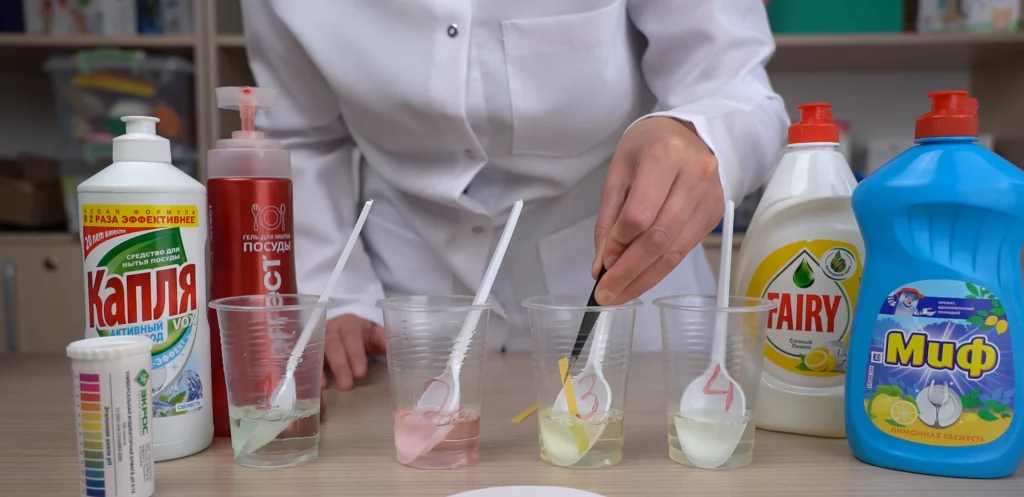
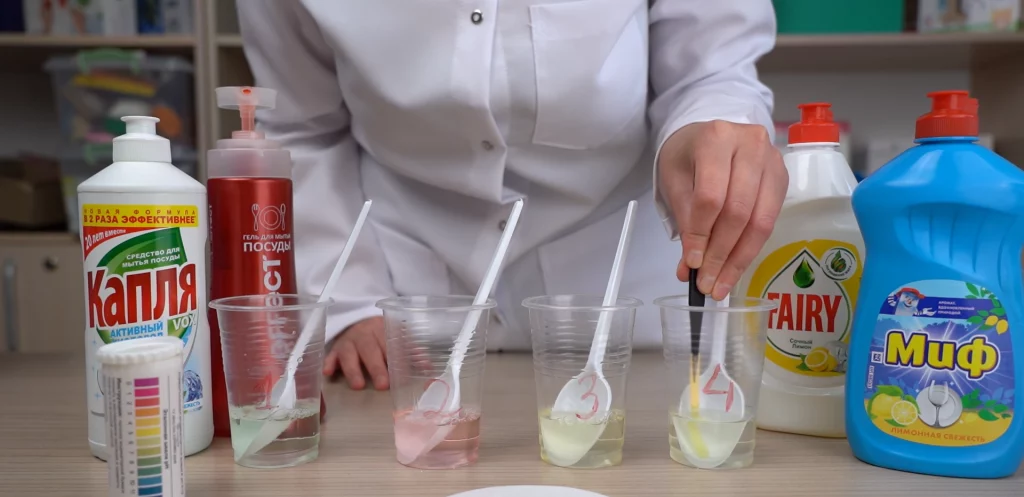
Step 9.
Place the indicator paper on top of the paper and determine the pH using a pH reference scale.
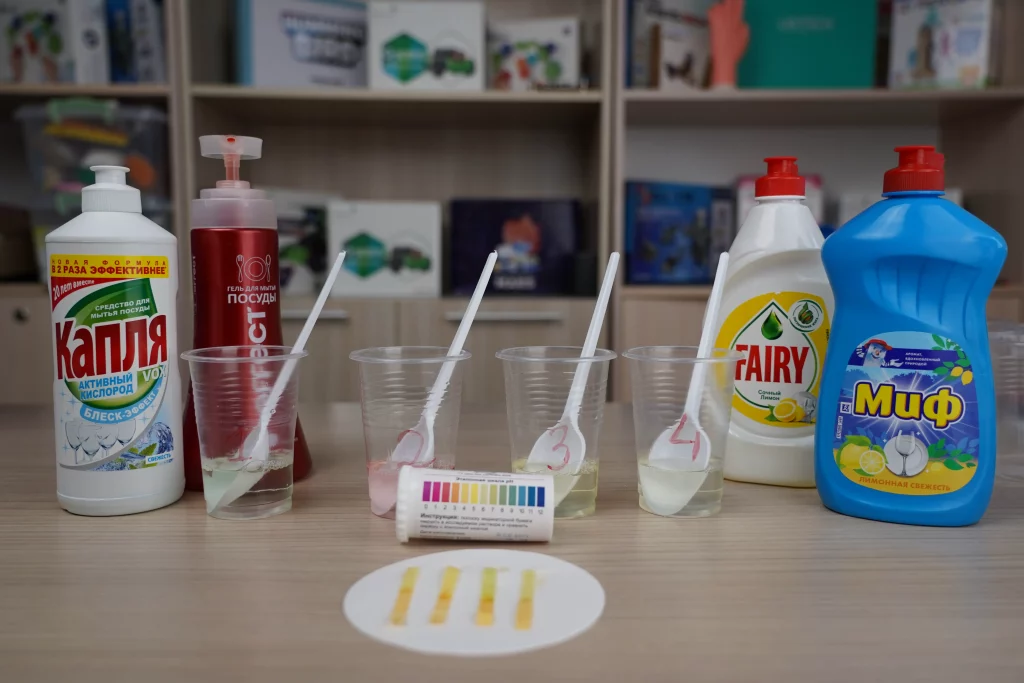
Step 10.
Record the resulting pH values of each liquid in the table below.
| Name | РН | environment (alkaline, neutral, acidic) |
| Капля | ||
| Effect | ||
| Миф | ||
| Fairy |
Experiment № 4. Determination of the pH of laundry detergent
Step 11.
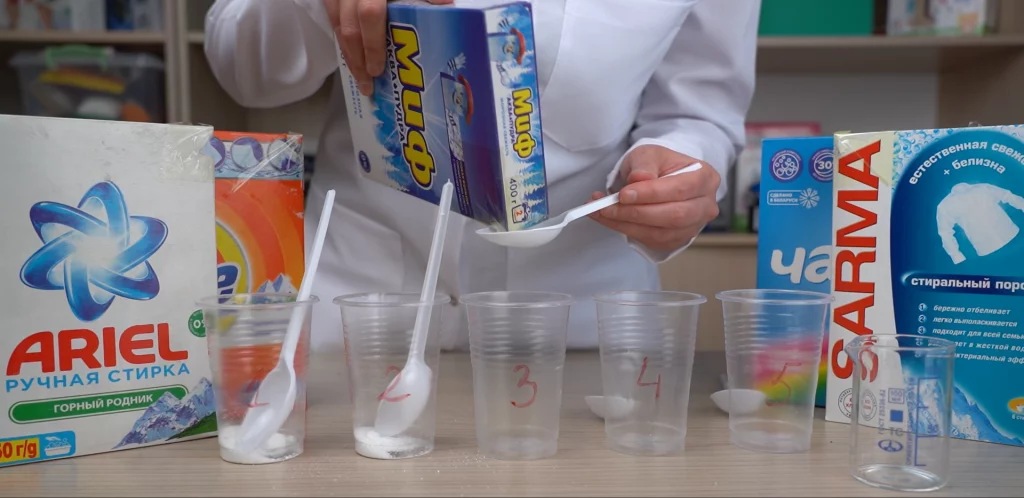
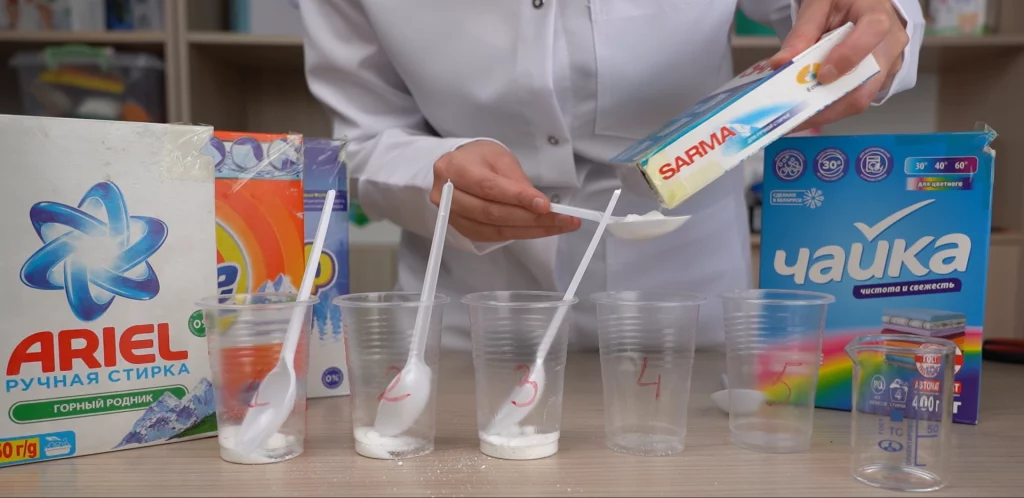
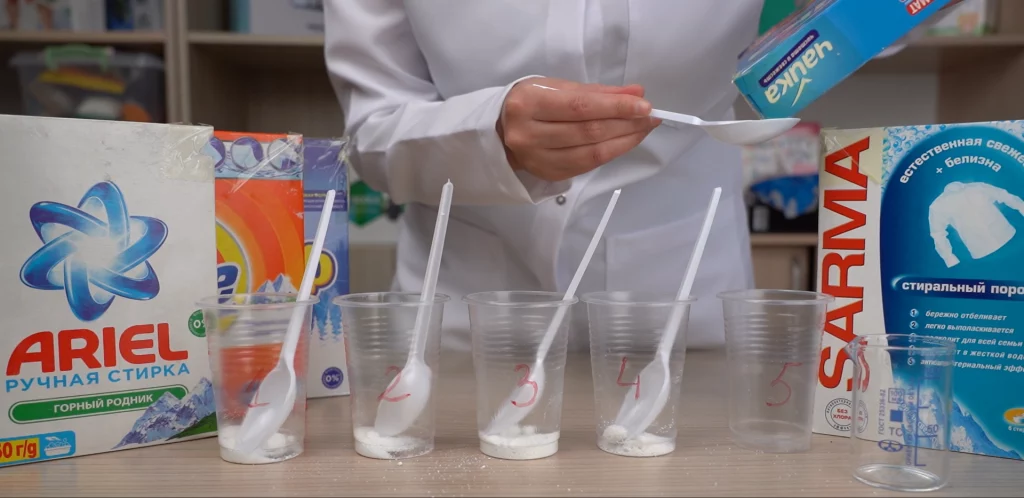
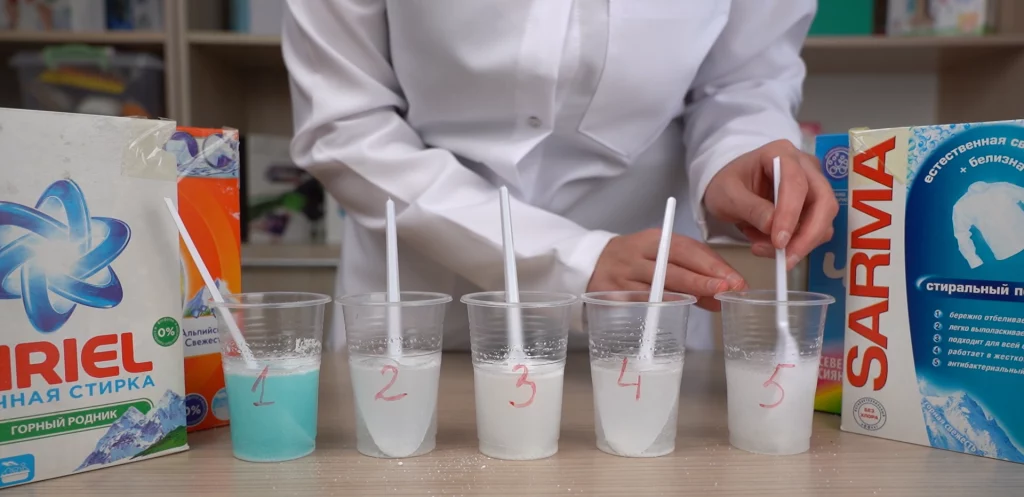
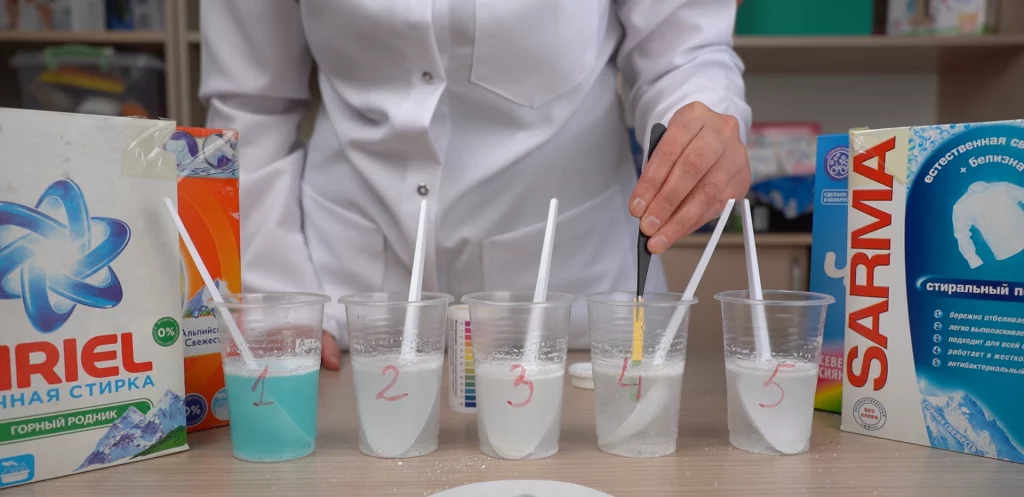
Number five beakers. Put half a spoonful of different laundry detergents in each beaker.
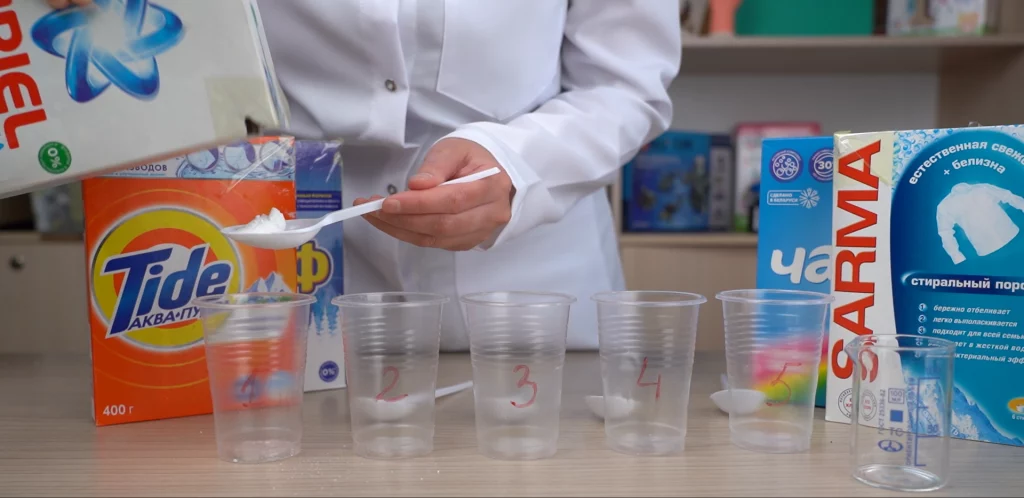
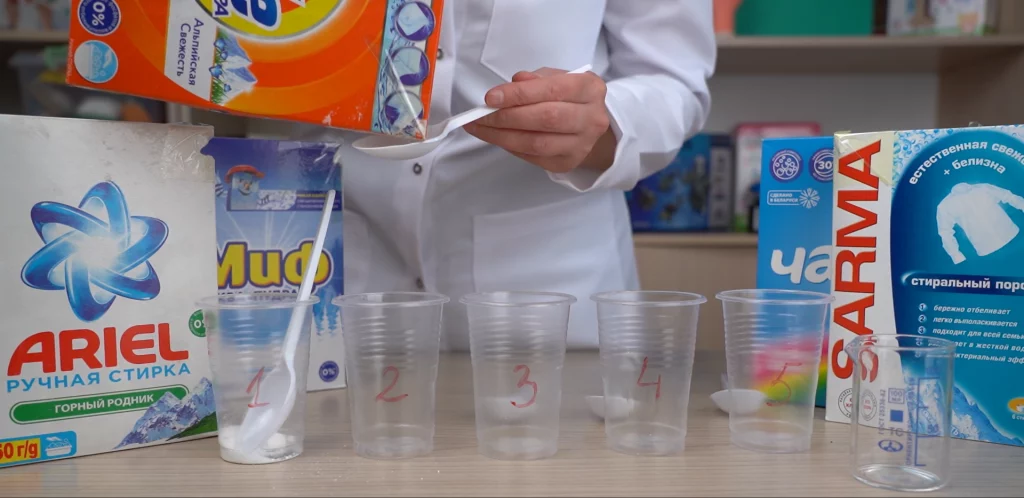
Step 12.
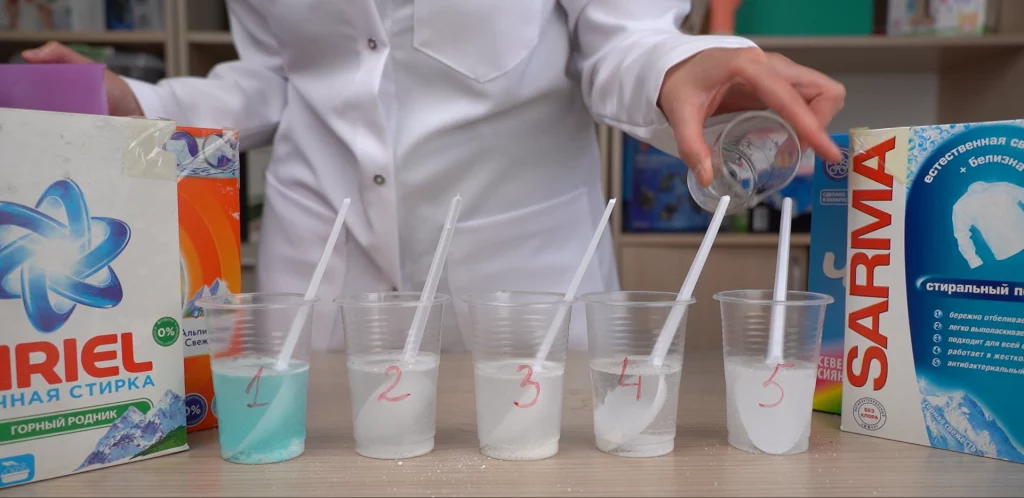
Fill the glasses with water to the center. Stir the contents until the laundry detergent is completely dissolved in the water.
Step 13.
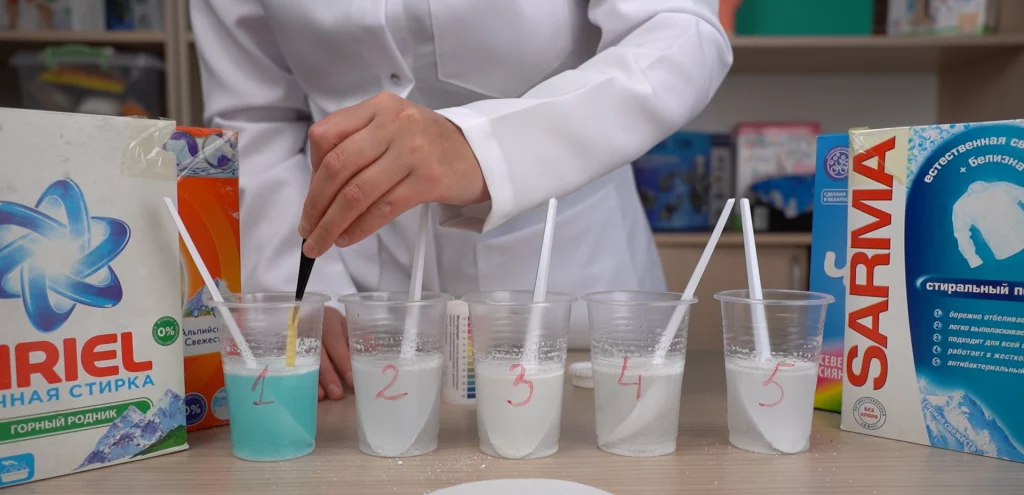
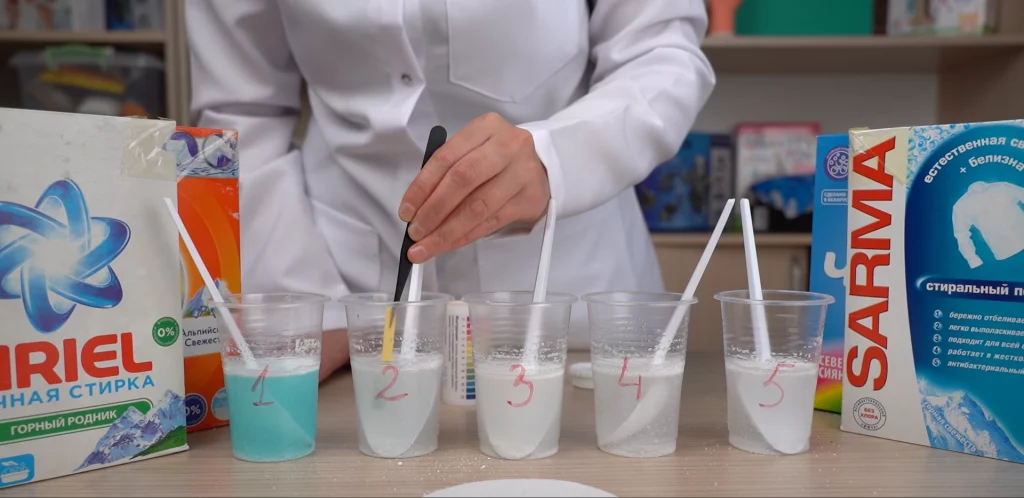
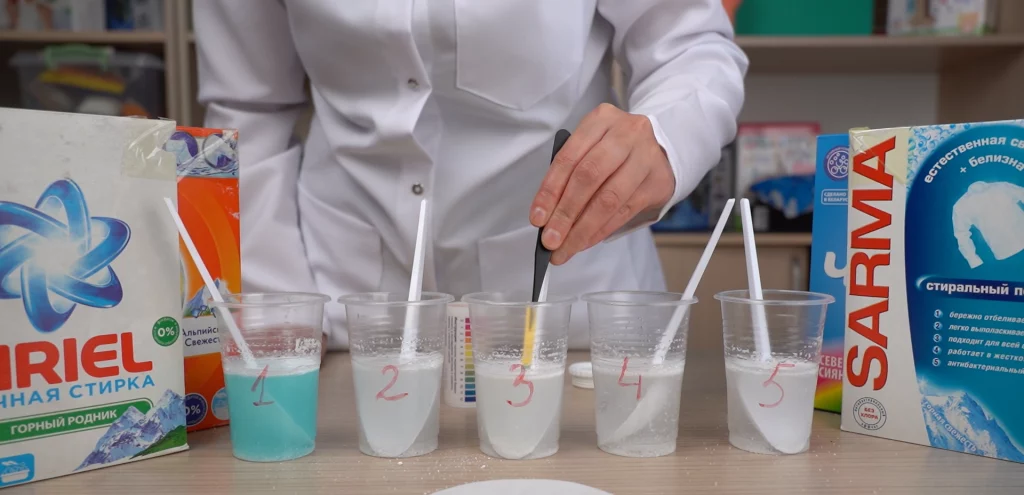
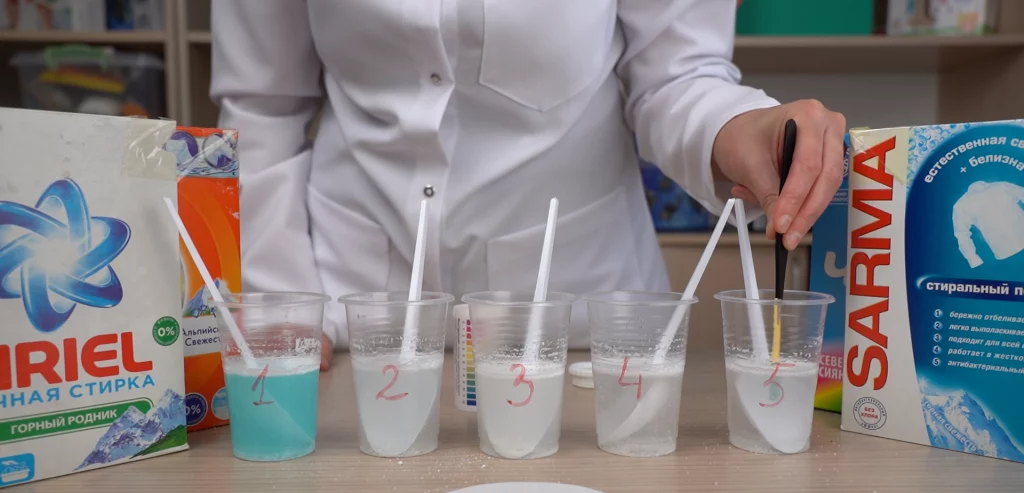
Check the pH by placing indicator strips in the beakers for a few seconds.
Step 14.
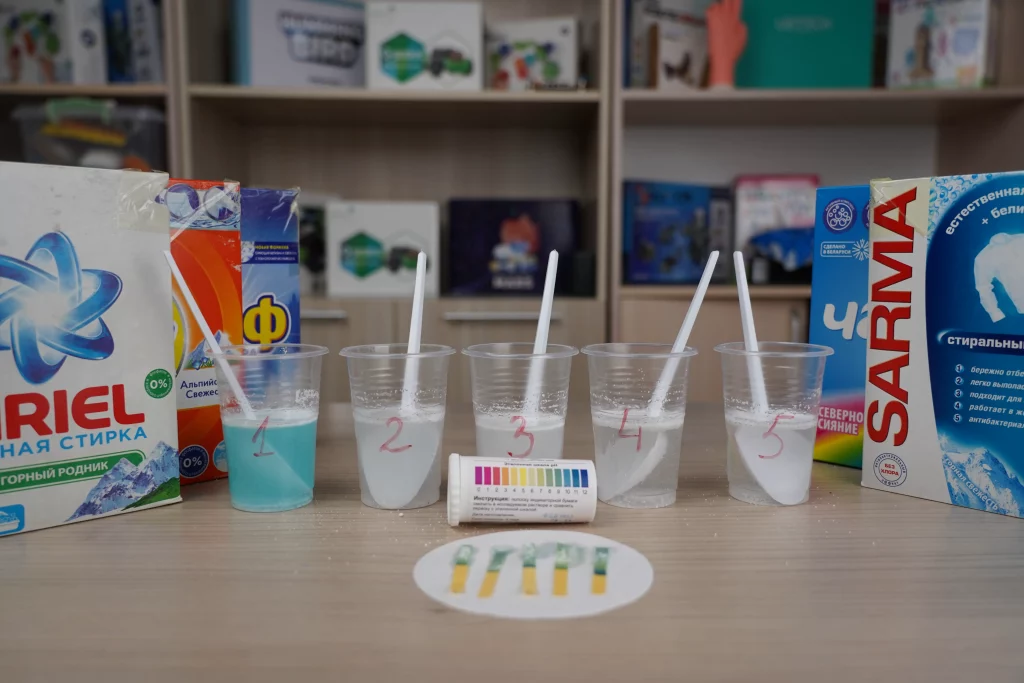
Place the indicator paper on top of the paper and determine the pH using a pH reference scale.
Step 15.
Fill in the table with the data obtained from the pH measurement.
| Powder name | РН results | environment (alkaline, neutral, acidic) |
| Ariel | ||
| Tide | ||
| Миф | ||
| Sarma | ||
| Чайка |
Step 16.
Draw conclusions and answer the questions after the practice:
- What are the effects of laundry detergent and dishwashing liquid on plant life? What conclusions can be drawn from the experiment?
- What conclusions can be drawn by comparing the pH scales of dishwashing liquids?
- Among the dishwashing liquids considered, which ones have low harmful effects on humans and which ones have high harmful effects?
- What conclusions can be drawn by comparing the pH scales of laundry detergents?
- Among the laundry powders considered, which one has low harmful effects on humans and which one has high harmful effects on humans?
Conclusion
In this practical work, the students conducted research on household chemical products. They studied their composition and made a comparative analysis. Observing the impact of synthetic detergents on living organisms, they came to the conclusion that such products can have a negative impact on nature. They also determined the pH level of the environment of household chemical products, which are less harmful to humans and more effective in use.