
Lab 3. Lesson
The title of the laboratory work: Determining the acceleration of gravity using a mathematical pendulum
Purpose of the work:
- Identify the initial velocity of a body thrown horizontally with the help of experiment.
Expected results:
- Initial velocity depends on the height and on the distance the body has traveled.
Teacher’s Guide:
- Divide the students to 3 students in each group.
- Before starting laboratory work, read the safety rules:
- To download the worksheet, please follow this link:
Theoretical part
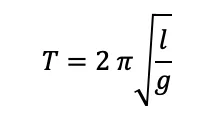
The period of oscillation of a mathematical pendulum depends on the length of the pendulum and the acceleration of gravity and can be found out by the following formula:
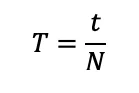
Period is the time of one full oscillation:
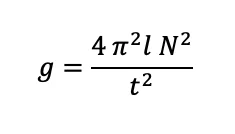
Using the formulas above, we get:
Sources:
- Криволинейное движение, равномерное движение материальной точки по окружности. Линейная и угловая скорости. (2019). Физика. Учебник для 9 класса общеобразовательной школы.
- Свободное падение тел, ускорение свободного падения. (2019). Физика. Учебник для 9 классаобщеобразовательной школы.
- Колебание математического и пружинного маятников. (2019). Физика. Учебник для 9 классаобщеобразовательной школы.
Experimental part
Procedure:
Step 1.
Set up a laboratory stand on the edge of your table. Hang the ball on a thread to the laboratory stand. The ball should hang at a distance of 3-5 cm from the floor.
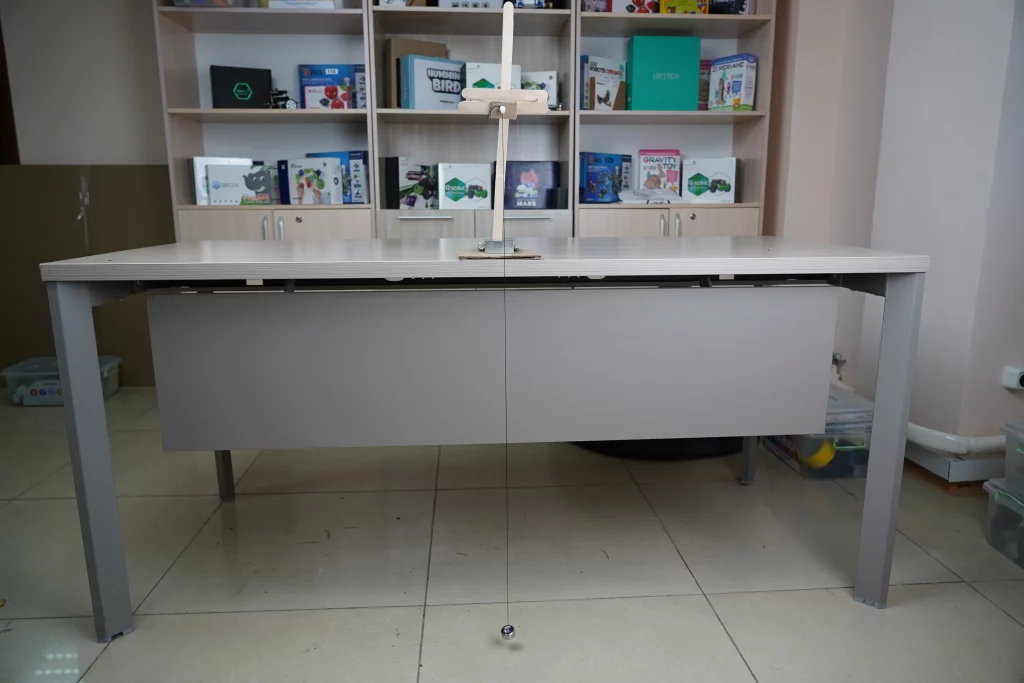
Step 2: Measure the length of the hanger with a measuring tape. Enter the data into the table.
Step 3. Using an electronic stopwatch, measure the time of 40 swings of the pendulum. To do this, pull the ball away from rest and, releasing the ball, start the stopwatch. Enter the data into the table.
Step 4. Repeat the experiment 5 times. Enter the data into the table.
Step 5. Calculate the acceleration of gravity for each experiment and find its average value. Enter the data into the table.
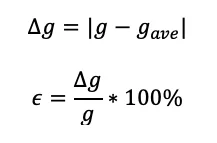
Step 6. Find the absolute and relative measurement errors, taking the value g = 9.8 m/s2 using the formulas:
Step 7. Write down the measurement result taking into account the error:

Research part
| № | Length, l, m | Number of oscillations, N | Time of oscillations, t, s | Acceleration of gravity, g, m/s2 | Average acceleration, gave, m/s2 |
| 1 | |||||
| 2 | |||||
| 3 | |||||
| 4 | |||||
| 5 |
When deriving conclusions, answer the following questions:
- How to find out the period of a mathematical pendulum?
Conclusion
The acceleration of gravity can be found out from the formula of the mathematical pendulum period, knowing the length of the pendulum and its period by doing measurements.