
8 grade. Lab 5. Lesson
The title of the laboratory work: Study of a series connection of components in the electrical circuit
Purpose of the work:
- Make sure that the rules of series connection work.
Expected results:
- Electric current in different parts of the circuit is the same when the parts are connected in series;
- The voltage of each part of the electric circuit that is connected in series sums up to the total voltage.
Teacher’s Guide:
- Divide the students to 3 students in each group.
- Before starting laboratory work, read the safety rules:
- To download the worksheet, please follow this link:
Theoretical part
Series connection is the one when the end of the first conductor is connected to the beginning of the second conductor, the end of the second conductor is connected to the beginning of the third conductor, etc.
The rules of series connection:

Sources:
- Последовательное и параллельное соединение проводников. (2018). Физика. Учебник для 8 классаобщеобразовательной школы.
Experimental part
Experiment.
Procedure:
Step 1.
Assemble the circuit as shown in the photo. Turn on the switch. Take the measurements from the ammeters I1, I2and voltmeters U, U1 and U2. Insert the results to the table.
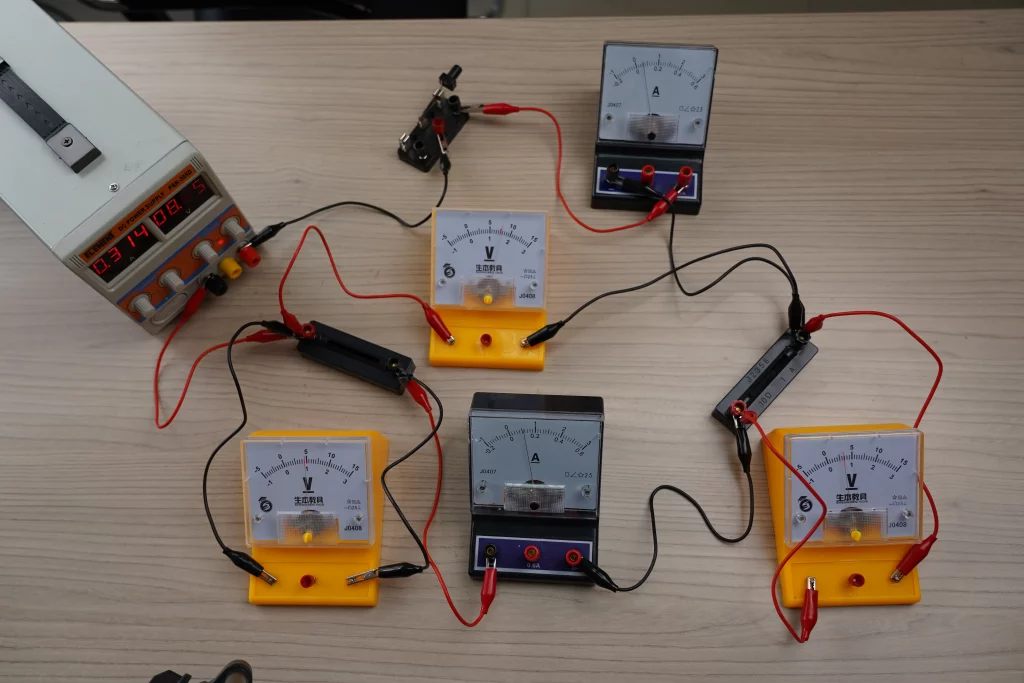
Step 2. Make sure that the rules of series connection work.

Step 3. Taking into account the Ohm’s law, calculate the resistances R1 and R2 and their total resistance R:
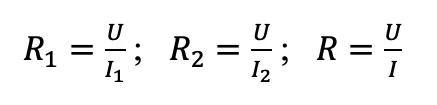
Insert the results into the table. Compare the total resistance R and the sum of resistances R1+R2.
Step 4. Check that the following holds:
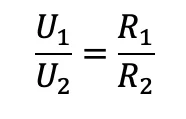
Considering the results, draw a conclusion.
Research part
| U1, V | U2, V | U, V | I1, А | I2, А | R1, Ohm | R2, Ohm | R, Ohm |
When deriving conclusions, answer the following questions:
- Which connection is called in series one?
- How electric current, voltage and resistance are identified in series connection?
Conclusion
Electric current in series connection is the same in all parts of the circuit. The voltage is different in different parts of the circuit when connected in series and they sum up to the total voltage.