
Lesson
Objective:
- To determine the significance of the Red Book of Kazakhstan
- Determining which species of plants and animals in Kazakhstan are included in the Red Book of Kazakhstan
- To study and collect information about protected plants and animals
Expected Outcomes:
After studying the project, students will have:
- bridging the gap between theoretical knowledge and its application in the real world
- form teamwork skills
- analyze and summarize the information obtained
- independently draw logical conclusions and draw inferences
Teacher’s guide:
- Divide students into groups.
- Before beginning practical work, familiarize yourself with the safety rules by following this link:
- Download the worksheet.
Theoretical part
The Red Book is an official document containing constantly updated data on the status and distribution of rare and endangered species of plants, animals and fungi.
The Red Book of the Republic of Kazakhstan consists of two volumes: 1st – Animals; 2nd – Plants. The book is published in the state and Russian languages. A total of 125 species are listed in the Red Book of Kazakhstan: fish – 16 species, amphibians – 3 species, reptiles – 10 species, birds – 56 species, mammals – 40 species. The red color of the cover is a signal of danger.
For each species (subspecies, population) of animals and plants included in the Red Data Book of the Republic of Kazakhstan, the following basic data are defined:
- Latin, Kazakh and Russian names of the species;
- status;
- depiction of appearance;
- past and present distribution in the Republic of Kazakhstan, mapped;
- abundance and its trends;
- main limiting factors and reasons for changes in abundance and range;
- information on the possibility of breeding in artificially created conditions, captivity and culture;
- the role of the population(s) inhabiting the territory of the Republic of Kazakhstan in preserving the gene pool of the species;
- taken and necessary measures of protection;
- sources of information.
- If necessary, the image of characteristic age and seasonal features of organism development (larva, egg laying, pupa, plant parts, etc.) is given.
Sources:
Natural Science 6th grade, part 2, Almaty Kitap Publishing House, 2019.
Practical part
Step 1. Draw a map of Kazakhstan on a paperboard. Divide each region.
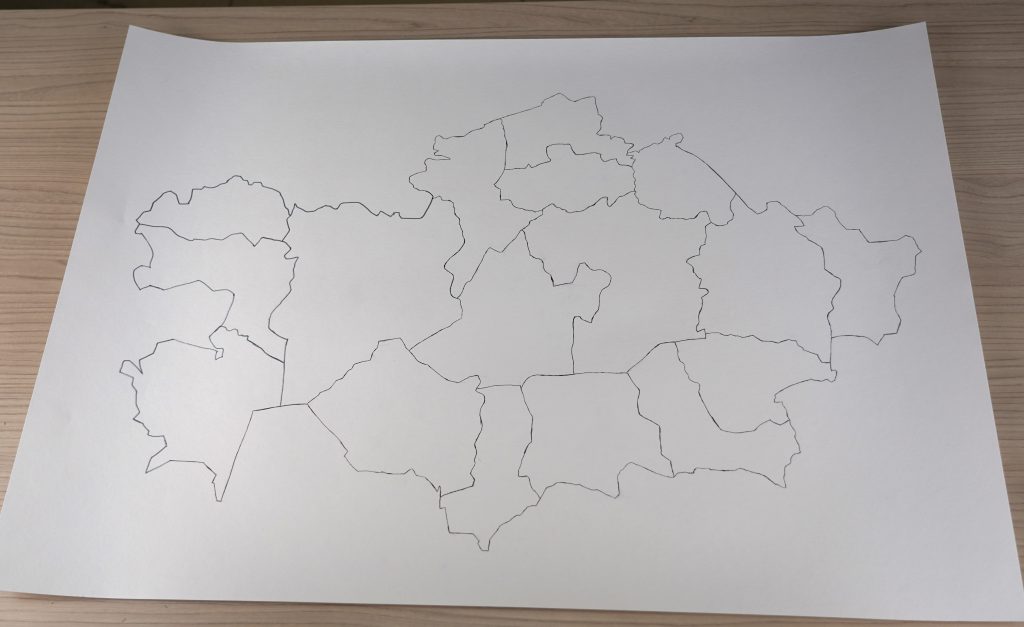
Step 2. Find one animal or one plant listed in the Red Book of Kazakhstan in each region. The animals and plants listed below were chosen for this project.
| Name of the area | Red Book animal/plant | ||
| Kazakh | Russian | English | |
| Abay | Кәдімгі таушымылдық | Пион уклоняющийся, Пион Марьин | Paeonia anomala L |
| Akmola | Адонис көктемгі | Адонис весенний | Adonis vernalis |
| Aktobe | Бобринский жарқанаты | Кожанок бобринского | Eptesicus (Amblyotus) bobrinskii |
| Almaty | Бәйшешек | Шафран алатауский | Crocus alatavicus |
| Atyrau | Ақ тұңғиық | Кувшинка белая | Nymphaea alba |
| VKO | Қар барысы немес Ірбіс | Снежный барс | Panthera uncia |
| Zhambyl | Тәңіртау қоңыр аюы | Тянь-шаньский бурый медведь | Ursus arctos isabellinus |
| Zhetysu | Қызыл қасқыр | Красный волк | Cuon alpinus |
| WKO | Шренк қызғалдағы | Тюльпан Шренка | Tulipa suaveolens |
| Karagandy | Арқар | Архар | Ovis ammon collium |
| Kostanay | Кіші аққу | Малый лебедь | Cygnus bewickii |
| Kyzylorda | Шағыл мысығы | Барханный кот | Felis margarita |
| Mangystau | Қоқиқаз | Фламинго | Phoenicopterus |
| Pavlodar | Қызылжемсаулы қарашақаз | Краснозобая казарка | Branta ruficollis |
| SKO | Бұйра лалагүл | Лилия кудреватая | Lilium martagon |
| Turkestan | Түркiстан ақ дегелегi | Туркестанский белый аист | Ciconia ciconia asiatica |
| Ulytau | Ақбөкен | Сайгак | Saiga tatarica |
Step 3. Gather the images of animals and plants you found and print them out from the printer. Or you can download the animals and plants listed in this work by clicking on the link: Link. Cut out the pictures with scissors.
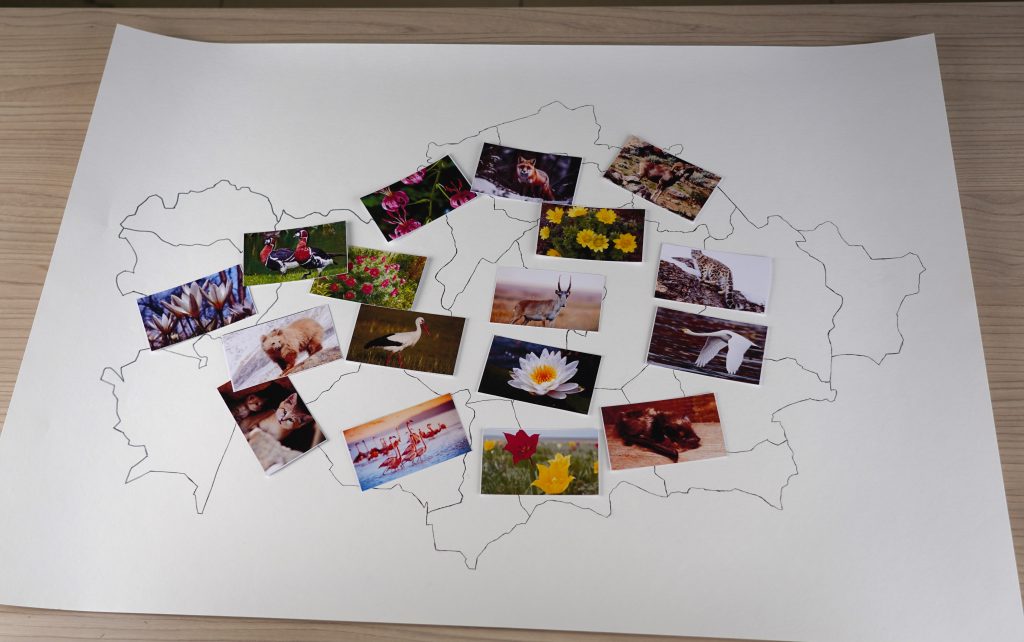
Step 4. Glue each picture to the location with glue.
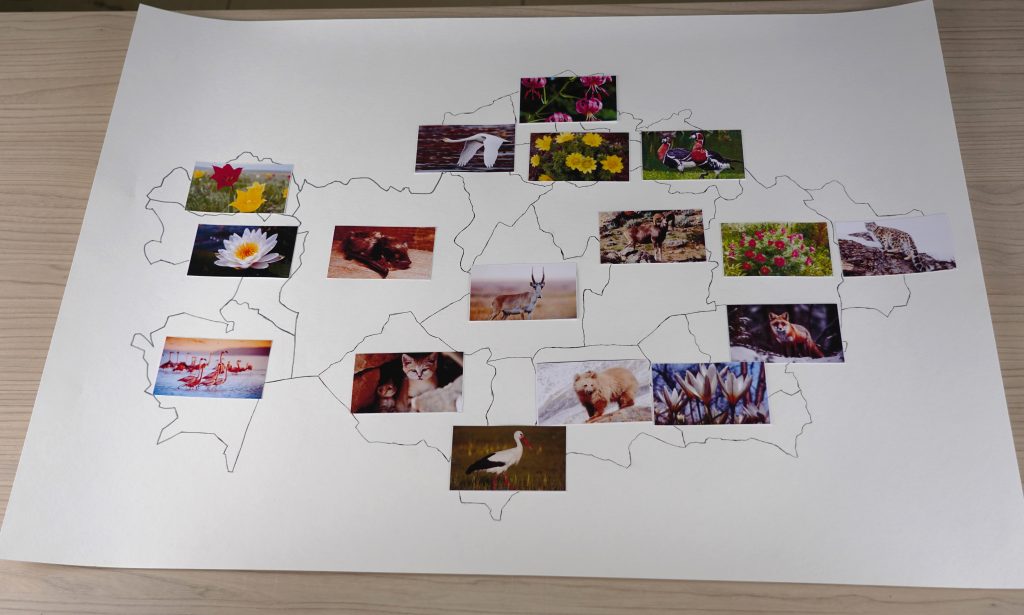
Step 5. Under the pictures, write the name of the animal or plant in three languages (Kazakh, Russian, English).
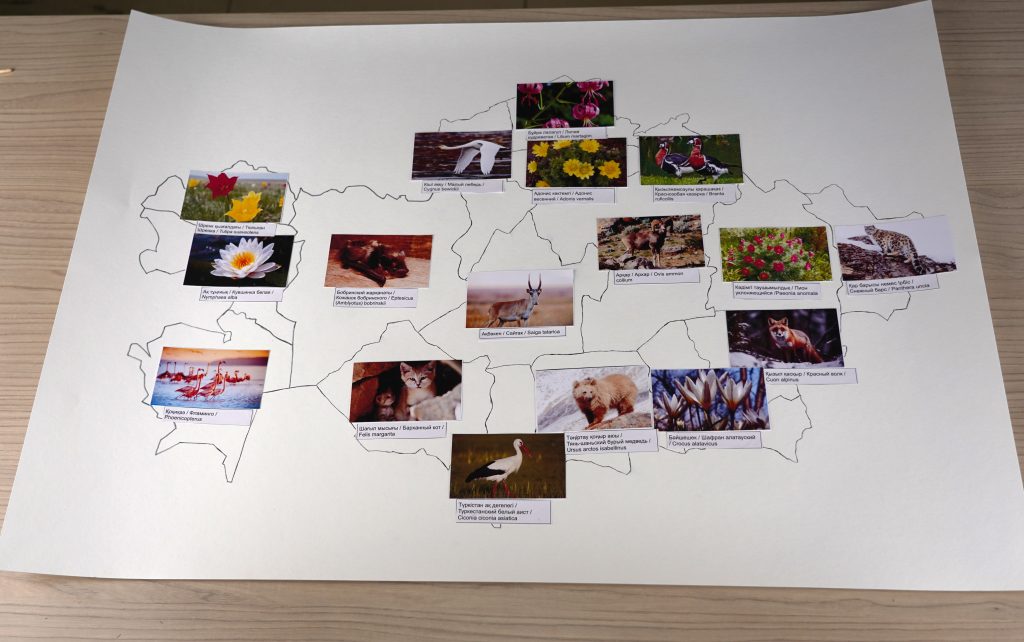
Step 6. Identify the category of extinction. The extinction category is categorized into five categories:
- Category 1. A species that is practically extinct on the territory of Kazakhstan. Listed in the IUCN Red List.
- Category 2. Areal and numbers are rapidly declining.
- category 3. Rare understudied and narrowareal species. Except for four points of finds outside the republic – it is actually endemic.
- Category 4. Not determined by status. Taxa belonging to one of the previous categories but currently lack sufficient information on their status in nature or they do not fully meet the criteria of the other categories but require special protective measures.
- Category 5. A species whose numbers are recovering at nesting sites.
Step 7: Color the left side of the images with the highlighted colors to represent the extinction category.
- Category 1-red color;
- Category 2-yellow color;
- Category 3-white color;
- Category 4-gray color;
- Category 5-green color.
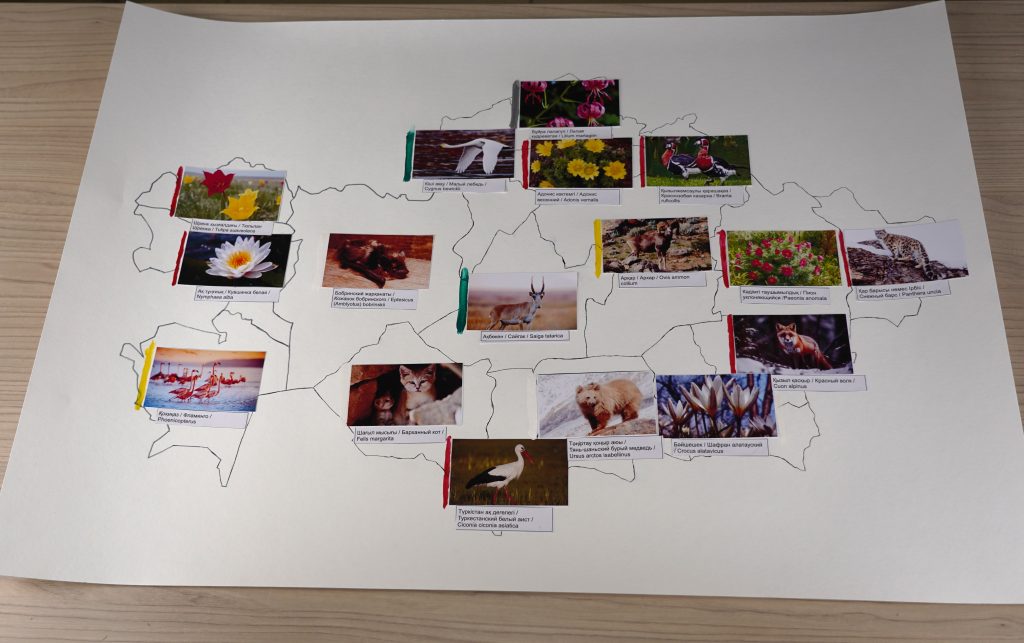
Step 8.With this, the Red Book is ready.
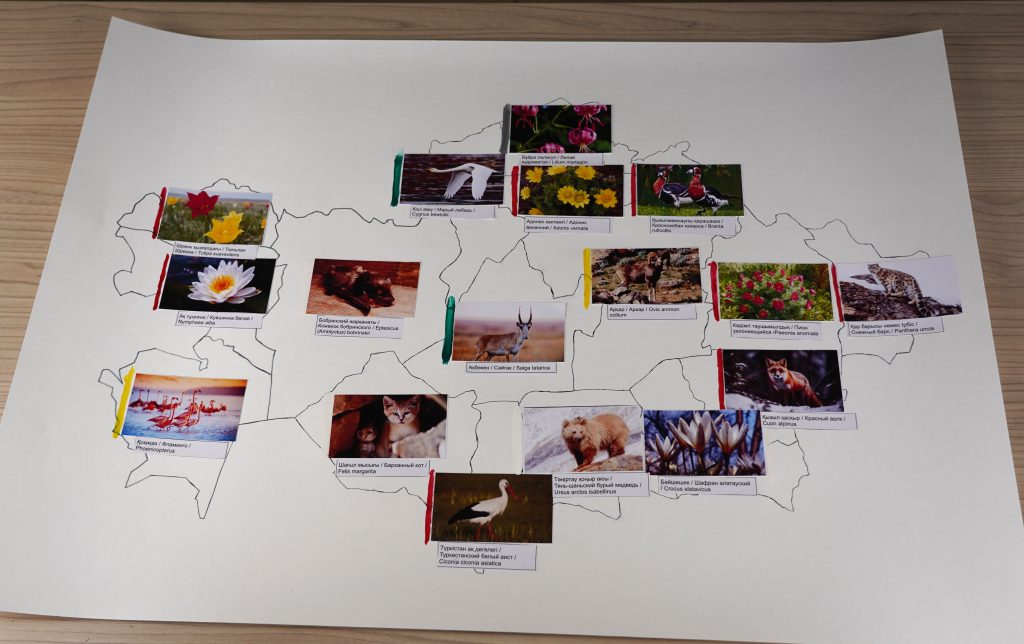
Step 9. Fill in the following information on the sheet.
| Name of the area | Red Book animal/plant | Degree of endurance | Scientific significance | ||
| Kazakh | Russian | English | |||
| Abay | |||||
| Akmola | |||||
| Aktobe | |||||
| Almaty | |||||
| Atyrau | |||||
| East Kazakhstan | |||||
| Zhambyl | |||||
| Zhetysu | |||||
| Western Kazakhstan | |||||
| Karagandy | |||||
| Kostanay | |||||
| Kyzylorda | |||||
| Mangystau | |||||
| Pavlodar | |||||
| North Kazakhstan | |||||
| Turkestan | |||||
| Ulytau | |||||
Step 10. Answer the following questions and draw conclusions.
- What is the significance of the Red Book of Kazakhstan?
- Give examples of three plants and three animals listed in the Red Book of Kazakhstan.
- What do you think can be done to prevent animal and plant species from being included in the Red Book?
Conclusion
During the practical work pupils collected and familiarized themselves with information about animals and plants included in the Red Book of Kazakhstan. They determined the degrees of their extinction. Creating a hand-made Red Book was a significant stage of the work, allowing students to visualize and systematize their knowledge. Each species included in this unique guidebook became a kind of “record” of the natural heritage that needs special protection and attention from the society.