
Mechanism of Ionic Bonding
Coulomb’s Law by PhET Interactive Simulations, University of Colorado Boulder, licensed under CC-BY-4.0 (https://phet.colorado.edu)
The title of the Project: Mechanism of Ionic Bonding
This virtual laboratory is intended for use in chemistry classes on the following topics:
- 10th grade. Chapter III. “Ionic bond”.
Objectives:
- Understand how the signs of charges affect the electrostatic force.
- Observe the relationship between the magnitude of a charge and the electrostatic force.
- Investigate the impact of distance on the strength of the electrostatic force.
Theory
Ionic bonding is a type of chemical bond formed by the electrostatic attraction between oppositely charged ions. Ions are atoms or groups of atoms that have gained or lost electrons, resulting in a positive (cation) or negative (anion) charge.
Coulomb’s Law and Ionic Bonding:
Coulomb’s Law describes the force of attraction or repulsion between two charged particles. It states that the force is directly proportional to the product of their charges and inversely proportional to the square of the distance between them. This law plays a crucial role in ionic bonding:
- Stronger attraction: The greater the charges of the ions (either positive or negative), the stronger the electrostatic attraction according to Coulomb’s Law.
- Closer proximity: Ions positioned closer together experience a stronger force due to the inverse square relationship with distance.
Key Points:
- Ionic bonds involve cations and anions.
- Coulomb’s Law governs the strength of the bond based on charges and distance.
- Ionic compounds are typically solid, brittle, and have high melting and boiling points.
- Ionic compounds are soluble in polar solvents.
- Ionic compounds conduct electricity in their molten or dissolved state.
Formation of Ionic Bonds:
Ionic bonds are formed when an atom loses one or more electrons, becoming a cation, and another atom gains one or more electrons, becoming an anion. The oppositely charged ions attract each other due to electrostatic forces.
Example: Sodium Chloride (NaCl)
In the formation of sodium chloride (NaCl), a sodium atom (Na) loses an electron, forming a sodium cation (Na⁺). A chlorine atom (Cl) gains an electron, forming a chloride anion (Cl⁻). The resulting sodium cation and chloride anion are attracted to each other by electrostatic forces, forming the ionic compound sodium chloride.
Properties of Ionic Compounds:
- Solid and brittle: Due to the strong electrostatic forces between ions, ionic compounds are typically solid and brittle.
- High melting and boiling points: Significant energy is required to overcome the strong electrostatic forces and break the ionic bonds, resulting in high melting and boiling points.
- Solubility in polar solvents: Ionic compounds are soluble in polar solvents like water. Water molecules, being polar, can interact with the charged ions, breaking the ionic bonds and forming a solution.
- Electrical conductivity in molten or dissolved state: In molten or dissolved states, the ions can move freely, carrying an electric charge, enabling electrical conductivity.
Practical part

This activity uses the PhET “Coulomb’s Law” simulation to investigate the relationship between charge, distance, and the force of attraction or repulsion between charged particles.
- Open the PhET simulation. This simulation has two screens: Macro scale and Atomic scale. We will conduct a series of experiments in the Macro scale screen.
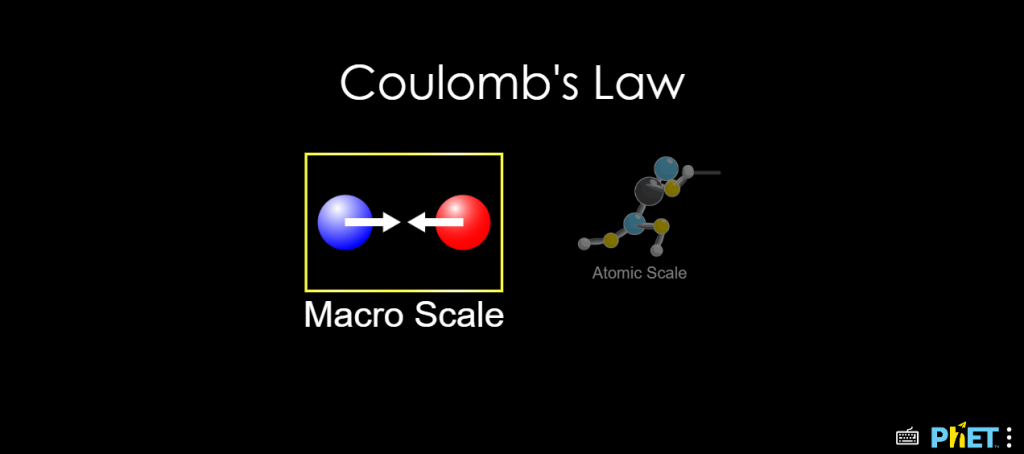
2. Explore the interface by adjusting the charges, their positions, and observing the resulting forces. Reset the simulation when finished.
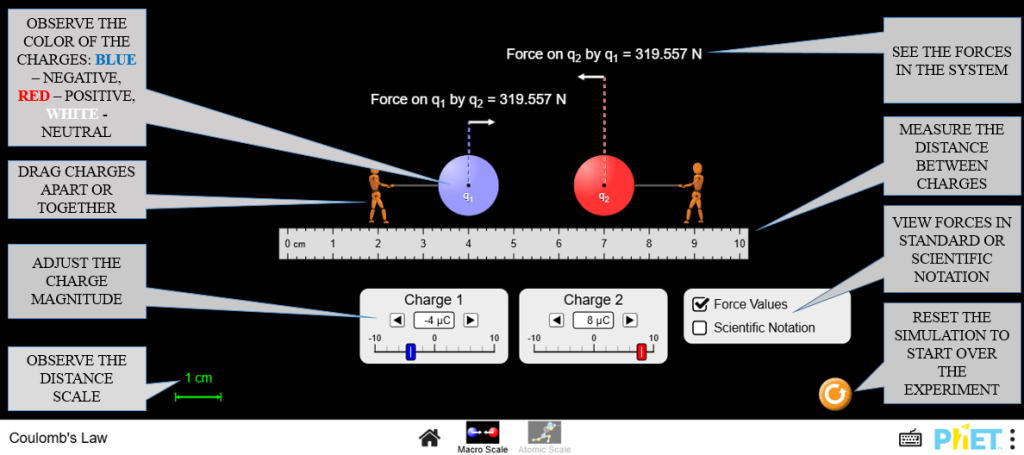
Virtual experiment No.1: Charge Signs and Force
3. Set Charge 1 to -8 µC and Charge 2 to +8 µC. Observe the force between the charges. What happens? What does the direction of the arrow indicate?
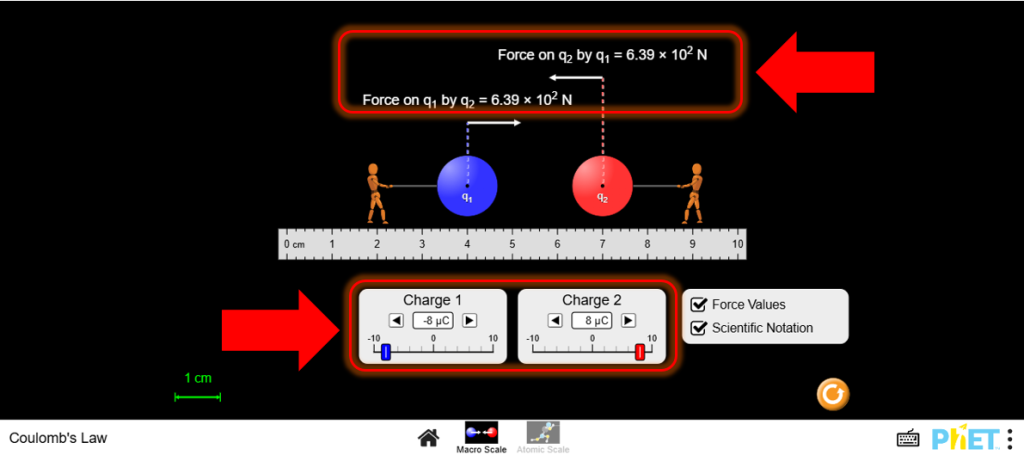
4. Change Charge 1 to +8 µC. What happens now? What does the arrow direction tell you?
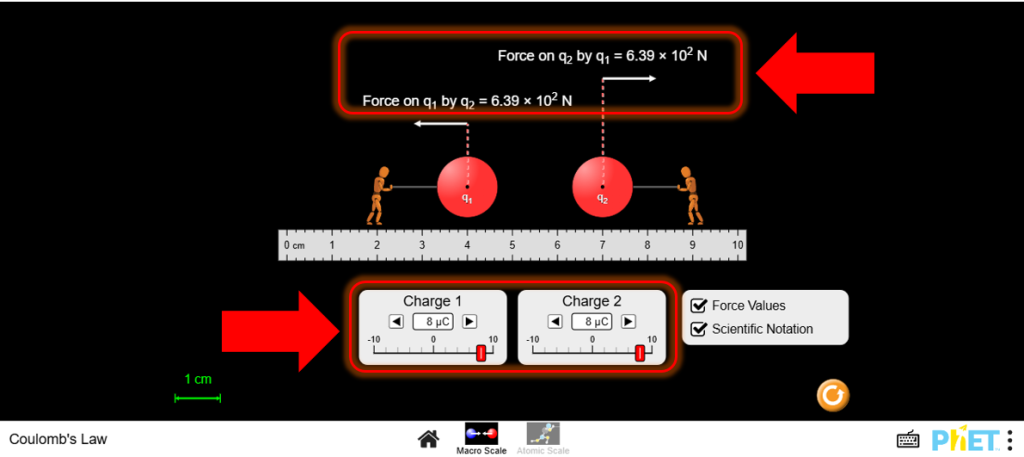
Conclusion: Opposite charges attract, while like charges repel.
Virtual experiment No.2: Magnitude of Charge and Force :
5. Set Charge 1 to 0 µC. What happens to the force?
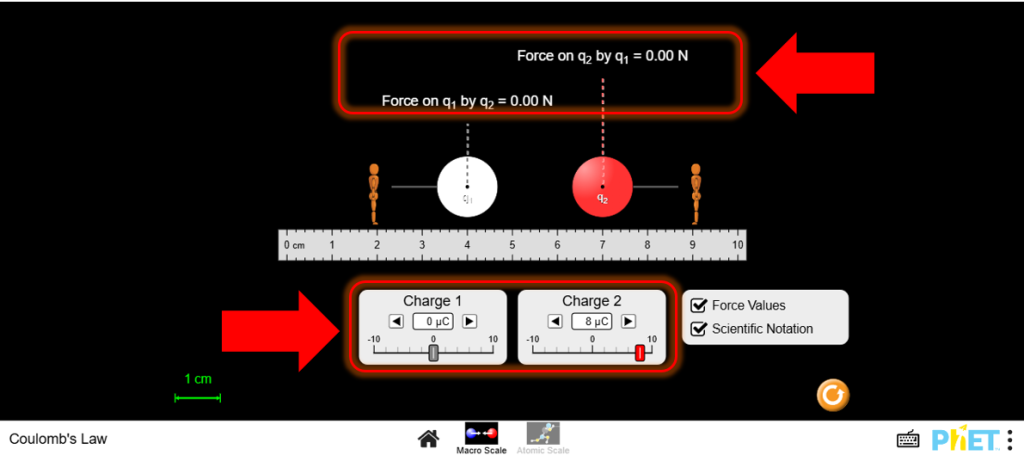
6. Gradually increase the magnitude of Charge 1 (negative) by 1 µC each time. Observe the force with each change.
7. Repeat step 6, but increase Charge 1 (positive) until +10 µC. Observe the force.
Conclusion: The greater the magnitude of the charge, the stronger the electrostatic force (both attractive and repulsive).
Virtual experiment No.3: Distance and Force:
8. Set Charge 1 to -8 µC and Charge 2 to +8 µC.
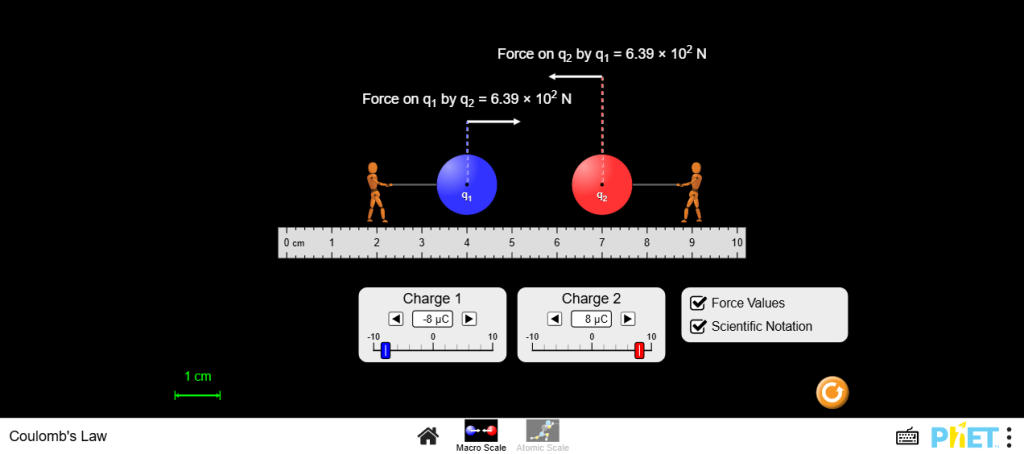
9. Gradually move Charge 1 closer to Charge 2 (1 cm at a time). Observe the force with each movement.
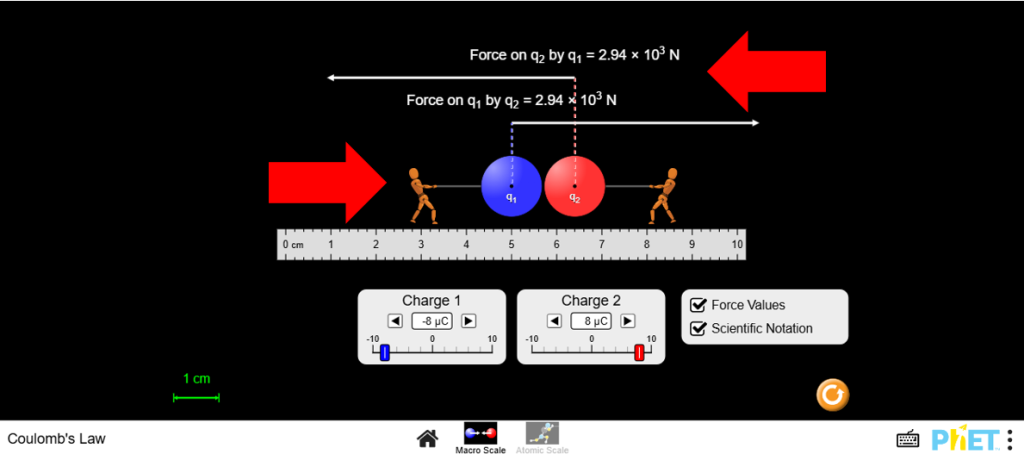
10. Now, gradually move Charge 1 farther from Charge 2 (1 cm at a time). Observe the force with each movement.
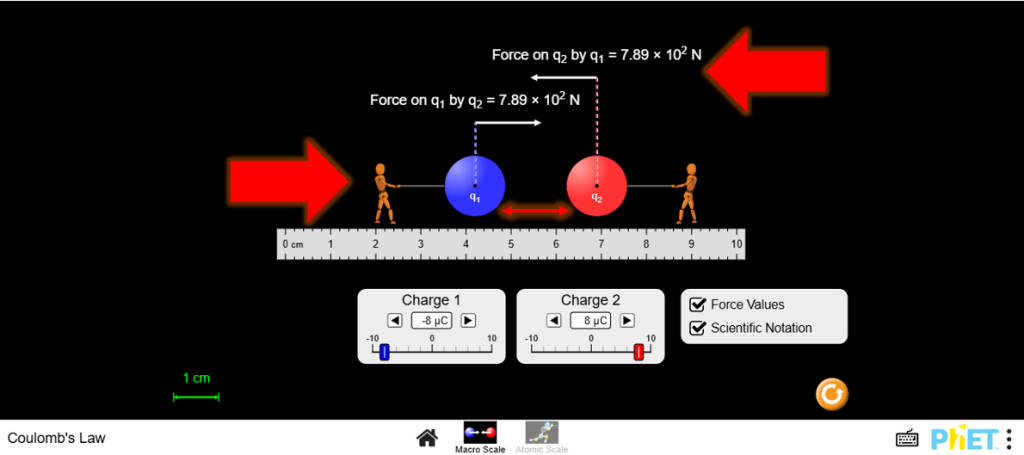
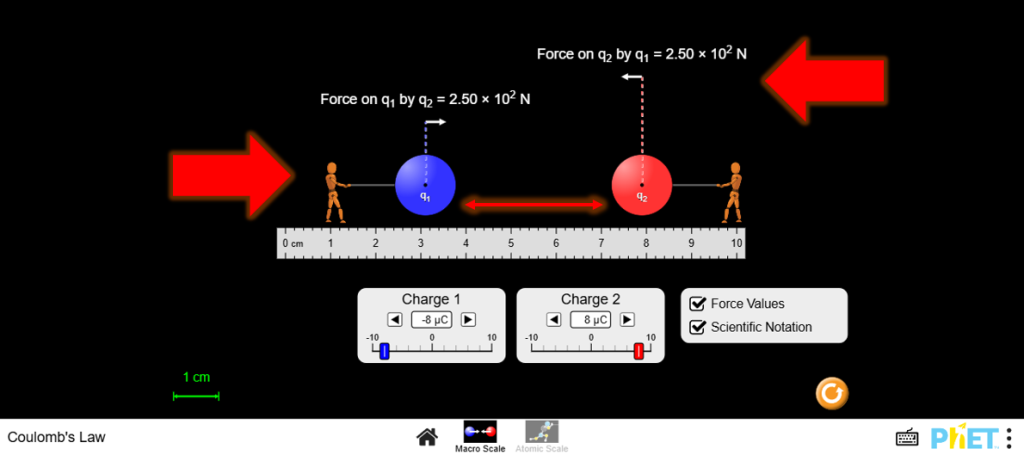
Conclusion: The force becomes stronger as the distance between the charges decreases. Conversely, the force weakens with increasing distance.
Conclusion
This exploration with the PhET simulation demonstrates the relationship between charge, distance, and the resulting electrostatic force. Opposing charges attract, while like charges repel. The force’s strength is directly proportional to the magnitude of the charges and inversely proportional to the distance between them.