
Decimal Multiplication
Area Model Decimals by PhET Interactive Simulations, University of Colorado Boulder, licensed under CC-BY-4.0 (https://phet.colorado.edu)
Objective:
- To perform multiplication of a decimal fraction by a natural number and a decimal;
- To explain that area is the product of two numbers and is additive;
- Use the area model to facilitate multiplication of decimals.
This virtual activity is designed for use in math lessons on the following topics
- Grade 5. “Multiplication of decimal fractions”
Theoretical Part
The rule for multiplying decimal fractions
To multiply two decimal fractions, you must:
- Write the fractions in a column with the commas aligned.
- Multiply each digit of the first fraction by each digit of the second fraction, ignoring the commas.
- Add the resulting products.
- In the resulting product, place a decimal point on the right to separate as many digits as there are in the sum of the fractional parts of both multipliers.
Multiplying a decimal fraction by a whole number
- To multiply a decimal fraction by a whole number, you must:
- Write the whole number as a decimal fraction with zeros after the decimal point, up to a number of digits equal to the number of decimal places in the first fraction.
- Multiply the resulting fractions using the decimal multiplication rule.
To multiply a decimal fraction by 10, 100, 1000, and so on.
To multiply a decimal fraction by 10, 100, 1000, and so on, you must:
- Move the decimal point to the right by as many digits as there are zeros in the number.
Virtual Experiment
The “Area Model: Decimals” simulation is designed to help students learn how to multiply decimals. Multiplication is learned by finding the area of a rectangle in the form of a Pythagorean table.
Workflow:
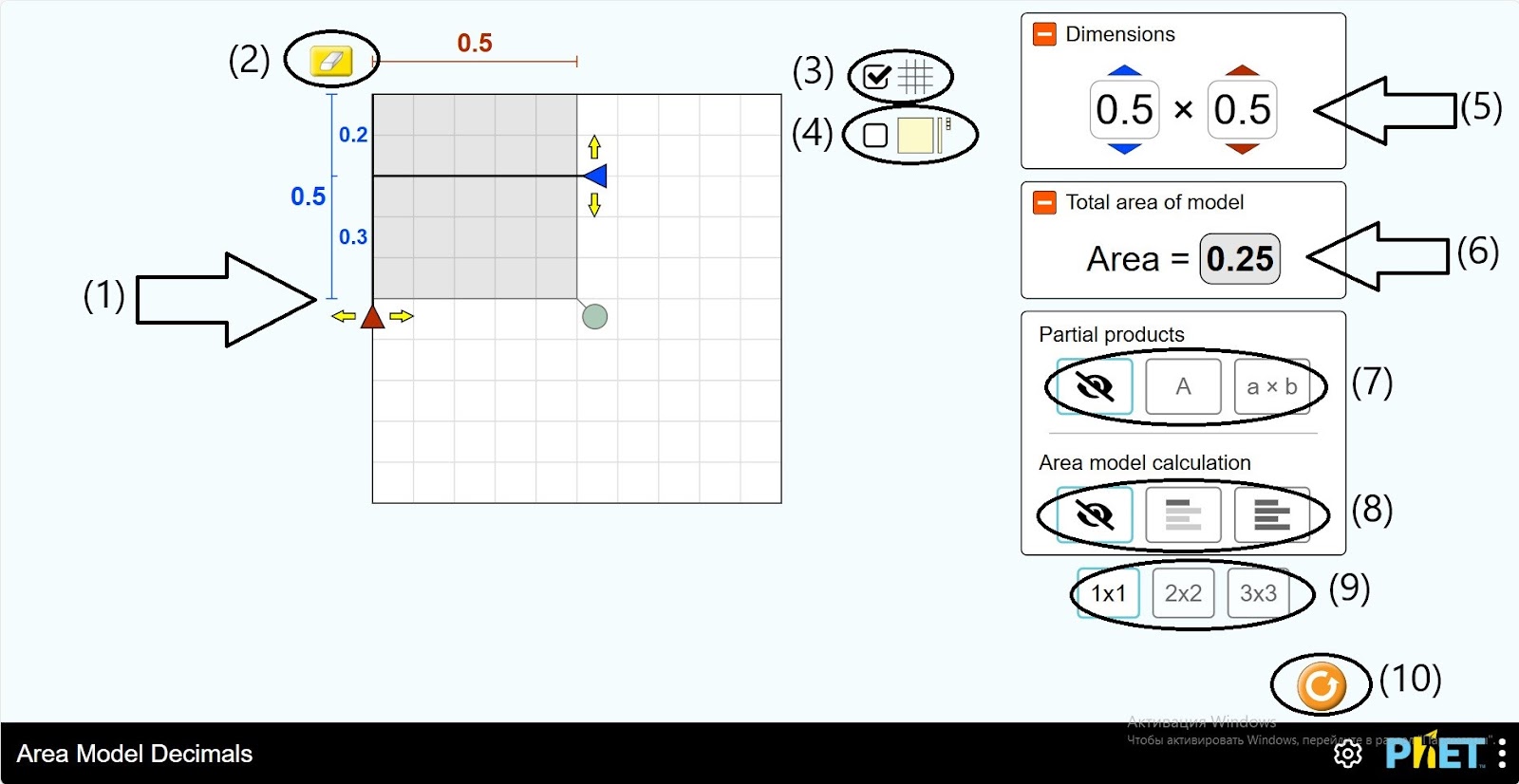
Step 1. Start the simulation: in the workspace provided to you:
- 10*10 table and dividing lines vertical, horizontal (1);
- Eraser (2);
- Button to hide the grid in the table (3);
- Button to color the square in the table (4);
- Multiplication and multiplication number board (5);
- Multiplication results table (6);
- Rectangle information in the table (7);
- Calculation fields and “hide” button (8);
- Table size: 1*1, 2*2 or 3*3 (9);
- Reload button (10).
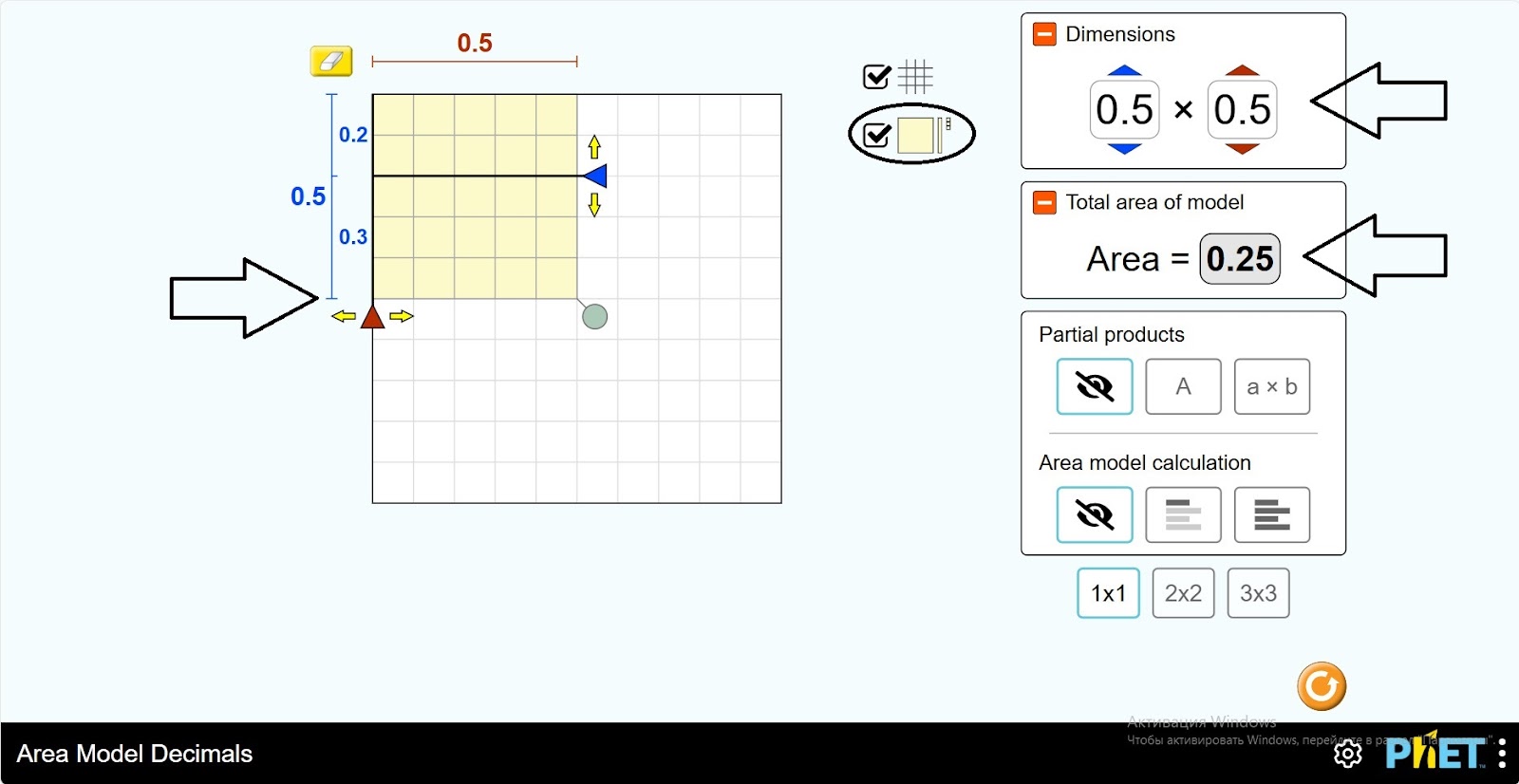
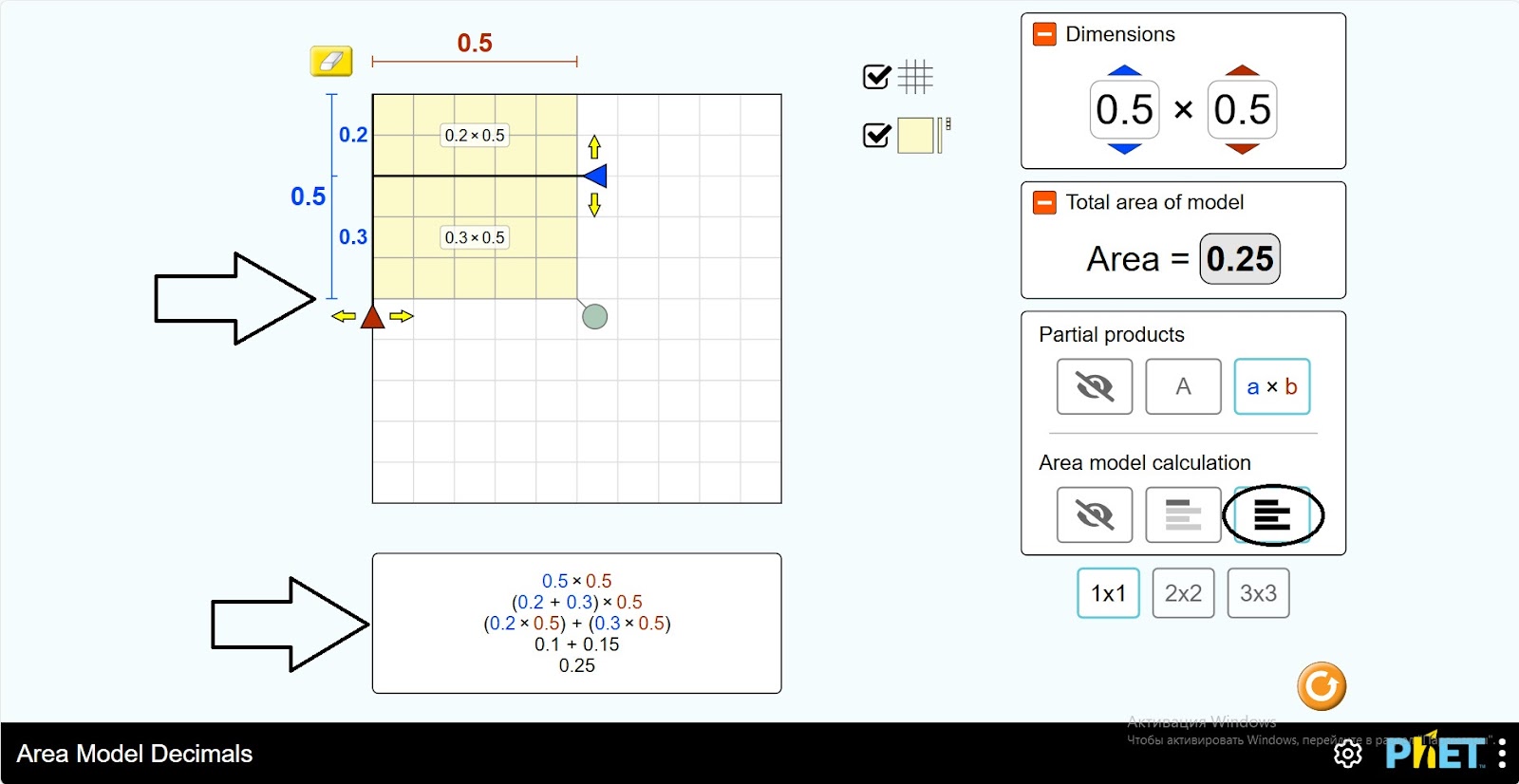
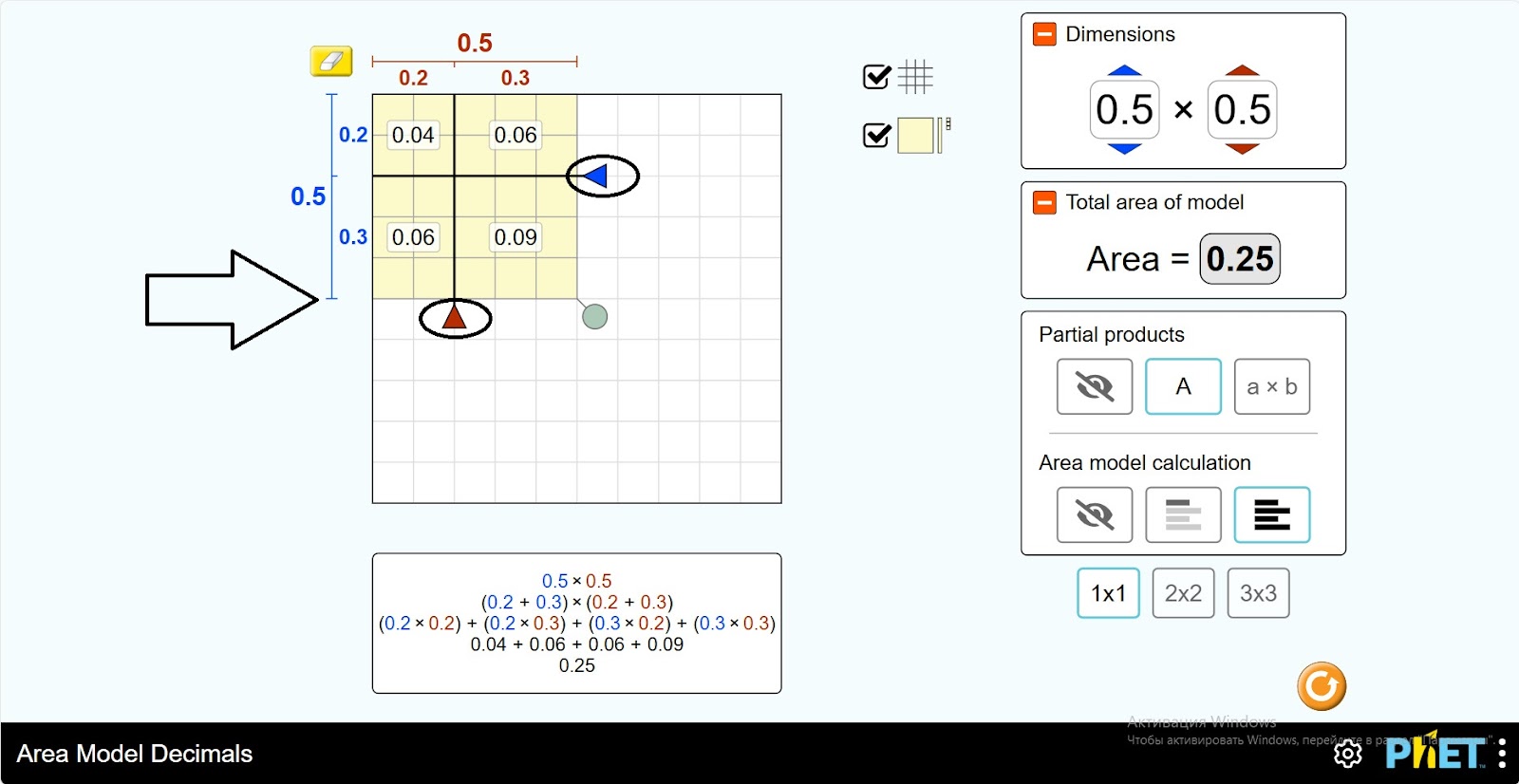
Step 2. The table is divided into 10 parts. Each part represents 0.1, which is an integer of 1. The table represents a square of size 0.5*0.5. Divided horizontally into sections (0.2;0.3). The Multiplier Numbers panel and the Multiplication Results panel display the data. Click the button to color the square.
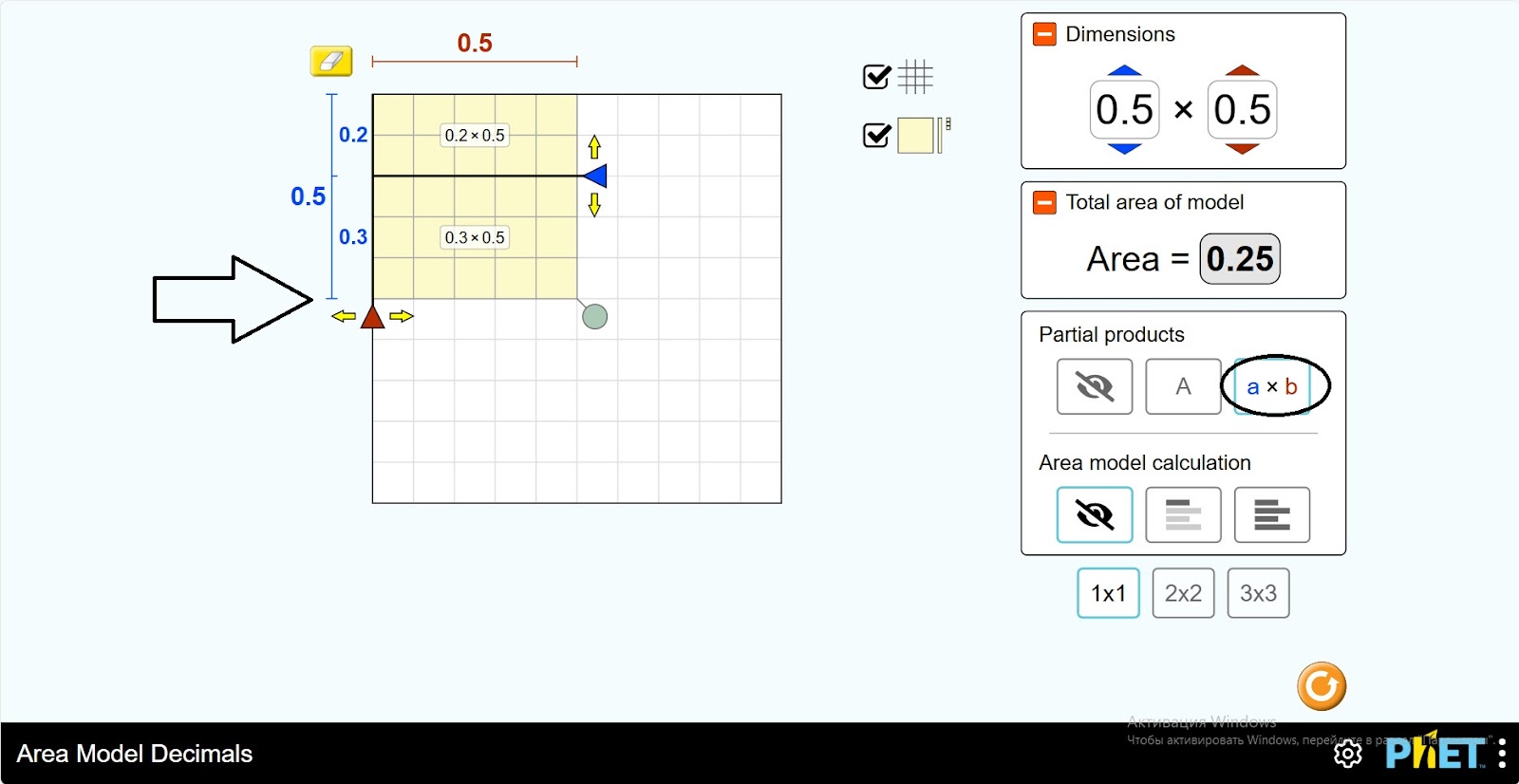
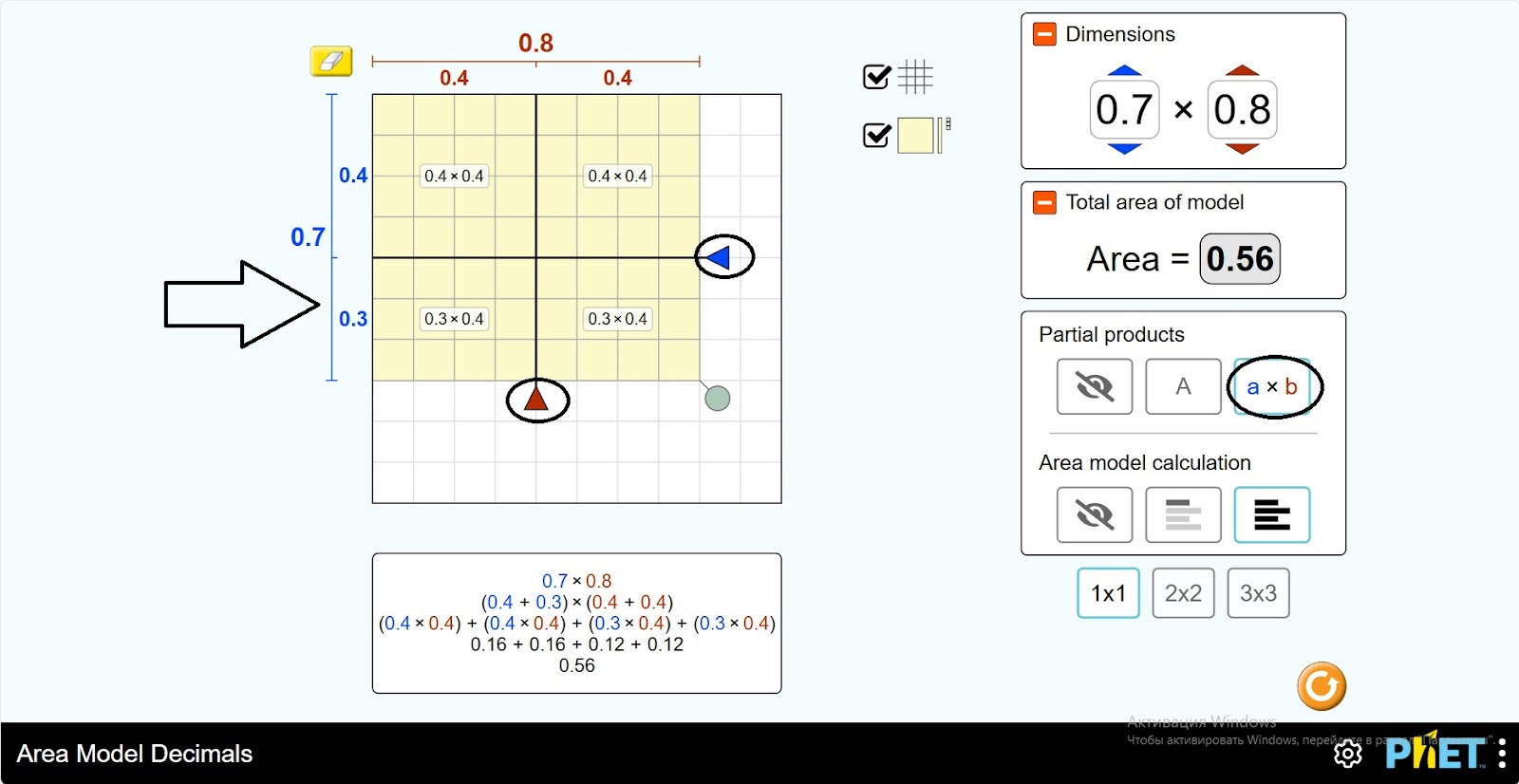
Step 3. Click the “a*b” button from the square information in the table. The expressions 0.2*0.5 and 0.3*0.5 appear in the parts of the square.
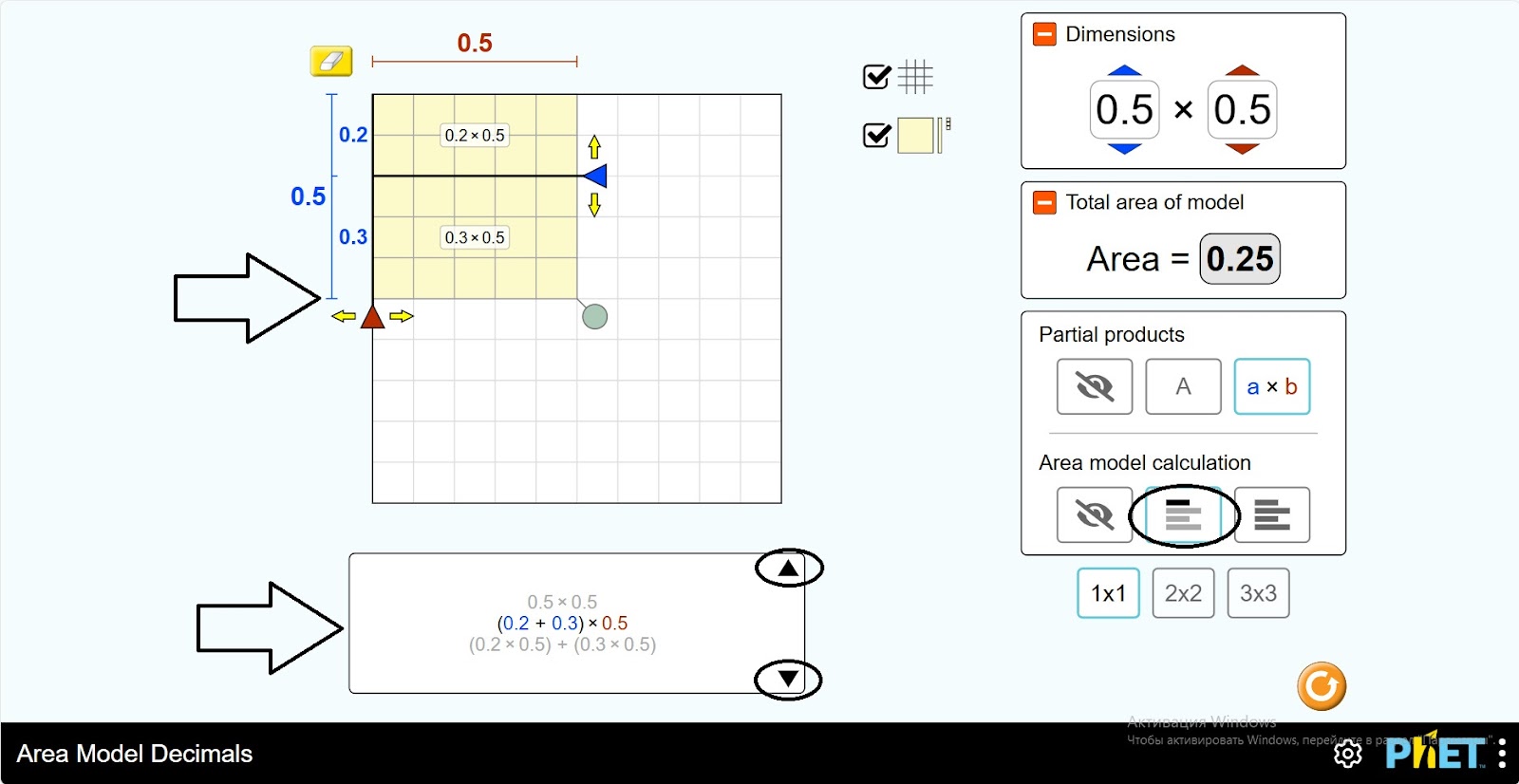
Step 4. 2 views of the Calculation Panel are given. They show the calculation of the area of the square. In one of them you will see the expression step by step by clicking the “Next” button, and in the other you will see the complete calculation at once.
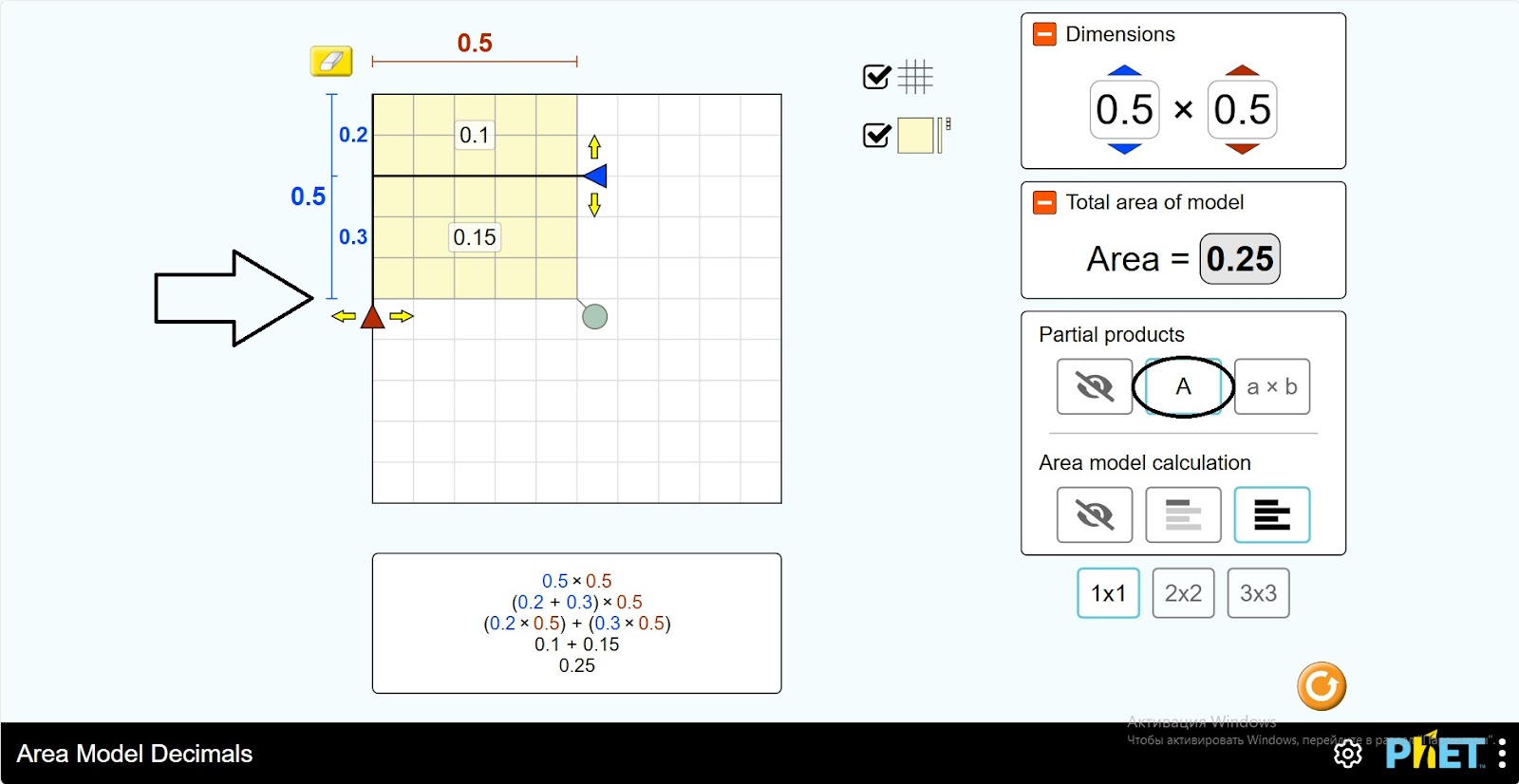
Step 5. Click on the “A” button of the square information in the table. The value of the expressions on the “a*b” button appears in the parts of the square.
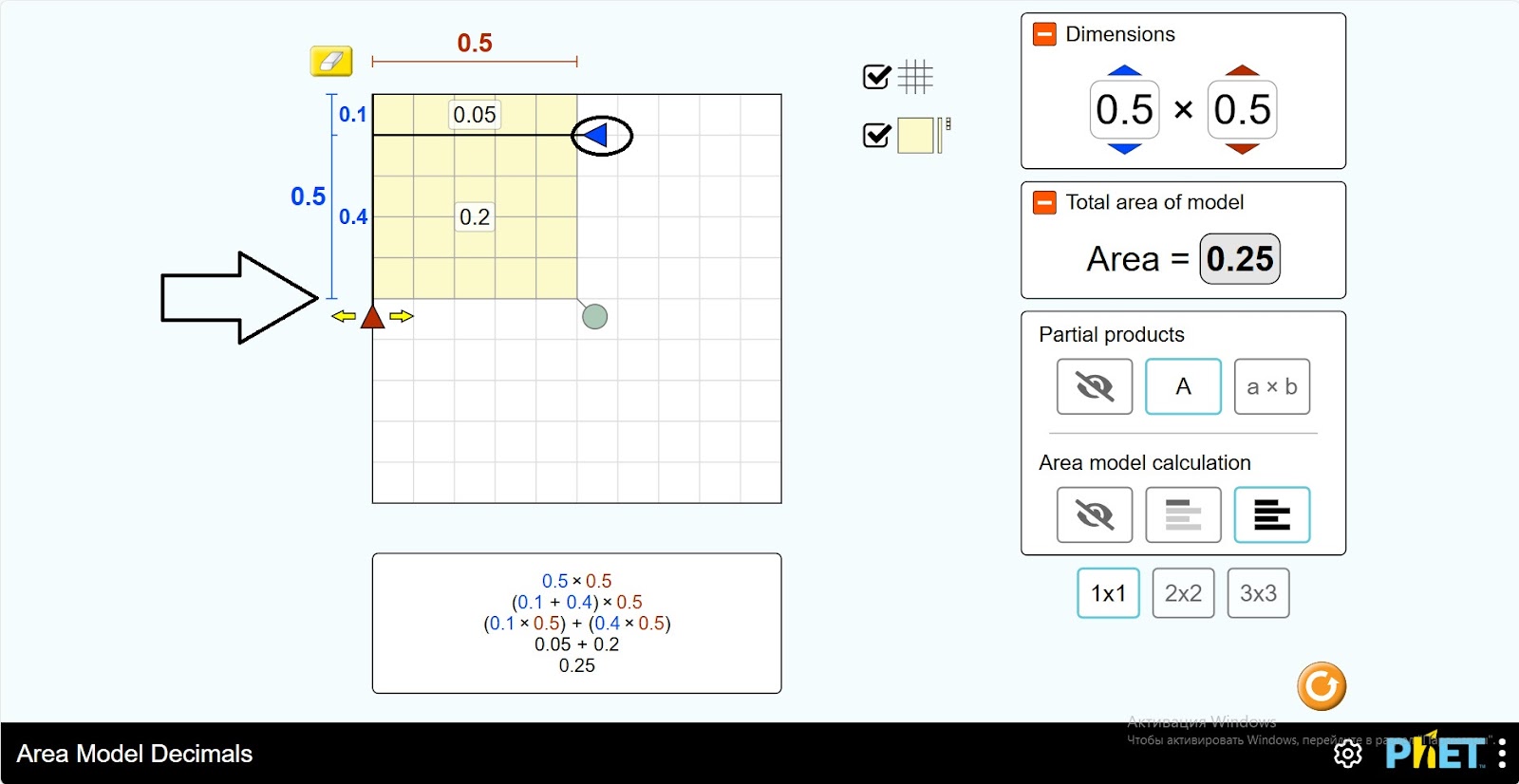
Step 6. Explore the changes in the product by moving the divider up and down the square.
Step 7. Move the horizontal divider up the square so that it does not divide the square. Move the vertical divider to the right. Examine the data. Observe the changes as you move the divider right and left.
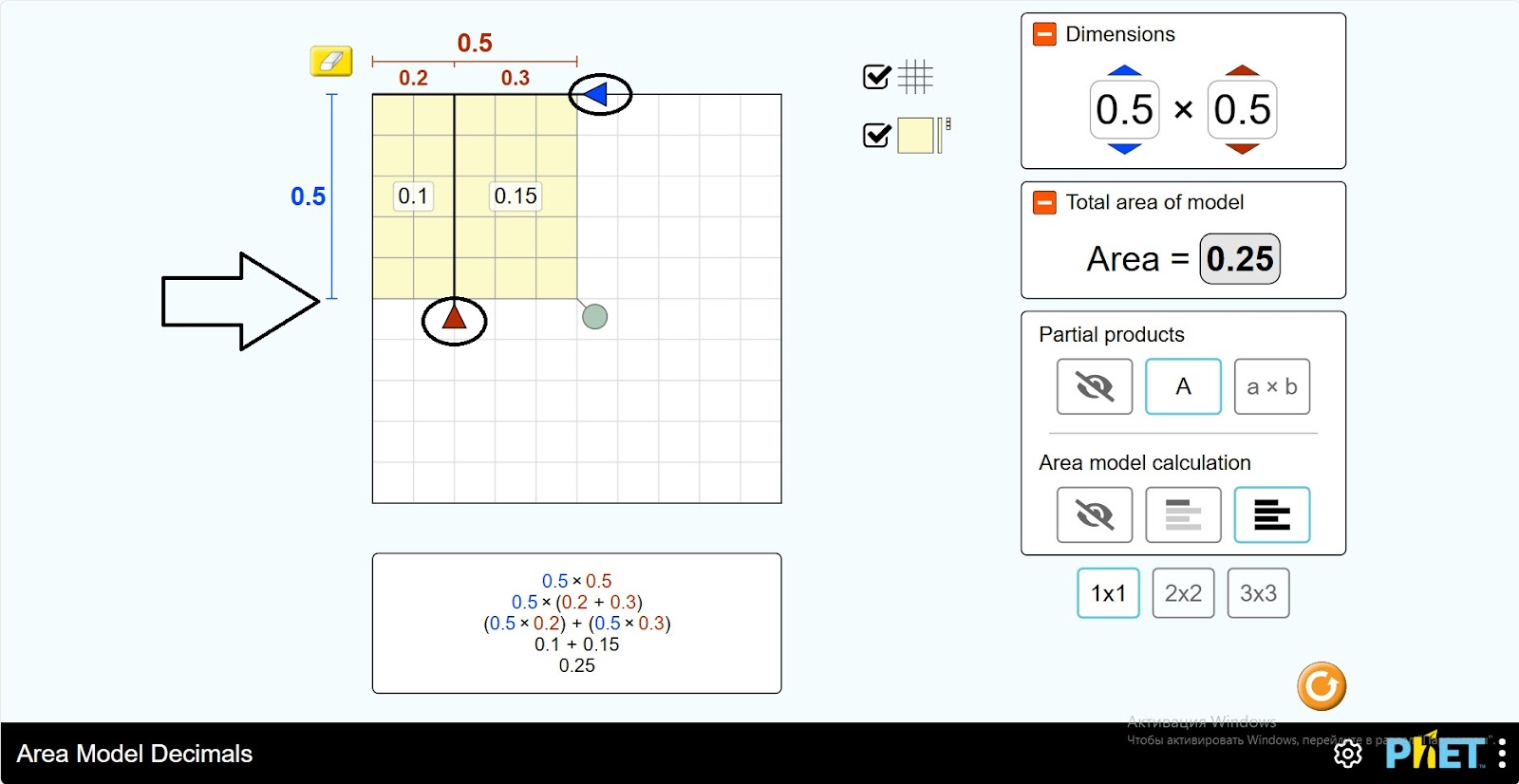
Step 8. Explore dividing the square into rectangles of different sizes by alternating the vertical and horizontal dividing lines in the square.
Step 9. Create a new rectangle size by clicking on the green button next to the square. Explore the product of decimals.
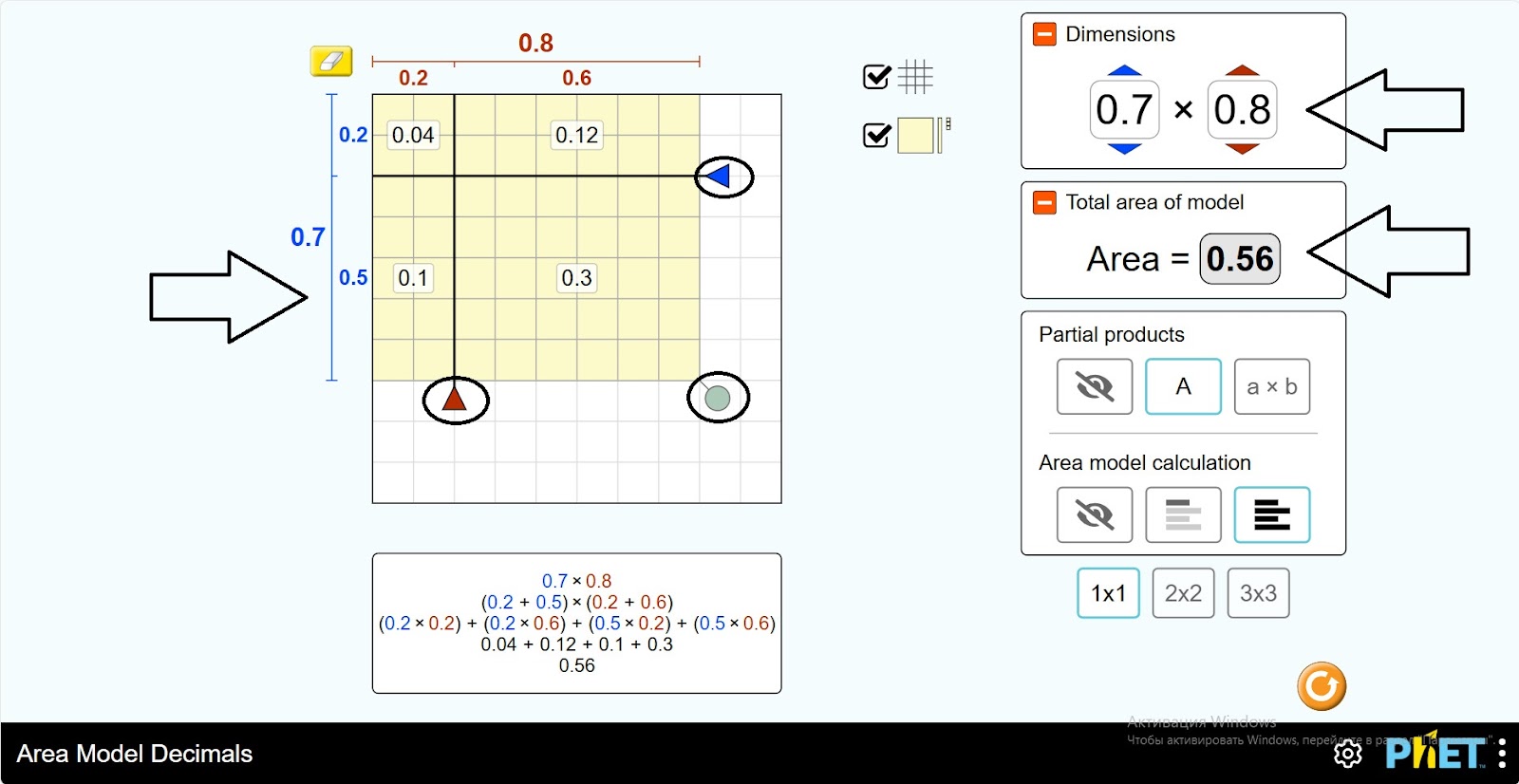
Step 10. Try to change the information about the quadrilateral in the table, the dividing lines.
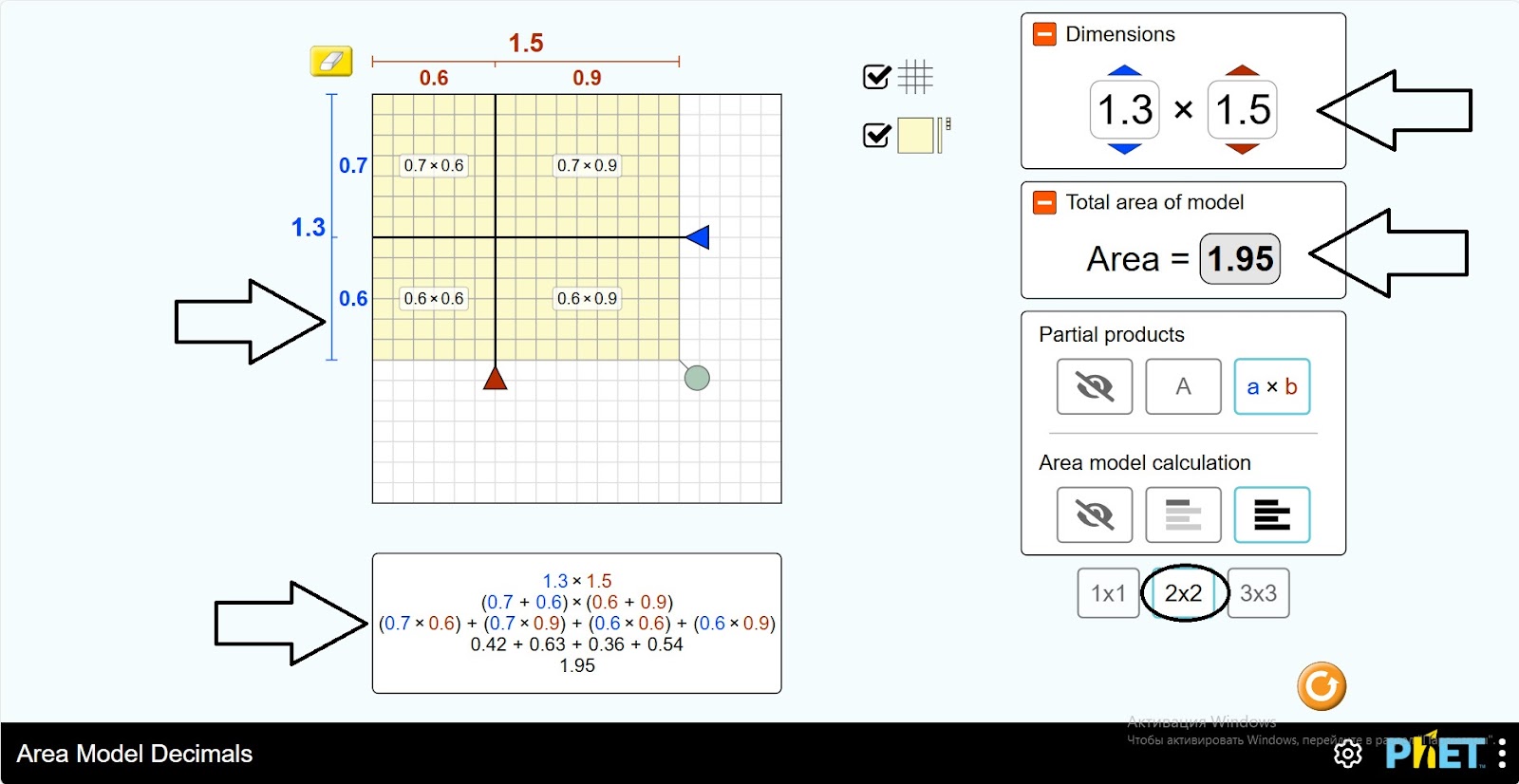
Step 11. You can change the size of the table to 2*2 and 3*3. Make the calculations by repeating the above steps. Change the dimensions of the rectangle and calculate the products.
Conclusion
In this virtual activity, students solve multiplication problems with decimal fractions using the area model. Multiplication in the Pythagorean table provides a visual way to learn the subject. This makes it easier to learn a new lesson.