
Modeling Projectile Motion
Projectile Motion by PhET Interactive Simulations, University of Colorado Boulder, licensed under CC-BY-4.0 (https://phet.colorado.edu)
Objective:
- Determine how each parameter (initial altitude, initial angle, initial velocity, mass, diameter, and height) affects the trajectory of an object with and without drag;
- Predict how a change in initial conditions will affect the trajectory of the projectile and provide an explanation for the prediction;
- Estimate where the object will land given the initial conditions;
- Determine that the projectile’s motions in the x and y axes are independent;
- Discuss the motion of the projectile using common vocabulary (e.g., launch angle, initial velocity, initial height, range, time).
This virtual activity is designed to be used in a 9th grade geometry class.
Theoretical Part
The motion of a projectile is a classical problem in mechanics, often considered in a simplified model where air resistance is not taken into account. However, under realistic conditions, air resistance has a significant effect on the trajectory of the projectile, especially at high speeds and significant altitudes.
Trajectory
Without considering drag, the trajectory of the projectile is a parabola. Air resistance deforms this parabola, reducing the range and maximum height of lift.
Vectors and Forces
Velocity: A vector quantity characterizing the speed and direction of motion.
Acceleration: A vector quantity that characterizes the change in velocity in magnitude and direction.
Gravity: A constant force directed vertically downward.
Drag force: Depends on velocity, air density, cross-sectional area, and drag coefficient.
Motion in the X and Y Axes
The motion of a projectile can be decomposed into two independent components: horizontal and vertical. Only the horizontal component of the initial velocity acts on the x-axis, while gravity and air resistance act on the y-axis.
Virtual Experiment
In Modeling Projectile Motion, students study factors that affect the trajectory of a projectile, such as angle, altitude, initial velocity, and drag. By combining their math and physics knowledge, students can perform a variety of projectile experiments.
Workflow:
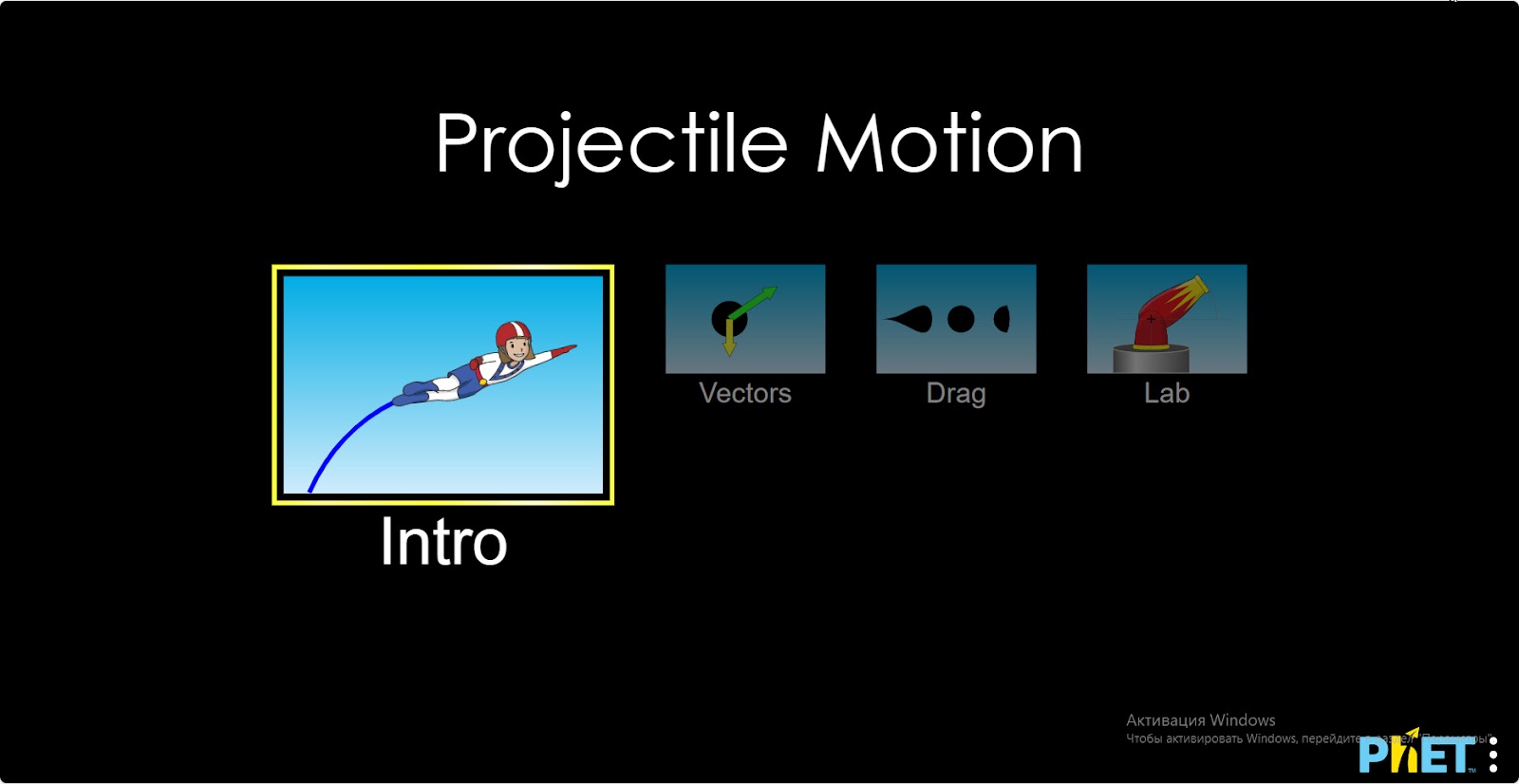
Step 1. Start the simulation: you will be presented with 4 different modes: “Intro”, “Vectors”, “Drag” and “Lab”. In this paper you will work in the “Intro” mode. Open the “Intro” section.
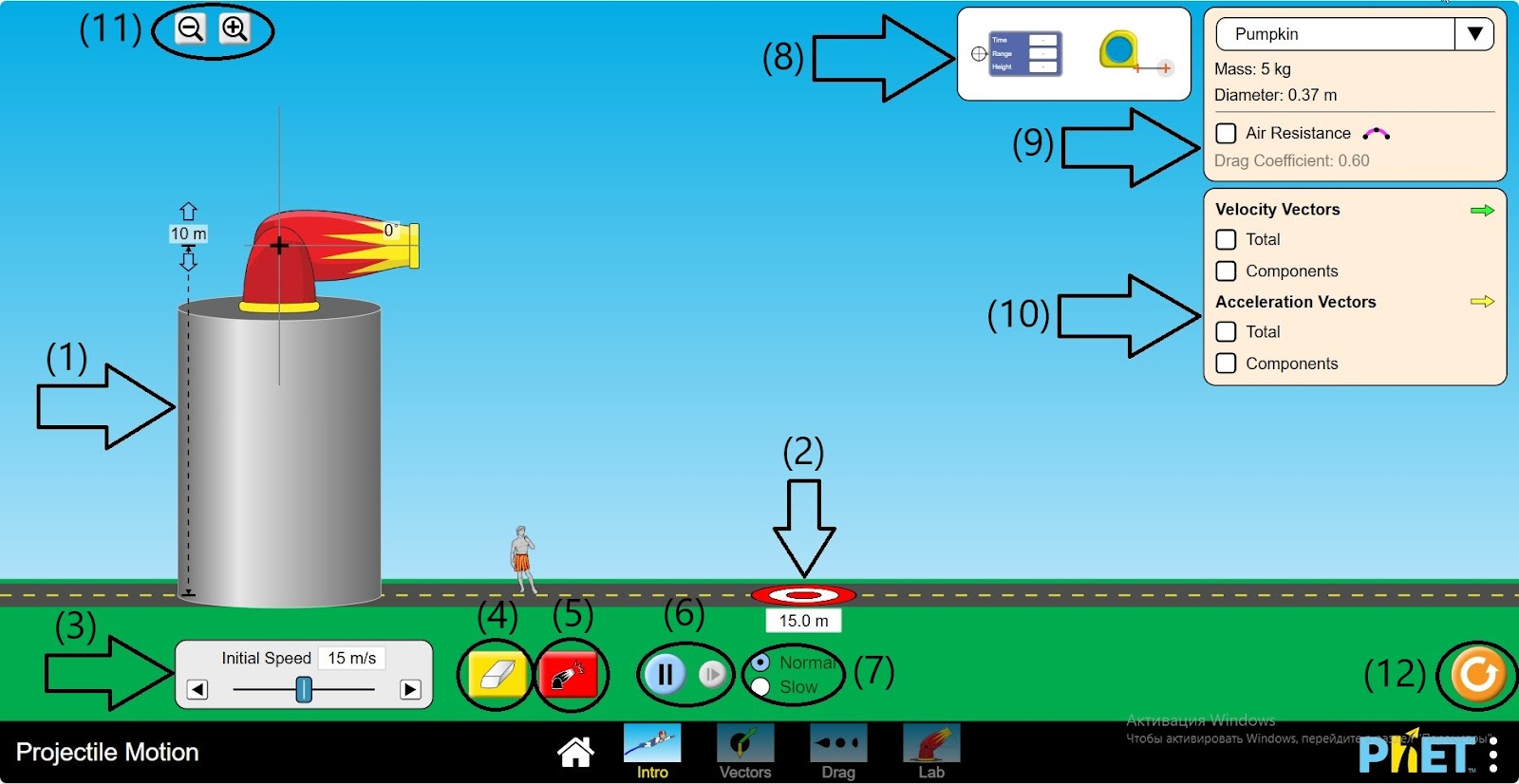
Step 2. In the workspace you are given:
- A projectile: 10 meters high, 0 degree angle (1);
- A tool for estimating where the object will land (2);
- An initial velocity transfer table (3);
- An eraser (4);
- Button to fire the projectile (5);
- Pause insertion, step forward button (6);
- Object exit from projectile: normal, slow (7);
- Exploration tools (8);
- Object data panel: name, mass, diameter, air effect, drag coefficient (9);
- Velocity vectors: general, components; Acceleration vectors: general, components (10);
- Zoom in and out buttons (11);
- Reload button (12).
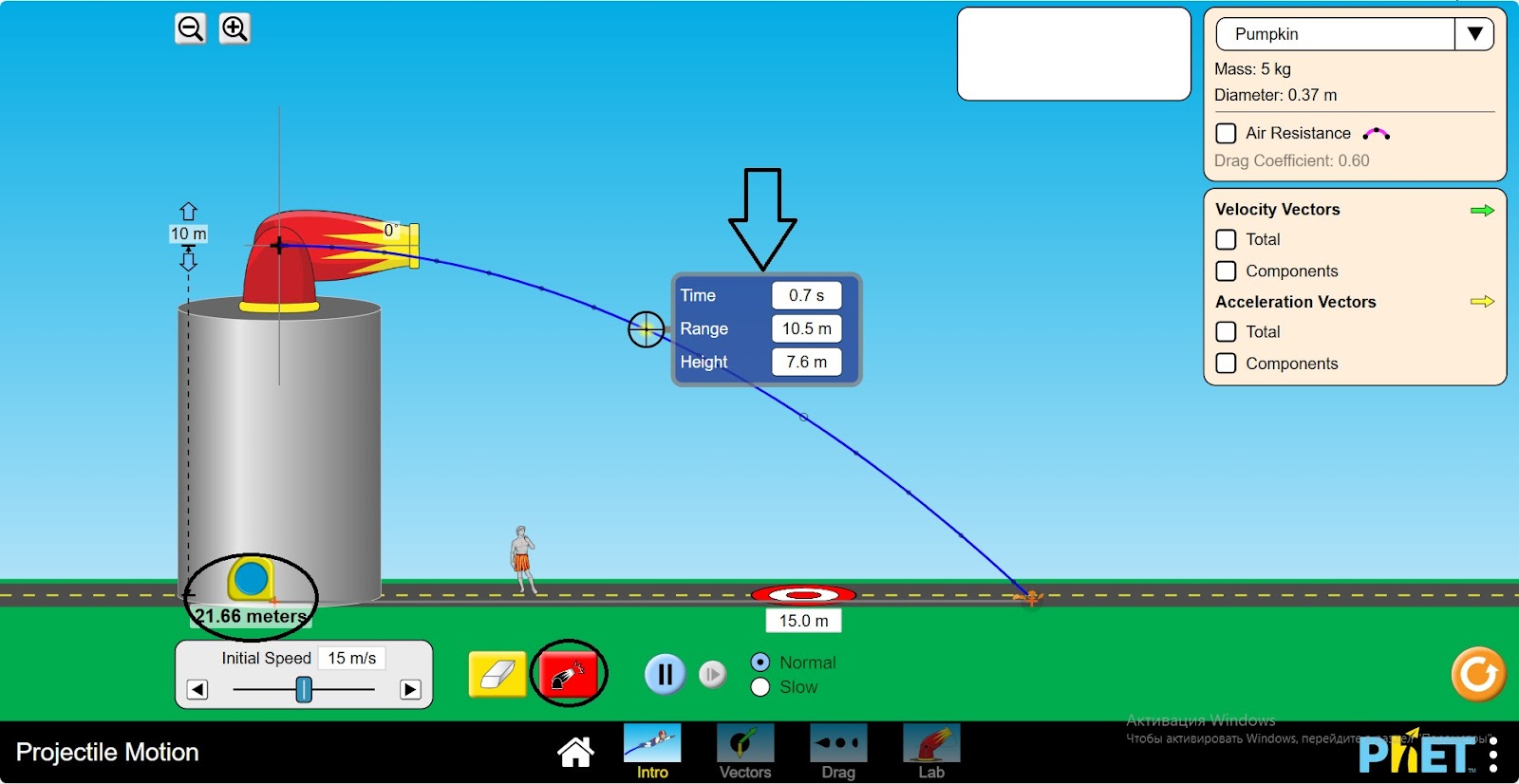
Step 3. Shoot the projectile. Object Pumpkin. Using the Explorers tools, measure time, path, height, distance.
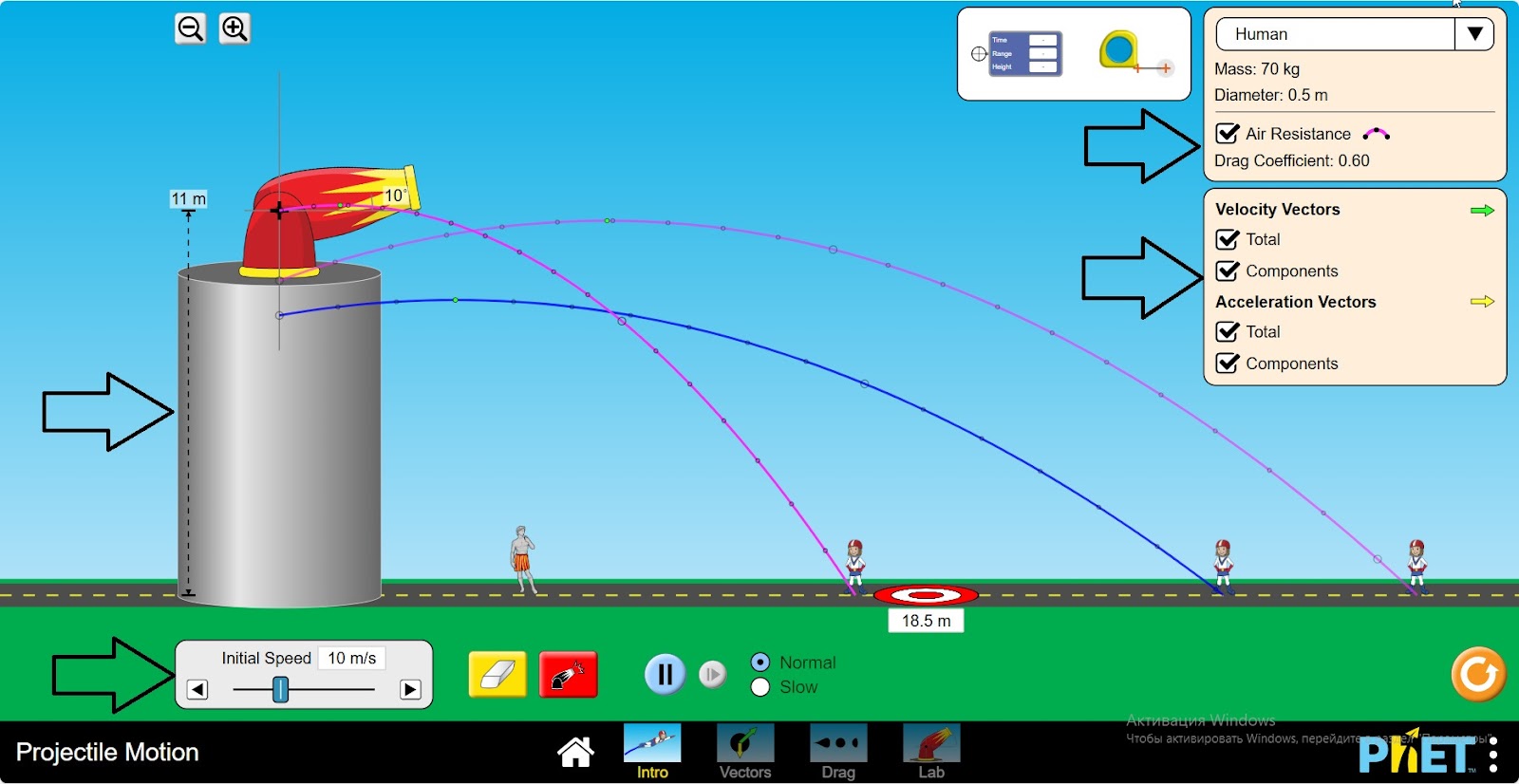
Step 4. Add air effects, velocity vectors and acceleration vectors. Use the special tool to estimate where the object will land.
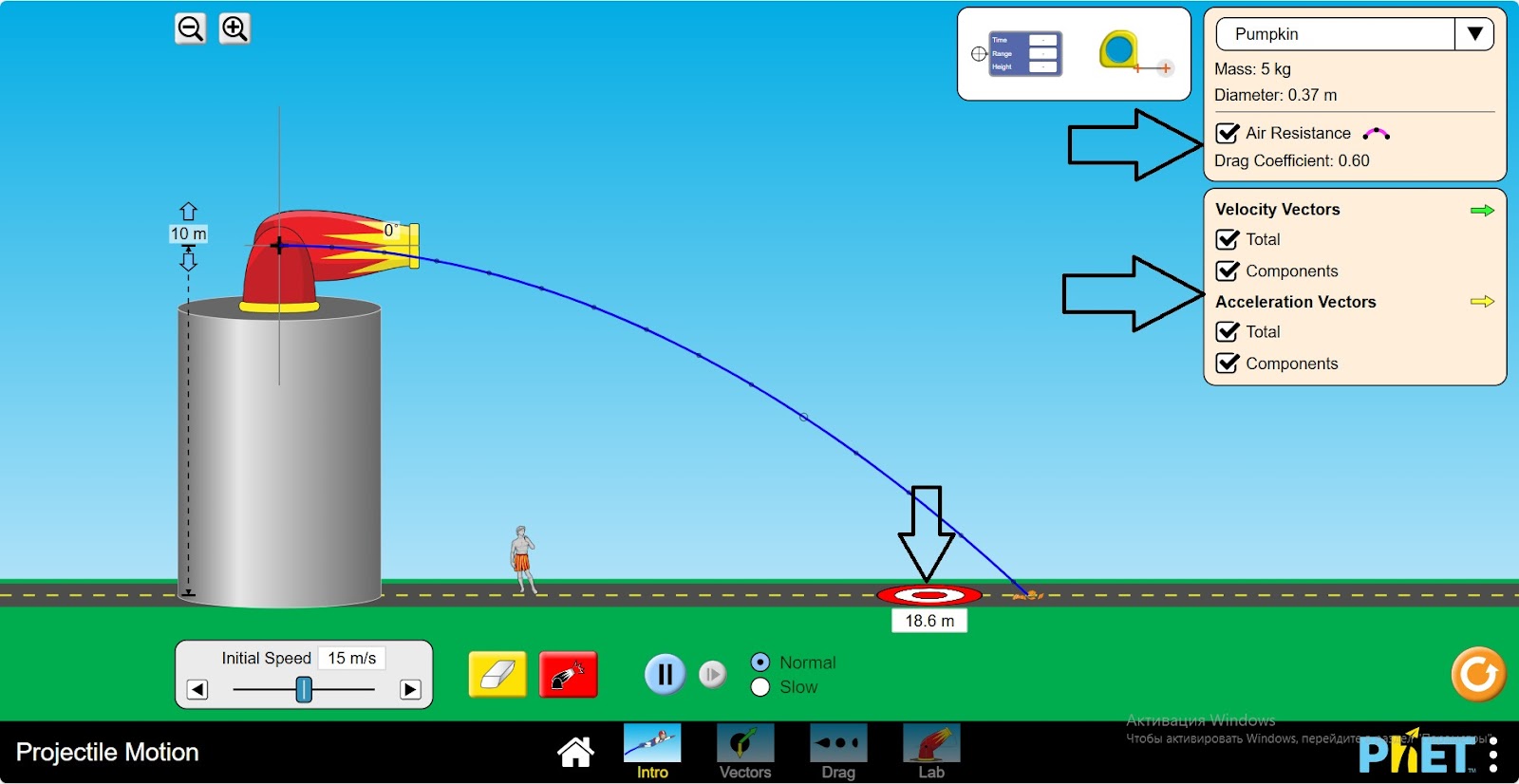
Step 5. Fire and examine the projectile.
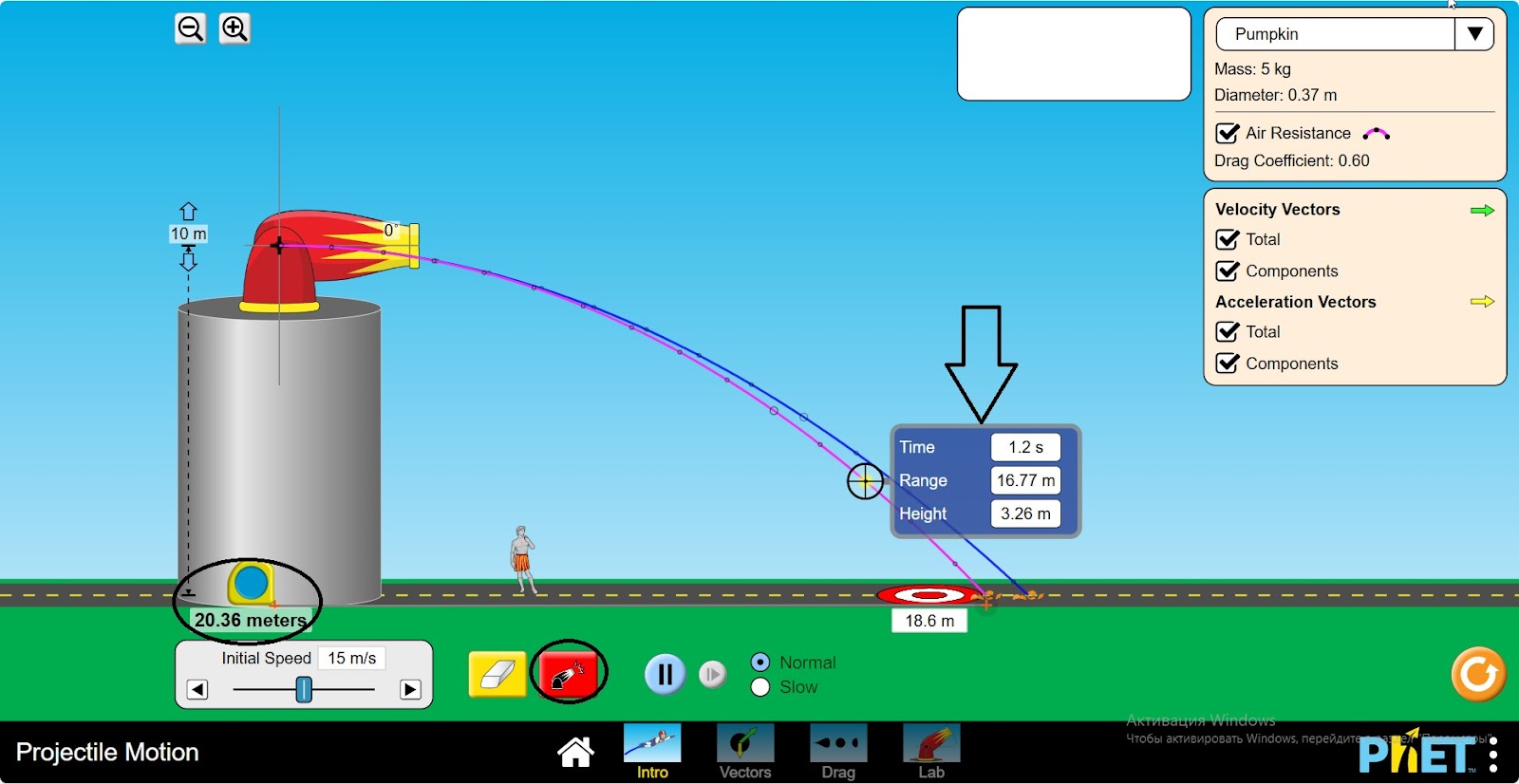
Step 6. Change the initial velocity. Fire and examine the projectile.
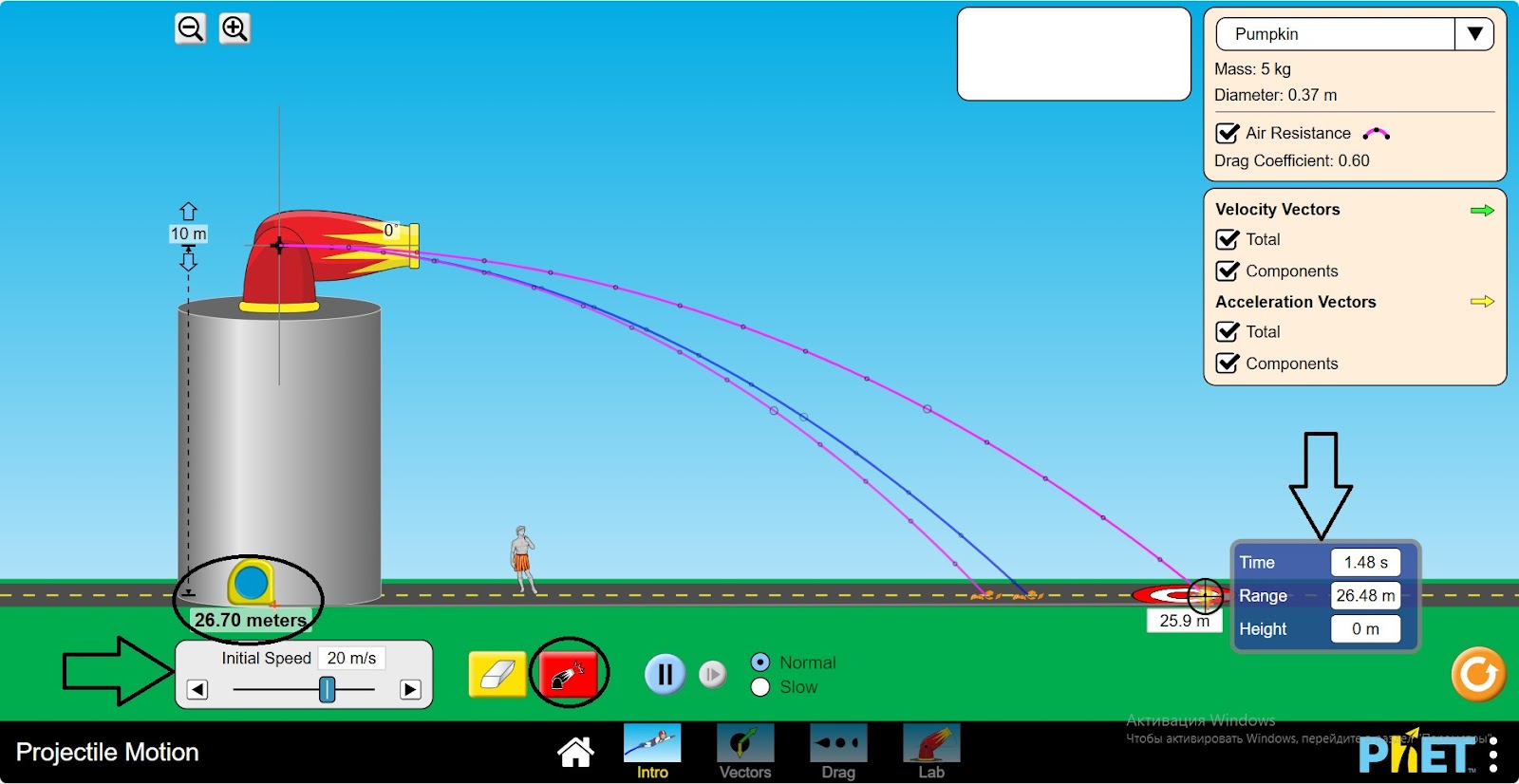
Step 7. Change the height of the projectile, the angle. Shoot and check the projectile.
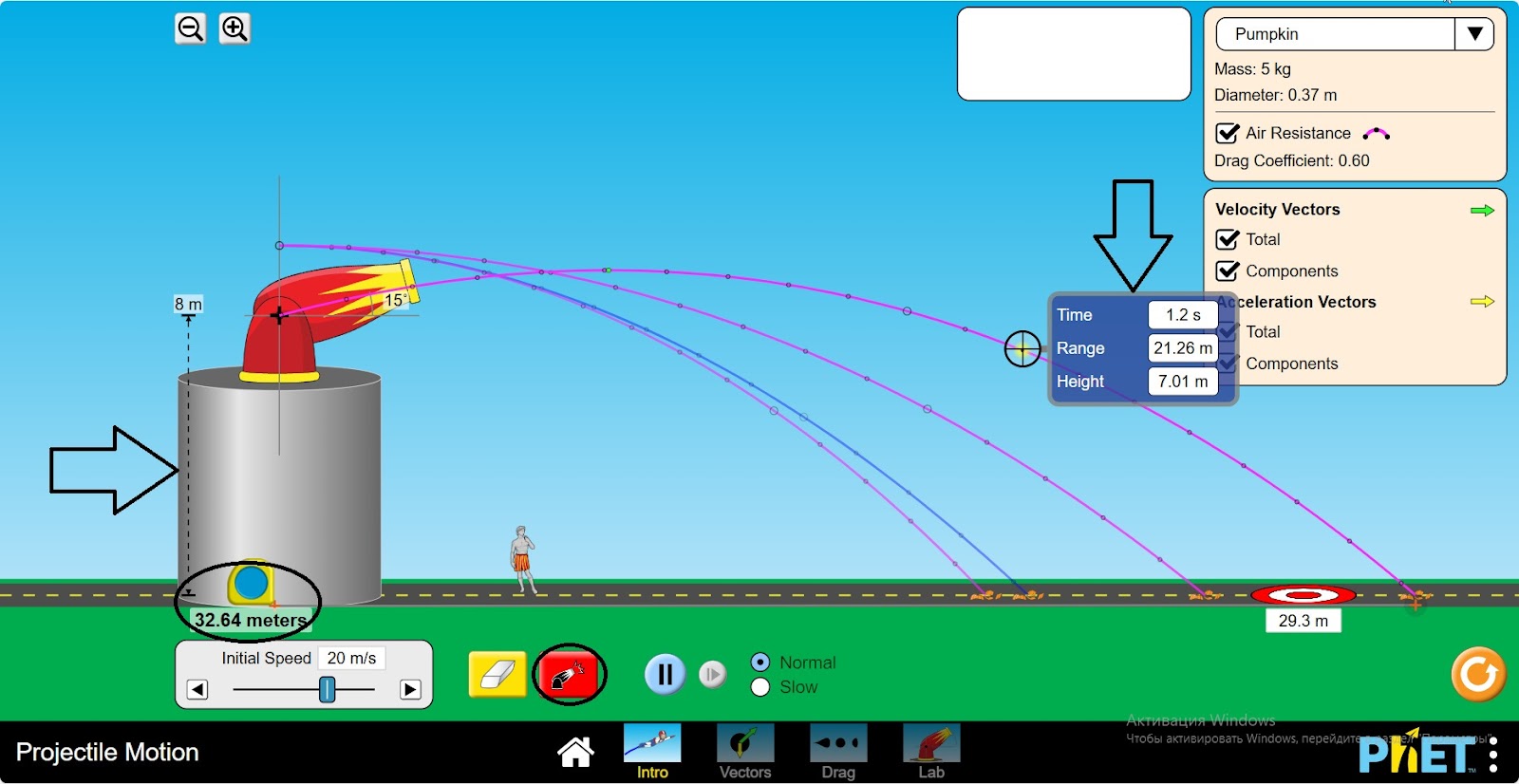
Step 8. Perform several experiments by changing the settings. Notice how each setting (initial height, initial angle, initial velocity) affects the trajectory of the object with and without air resistance.
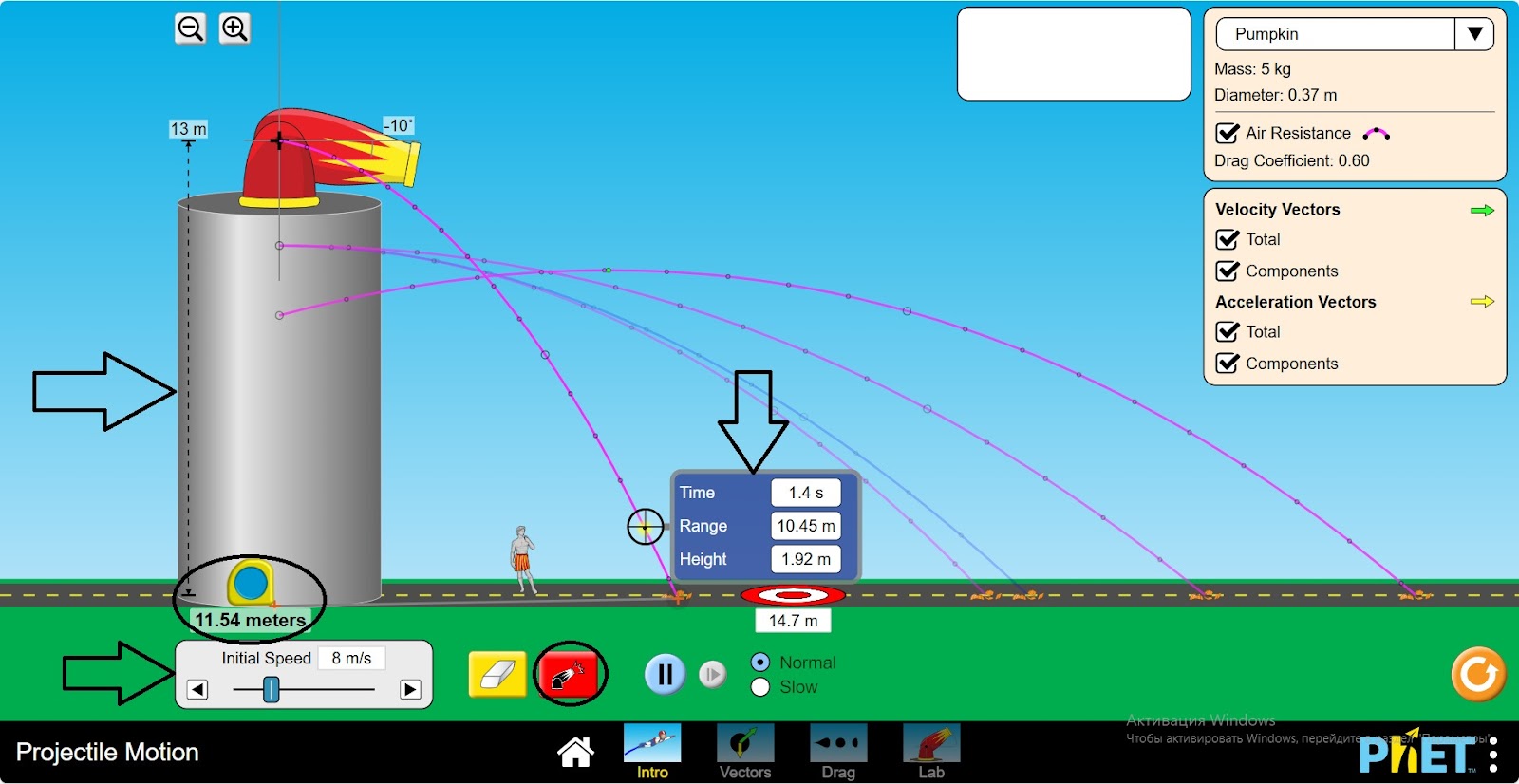
Step 9. The Object Data panel lists several object names: cannonball, tank shell, golf ball, baseball, soccer ball, pumpkin, human, piano, car. Select one of the objects. Snapping on the selected object changes its mass, diameter.
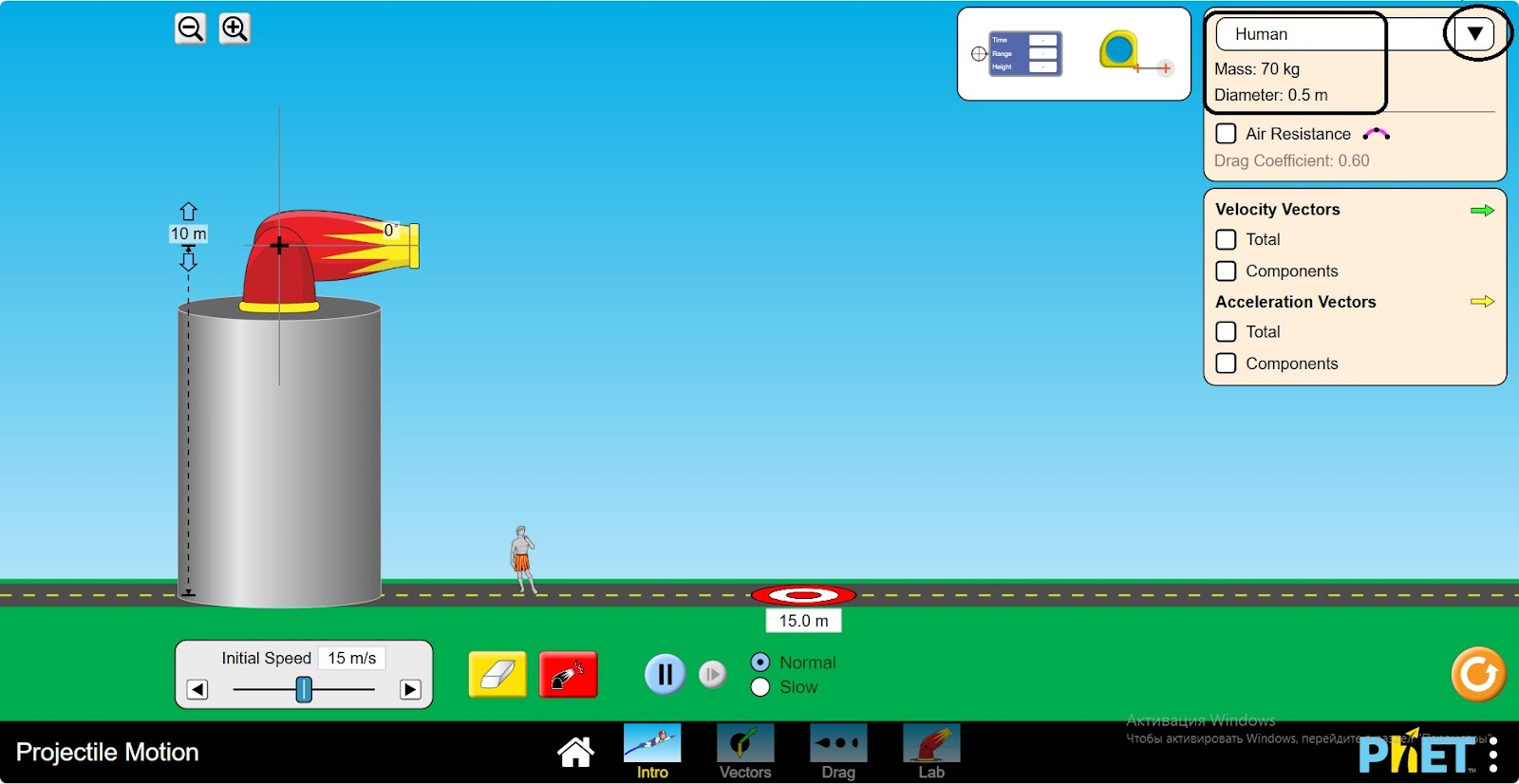
Step 10. Do some experiments and research by changing the settings of the selected object.
Conclusion
The study has allowed a deeper understanding of the physical processes occurring during the movement of the projectile in the atmosphere. The main parameters influencing the trajectory were taken into account: initial velocity, flight angle, mass, diameter and height. The results obtained can be used to solve various practical problems.