
Graph of a Trigonometric Function
Trig Tour by PhET Interactive Simulations, University of Colorado Boulder, licensed under CC-BY-4.0 (https://phet.colorado.edu)
Objective:
- To know the definitions and properties of trigonometric functions and be able to graph them.
This virtual activity is designed to be used in the algebra lesson in the next chapter:
- Grade 10. “Trigonometric functions, their properties and graphs”.
Theoretical Part
Properties of trigonometric functions
- Periodicity: All trigonometric functions are periodic. This means that their values are repeated after a certain interval. For example, the period of sine and cosine is 2π.
- Even and odd: Sine is an odd function (sin(-x) = -sin x) and cosine is an even function (cos(-x) = cos x).
- Ranges and Values:
For sine and cosine, the definition domain is all real numbers and the value domain is the interval [-1, 1].
For tangent and cotangent, the domain is all real numbers except the points where cosine and sine converge to zero, respectively. The range of values is all real numbers.
Graphs of Trigonometric Functions
Graphs of trigonometric functions allow us to visualize their properties.
- Sine: The graph of the function y = sin x is a sine wave that repeats periodically.
- Cosine: The graph of the function y = cos x is also a sine wave, but shifted by π/2 relative to the graph of sine.
- Tangent: The graph of the function y = tg x has vertical asymptotes at the points x = π/2 + πk, where k is an integer.
- Cotangent: The graph of the function y = ctg x also has vertical asymptotes, but at the points x = πk, where k is an integer.
Virtual Experiment
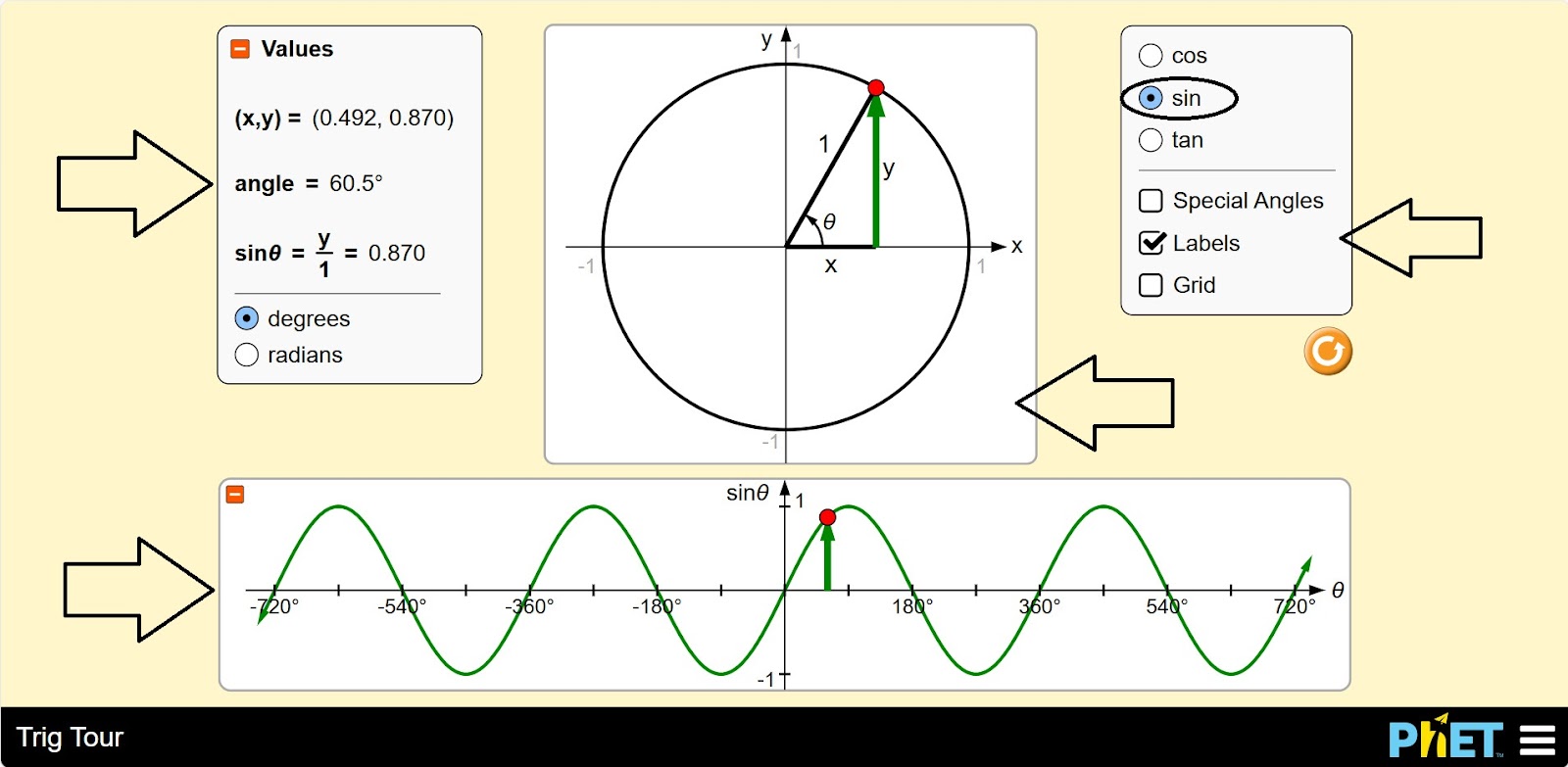
The Trig Tour simulator allows students to find the graphs of trigonometric functions, estimate or find the real values of trigonometric functions, and derive the signs of trigonometric functions ( + , -, 0) for any given angle without a calculator.
Workflow:
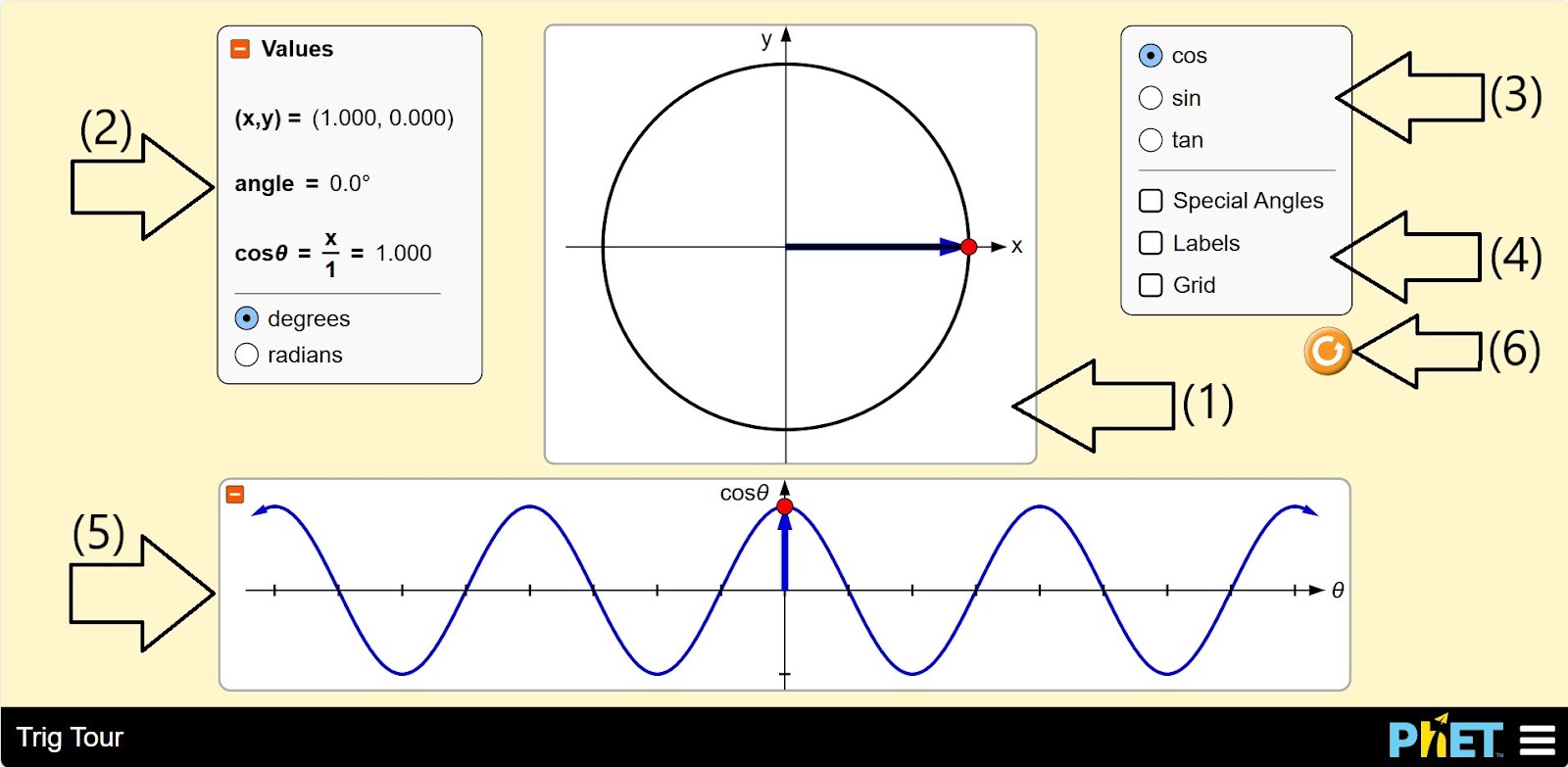
Step 1. Launch the simulator. In the workspace, you will see
- Unit Circle (1);
- Measuring angles: in degrees or radians (2);
- Types of trigonometric functions: sine, cosine, tangent (3);
- Buttons: special angles, labels, grid (4);
- Function graph (5);
- Reload button (6).
Step 2. Activate buttons special angles, labels.
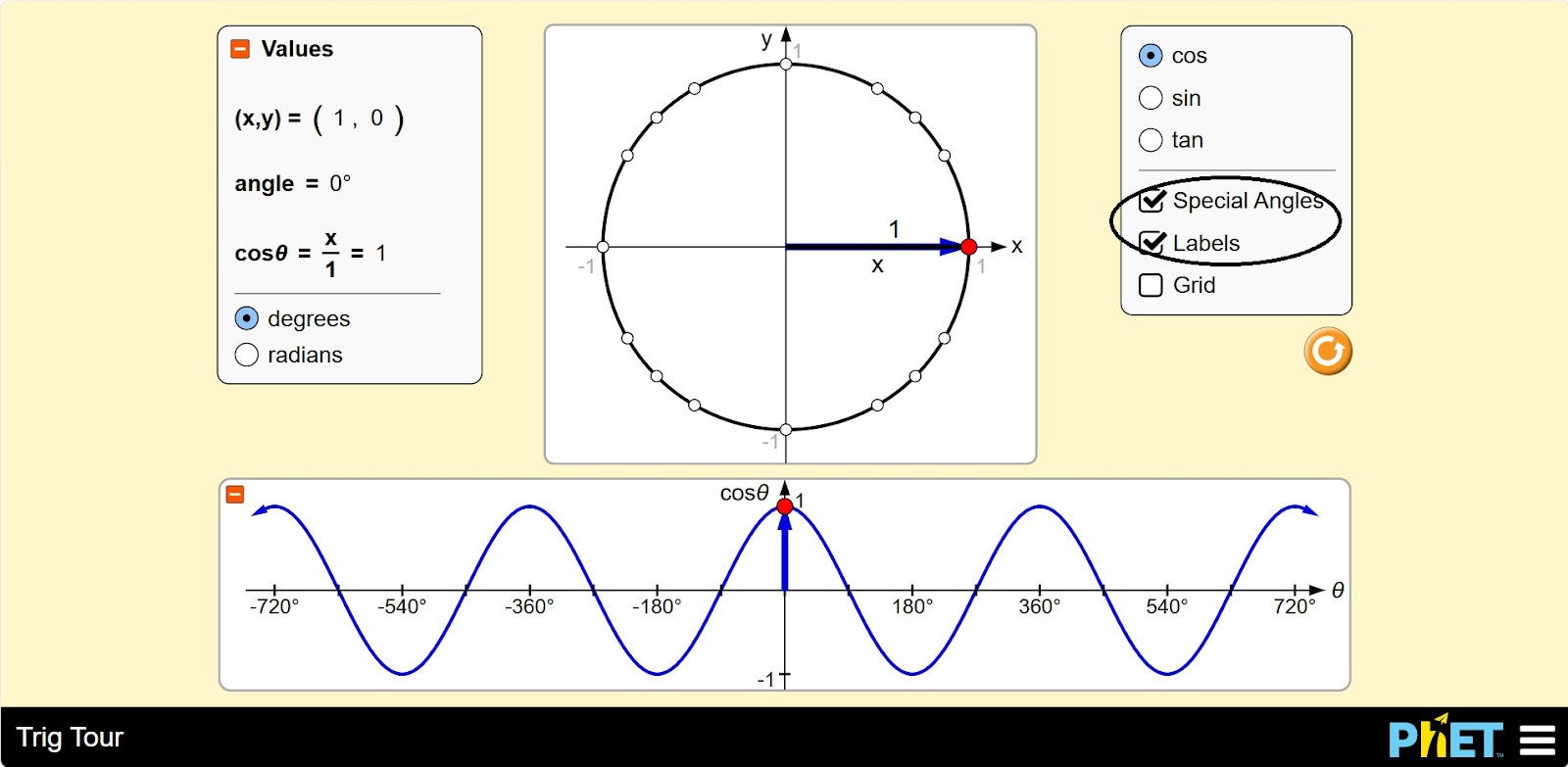
Step 3. When the angle is 0⁰, examine cos α. Value range [-1, 1]. The range of definition is all real numbers. Period 2π.
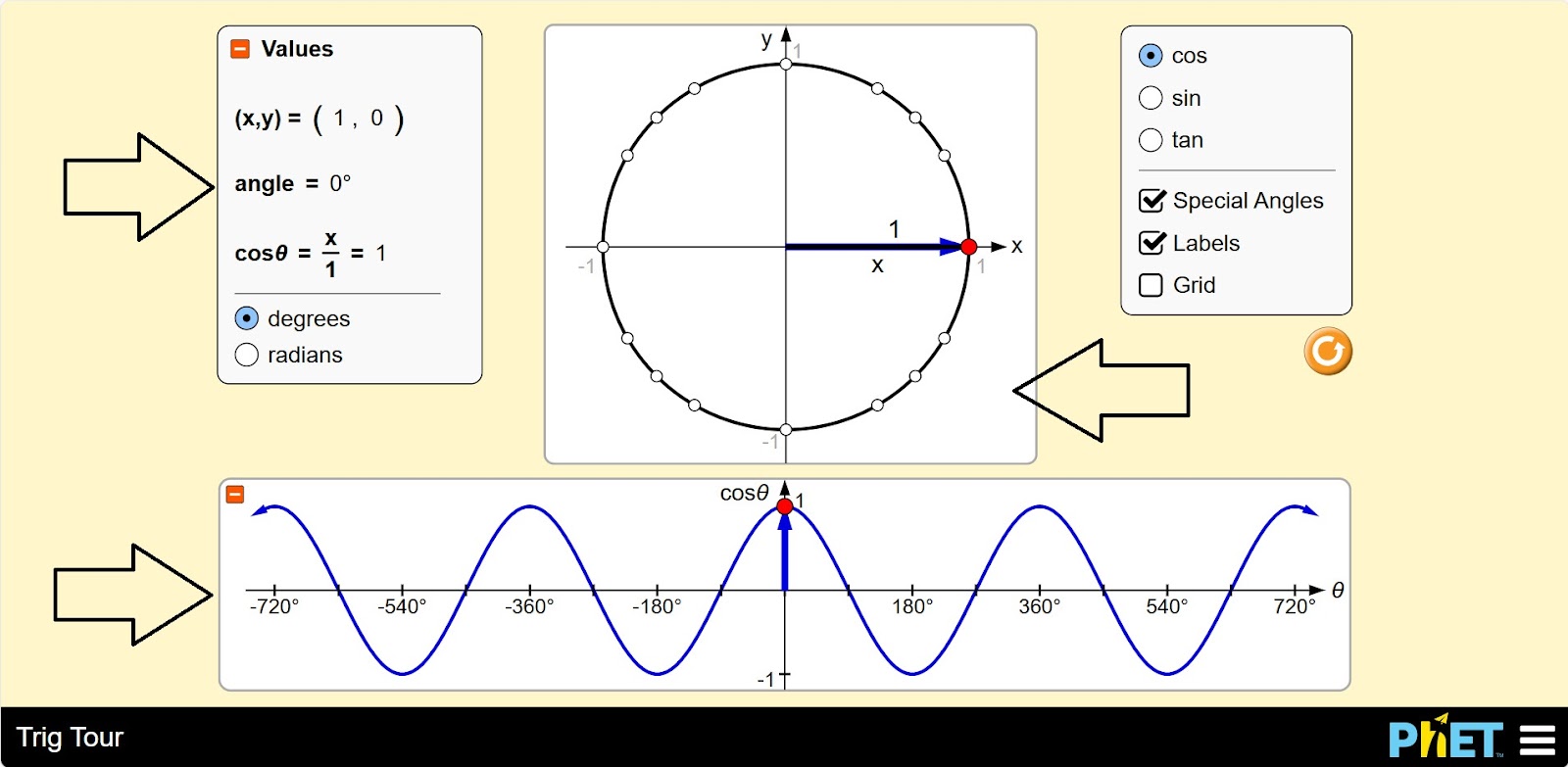
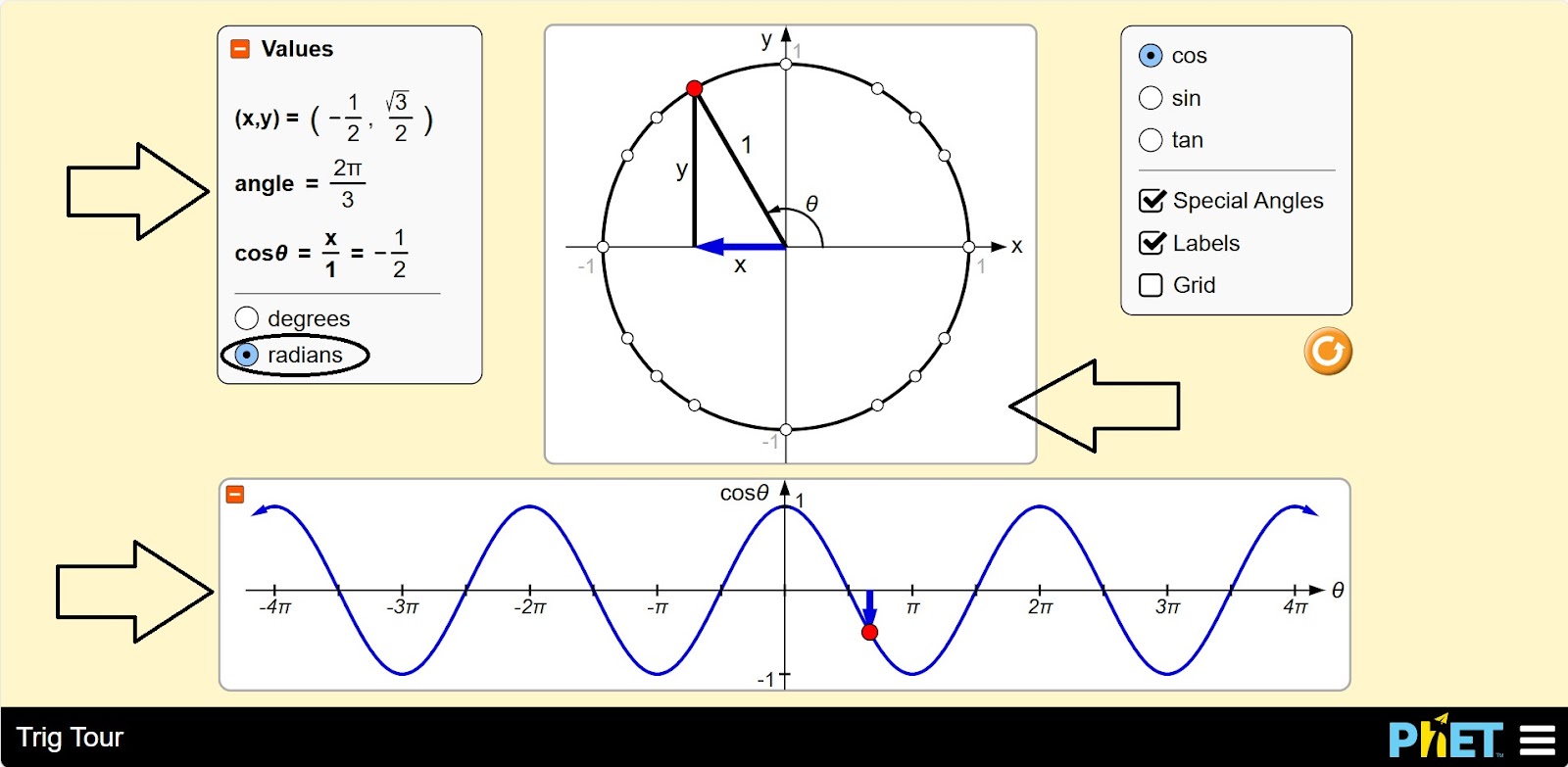
Step 4. Change the degrees of the angle to special angles and learn cos θ. Try changing the degrees to radians.
Step 5. Change the trigonometric function to sine. When the angle is 0⁰, examine sin α. Range of values [-1, 1]. The domain is all real numbers. The period is 2π.
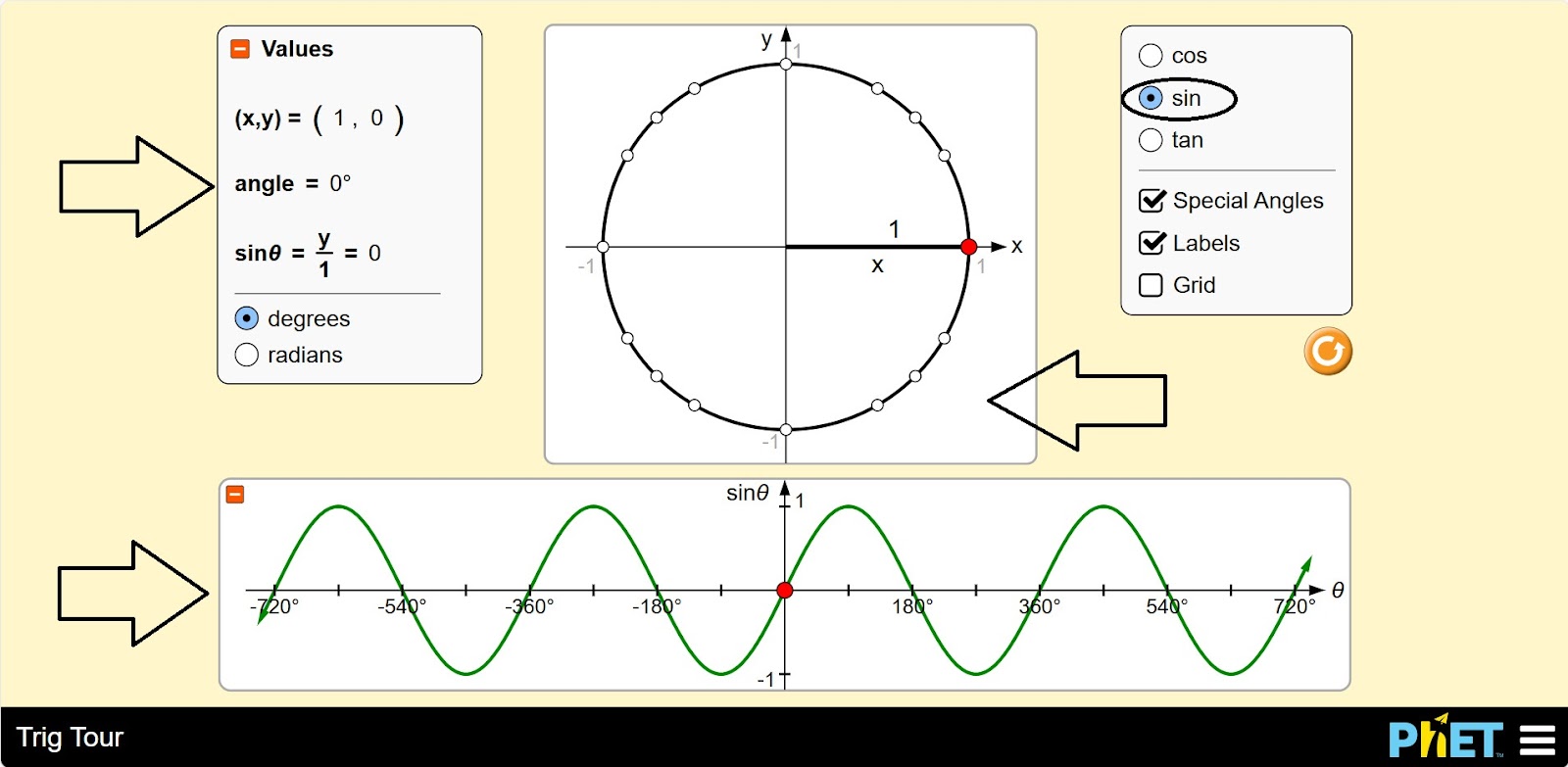
Step 6. Switch to special angles and study sin θ.
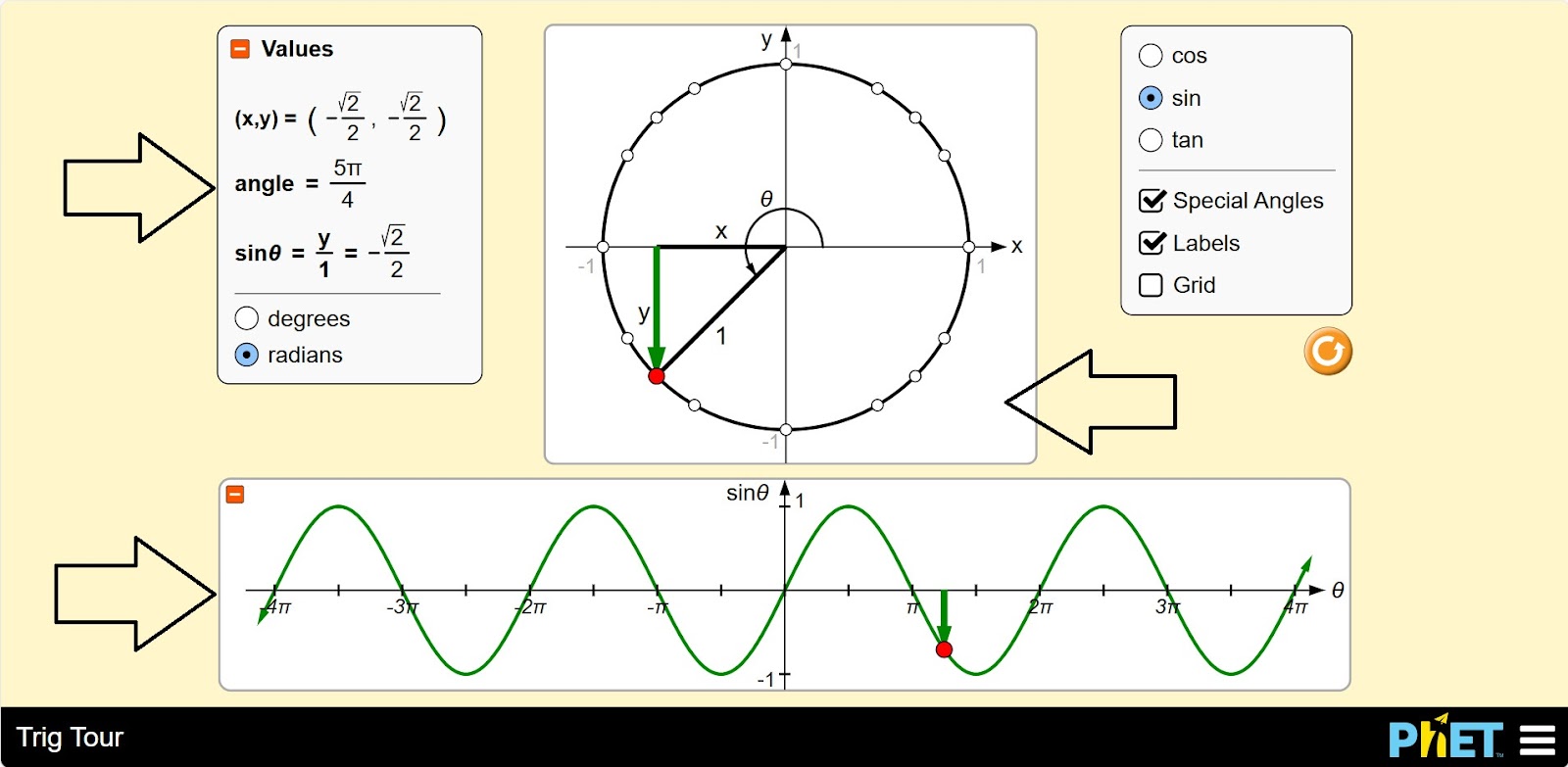
Step 7. Change the trigonometric function to tangent. If the angle is 0⁰, examine tg θ. The range of values is all real numbers. The tangent is defined for all angles except those that are multiples of π/2 (90 degrees) plus or minus any integer π. Period π.
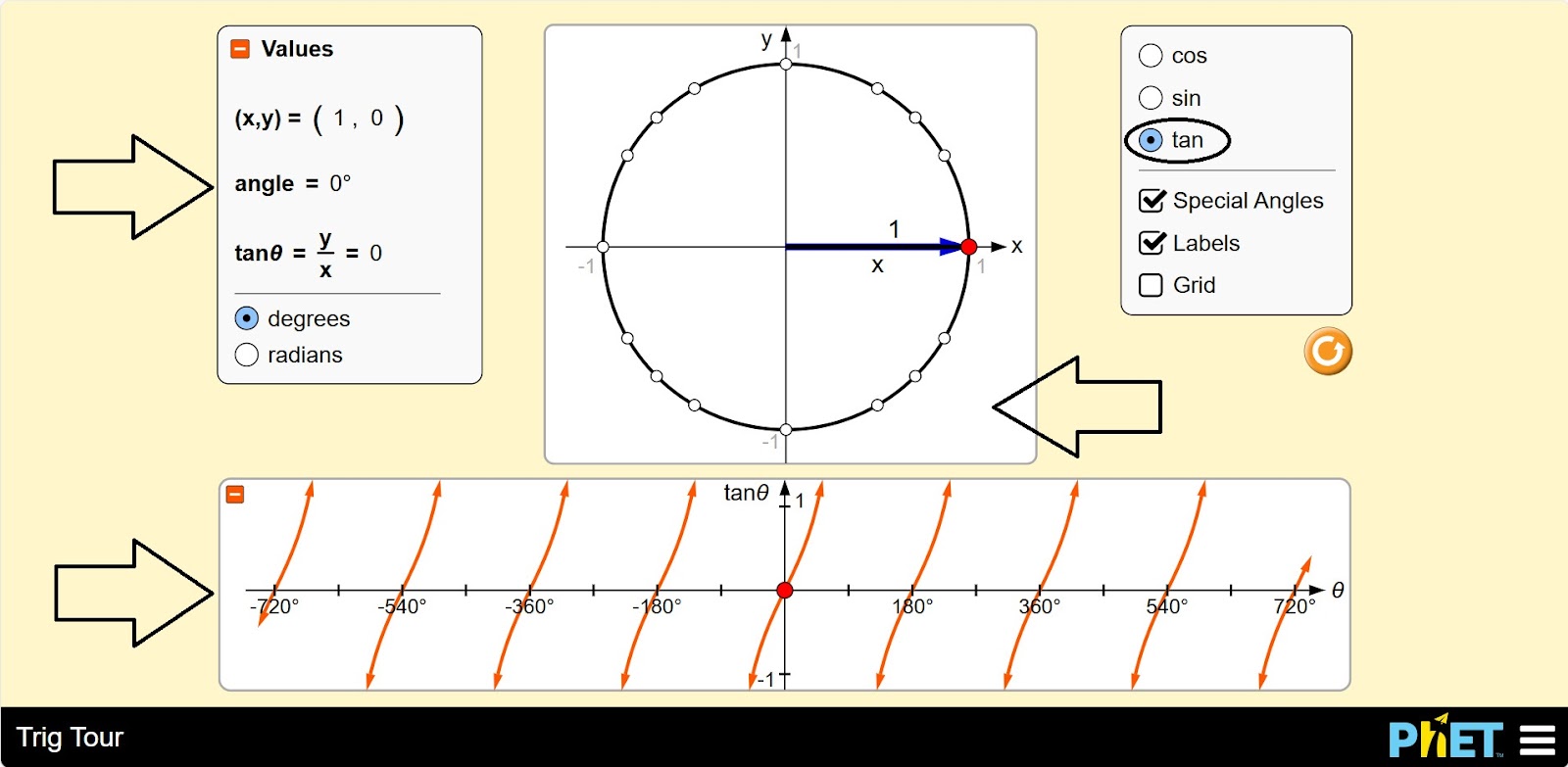
Step 8. Switch to special angles and examine the tangent θ.
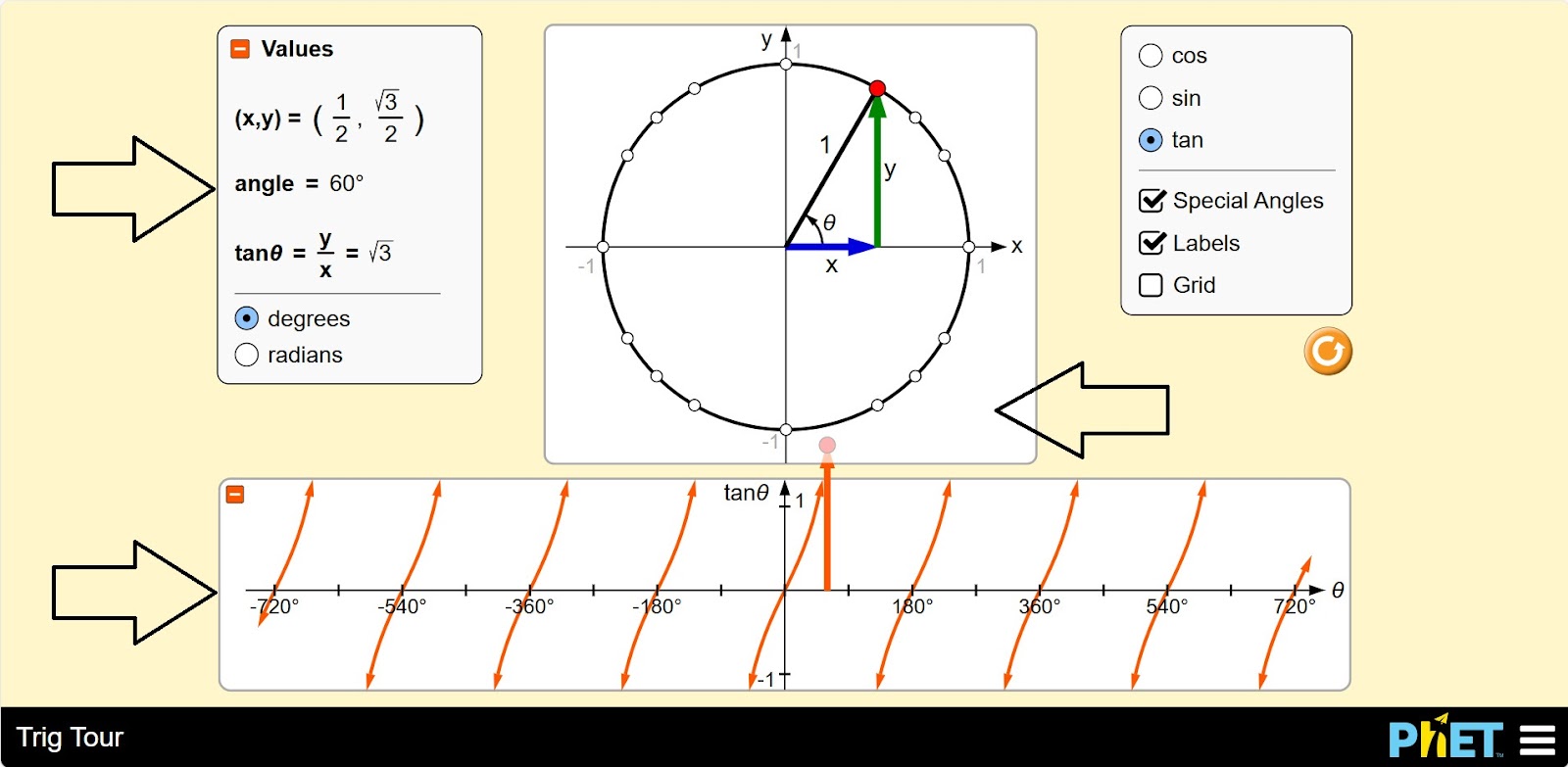
Step 9. Uncheck the special angles and examine the functions.
Conclusion
The student worked in a simulation and studied the graph of a function as a function of angle and the numerical values of the function as the side of a right triangle inscribed in a unit circle. Using the concept of the unit circle, he determined the sign of the trigonometric function ( + , -, 0) for any given angle without a calculator. Using the concept of the unit circle, he estimated the value of trigonometric functions for any given angle without a calculator.