
Lesson 1

Purpose of the work:
- To investigate the manifestation of modificational variability in plants, to learn how to construct a variation series and variation curve, and to draw conclusions about the nature of variability.
Expected results:
After completing the work, students can:
- develop teamwork skills
- be able to analyze and summarize the information received
- draw logical conclusions
Teacher’s Guide:
- The task is performed in groups of 4-5 people
- Before starting laboratory work, please read the safety rules by following the link:
- To download the worksheet, follow the link:
Theory
Variability is the property of living organisms to acquire new traits during life and development. It is the basis of diversity in nature and an important condition for evolution. There are two main types of variability: hereditary (genotypic) and non-hereditary (modificational).
Modificational variability is a change in the traits of an organism under the influence of environmental factors, without affecting the genetic apparatus of the cell. Such changes:
- are not inherited by offspring,
- occur on a mass scale,
- are related to the normal reaction of an organism to environmental conditions.
Examples of modificational variability:
- differences in the growth and mass of plants depending on lighting, watering, and soil composition;
- changes in the coat color of animals depending on temperature;
- differences in human height and weight depending on nutrition and lifestyle.
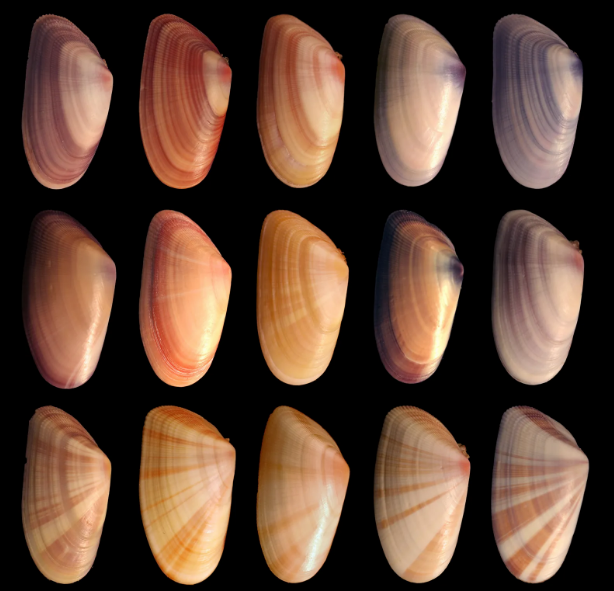
Each trait of an organism has a norm of reaction – the limits within which it can change under the influence of external factors. For example, human height may vary within certain boundaries depending on nutrition and health, but it cannot go beyond the norm.
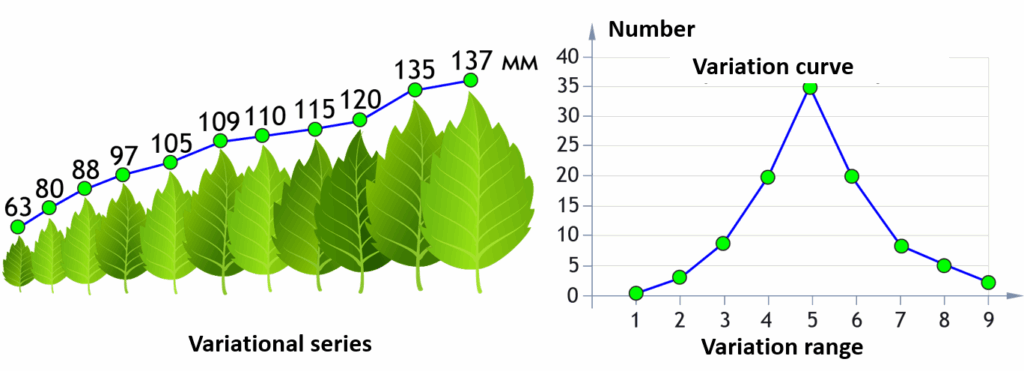
To analyze modificational variability, variation series and variation curves are used.
A variation series is the distribution of trait values (for example, the length of seedlings or the mass of fruits) in ascending or descending order.
A variation curve is a graphical representation of the distribution of a trait. Most often it has the shape of a bell (normal distribution): most values are concentrated in the middle zone, while extreme values occur less frequently.
Thus, by studying variation series and curves, one can identify the patterns of modificational variability and assess the influence of environmental factors on the development of organisms.
Practical part
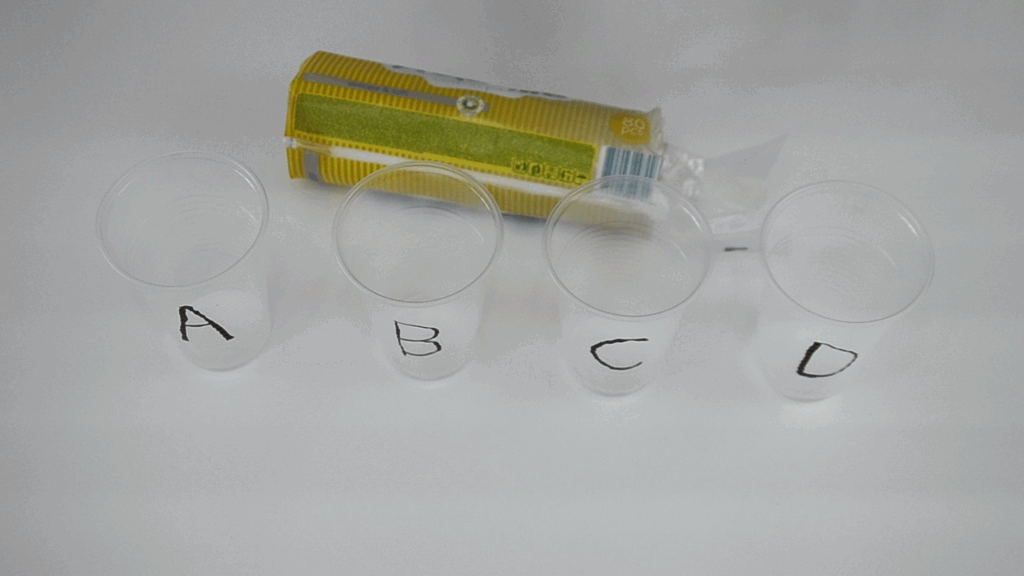
Step 1. In this experiment, we will study how light affects the growth of mung bean seedlings. To do this, we divide the seeds into four groups. Take four disposable cups and label them.
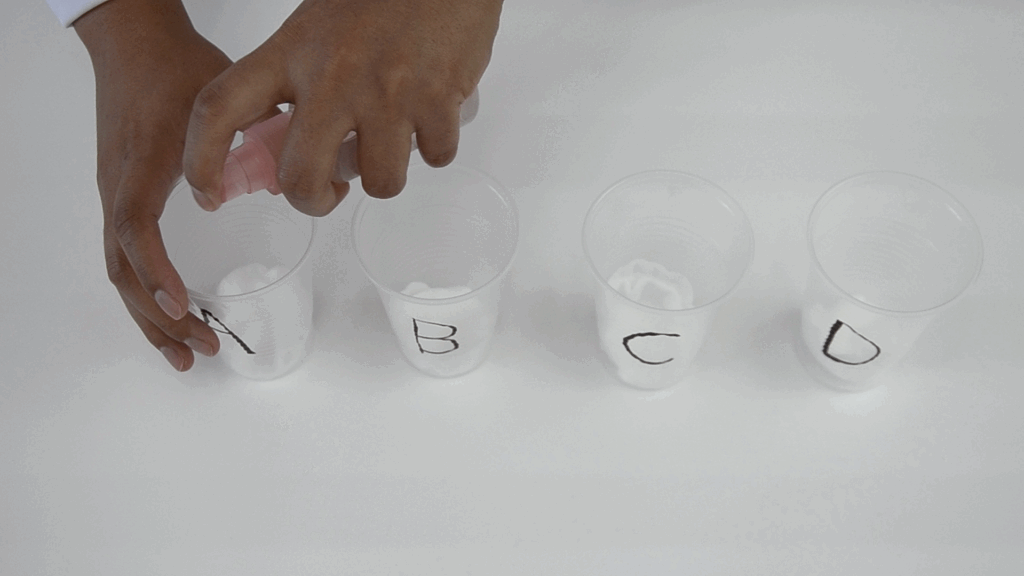
Step 2. Place cotton or cotton pads at the bottom of each cup. Moisten them by spraying with water.
Step 3. Put the mung bean seeds into the cups. About 10 seeds in each cup (or more to collect more data).
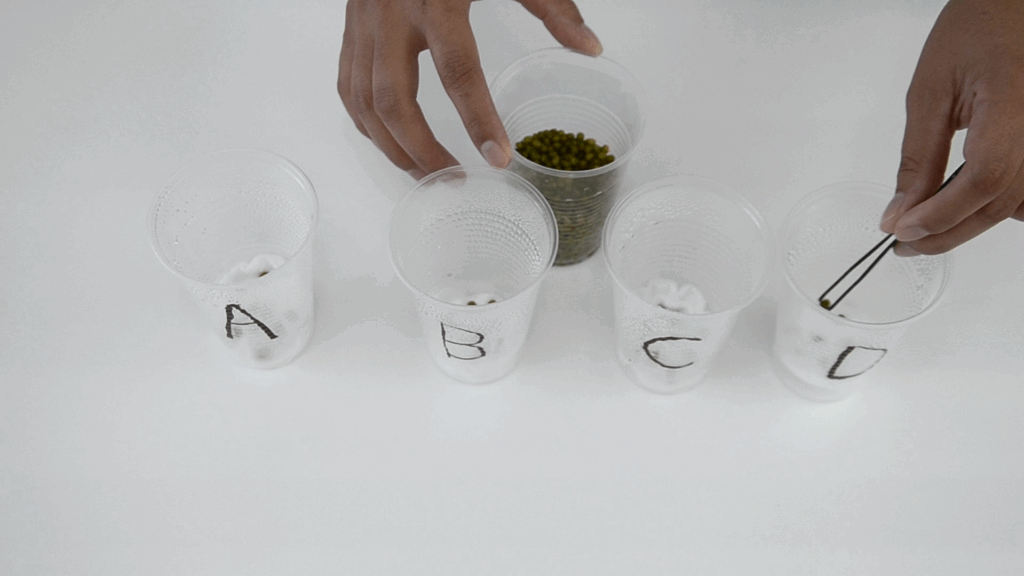
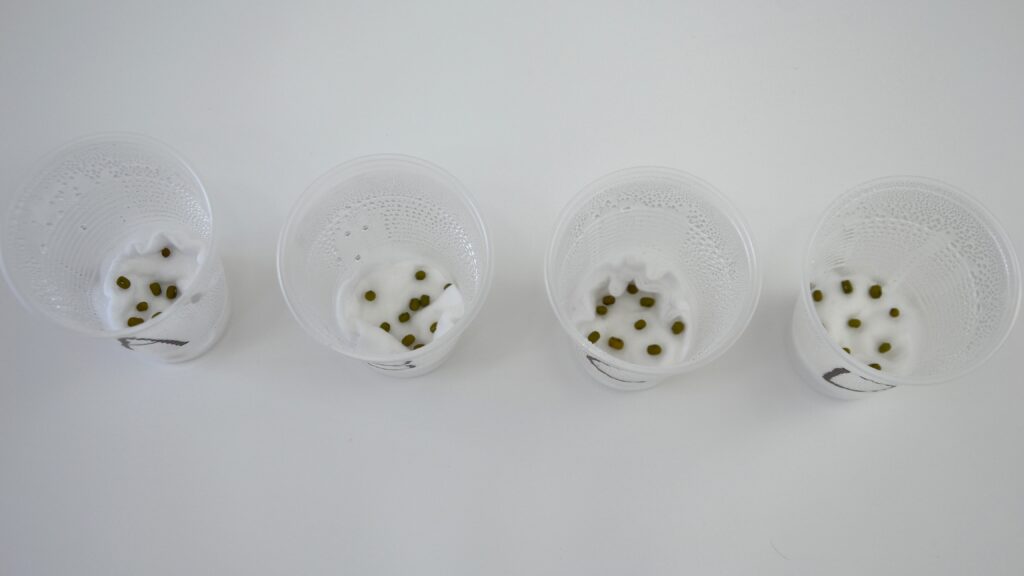
Step 4. Place the cups under different lighting conditions:
- Group A — on the windowsill (natural light).
- Group B — close to a desk lamp (10–15 cm).
- Group C — farther from the lamp (about 30 cm).
- Group D — in complete darkness (for comparison).

Step 5. Observe the seedlings daily and carefully moisten the cotton to prevent it from drying out. The first sprouts will appear after 1–2 days, and after 3–4 days, longer shoots will develop.
Tips:
- For studying modification variability, radish, cress, or alfalfa are also convenient: they germinate quickly, have long seedlings, and are easy to measure with a ruler.
- Soaking the seeds for 6–8 hours before planting speeds up germination.
Each group can be given its own growing condition (for example, light/dark, dry/moist, warm/cool, etc.).