
Lesson

Project Objective:
- To understand the working principle of a motor through hands-on practice.
- To investigate the effect of counterweights and vibrations on movement.
Interdisciplinary Connections
- Physics (electric current, mechanics, forms of energy)
- Technology (fundamentals of robotics)
- Visual Arts (decorating the robot, creating drawings from patterns)
Teacher’s Guide:
Divide students into groups of 4–5.
At the beginning of the lesson, ask several “guiding questions” to spark interest in the project:
- Is it possible to build a robot that can move and draw on its own?
- What types of energy are transformed when the robot operates?
- Will the robot work if you remove the batteries? Why?
Provide a brief safety instruction session before starting the activity.
Theoretical Part
Converting electrical energy into motion is a key process underlying modern technology and robotics. This process begins with the battery and ends with the operation of the motor.
How does a battery work?
A battery is a device that converts chemical energy into electrical energy. It contains two electrodes (anode and cathode) and an electrolyte.
As a result of a chemical reaction:
- Electrons are released at the anode;
- They flow through the external circuit to the cathode;
- The electrolyte enables the movement of ions.
Thus, the battery produces electric current.
Electric Circuit
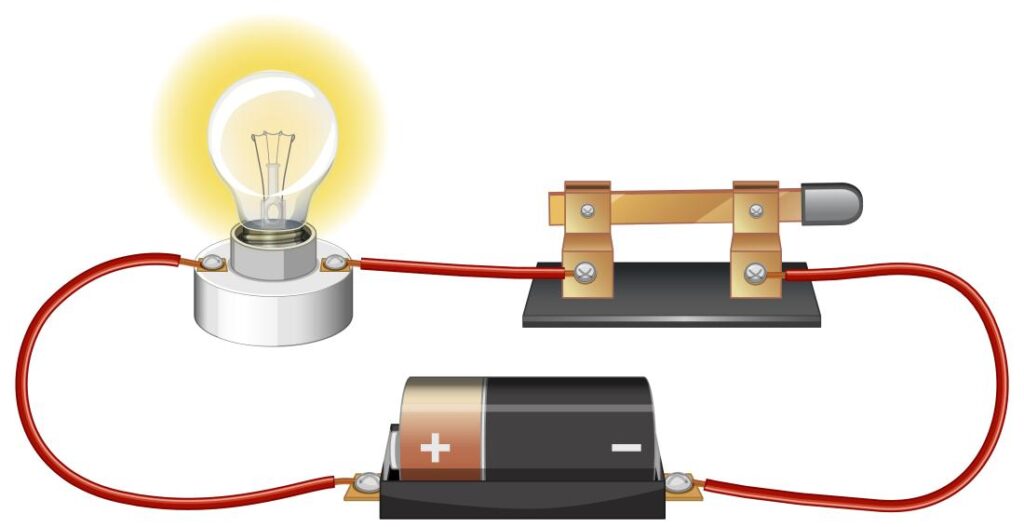
Electrical energy flows only through a closed circuit. If the battery is connected to the motor with wires, the circuit is closed and current flows. If the circuit is broken – the motor stops.
How the Motor Works
An electric motor converts electrical energy into mechanical energy.
- Inside is a coil of wire through which current flows.
- When a current-carrying wire is placed in a magnetic field, a Lorentz force arises.
- This force causes the coil to rotate.
- The rotational motion is transferred to the external shaft.
Effect of Counterweight
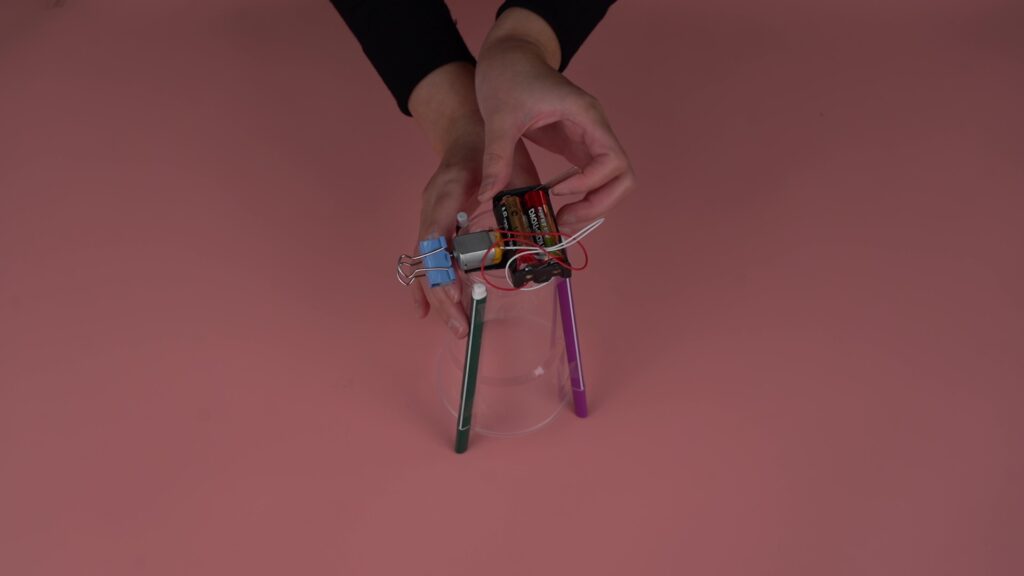
If a small weight is attached off-center to the motor’s shaft, rotation creates imbalance. This imbalance produces vibration.
- Balanced weight → the robot moves steadily.
- Off-center weight → the robot vibrates and moves in different directions.
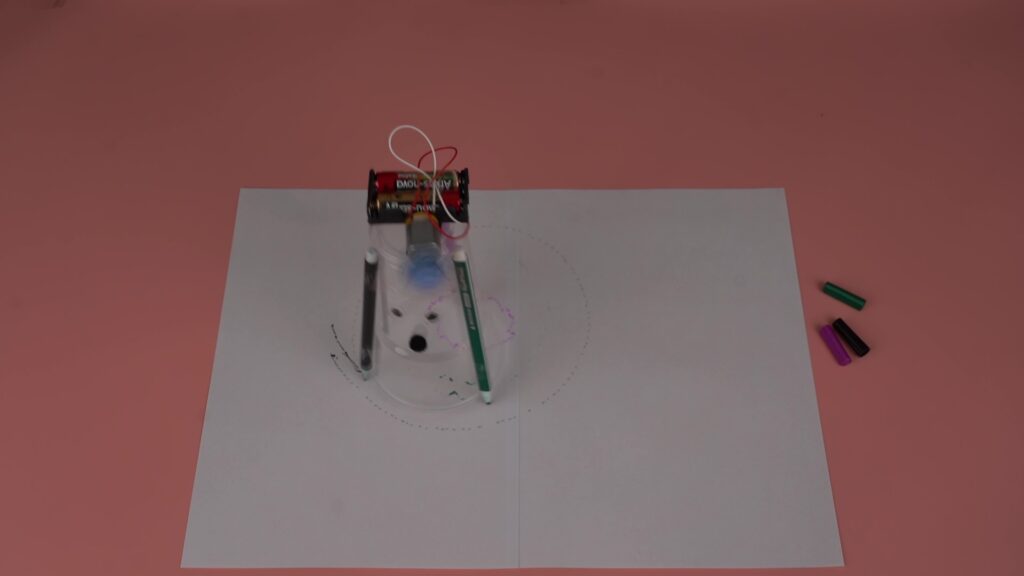
This principle allows the robot to leave colorful marks on paper.
This principle allows the robot to leave colorful marks on paper.
Scientific Conclusion
The battery converts chemical energy into electrical energy.
The electrical energy powers the motor, which converts it into mechanical motion.
Adding a counterweight to the motor’s rotation creates vibration, enabling the robot to move and draw.
Experimental Part
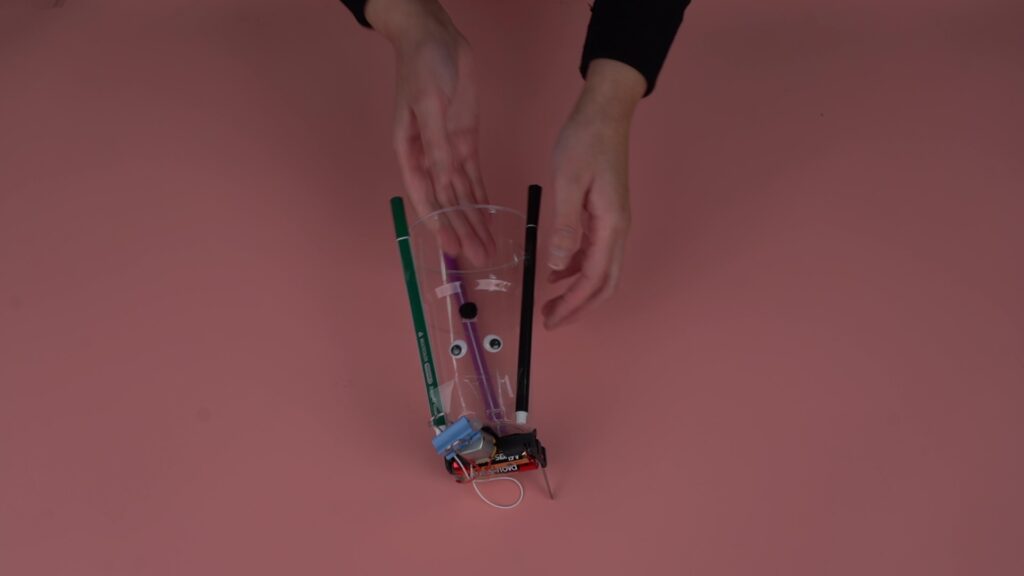
Step 1. Take a plastic cup. Place the markers vertically around it and secure them with tape. These will serve as the robot’s “legs.”

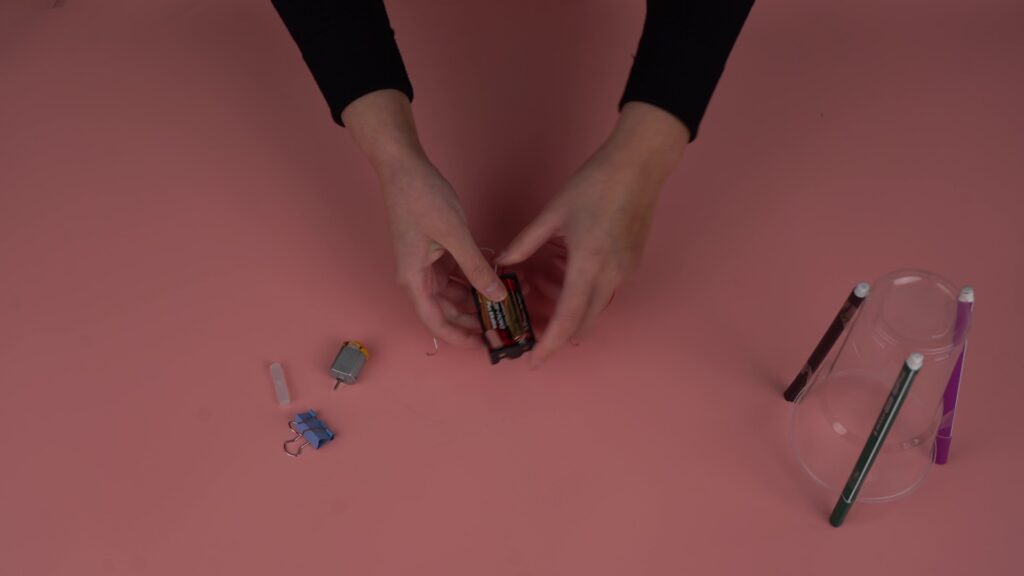
Step 2. Insert the battery into the holder and prepare the wires.
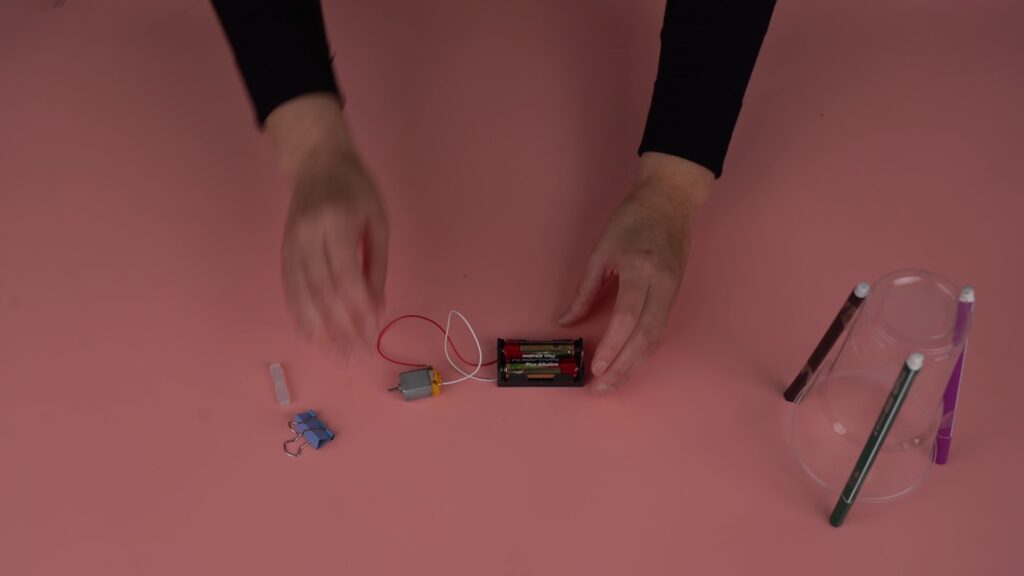
Step 3. Connect the motor and the battery holder with wires.
Step 4. Attach the motor and the battery holder to the top of the cup. Secure the wires with tape so they do not interfere.
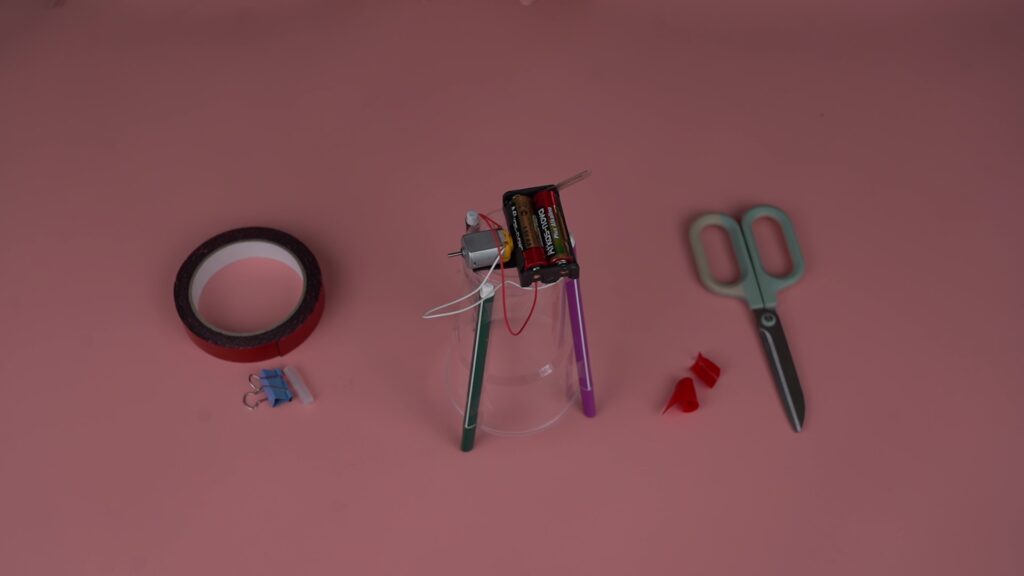
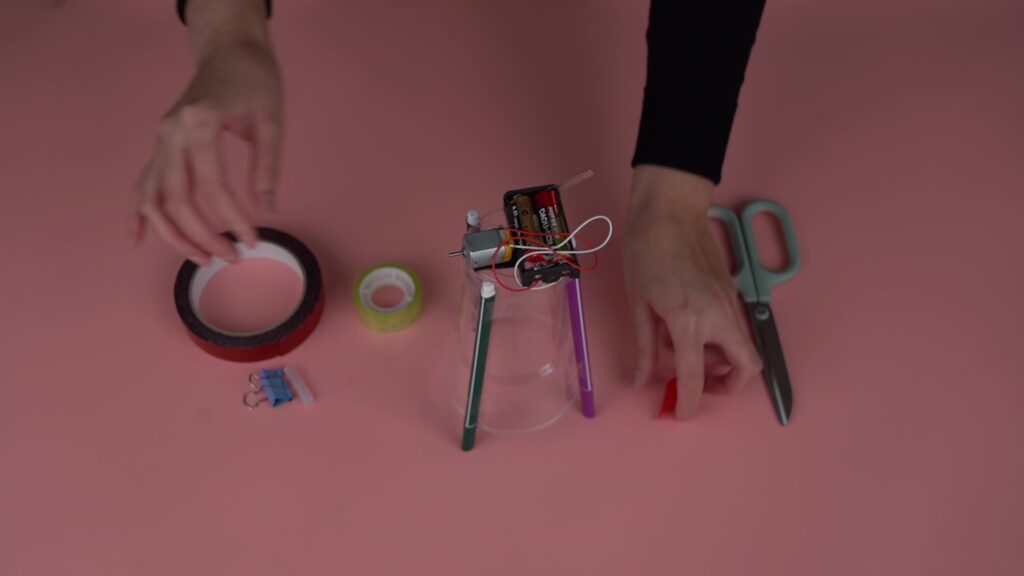
Step 5. Install a counterweight on the motor’s shaft: insert a small piece of glue stick and attach a paper clip. This creates imbalance and vibration.
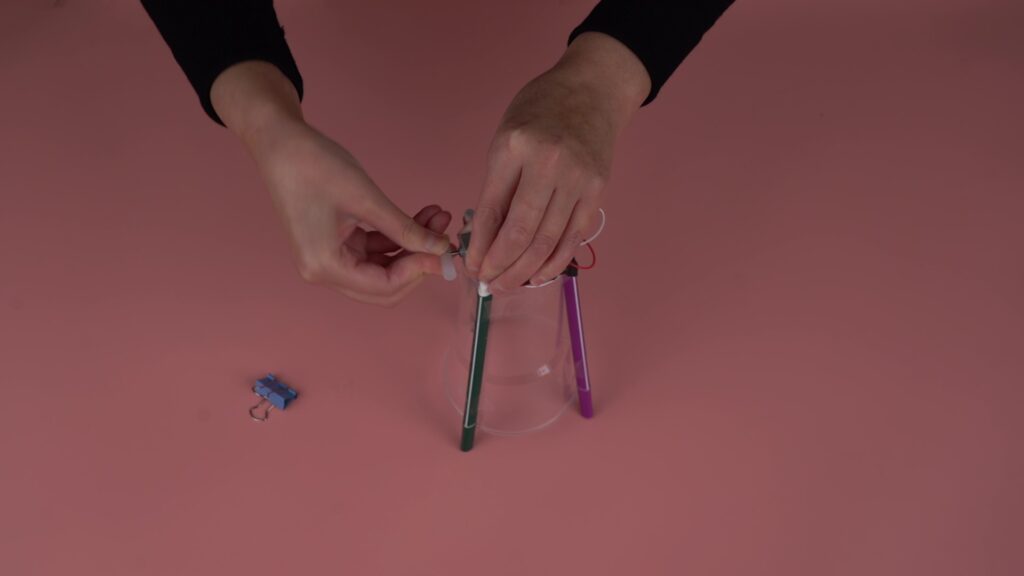
Step 6. If desired, decorate the robot with googly eyes and a nose.
Project Presentation
Students present their completed robots. Place the robot on a white sheet of paper and turn on the battery pack. The Art Bot will move around and leave colorful lines!
Conclusion
Through this project, students learned how to build a simple robot using electricity and a motor. The Scribble Bot combined scientific experimentation with creativity, providing students with an engaging and enjoyable experience.
Assessment
PBL Assessment Criteria:
Problem-Based Learning is an instructional method where students acquire knowledge and skills by working on a project and addressing real, engaging, and complex questions or challenges.
To assess the project, provide students with this resource (PBL rubrics – link):
- students understand the evaluation criteria in advance,
- students can fairly assess the work of their peers.