
Lesson 1
1. Topic of laboratory work: The structure of the organ of vision. The value of vision. Visual impairment. Hygiene of the visual organ.
2. The purpose of the work: to investigate the features of visual perception and describe the rules of visual hygiene
3. Subject, quarter, class:
8 grade
3 term
8.1.7.1 investigate the features of visual perception and describe the rules of visual hygiene
4. Description:
The structure of the eye is a phenomenal and complex process. The eye consists of several key parts, each of which plays an important role in the transmission and perception of light. The cornea, located in the front of the eye, protects it and collects light rays. The iris regulates the amount of incident light, and the lens focuses the image on the retina, where light is converted into nerve signals.
However, in order to maintain eye health, it is necessary to observe visual hygiene. It is important to give your eyes regular breaks when working on the computer or reading to prevent eye muscle tension and dryness. It is recommended to pause every 20-30 minutes and look at distant objects to diversify the focus.
It is also important to pay attention to the lighting when working or reading. Avoid bright or poor lighting to reduce eye strain. Regular ventilation of the premises is also useful to maintain optimal humidity, which can prevent dry eyes.
Visual impairments can occur for various reasons, such as genetics, age, bad habits or improper use of the eyes at work. Common vision problems are nearsightedness, farsightedness and astigmatism. In case of any symptoms or changes in vision, it is important to consult an ophthalmologist for professional advice and diagnosis.
Color blindness, or color blindness, is a feature of vision in which a person has difficulty distinguishing certain colors. This is a genetic disease that is inherited, and it occurs in both men and women, but most often manifests itself in males. A person suffering from color blindness has problems identifying red, green or blue colors. For example, for such a person, red may look green or brown. Color blindness is not a serious disease, but it can have an impact on everyday life. At school, children with color blindness may have difficulty performing tasks related to colors, for example, in studying maps or diagrams, where it is necessary to distinguish between different shades. However, modern technologies and special assistants, such as color filters or computer programs, make it possible to cope with these difficulties and provide full-fledged education for children with color blindness. In addition, it is important to support and understand children with color blindness, creating a barrier-free environment in which they can feel comfortable and develop successfully.
To maintain eye health, proper nutrition rich in antioxidants and vitamins such as vitamin A, C and E. is recommended. Contact lens wearers should follow hygiene rules and regularly monitor the condition of the lenses and eyes.
Vision is one of the most valuable senses, so it is worth paying due attention to its care and maintenance. By observing eye hygiene and receiving regular checks from an ophthalmologist, you can reduce the risk of visual impairment and maintain his health at a high level.
5. List of necessary equipment
A picture for the blind spot test
A Picture for astigmatism test
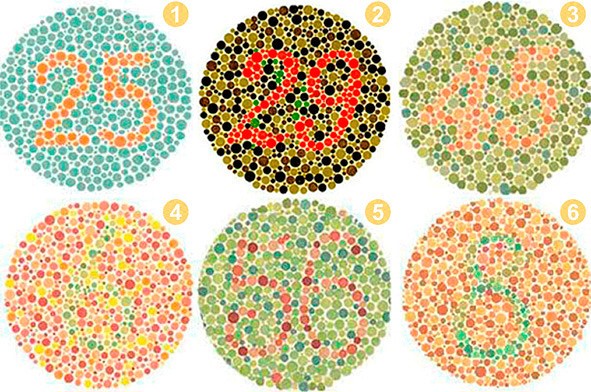
A picture for a color blindness test


6. Practical part
1) First, look at the drawing to determine the blind spot. Arrange the drawing with two crosses so that the cross in the circle is on the right at a distance of 30-40 cm from the eyes. Close your right eye and look at the cross in the circle. The left cross will disappear.
2) Turn the leaf 180 degrees and repeat this action for the second eye
3) Take a picture for astigmatism and look at it (Don’t forget to take off your glasses if you wear them). If the lines merge or bend, then you have astigmatism, if the picture does not change, then you are healthy.
4) Look at the picture with 6 colored circles. Try to identify the numbers written inside the circles. If you can identify at least 5 of the 6 digits, then you see all three primary colors. If you have difficulties, then your eye does not perceive either red, blue, or green colors. There’s nothing wrong with that.
5) Write the output of the work.
7. Teacher’s Guide
• Tasks are performed in groups of 2-3 people
• The picture for the color blindness test must be in color
8. Requirements for the design of laboratory work:
• Laboratory work must contain items in the following order:
Laboratory work number
Topic name
The purpose of the work
Hypothesis
Brief description of the theoretical part
Equipment
Steps in the correct sequence
Add a photo from experiment #1 (if you can’t insert a photo, you can add a picture)
Give a brief description
Add a photo from experiment #2 (if you can’t insert a photo, you can add a picture)
Give a brief description
Write a brief discussion and explanation of the topic covered
Write the conclusion of the work
• The workplace must be cleaned and put in order