
Week 1
Goal:
- The study of household chemistry.
- The study of the influence of household chemicals on a person.
- Study of the impact of household chemicals on the environment.
Expected results
After studying the project, students:
- acquire the skill of cooperation with a teacher and work in a group, in pairs
- analyze and summarize the information received
- a responsible attitude to the teaching will be formed
- communicative competence will be formed in the process of educational activity
- independently logically reason and draw a conclusion
- make sure that not all household chemicals are useful
- Making washing powder and liquid for washing dishes with your own hands
- understanding of the value of ecologically clean substances and the desire to use useful substances.
During the project you will learn:
- you will learn how to analyze the composition of household chemicals;
- assessing the impact of household chemicals on humans and the environment;
- manual preparation of washing powder and dishwashing liquid.
Subject:
- Chemistry (chemical experiments with household chemical appliances)
- Physics (viscosity and corrosivity of household chemicals)
- Biology (the effect of household chemicals on people)
- Artistic work (making homemade cleaning products)
Teacher’s Guide
- To evaluate the project, in the first week, provide this material (PBLrubrics) to students in order to:
- — the students previously understood by what criteria they needed to prepare,
- — the students were able to independently give an appropriate assessment to their colleagues.
- At the beginning of the lesson, it is recommended:
- — to encourage interest in the project, ask a few «leading questions», such as:
- – What applies to household chemicals?
- – What are the benefits of household chemicals?
- – What are their bad sides?
- – How often do you use them?
3. Divide into groups.
Theoretical part
Chemistry is one of the most important parts of natural science. We want to consider a separate part of the chemical industry, which is found in every home – household chemicals. The relevance of the chosen topic lies in the fact that the use of household chemicals is very convenient, fast, practical and gives excellent results. In everyday life, we widely use various chemicals that make housework much easier. But they harm us in some way.
Household chemicals help to keep the house clean. However, keeping clean with household chemicals, we underestimate the harm that it does to our health. Most detergents contain polyphosphates, which are dangerous not only for health, but also for the environment. Surfactants, chlorine, carbon dioxide, nitrogen oxides, phenol, formaldehyde, acetone, ammonia, enzymes, bleaches, abrasives, fragrances – this is a list of household chemicals that are used everywhere. (laundry, clothes cleaners, home textiles, various types and perfumes (air fresheners, scented candles and other types of fragrances that are now fashionable)). All these components are biologically aggressive. Environmental pollution with such chemicals contributes to the development of diseases such as dermatitis, allergies, and bronchial asthma.
In addition, another danger of household chemicals is that its excessive use weakens and even destroys beneficial microflora. According to the hypothesis, one of the reasons for the rapid spread of allergies among the inhabitants of the planet is the excessive sterility of our modern habitat, which leads to a disruption in the normal formation of the human immune system.
Only 3% are interested in the composition of household chemicals, try to choose hypoallergenic things, preferably gels, not powders.
46% believe that household chemicals can be harmful to health, in the form of allergies, coughs, dermatitis, but they do not consider alternative methods of cleaning, as they believe it saves their time.
51% did not even think about this issue, they trusted advertising and manufacturers.

The main additives contained in dishwashing liquid:
| Name | Description |
| Surfactants | As detergents, surfactants are used that form foam. However, abundant foam does not guarantee high-quality washing of contaminants and the safety of the washed surface. Chemical compounds resulting in a decrease in surface tension when concentrated at the phase interface. |
| glycerine | Colorless, viscous, hygroscopic liquid, soluble in water. It dissolves many substances well. Softens the negative impact of other components on the skin of the hands. |
| Salt (NaCl) | Sodium chloride is most commonly used to thicken dishwashing detergents. |
| Dyes | Dyes are introduced to achieve harmony with the appearance, packaging and aroma of the product, to mask unwanted shades, to attract and facilitate consumer choice. Dyes approved for use in cosmetic products are divided into three subgroups. In accordance with this, toxicological requirements also differ. |
| Flavors (Perfumes) | Additives used to mask and improve product odor. Many things can be hidden under this inscription, and manufacturers are not required to disclose their full composition. Many of them can cause attacks of irritants, allergens, migraines, asthma, and, according to scientists, cause endocrine diseases. |
| Water (hydrogen oxide) | Chemical substance in the form of a transparent liquid without color, odor and taste (in the normal state). Water is used in industry as a solvent.A large amount causes heaviness in the heart, kidneys and liver. |
| Antibacterial component | Special additives that prevent the development of various microorganisms and ensure hygienic cleanliness. In high concentrations, it destroys not only harmful bacteria, but also beneficial microorganisms. |
| complexing agent | Needed to soften water. Complexing agents (sodium polyphosphates, sodium citrate, nitrilotriacetate, zeolites, polycarboxylates). |
| Ethylenediaminetetraacetic acid (EDTA) | May enhance the penetration into the skin layers of some dangerous substances contained in the product. This mixture is a complexing agent that binds metal ions and creates a lot of foam, although a small amount of it does not mean that your dishes will be less clean. |
| Phosphate additives | Leads to a significant increase in the toxic properties of surfactants. They penetrate the microtubules of the skin, are absorbed into the bloodstream and distributed throughout the body. This leads to a change in the physicochemical properties of the blood and impaired immunity. |
The washing ability also depends on the value of the hydrogen ion activity indicator (pH). This indicator characterizes whether the agent is neutral or has an alkaline or acid reaction. Accordingly, pH is an important indicator of safety, since when washing dishes by hand, the product directly affects the skin of the hands. According to state standard, for products that have contact with the skin of the hands when used, the pH value should be in the range from 4.0 to 11.5. However, for products that are used frequently, especially when washing a large amount of dishes, a pH close to the neutral value of 6.0 – 7.0 is optimal.
The influence of detergents on biological objects
Used solutions of detergents after disposal end up in the soil, water bodies, where they are included in the circulation of ecosystem substances. Detergents, even after thorough rinsing of dishes, enter the human gastrointestinal tract and affect the intestinal microflora. If dishwashing liquid from clean, unwashed dishes enters the human body, then the protective shell around the walls of the stomach becomes thinner. The result is a stomach ulcer. The most dangerous surfactants are anionic (A-surfactants). They cause immune disorders, allergies, damage to the brain, liver, kidneys, lungs. Keep in mind that when using detergents, the surfactant enters your body, since even ten rinses in hot water do not completely free the dishes from chemicals. To reduce the harmful effects, use products in which the content of surfactants does not exceed 5%.
Sources:
- Правильный подход в выборе бытовой химии – Бытовая химия в нашем доме и альтернативные способы уборки – Кружок юных натуралистов г. Кемерово – Фауна (unnat42.ru)
- Анализ жидких средств для мытья посуды. | Образовательная социальная сеть (nsportal.ru)
- ИЗУЧЕНИЕ СОСТАВА И СВОЙСТВ ЖИДКИХ СРЕДСТВ ДЛЯ МЫТЬЯ ПОСУДЫ (school-science.ru)
Practical part
In the practical part, we will test the quality of dishwashing liquids and washing powders by conducting various experiments and seeing how they affect the environment.
The first week we experiment with dishwashing liquids. 4 types of liquid are involved in the experiments. These are: Drop, Myth, Effect, Fairy. You may substitute other fluids at your discretion.
Experiment №1. Study of the effect of solutions contained in dishwashing detergents on the skin
Step 1. Check out all the required materials.
- chicken skin
- plastic sauce bowl – 5 pcs
- капля
- миф
- effects
- Fairy
- water
- A4 paper -1 pc
Step 2. Divide the chicken skin into 5 pieces 3 * 2 cm in size.
Step 3. Mix each dishwashing liquid in a plastic sauce bowl with 15 ml of water. And pour clean water into the fifth gravy boat. This is necessary for comparison with other liquids.
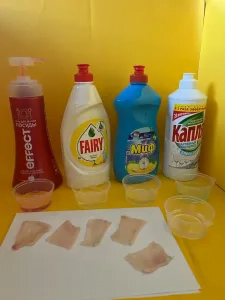
Step 4. Put chicken skins in these plastic sauce bowls.
Step 5. Leave for 1 hour.
Step 6. After 1 hour, we take out the chicken skins and put them on a white sheet.
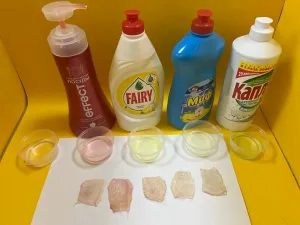
Step 7. At the end of the practice, draw conclusions and answer the questions:
- How did the colors of chicken skins change from the first species?
- How has the thickness of chicken skin changed from the first species?
- Look at the various changes in chicken skin and draw conclusions about how it affects human skin.
Experiment №2. Viscosity determination.
(This test shows how quickly dishwashing liquid is washed off when washing dishes. A high viscosity is not a good indicator for human health, as manufacturers use sodium chloride to increase the density in cleaning products, which, in turn, can cause skin cancer .)
Step 1. Check out all the required materials.
- plastic sauce bowl – 4 pcs
- капля
- миф
- effects
- Fairy
- stopwatch
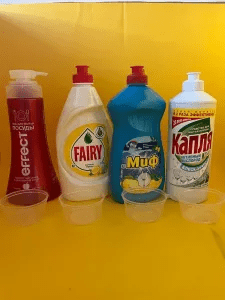
Step 2. Pour dishwashing liquid on top of the plastic sauce bowl.
Step 3. Repeat this process for each dishwashing liquid.
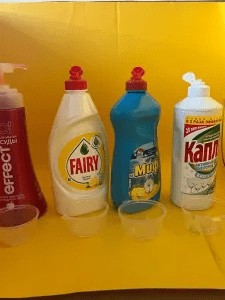
Step 4 Using a stopwatch, calculate how long it takes the liquid to completely drain and reach the bottom of the container.
Step 5. Record the calculated time in the table below.
| Name | Time |
| Капля | |
| Effect | |
| Миф | |
| Fairy |
Step 6. At the end of the practice, draw conclusions and answer the questions:
- Why does each liquid flow at a different speed?
- What harm can high viscosity cause to a person?
Experiment №3. Determination of the pH of dishwashing liquids
(The most suitable pH for hand skin = 7)
Step 1. Check out all the required materials.
- plastic sauce bowl – 4 pcs
- Капля
- Миф
- effects
- Fairy
- water
- universal indicator paper for pH determination
- pH reference scale
- paper A4-1 pc
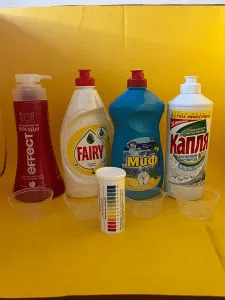
Step 2. Pour a drop of dishwashing solution into each plastic sauce bowl.
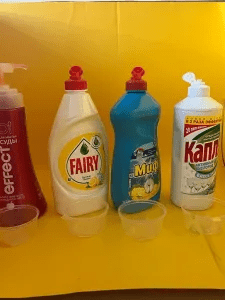
Step 3. Pour the same amount of water into plastic sauce bowls.
Step 4. Place the indicators in theplastic sauce bowl for a few seconds and check the pH.
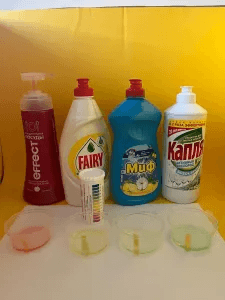
Step 5. Place the indicator papers on top of the white paper and calculate the PH using the pH reference scale.
Step 6. Fill in the pH result of each liquid in the table below.
| Name | РН | environment(alkaline, neutral, acidic) |
| Капля | ||
| Effect | ||
| Миф | ||
| Fairy |
Step 7. At the end of the practice, draw conclusions and answer the questions:
- Look at the pH result and determine which environment each dishwashing liquid belongs to (alkaline, neutral or acidic)?
- What did you learn by comparing the pH scales of liquids?
- Of these liquids, which harmful effect on a person is lower, and which is higher?
Experiment №4. Influence of dishwashing liquid on the processes of corrosion of iron substances.
Step 1. Check out all the required materials.
- test tube – 4 pcs
- Капля
- Миф
- effects
- Fairy
- water
- nail – 4 pcs
Step 2. Pour the same amount of water into the test tubes.
Step 3. From above, drip 2-3 drops of dishwashing liquid and mix.
Step 4 Place the nails one by one into the test tubes.
Step 5. Leave tubes with nails for 2 weeks.
Step 6. At the end of the practice, draw conclusions and answer the questions:
- How did the liquid affect the nails?
- What conclusions can be drawn by looking at the effect of the liquid?
- Is it safe to wash metal utensils with dishwashing detergent?