
Week 2
What ingredients in laundry detergent are harmful? What should be avoided?
According to the degree of harmfulness reduction, the components included in the powders can be distributed in the following order:
- phosphates;
- chlorine;
- sulfates;
- silicates;
- ammonia;
- boron;
- strictly limited amount of anionic surfactants – no more than 2%;
- nonionic surfactants of one type – no more than 3%;
- salts of toxic acids – no more than 1%;
- cationic surfactants – no more than 2%;
- synthetic flavors – no more than 0.01% or ideally odorless;
- dust – 0.5%;
A separate line in this list are flavors used in powders. Among which are alpha-isomethyl ionone, limonene, hydroxycitronellal, butylphenyl methylpropional, which are !!!prohibited components!!! and are able to act at the genetic level and lead to various kinds of mutations. Also in the list of flavorings: citronellol (smell of roses), linalool (smell of lily of the valley), coumarin (freshly cut hay), hexyl cinnamal – chamomile, which are allergens of various classes (from low to high), so the use of washing powders containing these components by people, prone to allergies, should be careful.
Practical part
In the practical part, we will check the quality of dishwashing liquids and washing powders by conducting various experiments and making sure how they affect the environment.
The second week we conduct experiments on washing powders. Five types of powder are involved in the experiments. These are: Tide, Ariel, Sarma, Миф, Чайка. You can substitute other powders at your discretion.
Divide into groups.
Experiment №1. Fill in the table “chemical composition of washing powder” below.
| Composition | Ariel | Tide | Миф | Sarma | Чайка |
| Anionic surfactants | |||||
| Surfactants nonionic | |||||
| sulfates | |||||
| Phosphates | |||||
| Phosphonates | |||||
| Carbonates (soda ash) | |||||
| silicates | |||||
| Polycarboxylates | |||||
| Zeolites | |||||
| soap | |||||
| Enzymes | |||||
| Oxygenated bleach | |||||
| Optical brightener | |||||
| Defoamers | |||||
| Antiresorbents | |||||
| Flavoring additives and fragrances | |||||
| benzyl salicylate | |||||
| Hexyl Cinnamic aldehyde | |||||
| Linalool |
Experiment №2. Perfume fragrances measurement
(“Fragrances” – this component of the powder, at least, has no use. Often the manufacturer does not openly tell what is hidden behind this word. These can be substances such as hexyl cinnamal or butylphenyl methylpropional, which are allergens. Therefore, the aroma can be dangerous middle element.)
Step 1. Check out all the required materials.
- Миф
- Чайка
- Ariel
- Tide
- Sarma
- water
- plastic spoon – 1 pc
- plastic glass – 5 pcs
Step 2. Pour the same amount of water into each container.
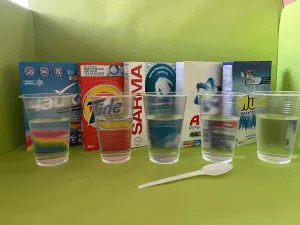
Step 3. Add 2 tablespoons of laundry detergent to each glass and stir.
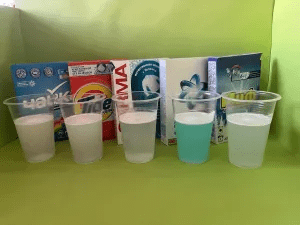
Step 4. Assess the smell of the fragrance.
Step 5. Leave for 10 minutes.
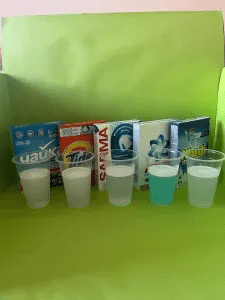
Step 6. Evaluate the smell of the fragrance again.
Step 7. Make a table of the results.
| Powder name | Odor specificity | Odor specificity after 10 minutes |
| Ariel | ||
| Tide | ||
| Миф | ||
| Sarma | ||
| Чайка |
Step 8. At the end of the practice, draw conclusions and answer the questions:
- What do you think determines the strong and weak smell?
- What do you think determines the change in smell of some powders after 10 minutes?
Experiment №3. Determination of the pH of washing powder
Step 1. Check out all the required materials.
- Water mixed with washing powder in a glass prepared in experiment №2
- universal indicator paper for pH determination
- A4 paper – 1 pc
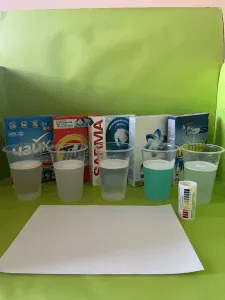
Step 2. Place the universal water pH indicator paper in the glass prepared in experiment №2 for a few seconds.
Step 3. Remove the indicator papers from the water and place them on the A4 sheet.
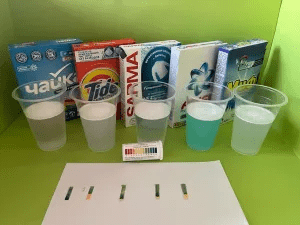
Step 4. Calculate PH using the pH indicator scale.
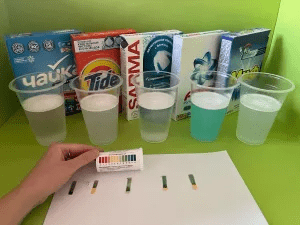
Step 5. From the results, write a table.
| Powder name | РН results | environment(alkaline, neutral, acidic) |
| Ariel | ||
| Tide | ||
| Миф | ||
| Sarma | ||
| Чайка |
Step 6. At the end of the practice, draw conclusions and answer the questions:
- Look at the pH result and determine which environment each laundry detergent is in (alkaline, neutral or acidic)?
- What did you learn by comparing the pH scales of the powders?
- Of these powders, which harmful effect on humans is lower and which is higher?
Experiment №4. Checking for the presence or absence of phosphate in washing powder
The acid residue of phosphoric acid – phosphate – Ion (PO43-) – is contained in the sodium phosphate molecule (Na3PO4). To conduct a qualitative reaction for the determination of phosphate ions in solution, a small amount of silver nitrate is added to sodium phosphate. As a result of the reaction, a light yellow suspension of silver phosphate is formed:
Na3PO4 + 3AgNO3= Ag3PO4 ↓+3 NaNO3
Step 1. Check out all the required materials.
- Water mixed with washing powder in a glass prepared in experiment #2
- silver nitrate
- plastic sauce bowl – 5 pcs
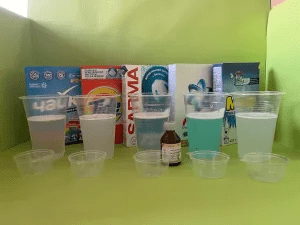
Step 2. Pour the same amount of water from the glass that you prepared in experiment №2 into the plastic sauce bowls.
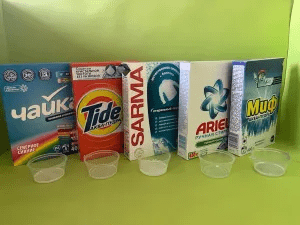
Step 3. Drop 2 drops of silver nitrate into the water in each plastic sauce bowl and watch the process.
If, after instillation of silver nitrate, the water turns yellow, then it contains phosphate.
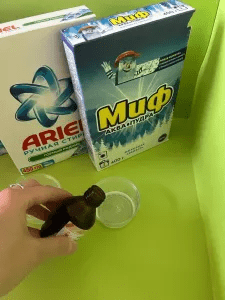
Step 4. Repeat this process for each powder.
Step 5. At the end of the practice, draw conclusions and answer the questions:
- Which powder contains phosphate?
- What harm does phosphate do to the environment?
- What effect does phosphate have on human health?
- How harmful is hand washing with phosphate detergent?
Experiment №5. Determining the quality of washing powder
Step 1. Check out all the required materials
- Water mixed with washing powder in a glass prepared in experiment №2
- green mortar
- plastic sauce bowl – 5 pcs
Step 2. Pour the same amount of water from the glass that you prepared in experiment №2 into the plastic sauce bowls.
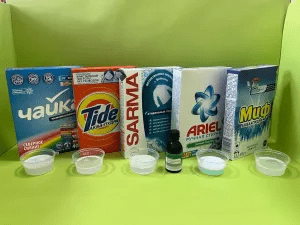
Step 3. Put 2 drops of the green mortar into the water in each plastic sauce bowl and watch the process.
If the washing powder is of high quality, then the solution should discolor. And if it turns green and remains in the same color, then the quality of the powder is poor.
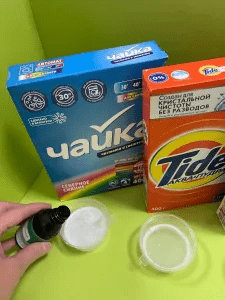
Step 4. Repeat this process for each powder.
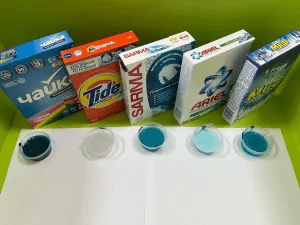
Step 5. At the end of the practice, draw conclusions and answer the questions:
- Which powder changed color under the action of a green mortar?
- What determines the color change of the powder?
Experiment №6. Handmade washing powder.
Step 1. Check out all the required materials
- laundry soap – 75 g
- baking soda 125 g
- soda ash – 100 g
- grater
- container
Step 2. Grate laundry soap.
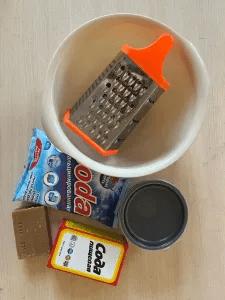
Step 3. Mix baking soda and soda ash in soap.
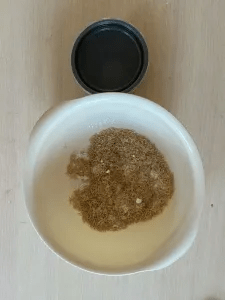
Step 4. We put the finished mixture in a container.
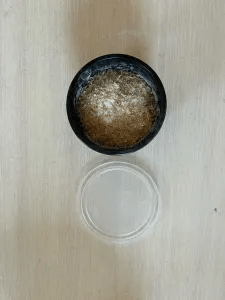
Instructions for use:
Before washing, dilute the powder in hot water and pour into the drum.
Powder consumption – 2-3 tbsp. l. for the machine automatic (fill in the drum) and 1 tbsp. l. for hand washing.
To wash woolen and silk fabrics, soda ash must be removed from the recipe and the amount of alkali reduced, by adding citric acid, you can add about 60 grams.
For synthetic fabrics, soda ash must also be removed.