Lesson 3
Alternative energy sources
Hydrogen energy — a developing branch of energy, the direction of the generation and consumption of energy by mankind, based on the use of hydrogen as a means for the accumulation, transportation and consumption of energy by people, transport infrastructure and various production areas. Hydrogen is chosen as the most common element on the earth’s surface and in space, the heat of combustion of hydrogen is the highest, and the product of combustion in oxygen is water (which is re-introduced into the circulation of hydrogen energy). There are many ways to produce hydrogen.
Hydrogen fuel is an eco–friendly alternative to gasoline and diesel, since the main by-product of its use is water. In addition, hydrogen has a much lower consumption than gasoline – only 0.6 kg per 100 km. A hydrogen refueling station consists of a hydrogen storage system, cooling, compression and dispensing devices. The project partner is the world–renowned French company Air Liquide, which has mastered the entire supply chain of hydrogen over the past 50 years: from production to storage, distribution and application development for end users. To date, the company has designed and installed more than 120 hydrogen filling stations around the world.
Currently, KMG is updating its development strategy for 2022-2031 and has approved a low-carbon Development Program. KMG intends to reduce CO2 emissions by 15% by 2031 from the level of 2019, which is about 1.6 million tons of CO2. It is planned to achieve this goal through improving energy efficiency and energy conservation, the development of renewable and hydrogen energy, the use of carbon capture and storage technologies, and the implementation of forest-climatic projects.
Electrolysis as a method of producing hydrogen.
From the point of view of chemistry, electrolysis is an oxidation—reduction process that occurs on electrodes when a direct electric current passes through an electrolyte solution.
Electrolysis is one of the best ways of gilding or coating metal with copper, gold.
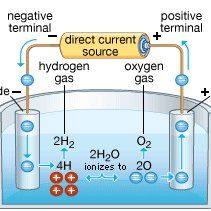
The ordered movement of ions in conducting liquids occurs in an electric field, which is created by electrodes — conductors connected to the poles of an electric energy source. The cathode during electrolysis is called the negative electrode, the anode is called the positive one. Positive ions — cations (metal ions, hydrogen ions, ammonium ions, etc.) — move to the cathode, negative ions — anions (ions of acid residues and hydroxyl group) — move to the anode.
Electrolysis is widely used in modern industry. In particular, electrolysis is one of the methods of industrial production of aluminum, copper, hydrogen, manganese dioxide, hydrogen peroxide. A large number of metals are extracted from ores and processed by electrolysis (electroextraction, electrofining). Electrolysis is also the main process by which a chemical current source functions. Electrolysis finds application in wastewater treatment (processes of electrocoagulation, electroextraction, electroflotation).
It is used to produce many substances (metals, hydrogen, chlorine, etc.), when applying metal coatings (electroplating), reproducing the shape of objects (electroplating).
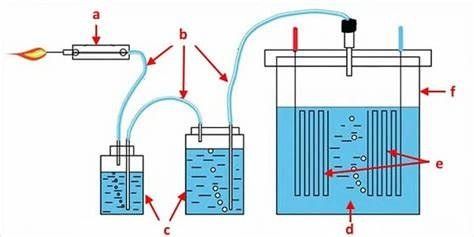
a – burner
b – hydrogen
c – hydraulic lock
d – electrolyte solution
e – electrodes (red-Cathode, black-Anode)
f – electrolytic cell
Sources:
1. HYDROGEN PRODUCTION DURING WASTE-FREE SLAG PROCESSING. Temirkhan A.N. – 2013. – Vol.2, part 2 – pp. 81-82
2. The reverse designation of the sign of the cathode and anode is found in the literature when describing galvanic cells
3. Electrosynthesis // Chemical Encyclopedia
4. https://kapital.kz/economic/99424/kazmunaygaz-zapustit-pervuyu-vodorodnuyu-azs-v-kazakhstane.html
Presentation discussion of projects
This week, students should present their finished project on the following points:
– production of hydrogen from aluminum
– the principle of operation of the hydrogen burner
– production of hydrogen. Electrolyzer
– launch of a hydrogen-fueled rocket
– presentation on the topic: hydrogen fuel & traditional (carbon) fuel: benefit or harm
Assessment
PBL evaluation criteria:
Project based learning (project-based learning) is a learning method in which students acquire knowledge and skills by working on one project for 3 or 4 weeks to research and find an answer to a genuine, interesting and complex question, problem or challenge (follow the link below PBL Rubrics).