Week 3
In this project, we create a solar collector model. In general, we divided the work that needed to be done into 3 weeks. For the third week, we have been creating a collector model by combining cardboard papers and cans.
Step 1. Divide 5 people into groups. Read all the necessary materials.
Step 2. We glue a rectangle 44*19 cm in size with a rectangle 44*19 cm in size with hot glue. Keep in mind: carved circles on two cardboards should not be in the same direction, but in the opposite direction. Because if air enters through the hole in the side, then it comes out through the hole in the sole.
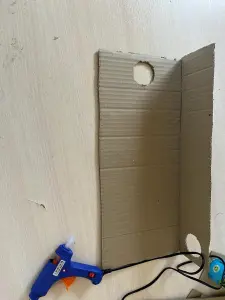
Step 3. We attach the connected cans to cardboard 44*19 cm through hot glue for a segment of 30 cm in the middle.
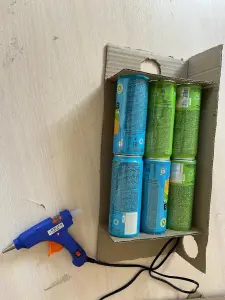
Step 4. We fasten the second side surface 44 * 9 cm in size to the finished collector through hot glue. The holes on the sidewalls should be parallel to each other.
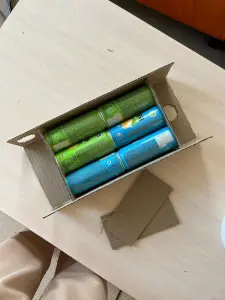
Step 5. We fix two rectangles measuring 18.5*9 cm with hot glue on both sides of the collector.
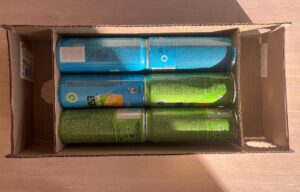
Step 6. We paint the collector with black spray paint.
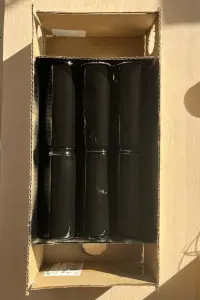
Step 7. Glue the food film to the surface with hot glue.
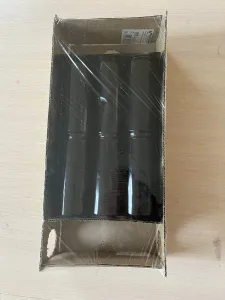
We have completely manufactured the solar collector. Now let’s do the calculation as an experiment. With the help of these calculations, we will make sure how much heat, how much fuel or how much a collector is required for the class / room in which we are.
Experiment №1
Task number 1.
Let’s calculate the volume and mass of air of the class/room in which we are. To do this, you need the height and size of the area of the same room. Where 𝞺=1,22 kg/m3 – air density.
As an example, let’s calculate the volume and mass of air in a house with a ceiling height of 2.5 m and an area of 28 м2.
| Given: | Solution: |
| S=28 м2 h = 2,5 m 𝞺=1,22 kg/m3 Find: m – ? | V=S*h=28*2.5=70 m3 m=𝞺*V=1.22*70=85.4 kg |
Task number 2.
Let’s calculate the amount of heat required to heat the air in the room up to 20°C. Where c = 1005 J/kg*k is the heat capacity of the air (according to your calculations, you will get the value of the outgoing mass)
| Given: | Solution: |
| c=1005 J/kg*k ∆t=20°C m=85.4 kg Find: Q -? | Q=cm∆t Q=1005*85.4*20=1716540 J |
Task number 3.
Calculate the amount of fuel needed to heat this air mass. Where q is the specific heat of combustion of the fuel. (according to your calculations, you will get the amount of heat released)
| Given: | Solution: |
| Q=1716540 J q(gas)= 44 MJ/kg q(wood) = 13 MJ/kg q(coal)= 27 MJ/kg Find: m -? | Q=qm m=Q/q m(wood) =1716540/13000000=0,132 kg m(coal) =1716540/27000000=0,0635 kg m(gas) =1716540/44000000 = 0,039 kg |
Task number 4.
Let’s calculate the amount of heat transferred by one pipe of the solar collector, and how many pieces of collectors are needed to heat one room.
As an example, calculations of the collector for the city of Astana are given.
Given:
The effective absorption area of the solar collector is S=0.092 м2 (per 1 pipe).
The average annual amount of insolation in Astana is Р=1144 kW*h/м2. (for other cities, the amount of insolation is indicated in the table).
Efficiency – from 67% to 80% (for obsolete collectors, actual minimum values will be used, so the results will be slightly underestimated).
Find:Q(collector), N(collector) -?
Solution:
Q(collector)=SР𝞰=0,092*1144*67=70516,16 W*h/ м2.
N(collector)=1716540/70516,16=24,3425≈25 piece collector.
Table. Seasonal values of average daily insolation for the main cities of Kazakhstan
| City | Average amount of solar radiation per day, kW*h/ м2 | Annual amount, kW*h/м2 | |||
| Winter | Spring | Summer | Autumn | ||
| Atyrau | 52 | 124 | 163 | 85 | 1272 |
| Balkhash | 49 | 138 | 172 | 99 | 1372 |
| Kyzylorda | 75 | 152 | 191 | 127 | 1634 |
| Oskemen | 53 | 124 | 145 | 78 | 1198 |
| Aktau | 58 | 125 | 177 | 99 | 1382 |
| Aktobe | 41 | 116 | 153 | 73 | 1147 |
| Almaty | 83 | 132 | 173 | 130 | 1554 |
| Aral | 53 | 125 | 166 | 92 | 1306 |
| Astana | 42 | 121 | 144 | 74 | 1144 |
| Baikonur | 63 | 138 | 179 | 108 | 1464 |
| Zhanaozen | 71 | 126 | 176 | 106 | 1435 |
| Kapchagai | 80 | 144 | 183 | 134 | 1621 |
| Karaganda | 45 | 124 | 149 | 78 | 1186 |
| Kokshetau | 43 | 124 | 149 | 78 | 1186 |
| Kostanay | 39 | 121 | 144 | 67 | 1111 |
| Pavlodar | 44 | 131 | 145 | 72 | 1175 |
| Petropavl | 39 | 122 | 143 | 60 | 1091 |
| Semey | 49 | 121 | 144 | 78 | 1208 |
| Талдыкорган | 79 | 144 | 184 | 128 | 1600 |
| Taraz | 71 | 136 | 201 | 132 | 1621 |
| Turkestan | 76 | 148 | 195 | 132 | 1652 |
| Oral | 42 | 122 | 154 | 65 | 1148 |
| Shymkent | 71 | 137 | 210 | 133 | 1650 |
Conclusion
Energy has become one of the most essential resources for human life. The traditional energy we use is not environmentally friendly and has a high financial cost. Plus, they get depleted. Therefore, the introduction of alternative energy sources will be the solution to these issues. One of them is solar energy. It is the cheapest renewable energy source. According to some studies, in the next 20 years, solar energy from coal and gas energy will come out ahead in terms of volume in many countries.
And in this project we have developed a collector model that converts this solar source into thermal energy and carried out 3 experimental works.
Assessment
PBL evaluation criteria:
Problem based learning (problem-oriented learning) is a learning method in which students acquire knowledge and skills by working on one project for 3 or 4 weeks to research and find an answer to a genuine, interesting and complex question, problem or challenge (then follow the PBL Rubrics link to the Rubrics).