
Lesson 1
Project Objective.
- To calculate expenses and income and distribute the overall budget. Keeping track of your daily expenses.
- Financial literacy. Setting financial goals.
- The game Monopoly.
Teacher’s Guide.
- To evaluate the project, provide this material (PBLrubrics) to students the first week to: (PBLrubrics) – Students understood in advance what criteria they needed to prepare by,
– The students were able to give an appropriate assessment to their peers. - The duration of the project was three weeks.
- In the first part of the project, each student works independently.
- Each student creates a google spreadsheet using the specified templates, to calculate monthly expenses. Then, during the month, they make changes to their spreadsheet. This could be a family budget or a student’s personal budget (their choice).
- Then in the second part of the project, the children develop a game of Monopoly.
- Before beginning the second part, divide the class into teams of 4-5 students.
- Print out all the materials to the teams or students can draw on their own.
- Before the practical part, introduce the rules of the game Monopoly.
Interdisciplinary Communication
– Mathematics
– Computer Science
– Artwork
Theoretical part
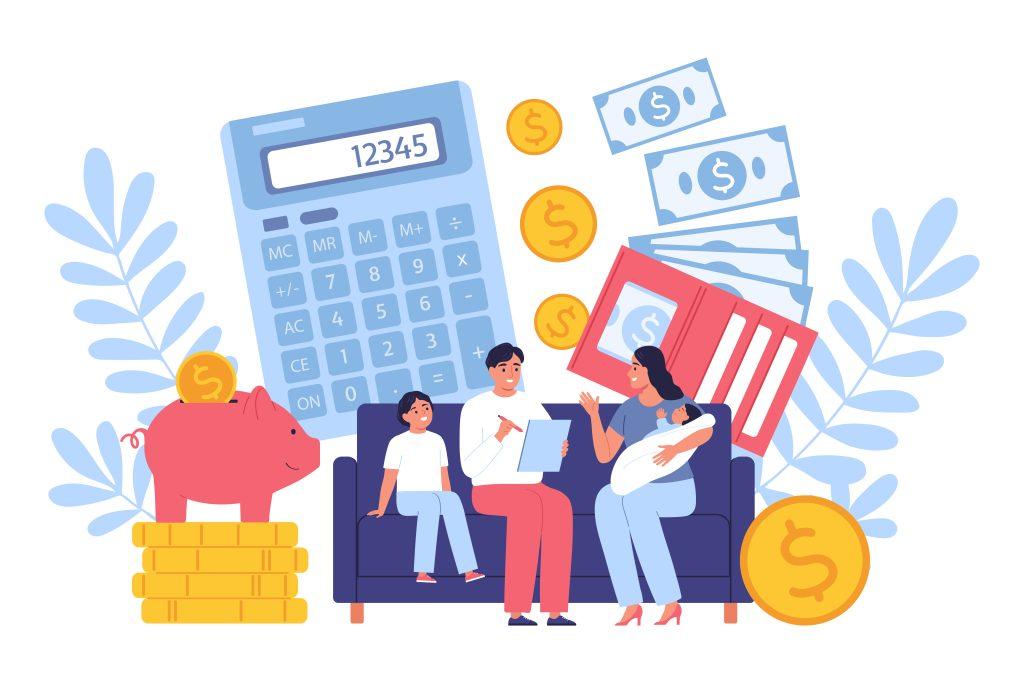
A household budget is the family’s financial plan, which includes the total family income and expenses.
The main task of a budget is the proper distribution of money.
A budget is a useful tool with which we can:
- accurately control our financial situation;
- make informed decisions about expenditures and savings;
- eliminate unnecessary expenditures;
- quickly achieve their financial goals, for example: buy a car;
- an apartment, go on vacation abroad.
- We can not only plan expenses and income for a week, month (or even year), but also visually control the implementation of their plans, make budget forecasts, and much more!
BUDGETING IS NOT A COMPLICATED OPERATION! IT DOES NOT REQUIRE ANY SPECIAL KNOWLEDGE OF ECONOMICS OR MATHEMATICS!
Anyone can learn how to budget at home, you just have to believe in its usefulness and start. In as little as a month, you will see that a budget helps you manage your money more efficiently.


Source:
https://fingramota.kz/ru/post/urok-1-planirovanie-rashodov-i-dohodov-eto-osnova-finansovogo-uspeha
https://ru.freepik.com/search?format=search&query=%D1%81%D0%B5%D0%BC%D0%B5%D0%B9%D0%BD%D1%8B%D0%B9%20%D0%B1%D1%8E%D0%B4%D0%B6%D0%B5%D1%82
Practical part.
Step 1: Calculate expenses and income and distribute your total budget. Tracking your daily expenses.
The first step to budgeting is to keep track of your daily expenses.
It is not hard to remember how much money is spent on fixed expenses, such as rent or car payments, and it may be harder to remember variable expenses. Using the worksheet provided , students write down all expenses incurred over a 30-day period. They then categorize the expenses and calculate their total for the month.
- You determine the expenses incurred during the month.
- You record the date of the loss and how much was spent
- You determine how you want to classify or group your expenses
- You summarize your expenses by sorting them into these groups
It’s not hard to remember how much money is spent on fixed expenses, such as rent for an apartment or car fees, and it can be harder to remember variable expenses.
You can use different kinds of spreadsheets such as Excel, Google spreadsheet, etc. to record, or you can use ready-made templates.
For the Google entry, you can go to the link: https://docs.google.com/spreadsheets/d/1g6bViZlCFg4zWZsEvWk-gsIINkwFjEKs/edit#gid=325264767
Download and save this spreadsheet to your computer by following this link. Or duplicate it on a new GoogleTable. And then you can edit it.
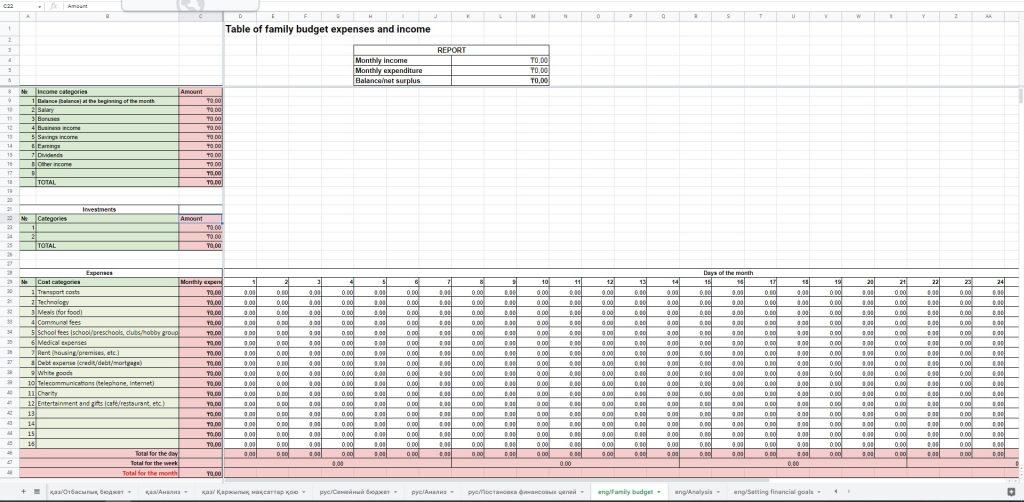
DIRECTIONS TO THE ASSIGNMENT
Record all of your expenses using the 30-day expense tracking worksheet. Complete the worksheet at the end of the month by adding up expenses
Notes:
* Do not write about ATM cash withdrawals. Each time you spend money, write each one down.
– If you have trouble remembering how much you spent, put one envelope with checks.
– If you received an item that did not present a check, write it down on a piece of paper and put it inside the envelope. – On days when there is no loss, write “none” and write down the value 0 (zero).
– If you eat out of school, divide the cost of food for the month by the number of days and record that amount.
* Use the categories at the top of the worksheet to mark your expenses. If there is a different category than them, you can write a category called “Other
– Remember, this exercise forms the basis of your future budget. It is better that your spending is normal because it allows you to control your true spending habits.
Step 2: Setting financial goals
Depending on the length of time, goals can be divided into three categories:
* Short-term-goals that can be achieved in less than a year
* Intermediate period-goals that can be achieved within one to five years
* Long-term-goals that take more than five years to achieve
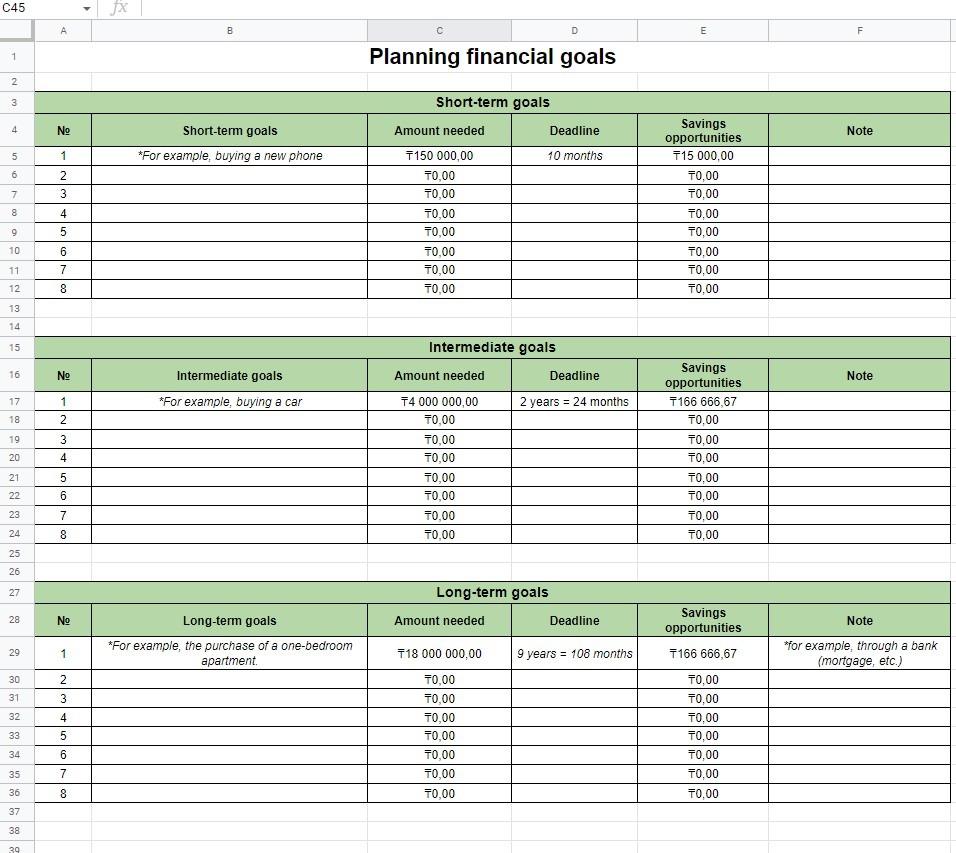
Notes:
* This assignment can be done in the second week of class.
* Try to direct students to the financial aspect of their goal.
* If students cannot think of four goals, suggest that they make their goals simple. You can use examples to raise money for gifts, get new clothes, new things, or go on one trip.
* Prioritizing a goal is an important part of the project. When students start their budget, they should consider how much they will save to meet their financial goals. This can be tricky, and students should go back to what they think is most important when it comes to setting and prioritizing their goals.
Homework.
- Track your expenses and income daily for the month and fill out a chart.
- At the end of the project, each student will present (in the form of a chart and graphs)
- personal (family) budget. Analysis
- Financial goals by 3 categories. A financial plan to achieve with a timeline