
Lesson 3
Purpose of the work:
- Determine the presence of proteins in various foods and compare their content.
Expected results
After studying the project, students will be able to:
- Gain teamwork skills
- analyze and summarize the information received
- independently build logical reasoning and draw conclusions
Teacher’s guide:
- Divide the students so that there are 3 students in each group
- Before proceeding with the laboratory work, read the safety rules by clicking on the link:
- To download the worksheet, go to:
Precautions:
- Use droppers to take the reagents from the bottle.
- Wear lab aprons and hand gloves during the experiment.
- While performing the experiment handle chemicals with care.
- Refer to the lab manual before beginning with the experiment.
- Be careful while handling chemicals and other acidic solutions.
Theoretical part
Proteins are high-molecular natural organic substances built from amino acids and playing a fundamental role in the structure and life of organisms. Proteins carry out metabolism and are part of complex cellular structures – organelles.
The role of proteins in the human body is extremely important, as they are involved in the most important processes in the body. Protein intake should be optimal, since both the lack and excess of protein in food is harmful to humans. The average requirement for an adult is 100 g of protein per day. In terms of composition, protein substances in food should be approximately 2/3 of animal origin and 1/3 of vegetable origin. Proteins are rich in meat, fish, eggs, milk, cereals and legumes.
Practical part

Step 1. Number the tubes. Drop a small amount of egg white with a pipette into tube No. 1.


Step 2. Drop a small amount of milk into test tube No. 2.

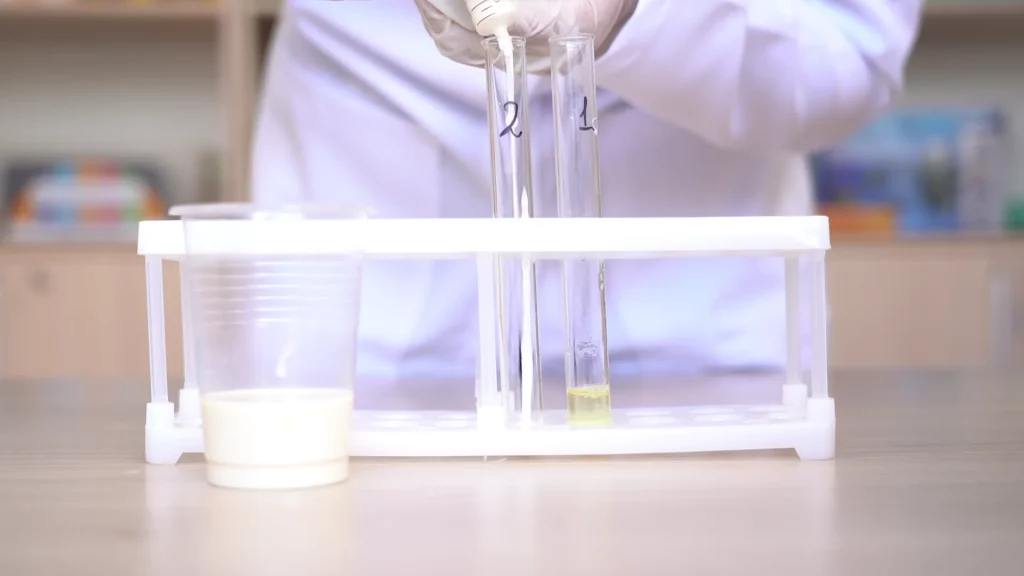
Let’s carry out the Biuret reaction. Be sure to wear gloves before starting the experiment. Be careful with a sodium hydroxide! The Biuret test is an experiment to determine the protein content in a product by adding sodium hydroxide and copper sulfate.
Step 3. Using a pipette, add 5-6 drops of copper sulphate to test tube No. 1.


Step 4. Shake the tube until the mixture inside is homogeneous.
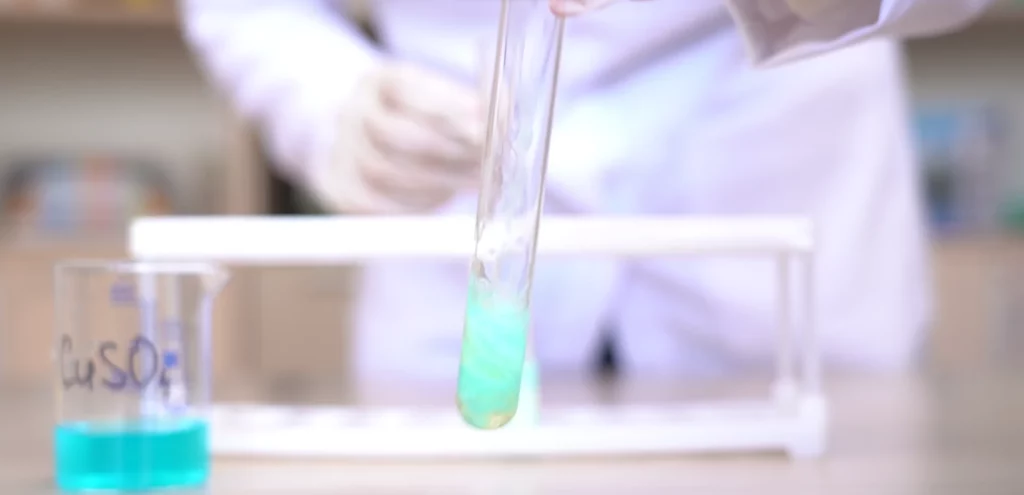

Step 5. Repeat steps 3-4 for test tube No.2.


Step 6. Then add 3-4 ml of sodium hydroxide to test tube No. 1.


Step 7. Shake the tube.
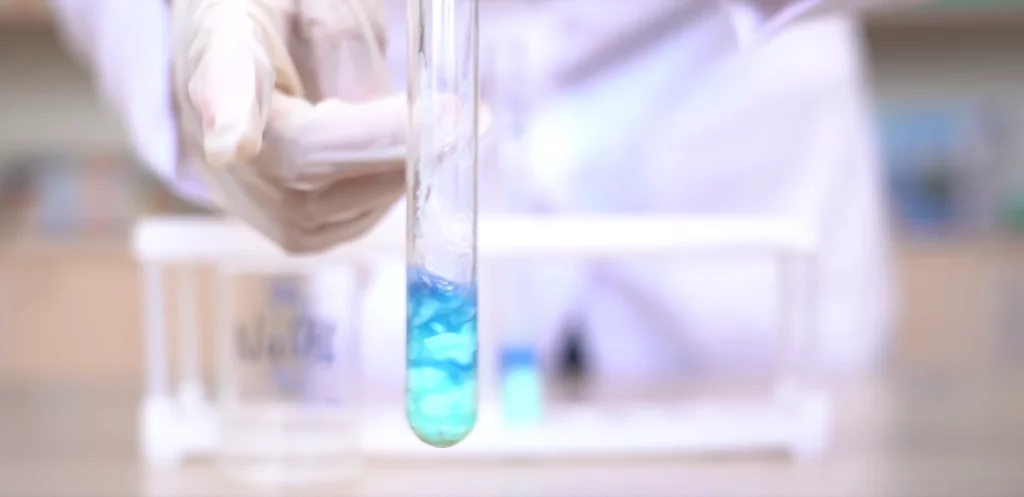

Step 8. Add 3-4 ml of sodium hydroxide to test tube No. 2.


Step 9. Gently shake the tube.
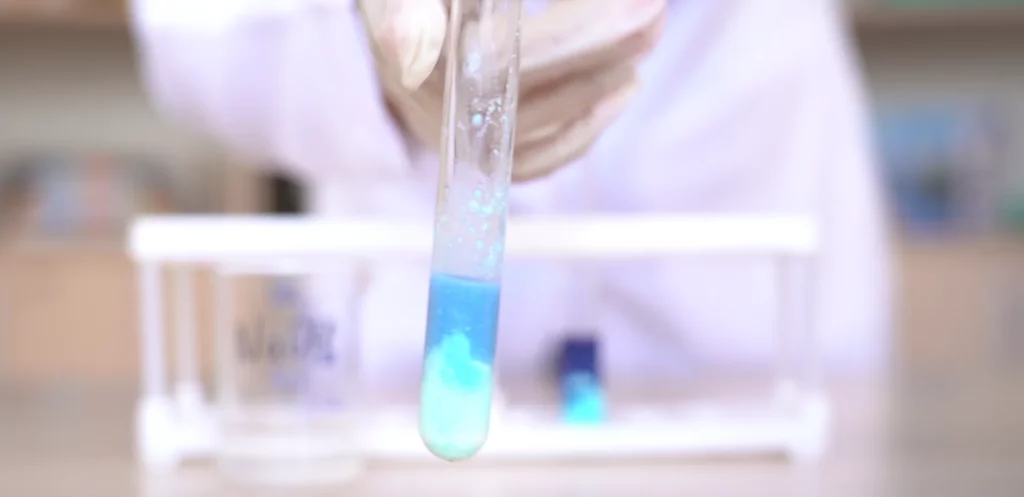


Step 10. Observe the color change of the tubes. Complete the table below on your worksheets by comparing the results of the experiment with the image shown above:
| Product name | Received color after reaction | Concentration of the protein |
| Egg white | ||
| Milk |
Write the answers to the questions below in your copybook:
- In this occasion what color indicates the presence of protein in the food?
- Based on your results, which food has the most protein and which has the least?
- What are the methods for determining the protein in the composition of things used for?
Conclusion
In this practical work, students learned to identify proteins in the composition of food products. The acquired knowledge and skills can be applied in the future directly in everyday life.
Homework
1. Compare the protein content in plant and animal products, create a table. You can use data from studies or available sources of information, as well as information from food labels at home.
2. What diseases can be caused by a lack of proteins in a human body? Describe several diseases and their symptoms.