
Creating Balance
Balancing Act by PhET Interactive Simulations, University of Colorado Boulder, licensed under CC-BY-4.0 (https://phet.colorado.edu)
Objective:
- To predict how materials of different masses can be used to create balance on a board;
- Predict how changing the position of a weight on the board will affect its motion;
- Guess which way the board will tilt when you place objects;
- Use your rules to solve balance puzzles.
This virtual activity is designed for use in the math lessons in the following chapter:
- Grade 4. “Equation and Inequality, Expression. Voyage to space”.
Theoretical Part
What is an equilibrium?
Imagine you are standing on one leg. In order not to fall, you have to keep your body straight. That’s what balance is! When all the forces acting on you are balanced, you are standing straight.
Properties of balance
- Weight matters: The heavier the object, the harder it pulls the lever down.
- Distance matters: If a heavy object is placed closer to the center of the lever, it will have less effect on its tilt than if it is placed on the edge.
- All together: For the lever to be balanced, all the objects on it must balance each other.
The lever has the same function as a large scale. When you place objects on it, it can tilt to one side or the other. Why does this happen? It depends on the weight of the objects and how far they are from the center of the board.
How can you predict what will happen to the lever?
- Find the center: Imagine that the lever is a swing. The center of the lever is where the swing is balanced.
- Weigh everything: Imagine that each object on the lever is a kettlebell. The heavier the kettlebell and the farther it is from the center, the harder it will pull the lever down.
- Compare the forces: If the forces pulling the lever down on one side are equal to the forces on the other side, the lever is level. If the forces are not equal, the lever will tilt toward the greater force.
Virtual Experiment
In a virtual activity, students play by placing objects on a lever to learn about balance. Explore equating the lever with different substances to determine the mass of mystery objects. Guesses which direction the lever is moving when supports are removed. Solve balance puzzles. As the level increases, the puzzles become more difficult.
Progression:
Step 1. You are given 3 different modes, “Intro”, “Balance Lab” and “Game”. Open the “Balance Lab” section.
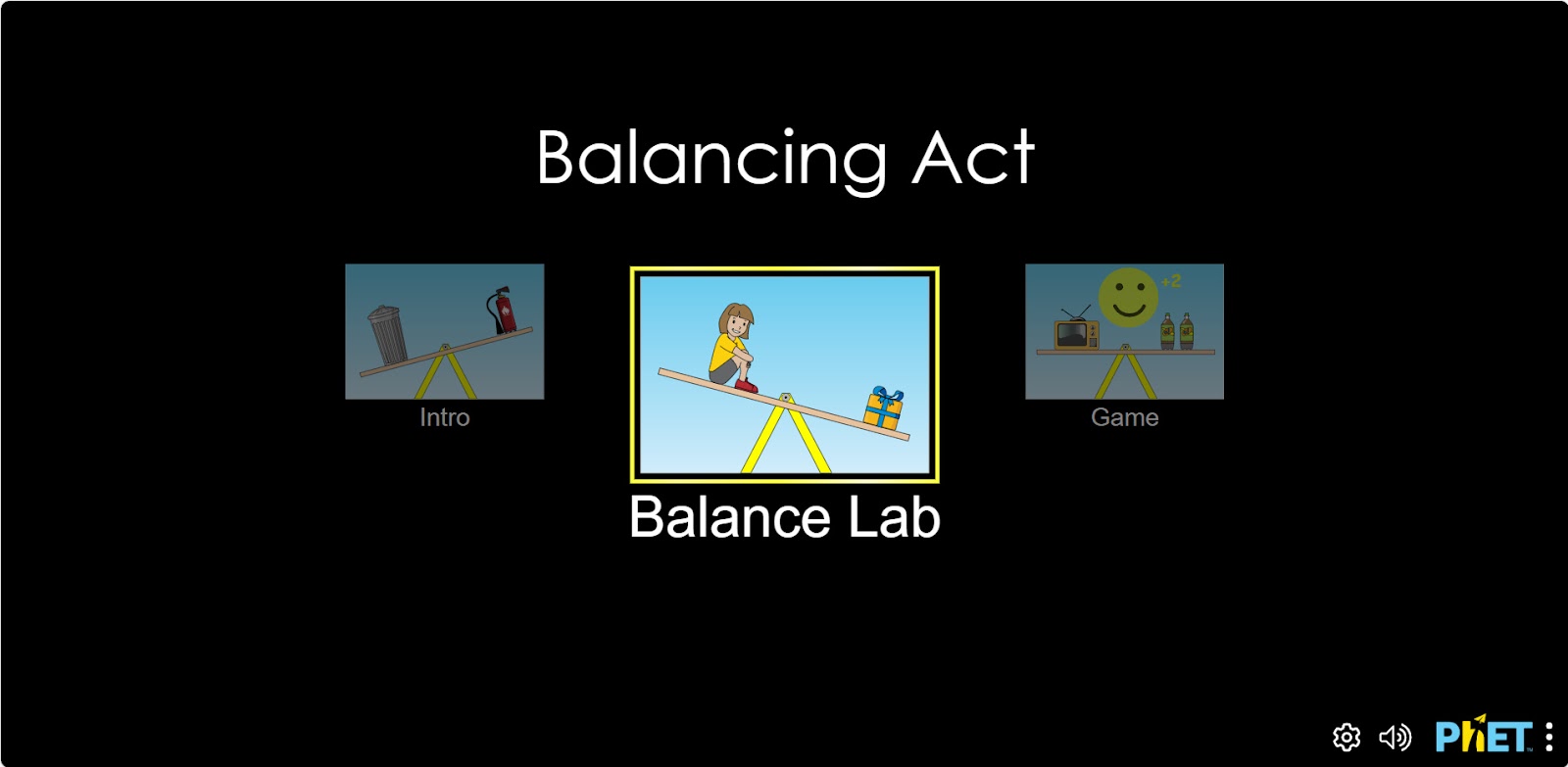
Balance Lab Section
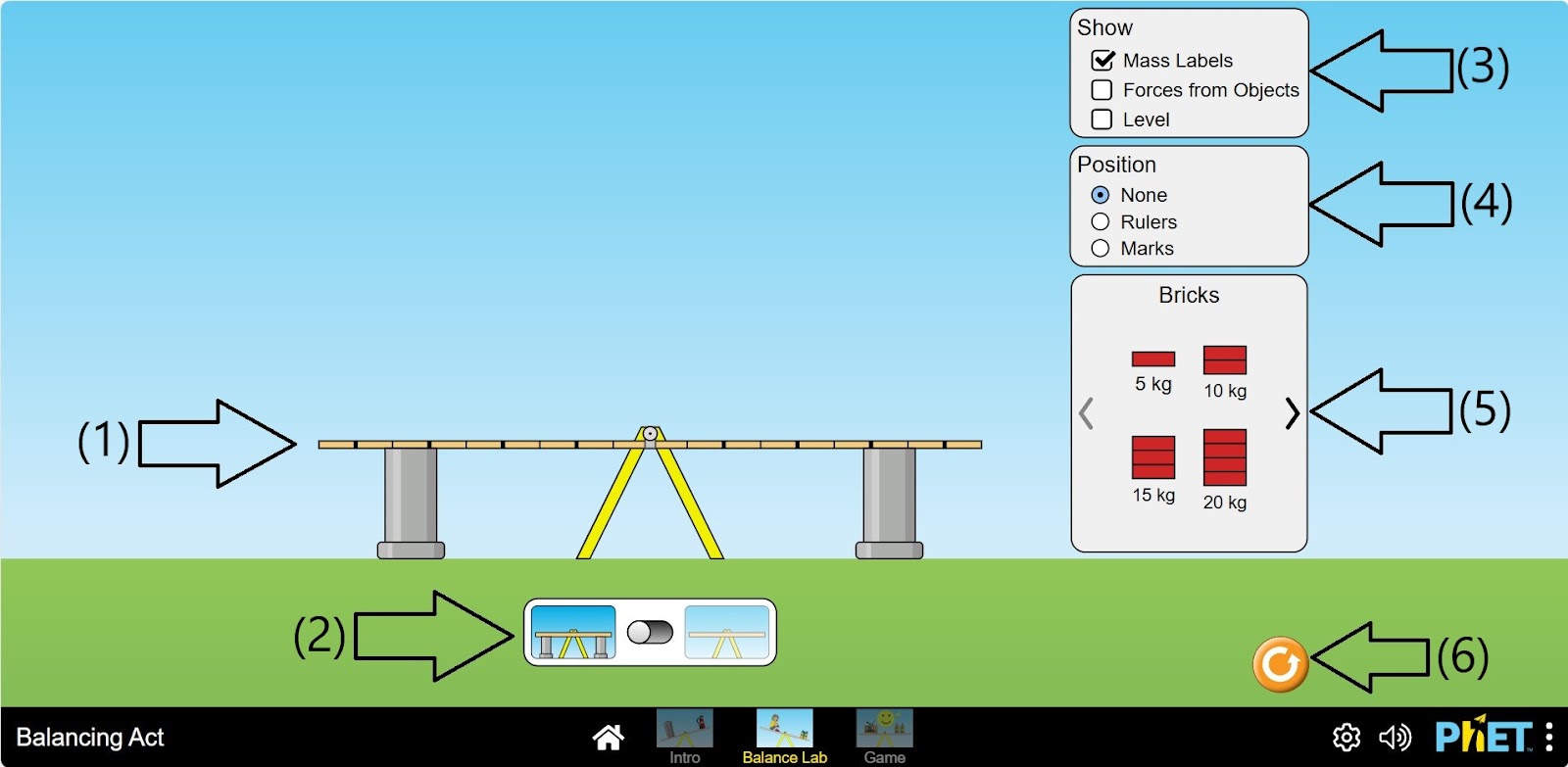
Step 2. In the work area provided to you:
- Lever (1);
- Knob to control the stand (2);
- Buttons for displaying mass, forces acting on objects, levels of equality (3);
- Buttons for measuring the distance from the reference point: none, ruler, sign (4);
- Objects with different masses: bricks, people, mysterious objects (5);
- Reset button (6).
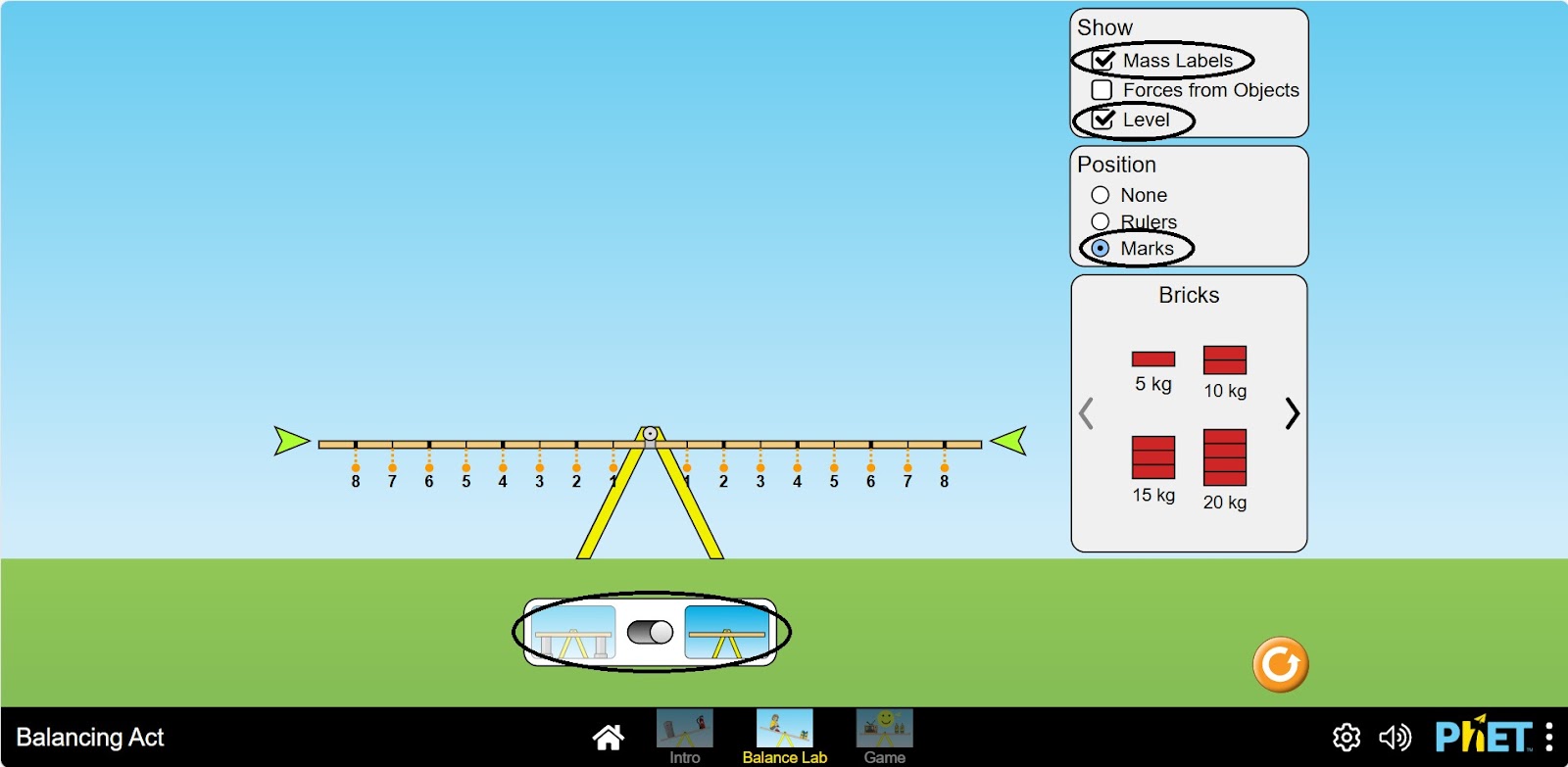
Step 3. Remove the frame. Level, add markers to measure the distance from the pivot point.
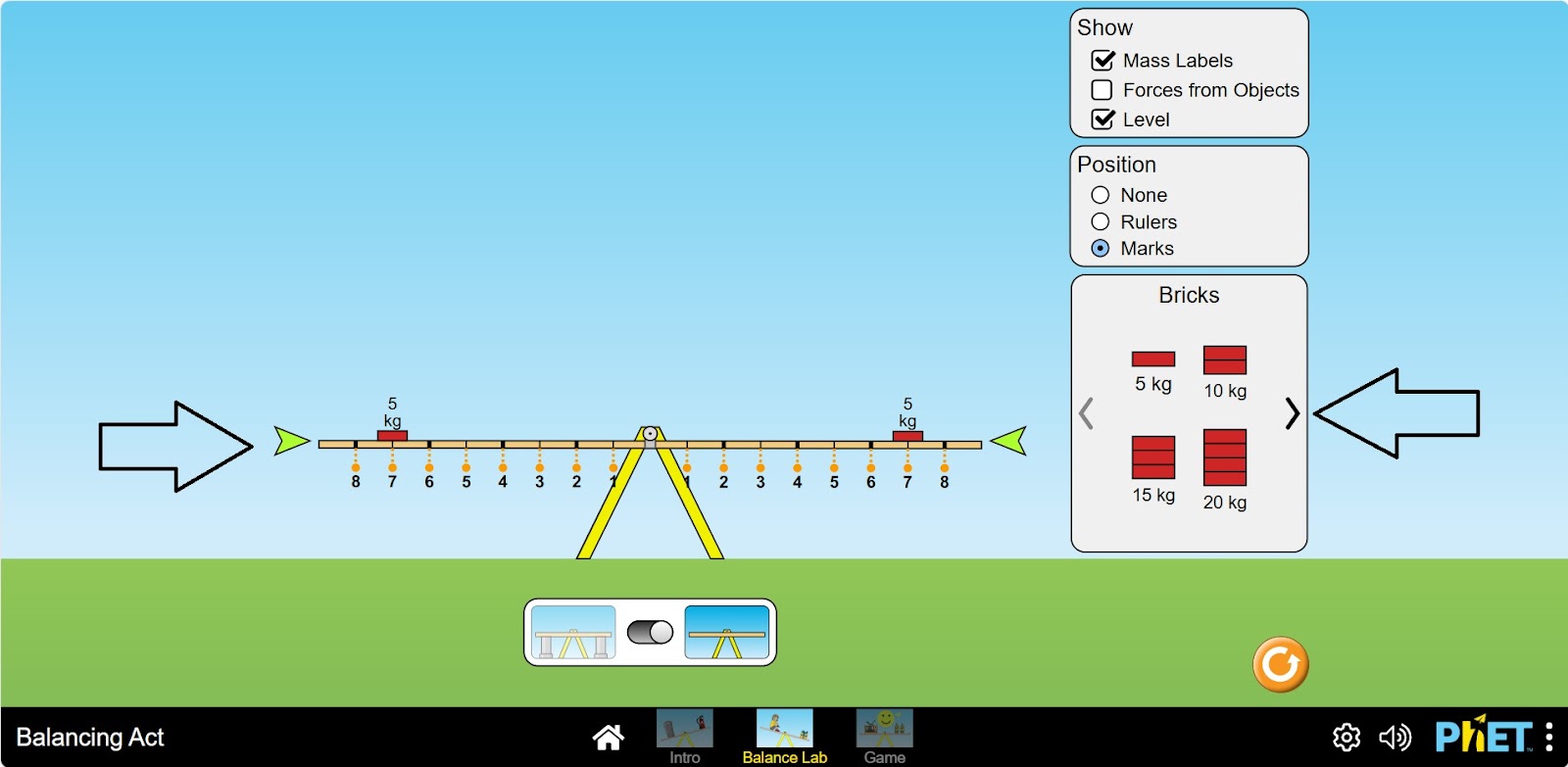
Step 4. Place objects of the same mass at the same distance on the arm (the object is a brick).
Step 5. Place objects of different masses at the same distance on the lever. (Object – People)
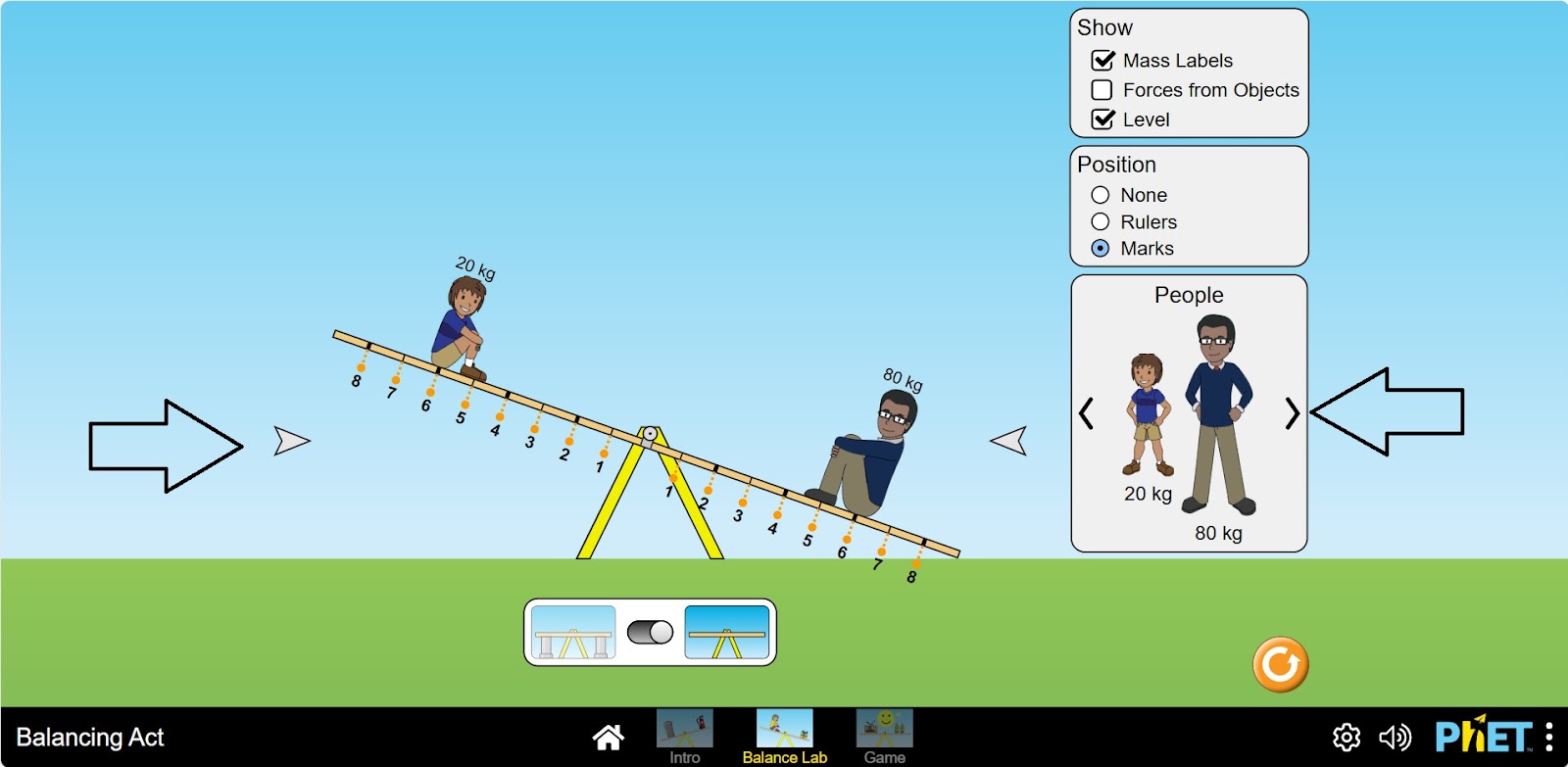
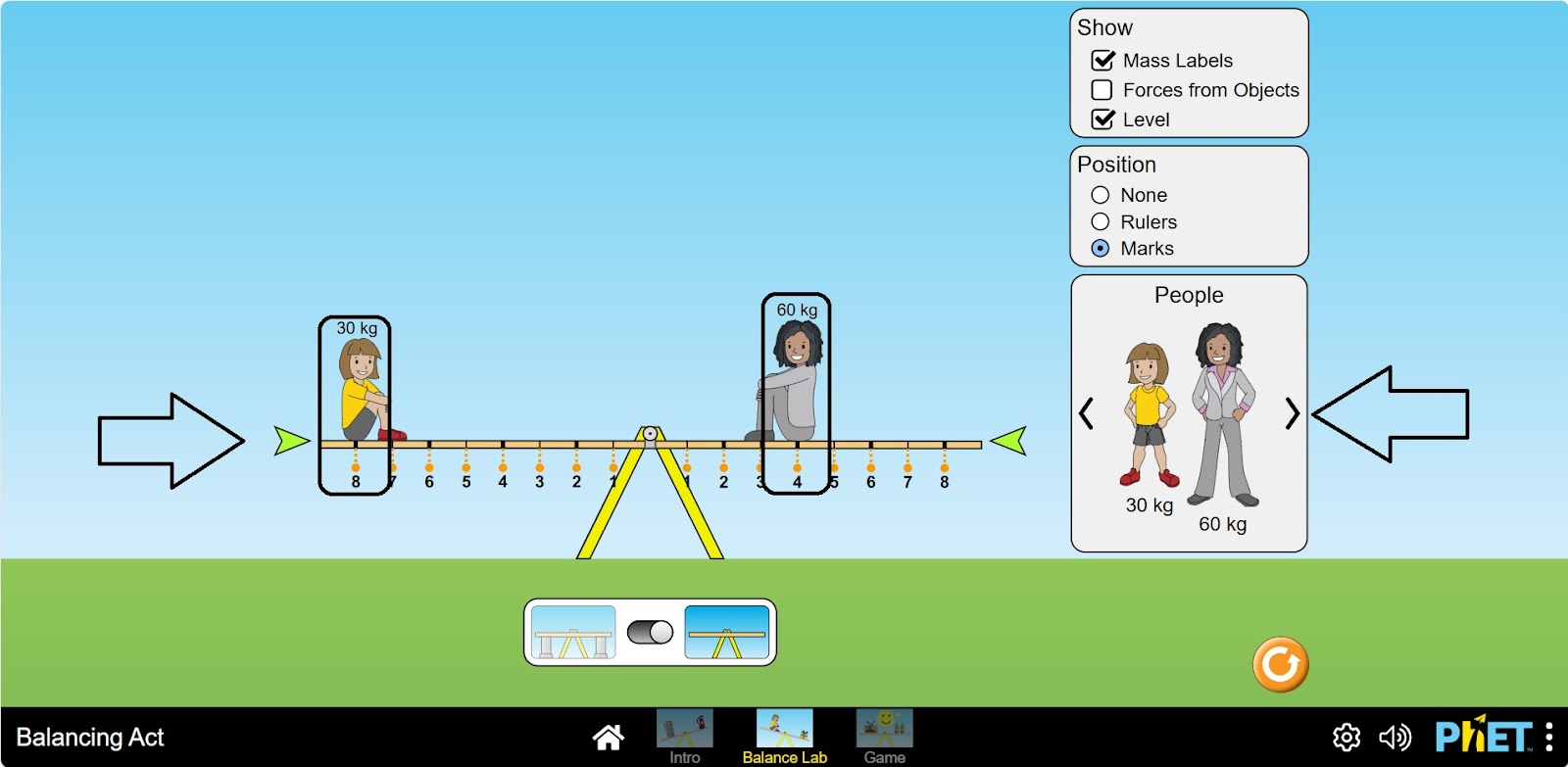
Step 6. Place people on the lever, the mass of one is twice the mass of the other. Let the person with the greater weight be twice as close to the fulcrum.
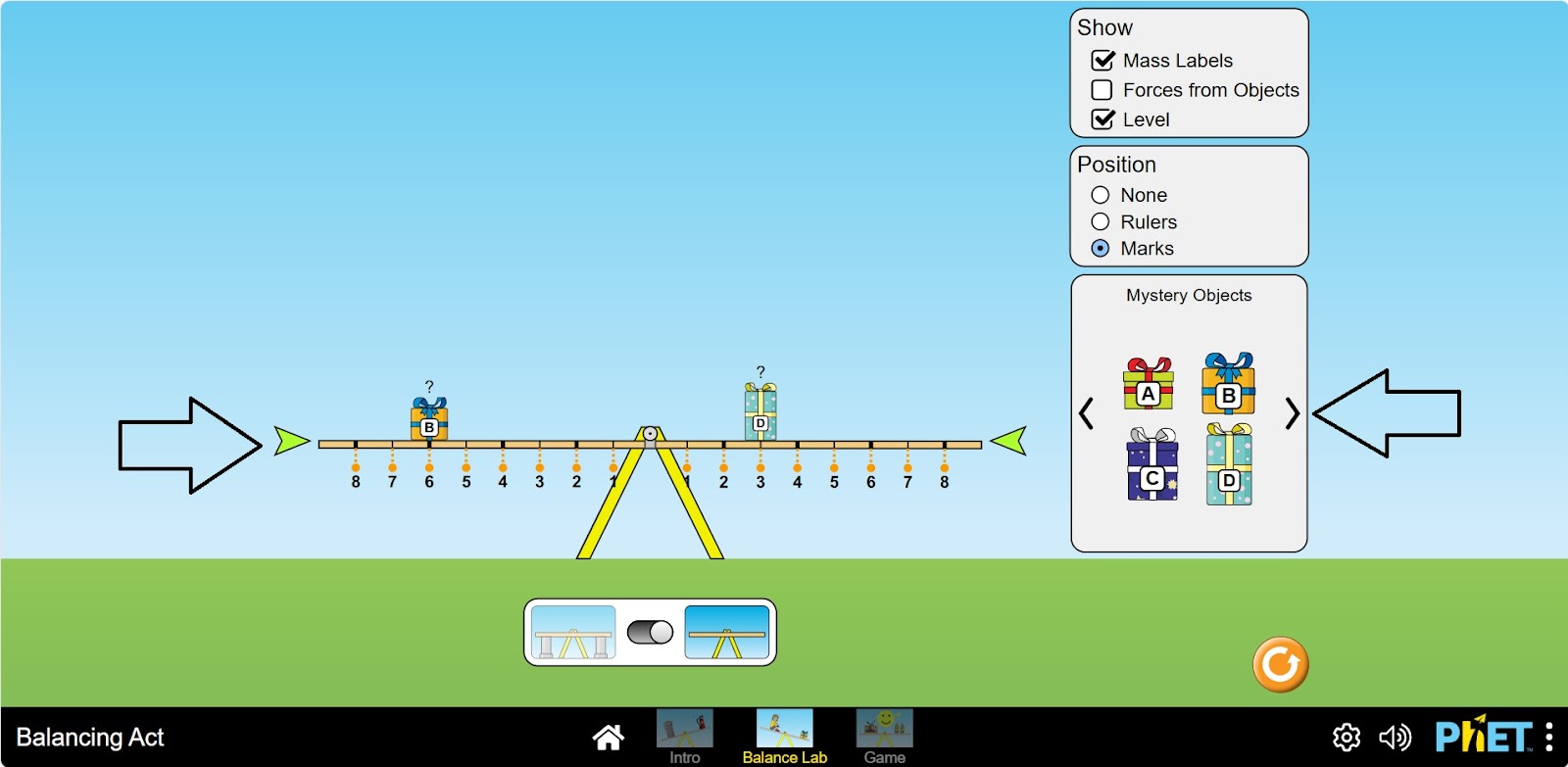
Step 7. Use comparisons to level the mystery objects by placing them on the lever.
Game Section
Step 8. Open the “Game” section. You will be given four levels. Open one level.
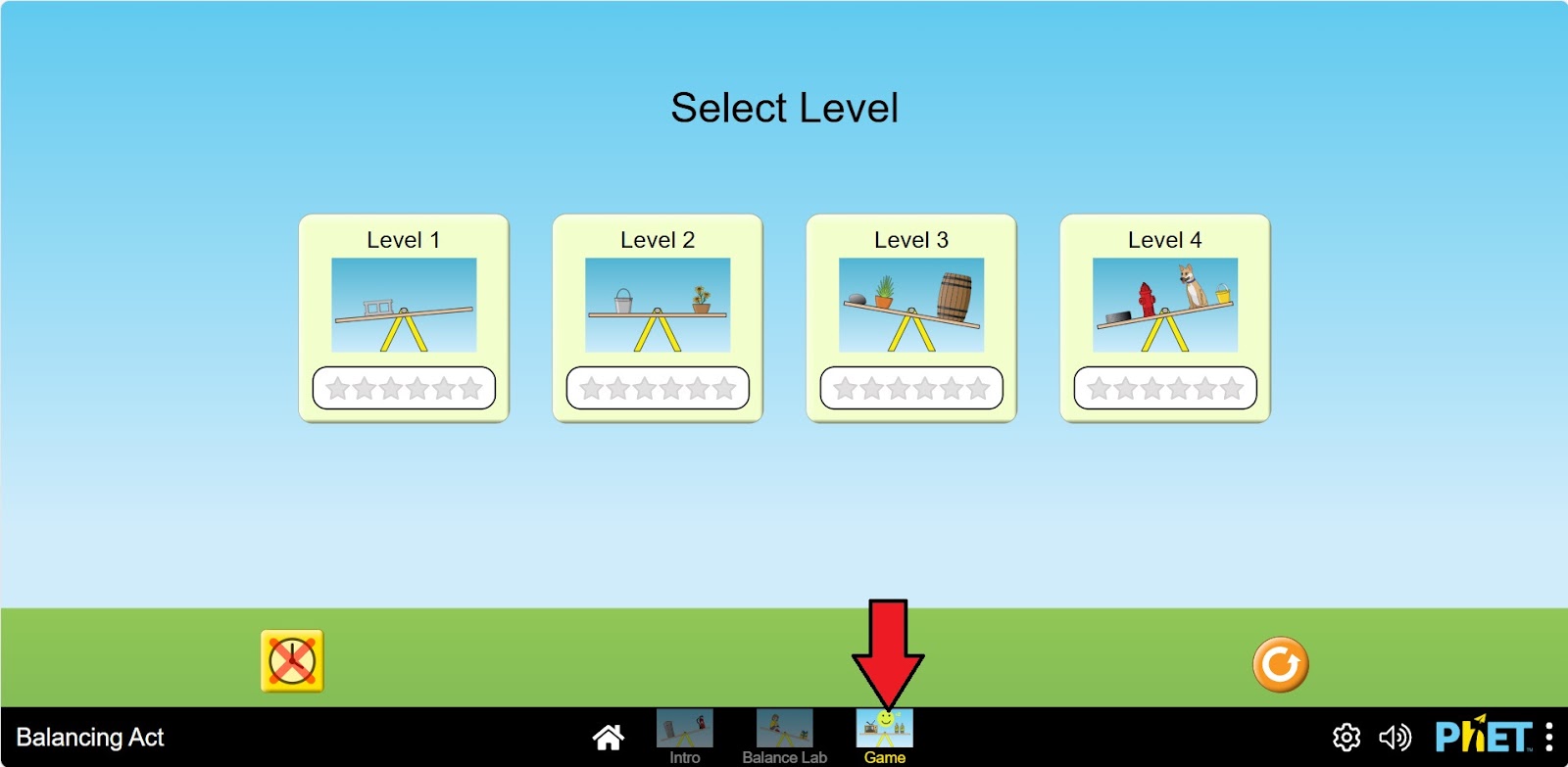
Step 9. You will be given tasks to align the lever, determine what happens when the support or body weight is removed. Once you have completed the task, you will move on to the next.
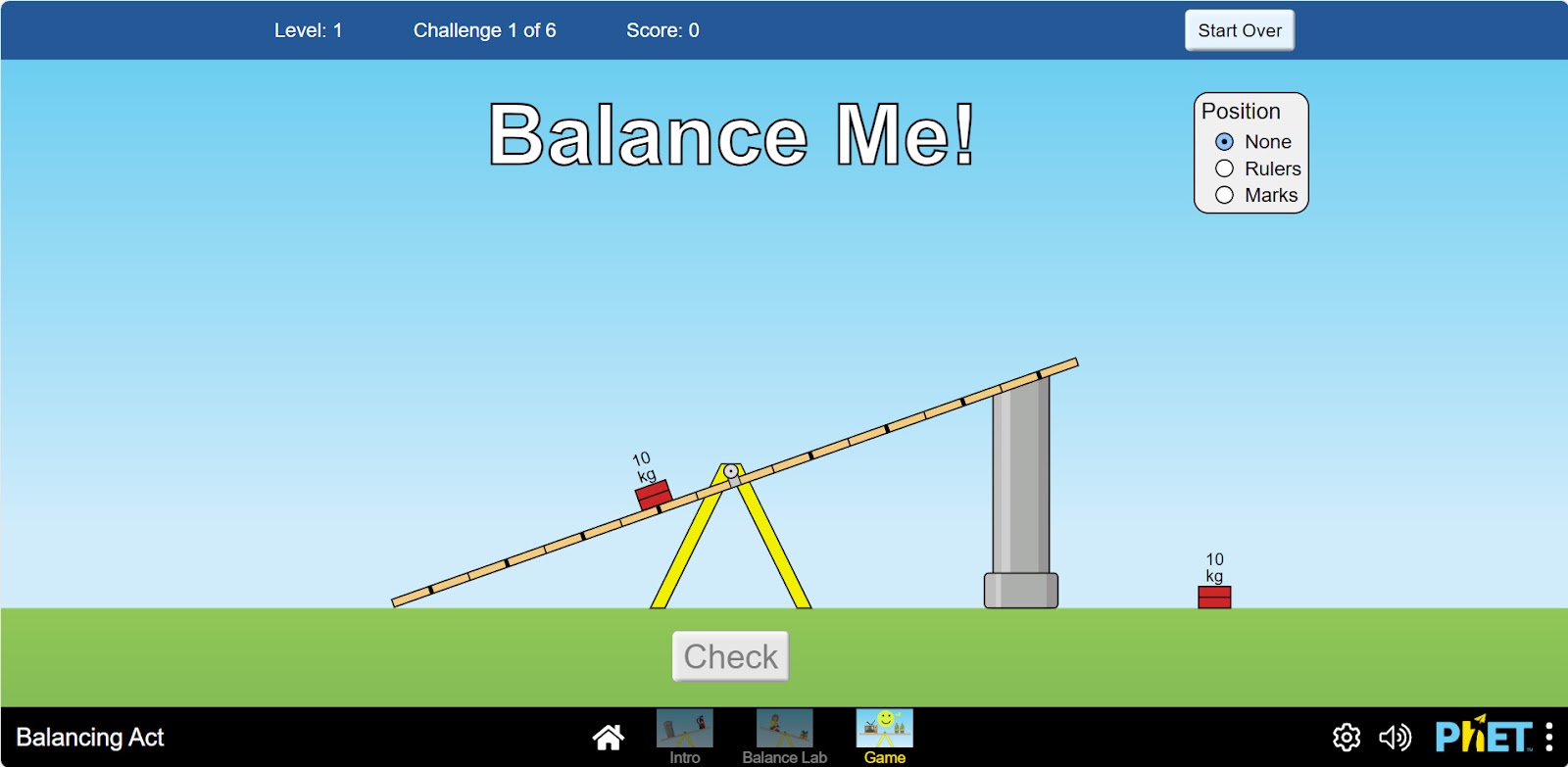
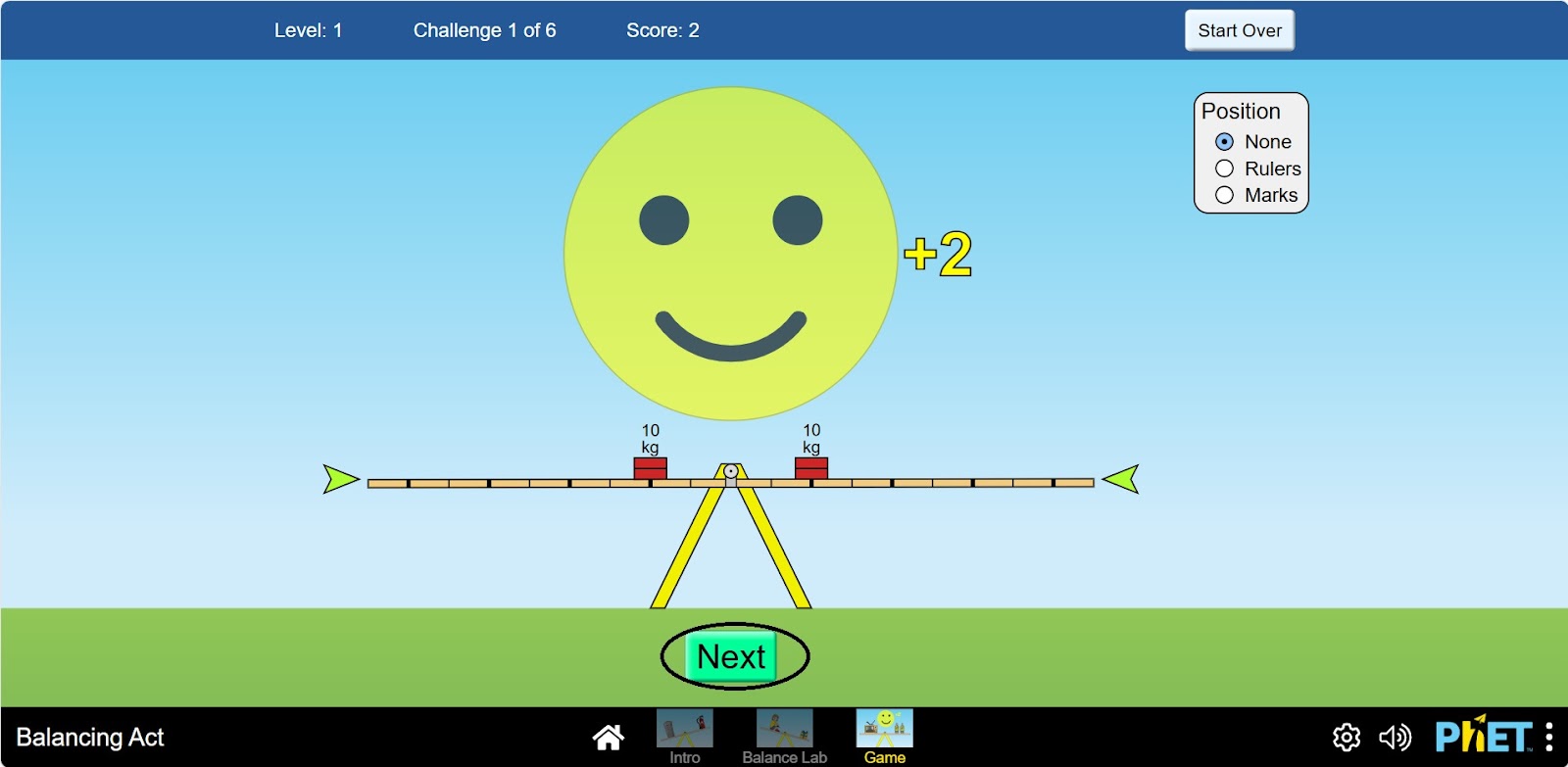
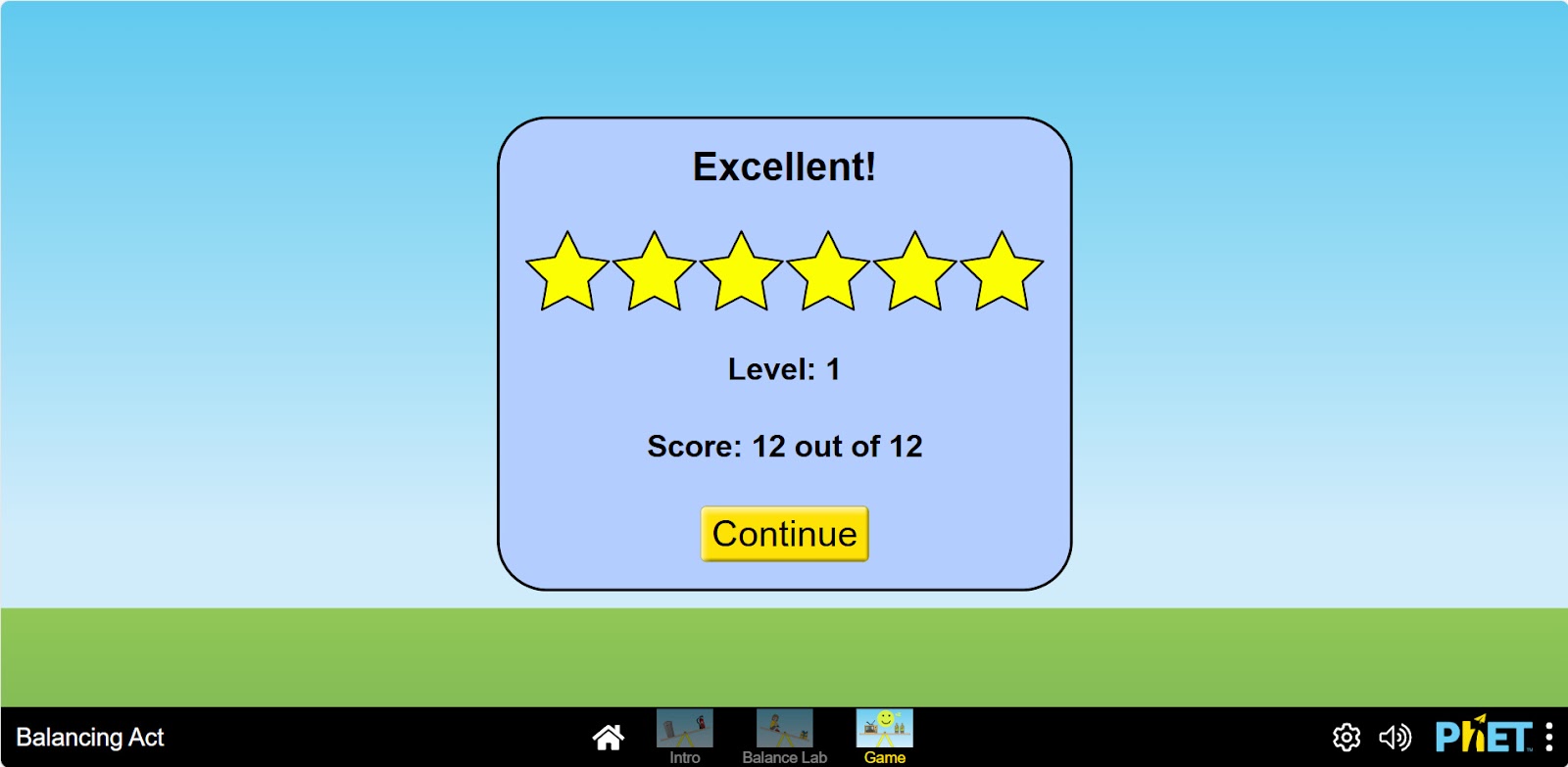
Step 10. On one level you will be given 6 tasks. Once you complete them, you can move on to the next levels.
Conclusion
Students have learned many interesting things about balance. To keep a lever in balance, you have to consider not only the weight of the objects, but also how far they are from the center.