Lesson 1
Topic of laboratory work: Hydrolysis of salts
The purpose of the work:
- Learn how to determine and calculate the pH of solutions;
- Experimentally determine the medium of medium salt solutions;
- Make molecular and ionic equations of hydrolysis of medium salts;
- Predict the reaction of medium salt solution medium.
Teacher’s Guide
- Children should do the experiment in groups of 2-3;
- The workplace must be cleaned and put in order;
- Safety precautions.
Theoretical part
Salt hydrolysis is the process of reaction between salt ions and water molecules. As a result of hydrolysis, salt ions can interact with water and change their chemical composition. This leads to the formation of acid or alkali, depending on the electrochemical nature of the salt.
To write the salt dissociation equations, you need to know the chemical formula of the salt. For example, consider the dissociation of the NaCl salt. The dissociation equation looks like this:
NaCl + H2O → Na+ + Cl– + H2O
In this case, Na+ and Cl- are the cation and anion, respectively, formed as a result of dissociation of the salt.
Medium salts are salts that have ions that can act as acidic or alkaline. Also, medium salts are salts that contain only metal ions (cations) and acid residues (anions). Such salts can dissociate in water as weak acids and weak bases. For example, the average NH4Cl salt dissociates in water as follows:
KF + H2O → K+ + F– + H2O
As can be seen from the equations, the dissociation of the average KF salt leads to the formation of acid ions of potassium and fluorine. KF is a salt formed by a weak HF acid and a strong KOH base.
The pH of dissociation of medium salts can be predicted using the concept of acid-base and the equilibrium of hydrogen ions in solution. If acid and base are formed in the solution, which are strong, then the pH of the solution will be about 7. If acid and base are formed, which are weak, then the pH of the solution will depend on the dissociation constant of the weak acid and base.
In the case of an average KF salt, the pH will be greater than 7, because the following reaction is not characteristic of potassium ions due to a high degree of KOH dissociation:
K+ + 2H2O = KOH + H3O+
At the same time, the reaction of fluorine with water is very characteristic, since HF is a weak acid and dissociates weakly:
F– + H2O = HF + OH–
Hence it turns out that due to the fact that the concentration of OH-ions will be higher than the concentration of H + ions, the solution will become alkaline.
Practical part

Salt hydrolysis
List of necessary equipment
- Soda ash
- Copper sulfate
- Water
- Universal indicator
- Spoon
- Scales
1. First we have to write dissociation reactions for hydrolysis of Na2CO3 and CuSO4 solutions in water.
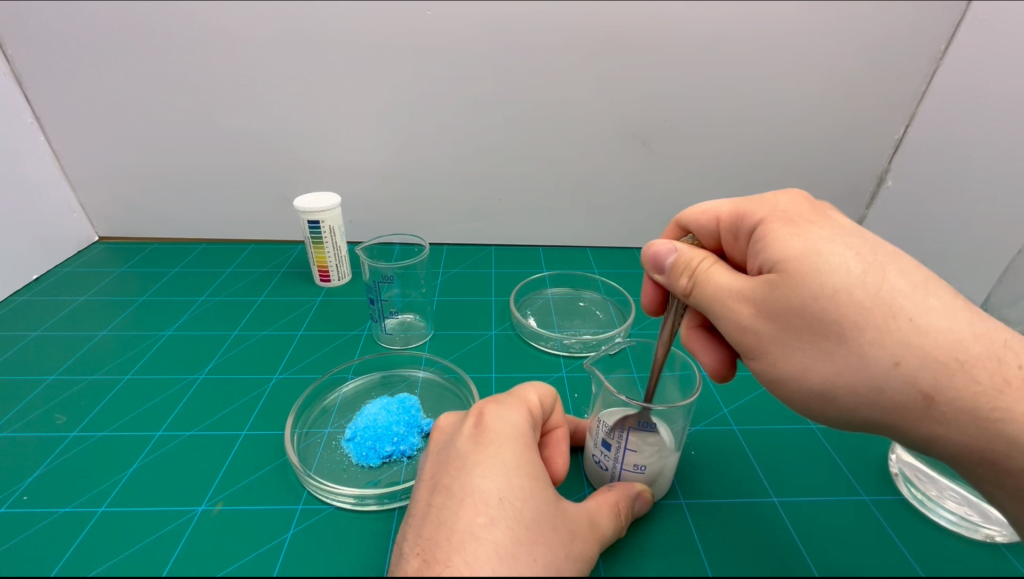
2. Now weigh 1 gram of Na2CO3 and dilute it in 50 ml of water. Stir the solution until all the salt is completely dissolved.
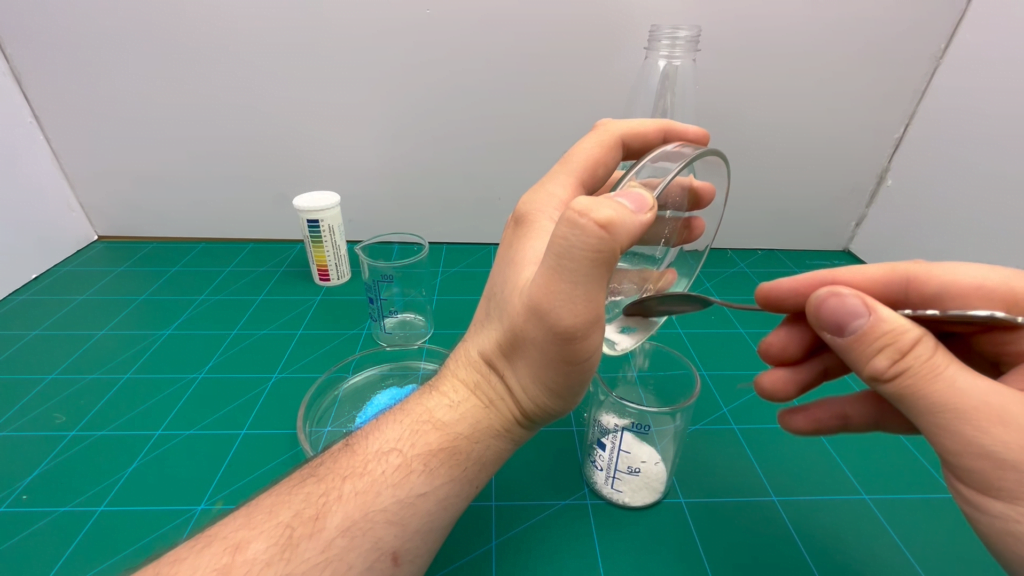
3. Repeat these steps for CuSO4
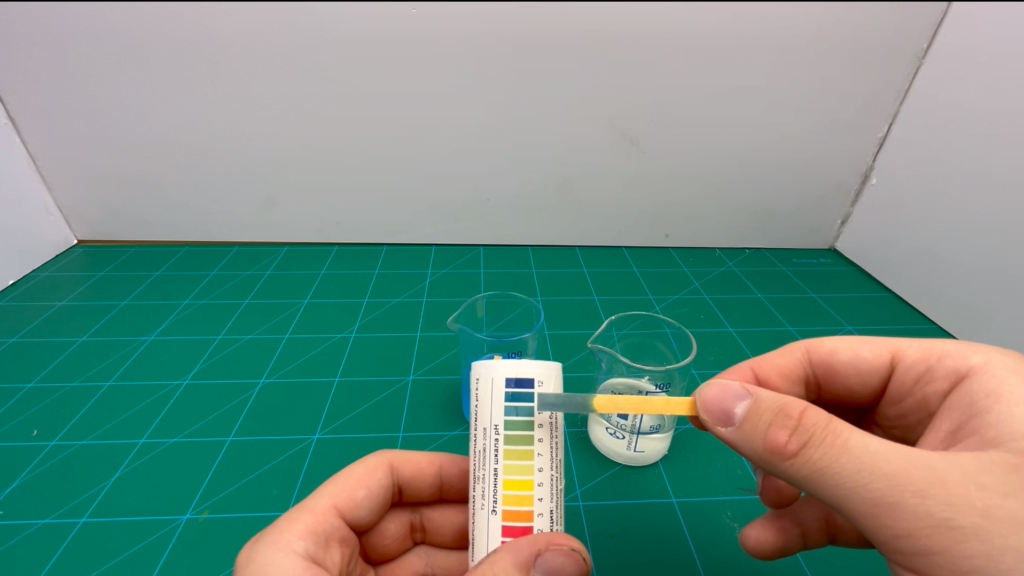
4. Take a litmus paper and dip it for 2 seconds into the Na2CO3 solution. Determine the color and pH of the solution. Write the result in a table.
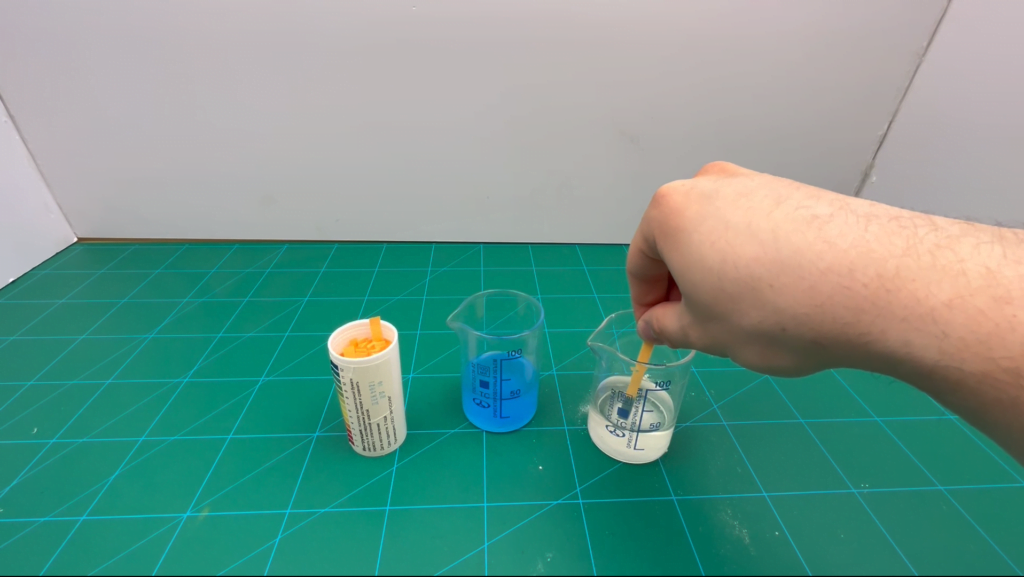
5. Repeat these steps for the CuSO4 solution.