Lesson 1
Topic of laboratory work: The law of conservation of mass of substances.
The purpose of the work:
- To study how the ratio of reagents affects the total number of products
- To carry out the reaction of soda with acetic acid
Teacher’s Guide:
- Tasks are performed in groups of 2-3 people
- Prepare reagents in advance
Expected results:
- Learn how to conduct a reaction to the release of carbon dioxide
- To prove that the substance is not destroyed, but transformed into another form
Safety techniques
Worksheet
Description
The law of conservation of mass is a fundamental principle of chemistry and physics, which states that the mass of matter cannot be created from nothing and does not disappear without a trace during chemical reactions or physical processes. This means that during any chemical reaction or physical change, the total mass of all interacting substances remains unchanged.
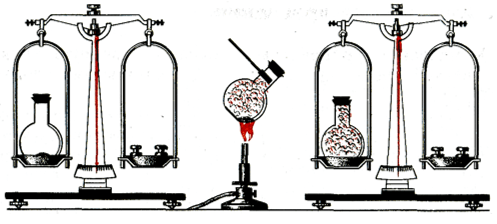
Why is it so important to monitor the ratio of reacting substances? Firstly, compliance with the law of conservation of mass allows you to accurately determine the amount of reagents required for the reaction. This is important from an economic point of view, since an excess of reagents can lead to their unnecessary consumption, and a shortage can affect the completeness of the reaction.
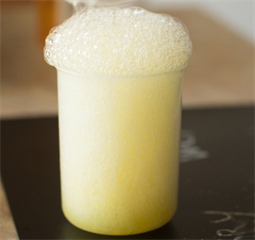

Secondly, the exact ratio of reactants is important to obtain the desired reaction products. If the ratio of reagents is incorrect, this can lead to the formation of undesirable by-products or even a complete absence of reaction.
Finally, the law of conservation of masses is of fundamental importance for understanding the nature of matter and its changes. It helps to establish that there are no “magical” and “mystical” transformations in the world, and any changes in matter are explained by the presence of certain chemical bonds and reactions.
In conclusion, understanding and observing the law of conservation of mass is the basis for successful study of chemistry and physics. This law allows you to accurately plan and control reactions, which is important both from a scientific and practical point of view.
Practical part
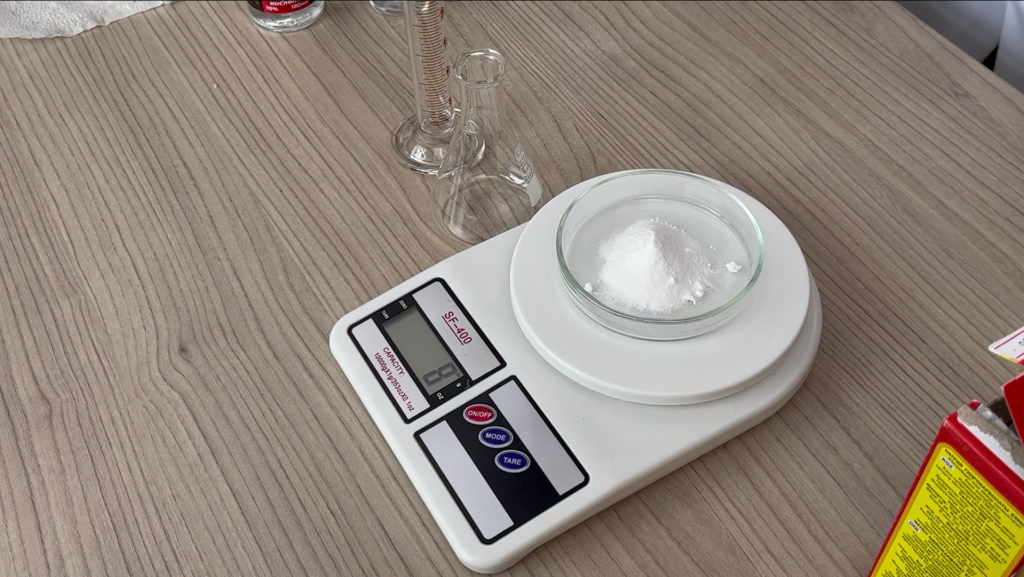
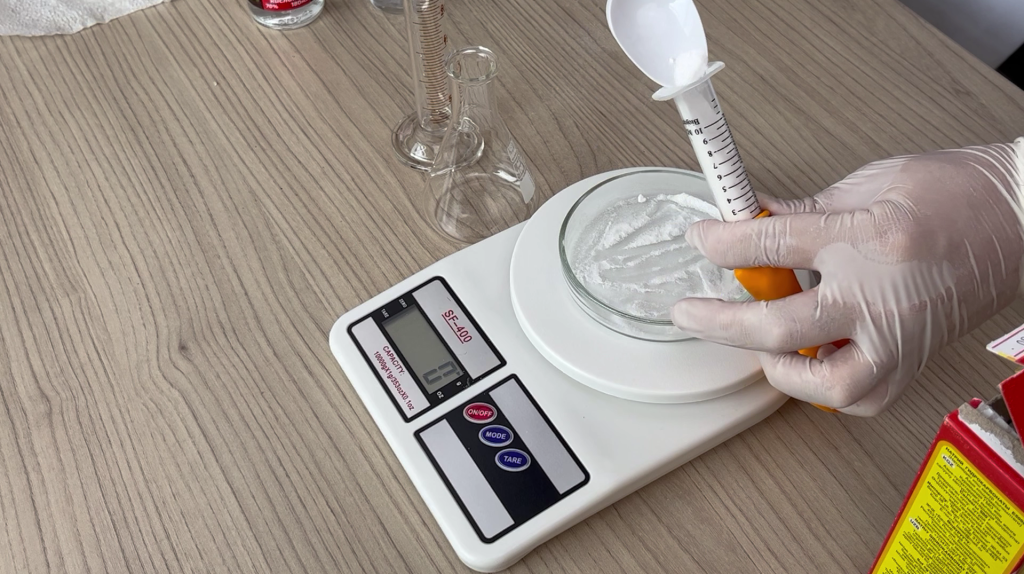
1. Turn on the scales and wight 8 grams of baking soda
2. Pour soda into the ball
3. Pour 7-8 ml of vinegar into the flask and add 42 ml of water
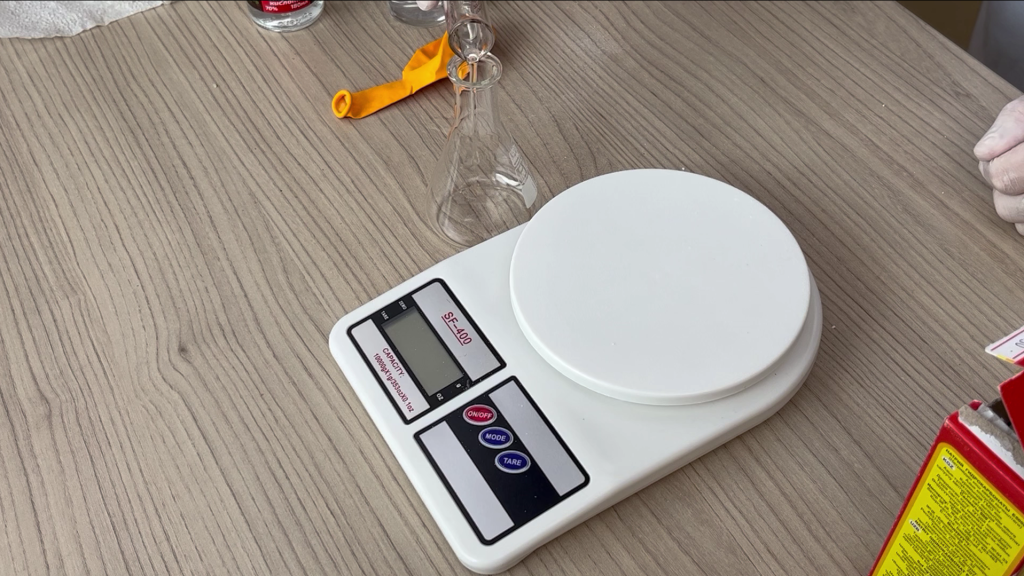
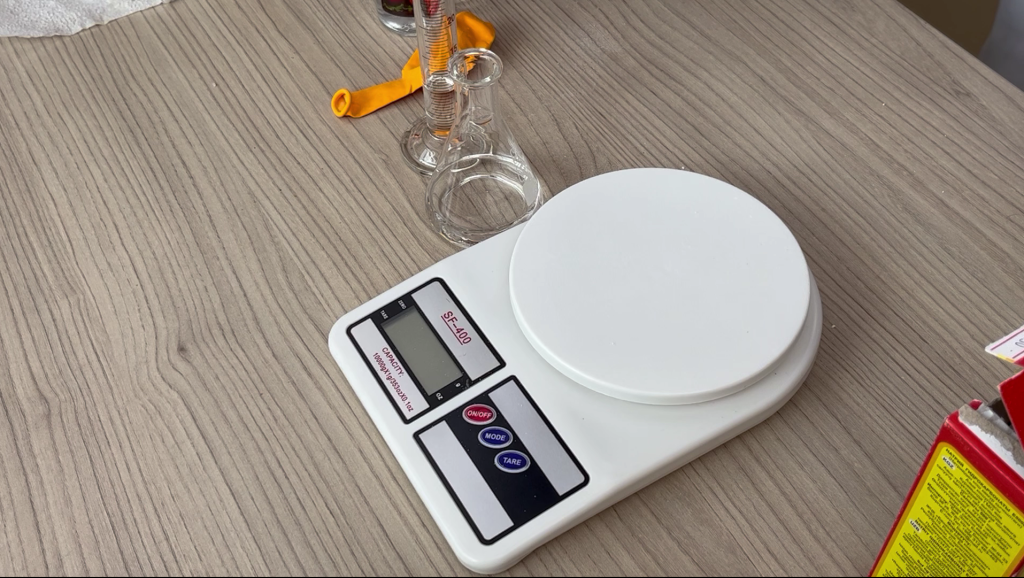
4. Pull baloon on the neck of the flask so that the soda does not pour into the flask
5. Measure the mass of the system
6. Pour the soda into the flask, turning the ball over
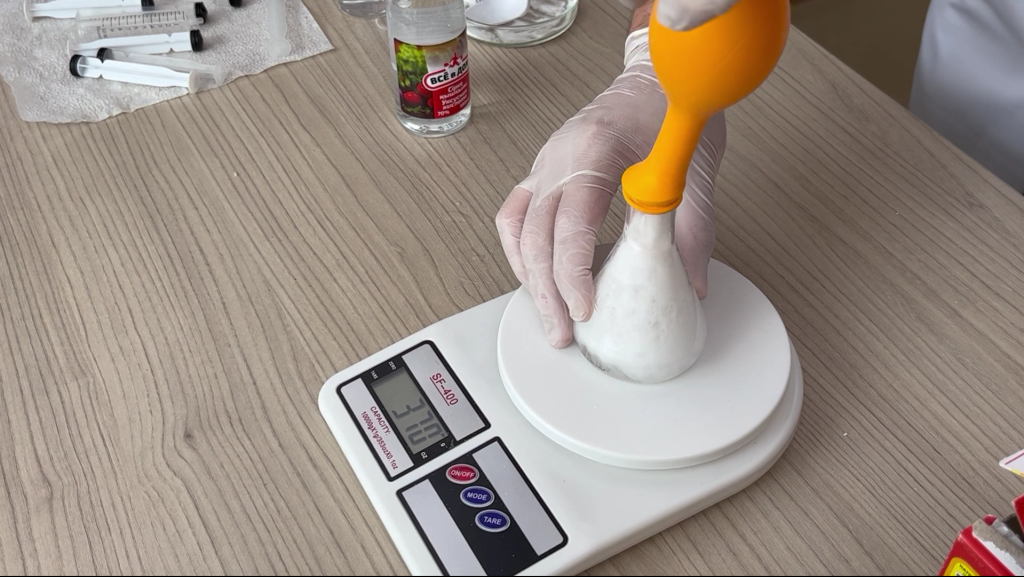
7. Observe the reaction, and wait until it is over
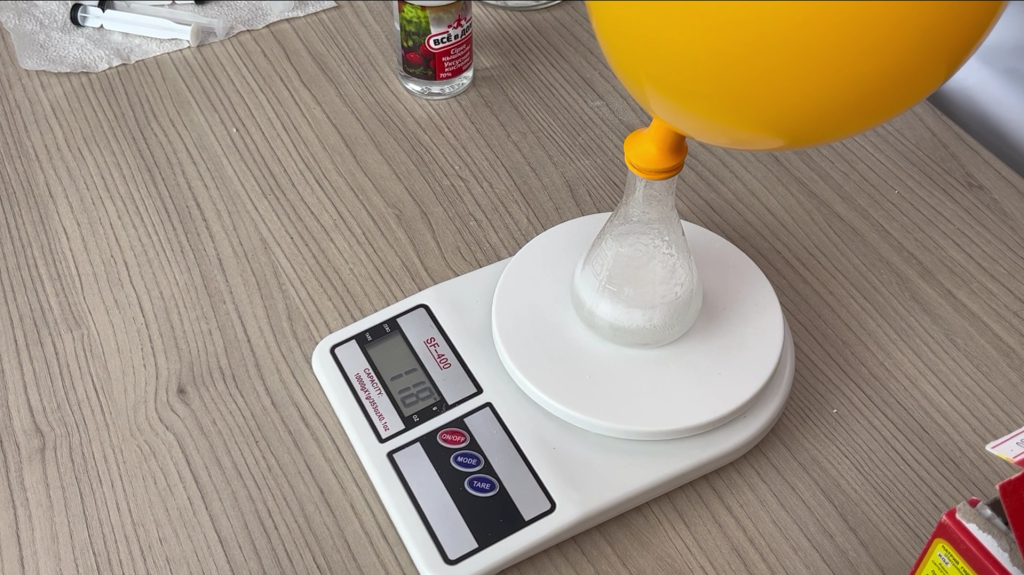
8. Measure the mass