
Lesson

Purpose of the work:
- To learn how to use statistical methods to estimate population size and to understand the importance of random sampling in ecology.
Expected results:
After completing the work, students can:
- develop teamwork skills
- be able to analyze and summarize the information received
- draw logical conclusions
Teacher’s Guide:
- The task is performed in groups of 3-4 people
- Before starting laboratory work, please read the safety rules by following the link:
- To download the worksheet, follow the link:
Theory
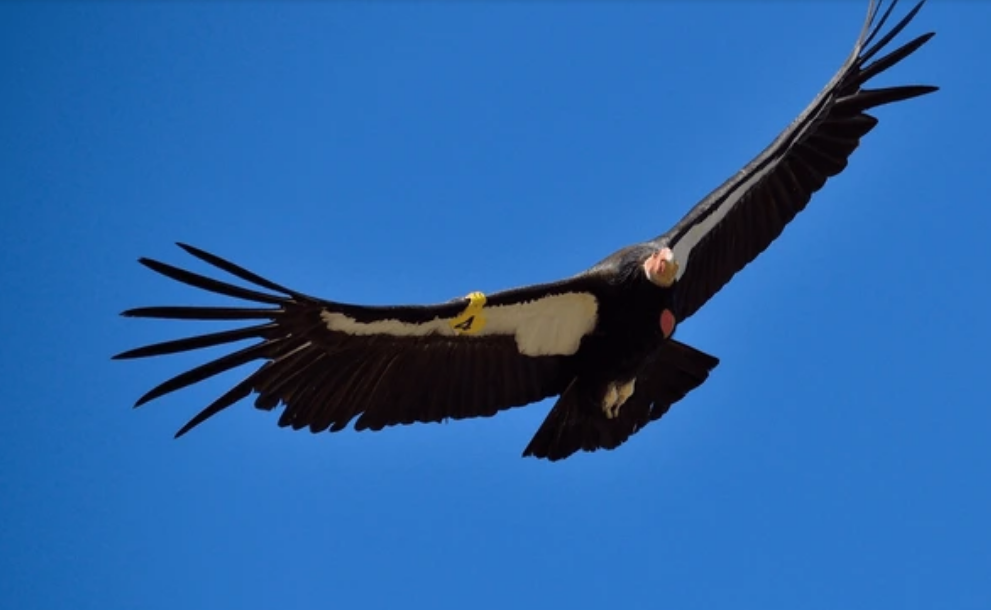
In ecology, a common task is to determine the size of a population. In real conditions, it is practically impossible to count all individuals, especially when dealing with fish in a lake, insects in a forest, or small animals over a large area. For this reason, statistical sampling methods are used. One of these is the Lincoln–Petersen method, also known as the “capture–mark–release–recapture” technique.

Principle of the method:
- In the first sample, a certain number of individuals (M) are captured from the population and marked (e.g., with paint, tags, rings, or chips).
- All marked individuals are then released back into their habitat.
- After some time, a second capture (C) is carried out, and among those caught, the number of previously marked individuals (R) is counted.
- It is assumed that the proportion of marked individuals in the second sample corresponds to their proportion in the entire population:
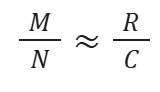
where:
- N — total population size (unknown),
- M — number of individuals marked during the first capture,
- C — total number of individuals captured in the second sample,
- R — number of marked individuals in the second sample.
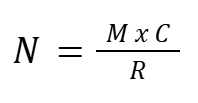
From this proportion, the formula is derived:
Conditions for reliable results in nature:
- Closed population — between captures, there should be no migration, reproduction, or mass mortality.
- Thorough mixing — after release, marked individuals must have enough time to mix evenly with the rest of the population.
- Retention of marks — marks should not fade, fall off, or affect the survival of the individuals.
- Equal chance of capture — both marked and unmarked individuals should have the same probability of being caught in the second capture (the mark must not hinder movement or make the animal more visible to predators).
- Sufficient sample size — both the first and second samples must be large enough so that random fluctuations do not significantly distort the result.
Practical part
Step 1. The teacher puts beads into a bag or container (at least 100 pieces). The exact number of beads is not revealed to students.
Step 2. Randomly take 30 beads from the bag. Mark them with a marker and return them to the bag.
Write down in your Worksheet: M = 30 (number marked).


Step 3. Mix all the beads thoroughly.

Step 4. Without looking, take out a handful of beads. Count the total number of beads taken out (C). Count how many of them are marked (R). Write down the data in your Worksheet.


Step 5. Calculate the population estimate using the formula:
where:
- N — estimated population size (unknown value we want to find);
- M (Marked) — number of individuals marked during the first capture;
- C (Captured) — number of individuals caught in the second (or subsequent) capture;
- R (Recaptured) — number of marked individuals among those caught in the second (or subsequent) capture.
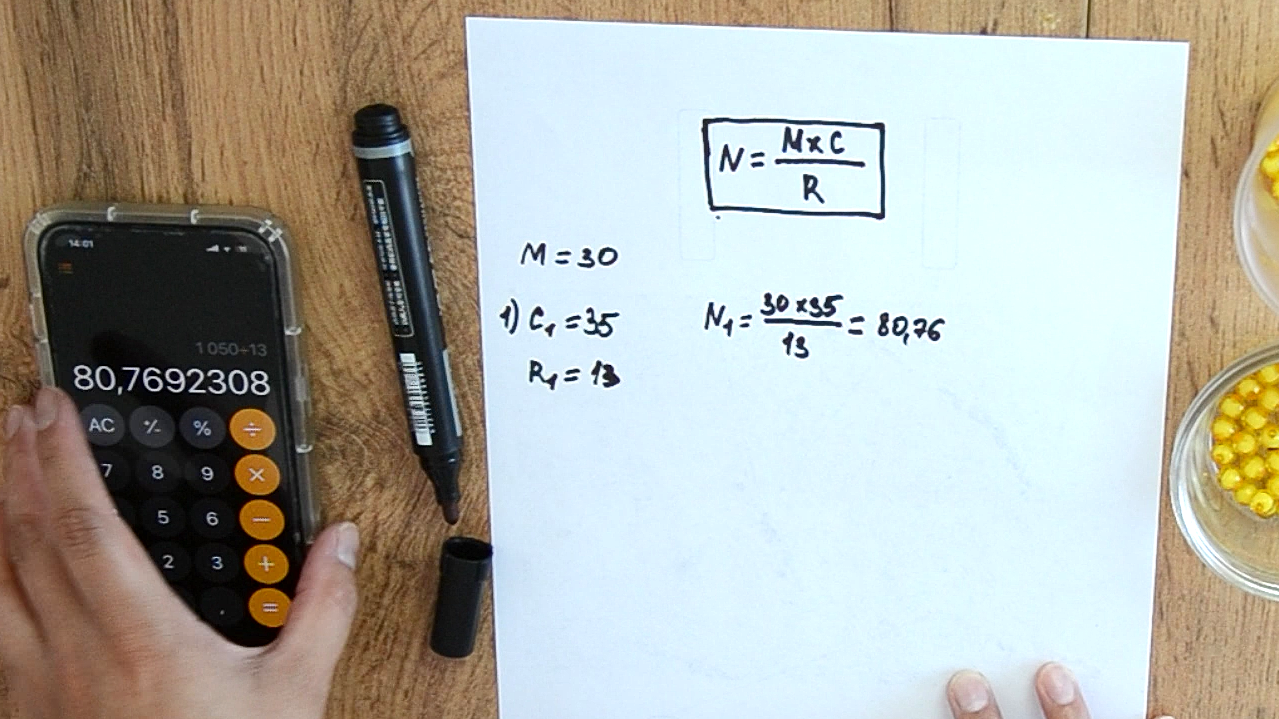
Step 6. Return all beads back to the bag, mix them. Repeat several such “captures” (e.g., 5 times). Each time record the values of C and R. Calculate the population estimate for each capture.
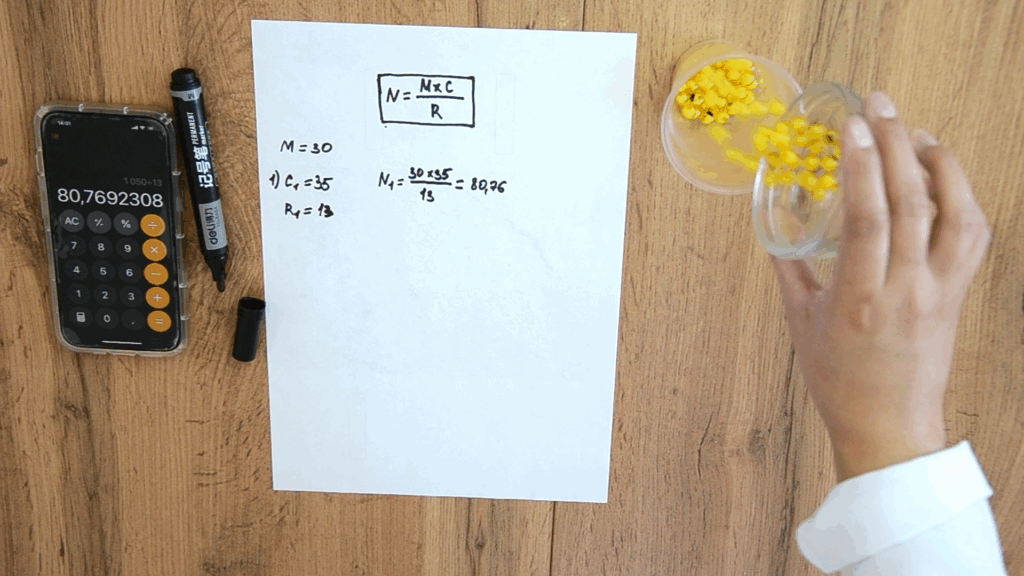
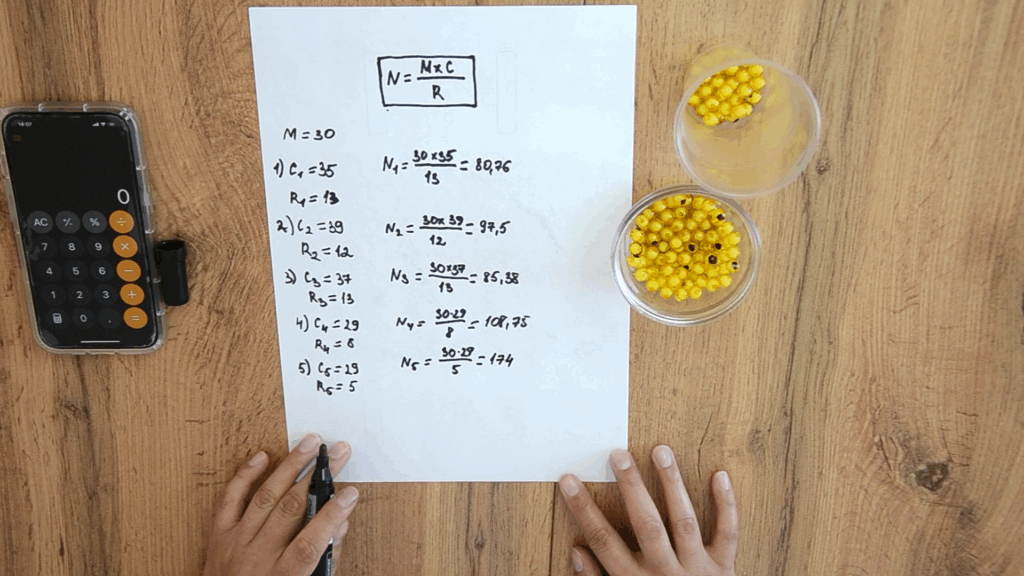
Step 7. Find the average value N̄ across all captures.

Step 8. Count the actual number of beads, or let the teacher announce the quantity. Compare the result with the actual number.
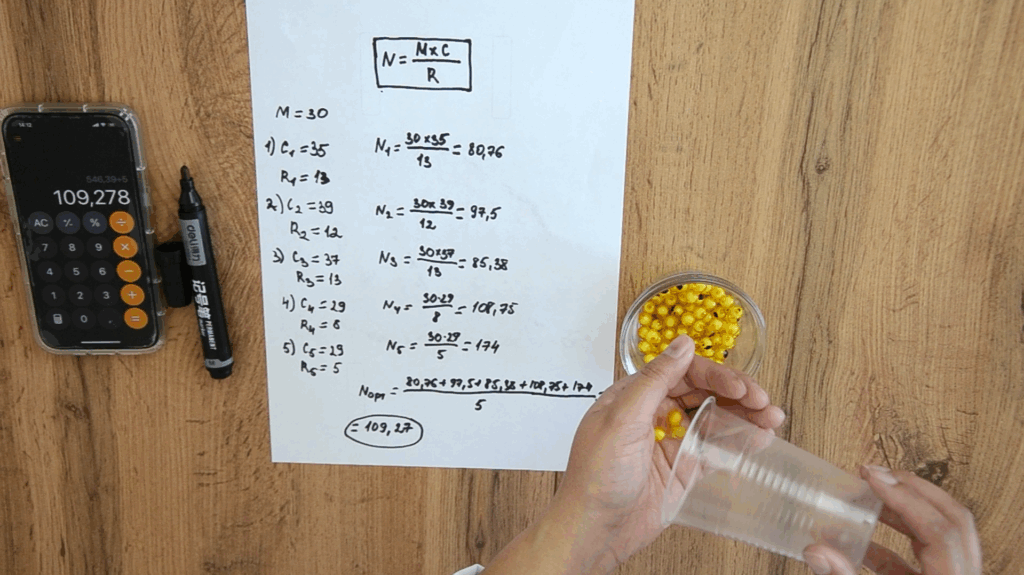
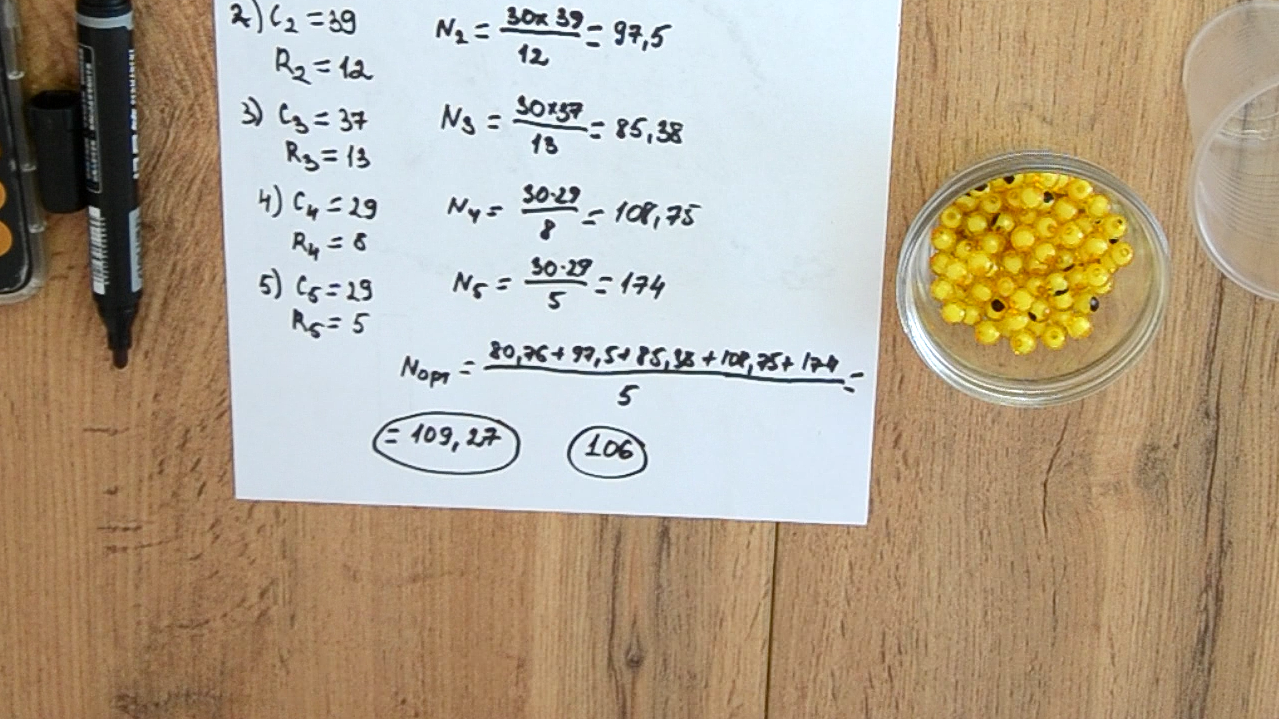
Example of calculation
M = 30
In five captures obtained: R = 13, 12, 13, 8, 5
At each capture C = 35, 39, 37, 29, 29
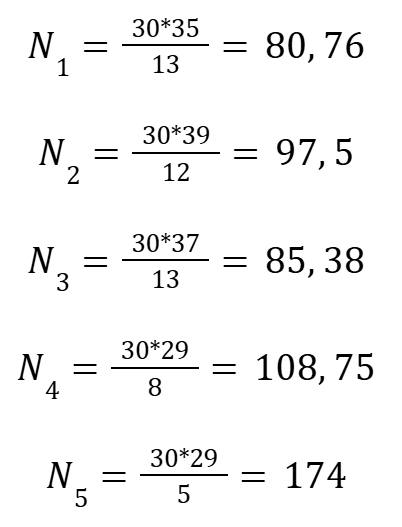
Average:

Result:
Actual N = 106 (only the teacher knows).
Average estimate ≈ 109 (students find out).
Conclusion
During the work, students became practically acquainted with one of the statistical methods for determining population size.
The use of sampling and random selection makes it possible to estimate the number of individuals in an ecosystem with high accuracy without the need to count them all.
The data obtained in the experiment confirm that the average estimate of population size is close to the actual value, while the variation in results is explained by the random nature of sampling.