Lesson
How to make a sugar rainbow?
Objective:
- To learn how to distinguish pure substances from mixtures.
Teacher’s Guide:
Before proceeding with the lab work, review the safety rules by following the link:
- Divide students into several groups.
- Download the worksheet by clicking on the link: worksheet
Theoretical part
Pure substances and mixtures are the basis of everything around us. Pure substances are substances consisting of only one kind of material. By pure substances, we mean substances with the same properties and composition. For example, take a cup of water. Water is a pure substance because there is only water and nothing else in the cup.
Mixtures – are formed when we mix several different substances. In mixtures, each substance retains its own characteristics.
In this practical work, water and sugar are pure substances. And food coloring refers to a mixture. A mixture includes both the solutions obtained by mixing them and the rainbow of the final result. In mixtures you can see that each substance retains its own characteristics, as food dye gives color to a solution, as sugar gives solutions of different densities coloured in each color, retaining the liquid form of water.
Practical part

Step 1.
Familiarize yourself with the necessary material. Put on rubber gloves.
Step 2.
Pour equal amounts of water into the glasses using a measuring cup (about 100-120 ml).

Step 3.
Put the sugar in the glasses. You do not put sugar in the first glass. Put 1 spoonful in the second glass, 2 spoonfuls in the third glass and 3 spoonfuls of sugar in the fourth glass. Dissolve the sugar in the water, stirring.

Step 4.
Add one color of food coloring to each beaker according to the table below and mix.
| color | spoon |
| yellow | 3 |
| orange | 2 |
| red | 1 |
| blue | 0 |

Step 5.
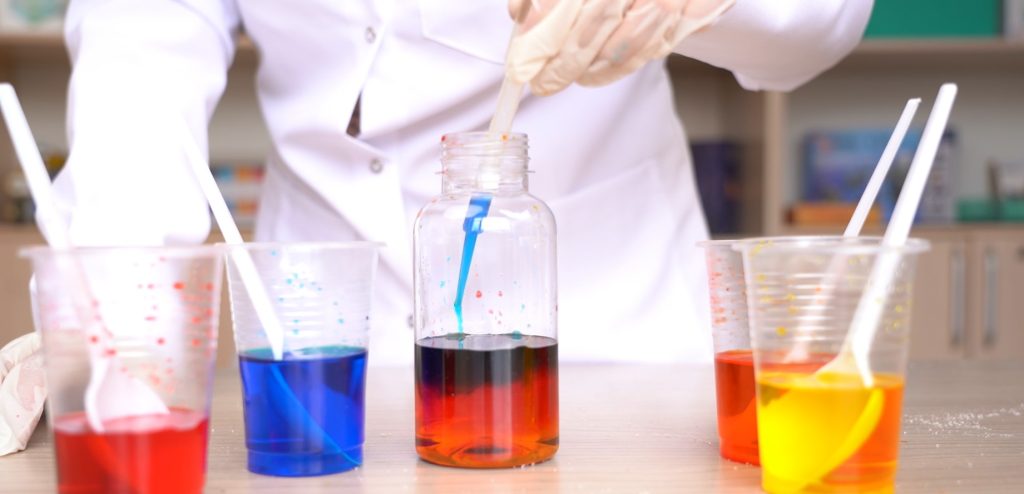
Pour the yellow solution with the most sugar into the bottle using a pipette.

Step 6.
In the same manner, pour the solutions with the colorant into the bottle with the pipette according to the amount of sugar contained. Arrange the colors from highest density (most sugary) to lowest density (least sugary): yellow→orange→red→red→blue. And the rainbow is ready.


Step 7.
Draw conclusions by answering the following questions:
- What does the practical work done have to do with pure substance and mixture? What do you think?
- How is a pure substance different from a mixture?
- People often use mixtures rather than pure things in their daily lives. Why?
- Give an example of a solid and liquid mixture.
Conclusion
In the “sugar rainbow” practical work, we studied the interaction of pure substances and mixtures using sugar solutions in water as an example. When different solutions of different densities interact, there is a separation into layers, which gives us a unique opportunity to observe colorful and interesting phenomena, such as a rainbow made of sugar. This work has led to a better understanding of pure substances and their interactions in solutions.