
Lesson
Objective:
- To learn how to calculate the mass fraction of a dissolved substance.
- learning to weigh things.
- preparing a salt mixture with a given concentration.
Teacher’s Guide:
- Before proceeding with the lab work, review the safety rules by following the link:
- Divide students into several groups.
- Download the worksheet by clicking on the link: worksheet
Theoretical part
Mass fraction is the ratio of the mass of a solution to the total mass of the solution. It allows you to understand how concentrated or dilute a solution is by using mass fraction.
The mass fraction of a substance is the ratio of the mass of a particular component (substance) to the total mass of the solution, expressed as a percentage. It is an index that is used to measure the concentration or content of a particular substance in a solution.
The formula for calculating the mass fraction is as follows:
Mass fraction = (mass of component / total mass of solution) * 100%
Where:
Mass fraction is the percentage content of a particular component in a solution;
Component mass – the mass of the substance you want to measure and express as a percentage;
Total mass of the solution – the total mass of all the components in the solution.
Practical part
Step 1.
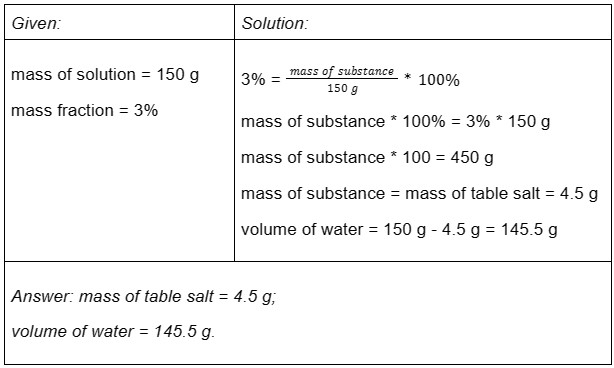
Calculate what mass of table salt and what volume of water should be taken to prepare 150 g of a 3 -normal solution of table salt. To do this, use the formula for calculating the mass fraction.

where, mass of substance = mass of table salt
Step 2.
After determining the mass of table salt and the amount of water, prepare the solution. To do this, pour the water into a 200 ml beaker and weigh it on an electronic scale. The amount of water should be 145.5 g.

Step 3.
Put the table salt in the saucepan and weigh it on the scale. The mass of salt should be 4.5 g.

Step 4.
Pour 145.5g of water into a 400ml glass and add 4.5g of salt. Dissolve the salt in the water by stirring with a spoon, then measure the solution. The solution should weigh 150 g. Dissolve 150g of 3% table salt.

Step 5.
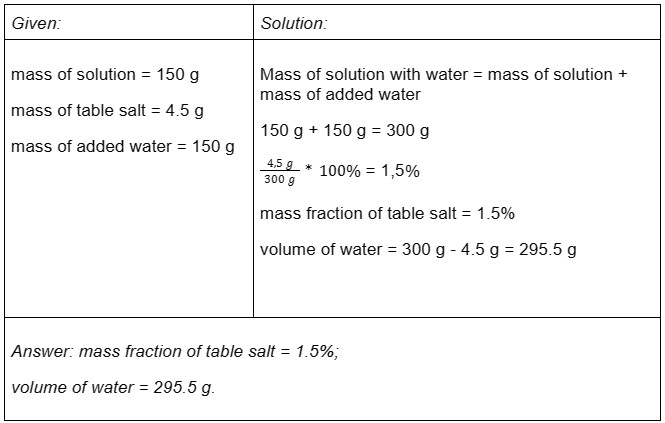
Now add 150 g of water to the resulting solution. To do this, pour the water into a 200 ml beaker and weigh it on an electronic scale.

Step 6.
Pour 150 ml of measured water into the 150 ml solution in a 400 ml beaker. And weigh it with an electronic balance.

Step 7.
Calculate how the concentration of the solution will change in this case (mass fraction of dissolved substances).
Step 8: Answer the following questions and draw conclusions:
- What does the mass fraction of a substance in a solution show?
- In what units is the mass fraction of a substance measured?
- Where in everyday life do you encounter the preparation of solutions of a given concentration?
- Why do you think it is necessary to maintain a strict ratio of substances in the solution of medicinal preparations?
Conclusion
In this practical work for students, a simple and accessible method was used. Students measured the mass of salt using kitchen scales and then dissolved it in water. Then, using a special formula, they determined the mass fraction of the dissolved substance. The results helped to deepen their understanding of the practical application of concentration ratios in chemical investigations.