
lesson
The title of the laboratory work: Examine Archimedes’ force
Purpose of the work:
- compare it to the weight of liquid displaced by the body;
- explore the dependence of the Archimedes’ force on volume of the body immersed into the liquid;
- having known the safety rules, follow them in the physics classroom.
Expected results:
- Archimedes’ force is equal to the weight of the liquid displaced by the body.
- Archimedes’ force is proportional to the volume of the body immersed into the liquid.
Teacher’s Guide:
- Divide the students to 3 students in each group.
- Before starting laboratory work, read the safety rules:
- To download the worksheet, please follow this link:
Theoretical part
Archimedes’ force is the buoyant force that acts on the body in the liquid or gas and pushes it upwards.
The formula of the Archimedes force is
FA = ρ V g
where ρ is the density of the liquid, V is the volume of the body immersed into the liquid, g is the free fall acceleration.
Sources:
- Выталкивающая сила. (2019). Физика. Учебник для 7 класса общеобразовательной школы.
Experimental part
Laboratory stand. To run this experiment, we need a laboratory stand. It can be made from scrap materials and stationery.
Procedure:
Step 1.
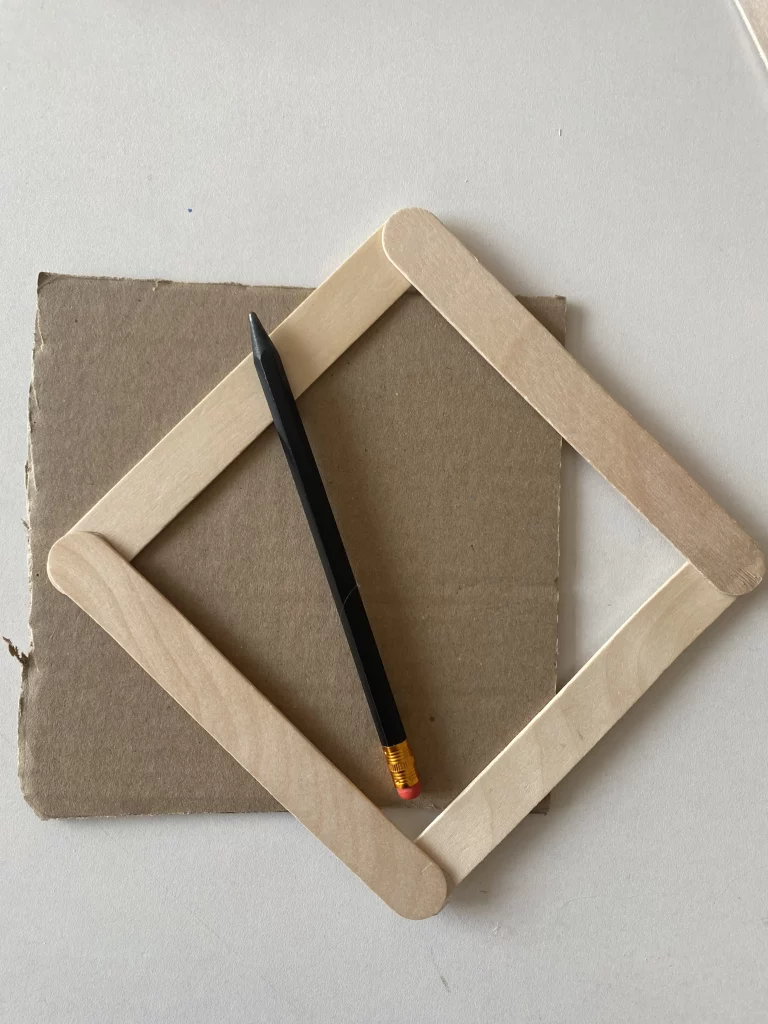
Glue 4 wooden sticks into a rectangle using hot glue as shown at the picture. Cut a rectangle of the same size from the cardboard. This is going to be the basis of the laboratory stand.
Step 2.
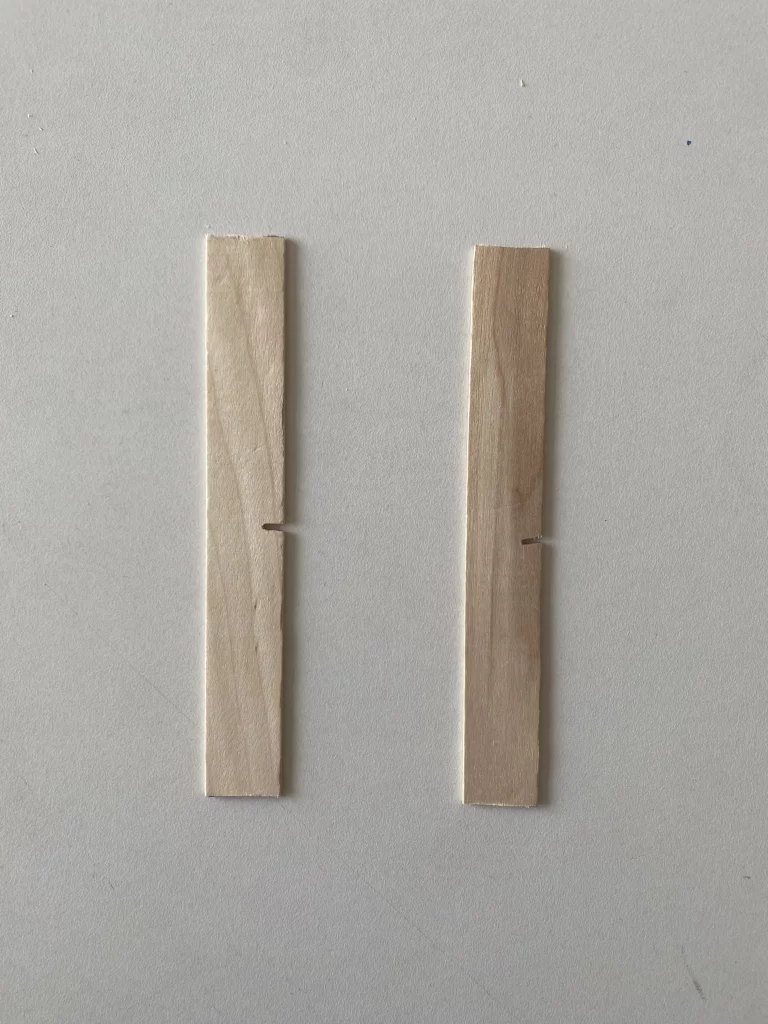
Take a stationery knife, 2 wooden sticks and cut the round ends to make them right angled. Then make a cut in the middle of the sticks of 3–4-millimeter length.
Step 3.
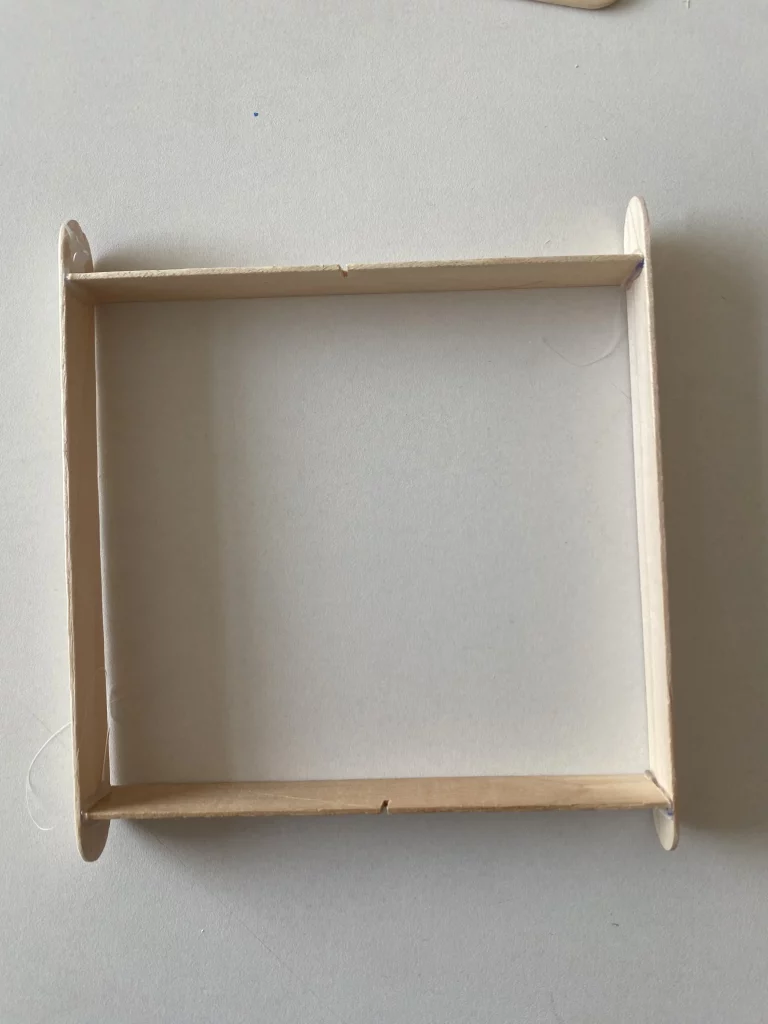
Using the prepared sticks and 2 more sticks, glue them with hot glue to make a rectangle as shown at the picture. This construction is going to be used to stick dynamometer on the laboratory stand.
Step 4.
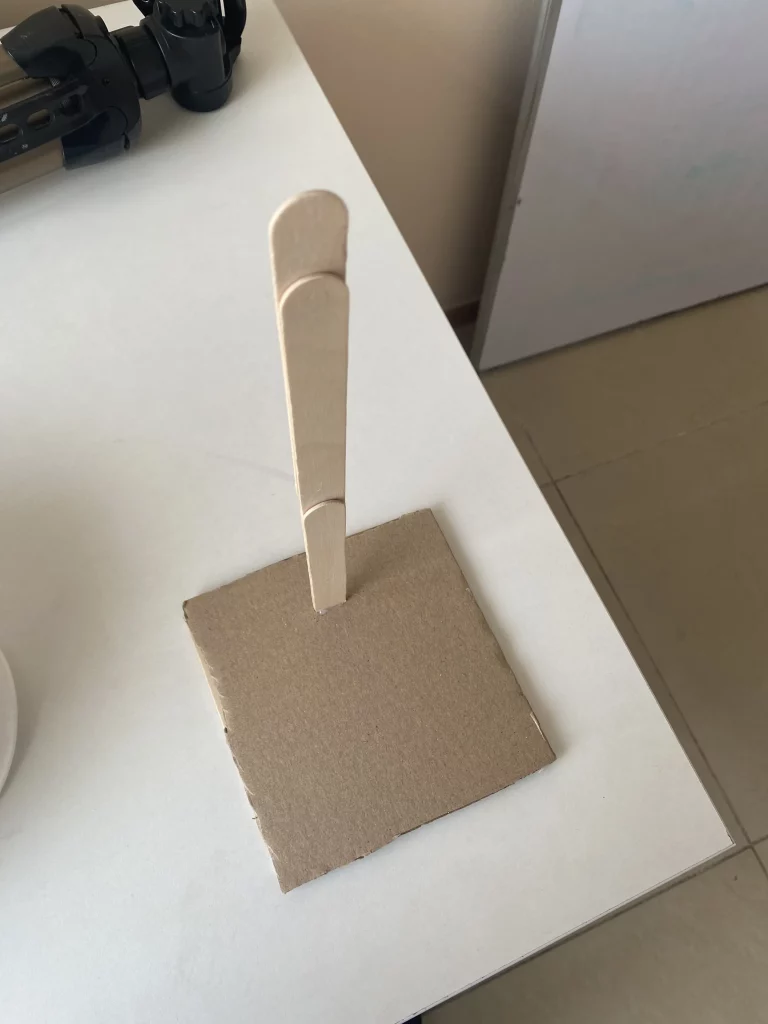
Make a hole in the cardboard and glue 2 wooden sticks into it using hot glue. Glue the cardboard piece to the wooden sticks piece using hot glue. Then add 2 sticks on top to make the stand taller.
Step 5.
Glue the upper construction to the axis of the lab stand. Wait 5 minutes until the hot glue dries up and gets hard, before starting the experiment.
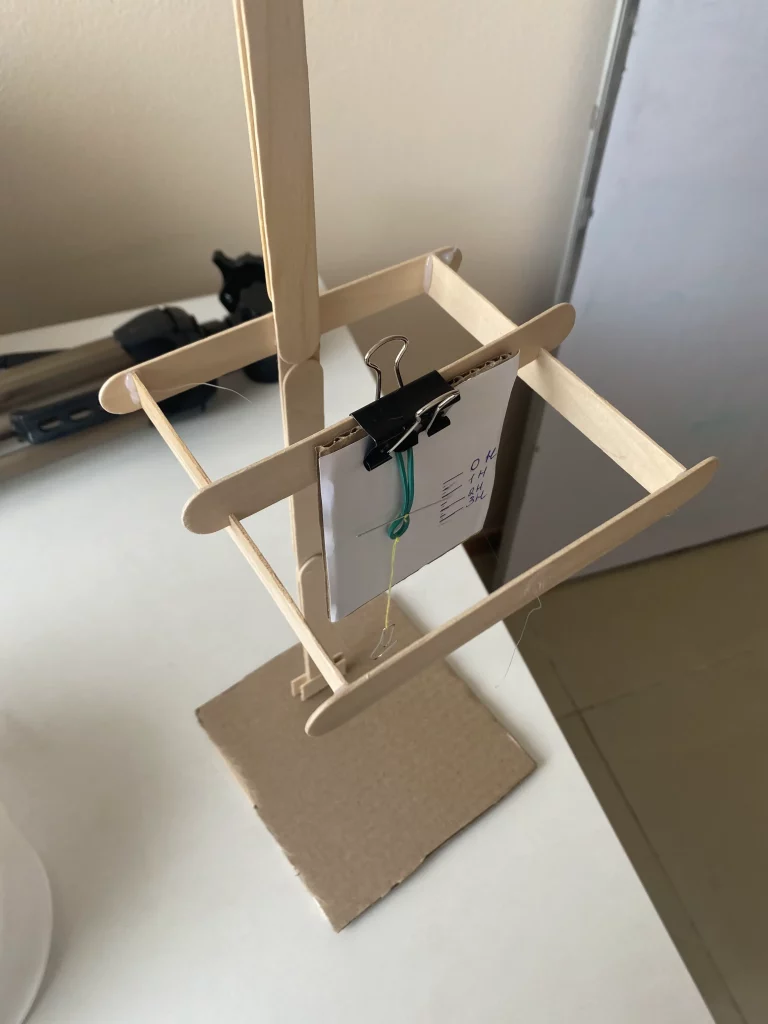
Now you can start the experiment.
Experiment 1. Compare Archimedes’ force with the weight of the liquid displaced by the body.
Procedure:
For this laboratory work we need laboratory stand, dynamometer, weights and beaker.
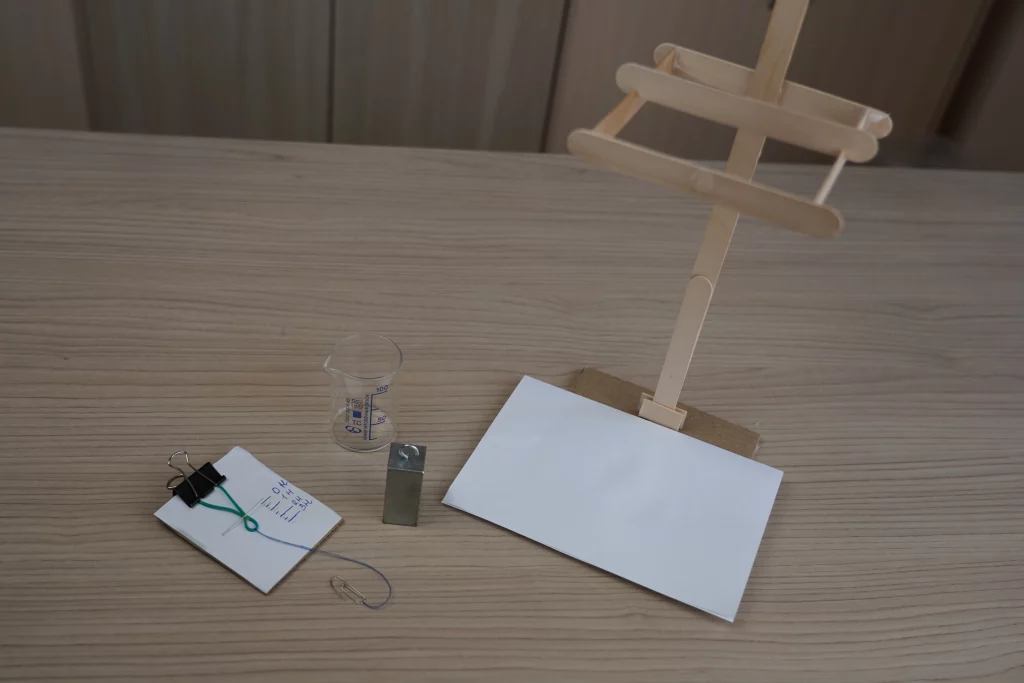
Step 1.
Stick the dynamometer to the laboratory stand.
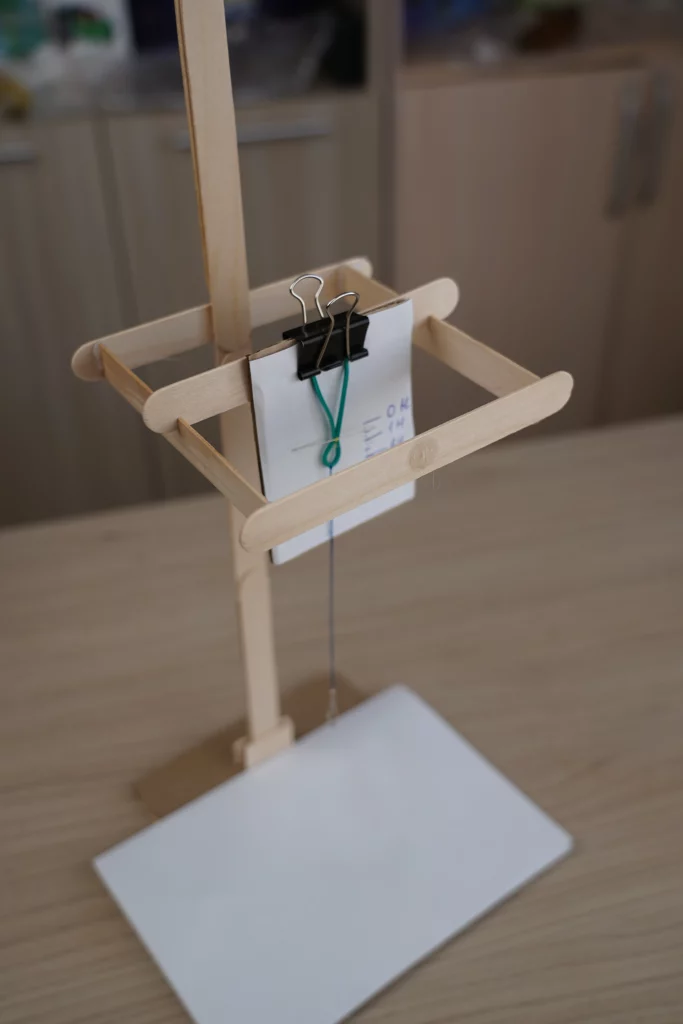
Step 2.
Measure the weight of the object in air. Stick the object to the dynamometer and write down the measurement to the table.
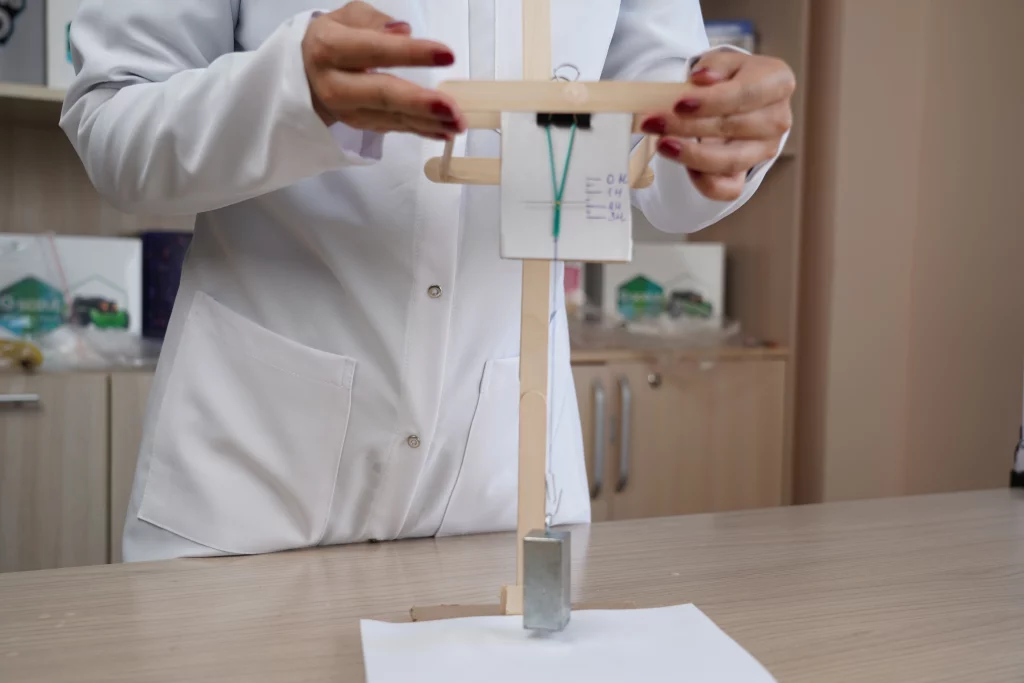
Step 3.
Measure the weight of the object in water. Take a beaker and fill it with water, measure the level of water. Hang the object to the dynamometer and lower it in the beaker into the water. Measure the level of the water. The difference of levels of water gives the volume of the liquid displaced by the object, write it down. Take the measurement of the dynamometer and write it down to the table.
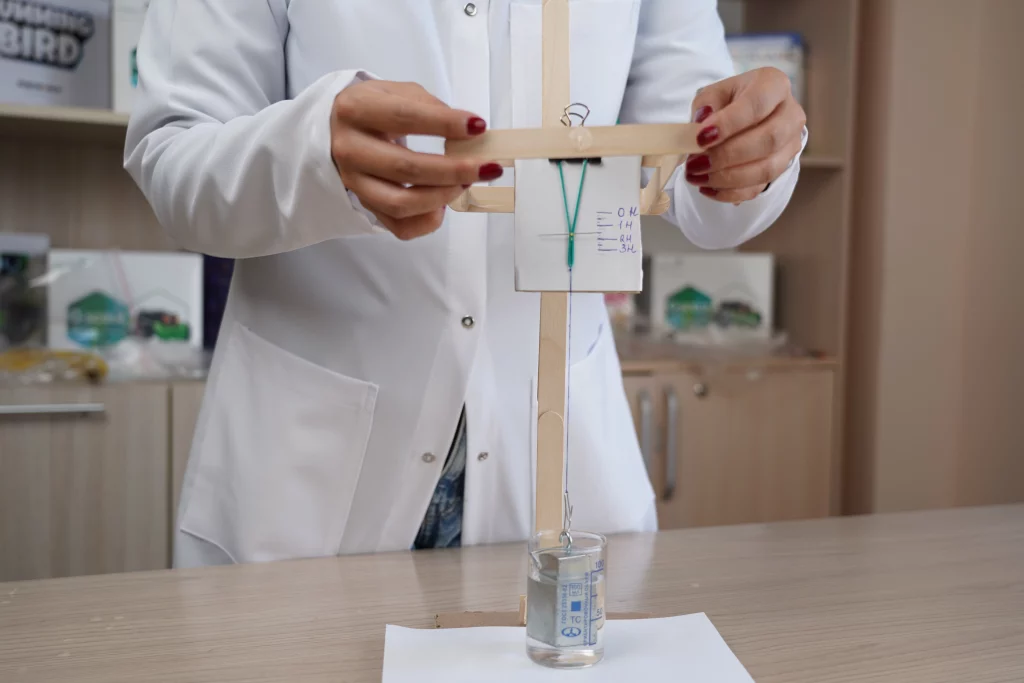
Step 4. Evaluate Archimedes force using the data from the table according to the formula:
FA = P0 – P
where P0 is the weight of the object in air, P is the weight of the object in water.
Step 5. Evaluate the weight of the liquid displaced by the body according to the formula:
P = ρ V g
where ρ is the density of the liquid, V is the volume of the liquid displaced by the body. The density of water is ρ = 1000 kg/m3, g = 10 m/s2. Write down the data to the table. Compare the values of the weight of the displaced liquid and the Archimedes force. Draw a conclusion.
Experiment 2. Examine the dependence of Archimedes’ force on the volume of the body immersed into the liquid.
Procedure:
Step 1.
Immerse the same object into the liquid in the beaker, but just half of its volume, measure the level of water. Calculate the difference, it is the volume of the immersed part of the body and the volume of the liquid displaced by the body, write down the result. Take the measurement of the dynamometer and write it down as the weight of the body in water.
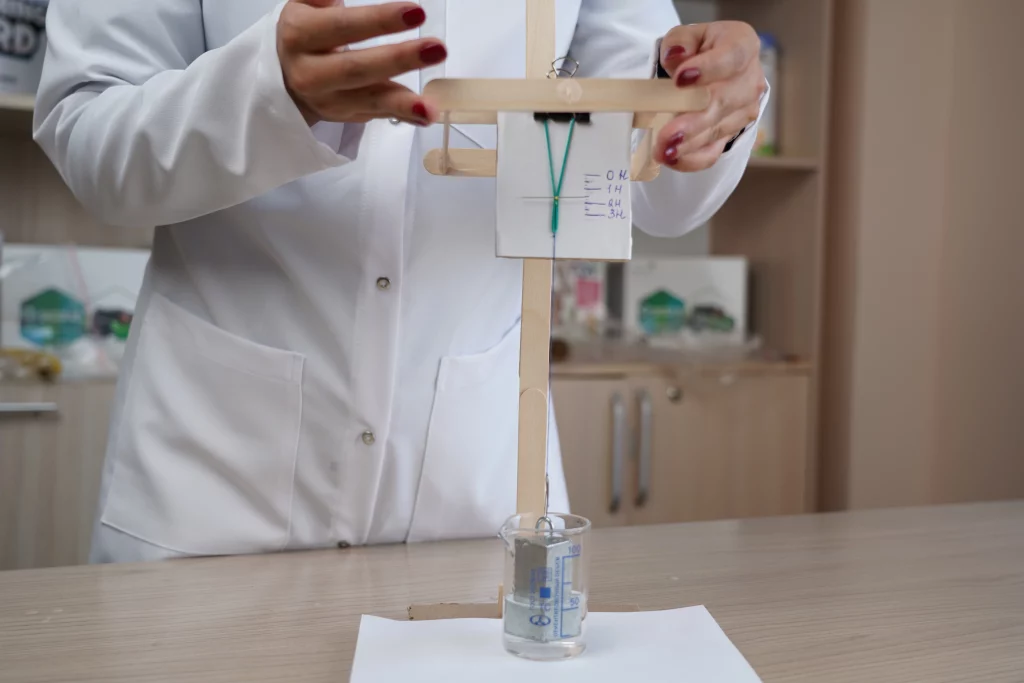
Step 2. Calculate Archimedes’ force and compare it to the Archimedes’ force from the previous experiment. How did it change when we changed the volume of the immersed part of the body? Draw a conclusion.
Research part
| № | Weight in air, P0, N | Weight in air with error, P0±ΔF, N | Weight in water, P, N | Weight in water with error, P±ΔF, N | Volume of immersed body, V, мл | Archimedes’ force, FА, N | Weight of displaced liquid, Pl, N |
| 1 | |||||||
| 2 |
When deriving conclusions, answer the following questions:
- Is there a difference between Archimedes’ force and the weight of displaced water?
- What does Archimedes’ force depend on? Did Archimedes’ force change when we changed the volume of immersed part of the body?
Conclusion
Archimedes’ force is equal to the weight of the displaced liquid. Archimedes’ force is proportional to the volume of the immersed body.