
Lesson
Project objective
– Will be able to describe the respiratory system;
– Identify the role of the respiratory system in the human body;
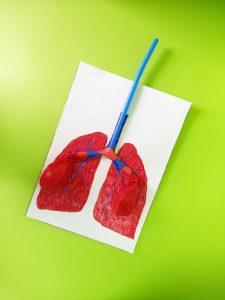
– Make a model of the respiratory system.
Teacher’s guide
– In the practical part of the project, pupils work in pairs.
– Pupils should be introduced to topics such as the respiratory system and its role in the human body.
– Before beginning the experimental part, familiarise and provide the students with all the necessary materials.
– Give brief instructions on how to use the scissors.
– Explain the PBL (project based learning) rubric to the students at the beginning of the lesson. Skills 4K (critical thinking, collaboration, creativity, presentation)
Safety in Steam lessons
Before we begin the lesson, teachers are advised to familiarise themselves with the safety procedures. If necessary (if using items specified in the PPE), brief the students. Go to Safety in Steam lessons
Theoretical Part
The respiratory system is the set of organs responsible for bringing oxygen from the surrounding air into the respiratory tract and performing gas exchange, i.e. getting oxygen into the bloodstream and removing carbon dioxide from the bloodstream back into the atmosphere. However, the respiratory system is not only the provision of oxygen to the body – it is also human speech, and the capture of various smells and heat exchange.
The human respiratory system is roughly divided into the airways, or conductors, which carry the air mixture to the lungs, and the lung tissue, or alveoli. The airways are conventionally divided into upper and lower airways according to the level of attachment of the oesophagus. The upper ones include:
- the nose and its appendages
- sinuses
- oropharynx
- larynx
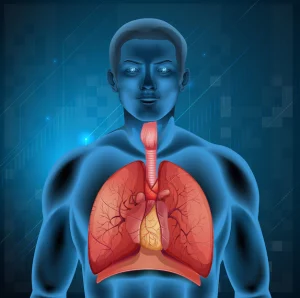
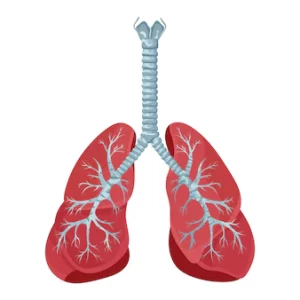
The lower airways include the trachea:
- trachea
- main bronchi
- bronchi of the following orders
- terminal bronchioles
The nasal cavity is the first borderline when air enters the body. Numerous hairs on the nasal mucosa stand in the way of dust particles and clean the passing air. The nasal sinuses are represented by well-blooded mucous membranes, and by passing through the sinuous nasal concha the air is not only purified, but also warmed. The nose is also the organ through which we can enjoy the aroma of freshly baked goods, or pinpoint the location of a public lavatory. This is because there are sensitive olfactory receptors on the mucosa of the upper nasal concha. Their number and sensitivity are genetically reprogrammed, which is how perfumers create memorable perfume fragrances.
The structure of the respiratory system ensures the necessary gas exchange. When breathing in, muscles stretch lung tissue, as a skilful musician fur an accordion, and the air mixture of atmospheric air, consisting of 21% oxygen, 79% nitrogen and 0.03% carbon dioxide, moves along the respiratory tract to the terminal department, where the alveoli, braided thin network of capillaries, are ready to receive oxygen and give up the exhausted carbon dioxide from the human body. The composition of exhaled air has a much higher carbon dioxide content of 4%. To imagine the magnitude of the gas exchange, just think that the area of all the alveoli in the human body is about the same as a volleyball court. To prevent the alveoli from sticking together, their surface is lined with surfactant, a special lubricant containing lipid complexes. The terminal sections of the lungs are densely braided with capillaries and the wall of the blood vessels is in close contact with the wall of the alveoli, which allows oxygen contained in the alveoli by the difference in concentration, without the participation of carriers, by passive diffusion into the blood. Oxygen is involved in oxidation processes, and the cell receives the energy required for vital activity as a result. Respiration and gas exchange are the most important functions of the respiratory system, but by no means the only ones. The respiratory system ensures the maintenance of heat balance by the evaporation of water by breathing. The attentive observer will notice that when the weather is hot, humans breathe more frequently. In humans, however, this mechanism does not work as efficiently as in some animals, such as dogs.
Practical part
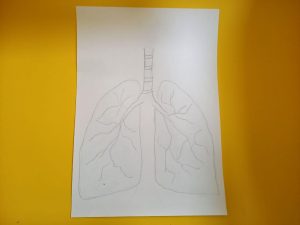
Step 1. Take white A4 paper and draw the lungs on it
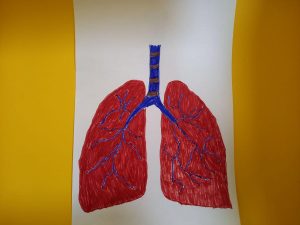
Step 2. Now you need to colour the picture
Step 3. Take a 21x30cm cardboard and use paper glue to glue the lung pattern onto the cardboard
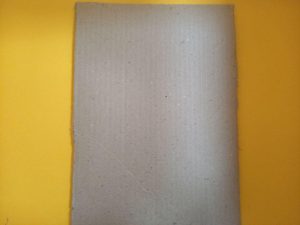
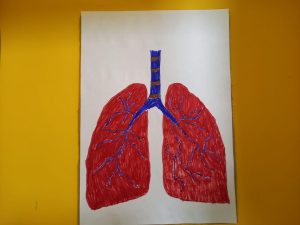
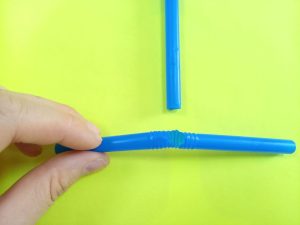
Step 4. Take 2 tubes, and make a hole in one of them with the size of the tube, then attach the second tube to the first with duct tape
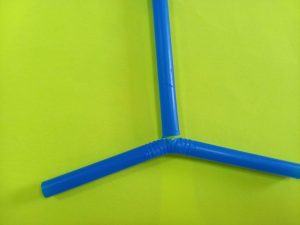
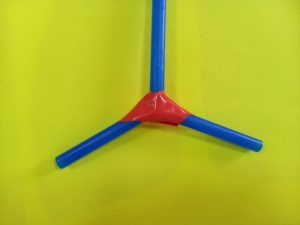
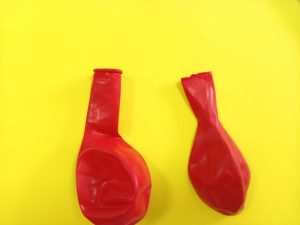
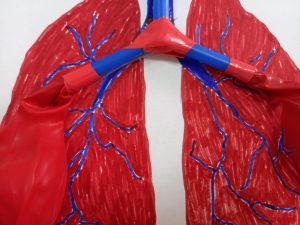
Step 5. Cut out the top of the 2 balloons and fix them to the tubes using duct tape. Secure the tube with double-sided tape to a piece of white paper with a design on it
Conclusion
In this lesson students have learned how the human respiratory system works and its role in the body. They also learnt which organs help us to breathe.

In this project, each pupil is awarded a STEAM title, by category:
– You have independently, investigated the human respiratory system, made a model of the respiratory system уou are a real scientist – a biologist!
– You have developed teamwork skills by working in pairs. You have shown your creativity in the practical work.
Evaluation

