
Trigonometric Function
Trig Tour by PhET Interactive Simulations, University of Colorado Boulder, licensed under CC-BY-4.0 (https://phet.colorado.edu)
Objective:
- To know the definitions of trigonometric functions.
This virtual activity is designed to be used in the algebra lesson in the next chapter:
Grade 9. “Sine, cosine, tangent, and cotangent of an arbitrary angle. Values of sine, cosine, tangent and cotangent of angles”.
Theoretical Part
The basic trigonometric functions are sine, cosine, tangent, and cotangent. These functions establish the relationship between the sides and angles of a right triangle.
For a deeper understanding of trigonometric functions, it is convenient to use the unit circle – a circle of radius 1 centered on the origin. Any point on this circle defines an angle with a positive direction from the positive half axis Ox. The coordinates of this point are equal to the cosine or sine of this angle.
Definitions of the trigonometric functions:
- The sine (sin) of an angle α is the ordinate of the point on the unit circle corresponding to the angle α.
- The cosine (cos) of an angle α is the abscissa of the point on the unit circle corresponding to the angle α.
- The tangent (tg) of an angle α is the ratio of the sine to the cosine of that angle: tg α = sin α / cos α.
- The cotangent (ctg) of an angle α is the ratio of the cosine to the sine of that angle: ctg α = cos α / sin α.
The values of trigonometric functions for some angles (0°, 30°, 45°, 60°, 90°, etc.) are often used in various calculations. These values can be found in special tables or calculated with a pocket calculator.
Virtual Experiment
In this activity, students estimate the value of trigonometric functions for any given angle without a calculator using the concept of a unit circle. Identifies specific trigonometric functions for given angles, using degrees or radians to measure angles.
Workflow:
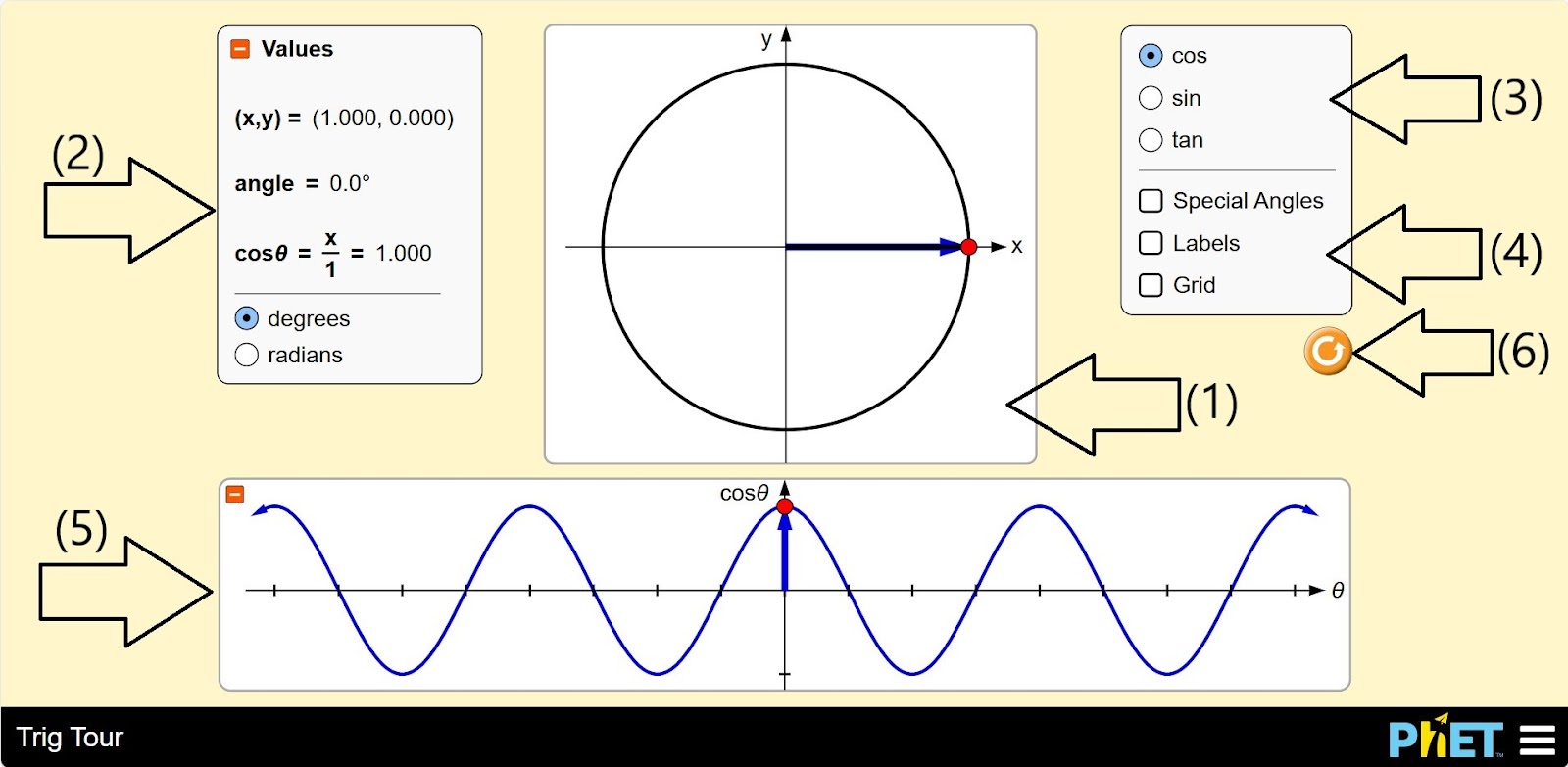
Step 1. Launch the simulator. In the workspace, you will see
- Unit Circle (1);
- Measuring angles: in degrees or radians (2);
- Types of trigonometric functions: sine, cosine, tangent (3);
- Buttons: special angles, labels, grid (4);
- Function graph (5);
- Reload button (6).
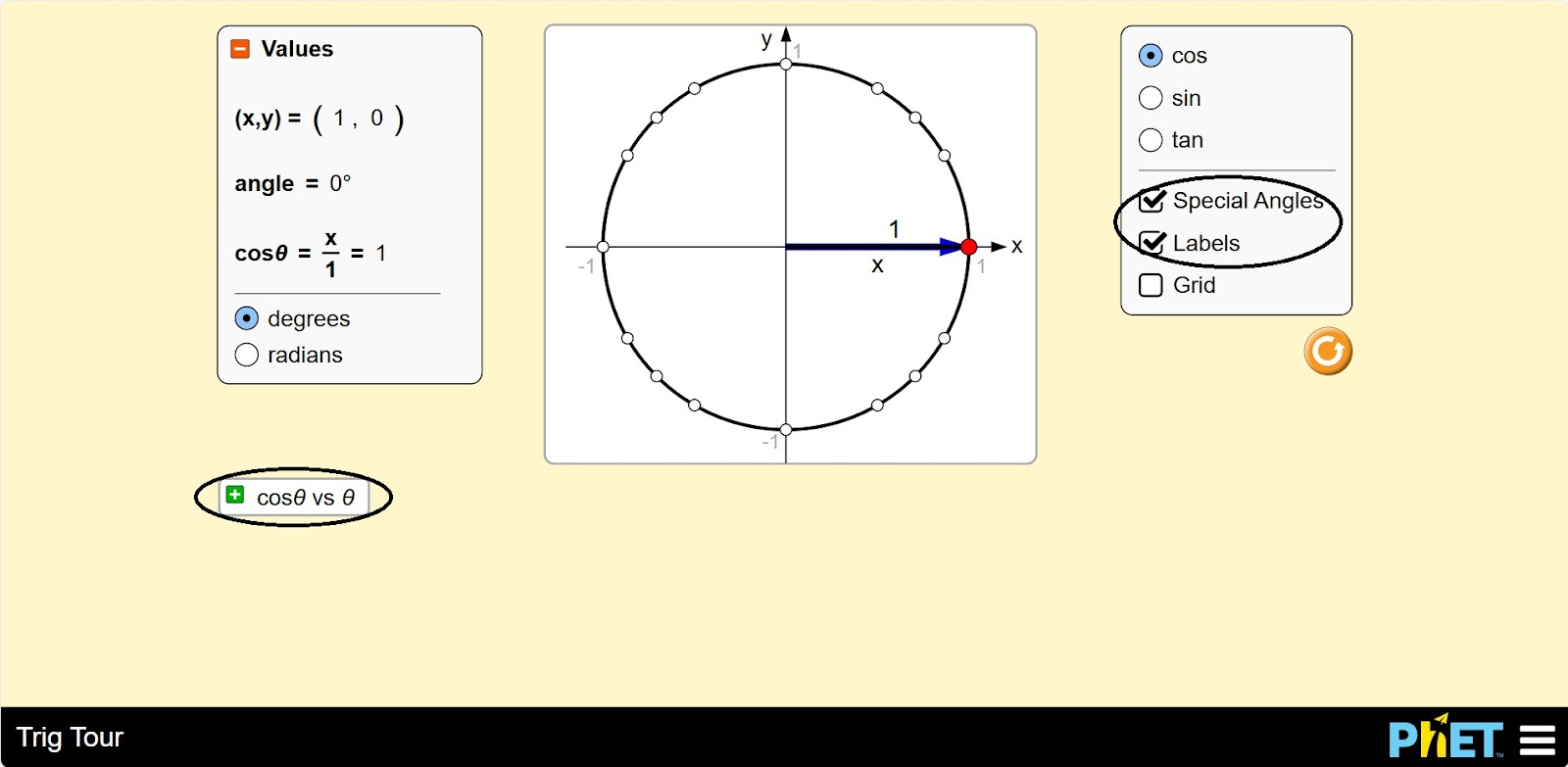
Step 2. You don’t need the function graph. Assemble it. Activate buttons special angles, labels.
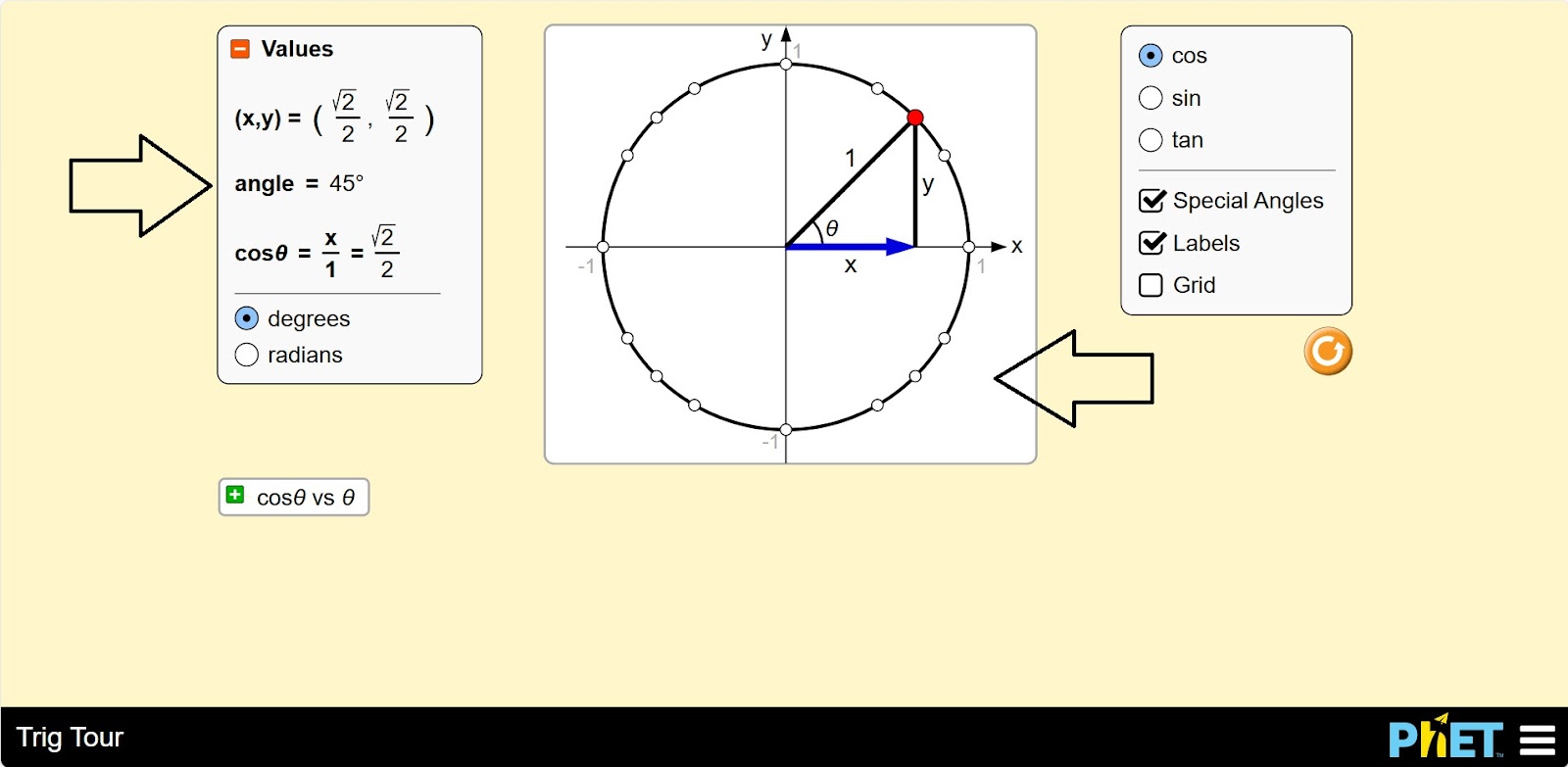
Step 3. When the angle is 45⁰, examine cos θ. Cosine (cos θ): the ratio of the length of the adjacent leg to the length of the hypotenuse.
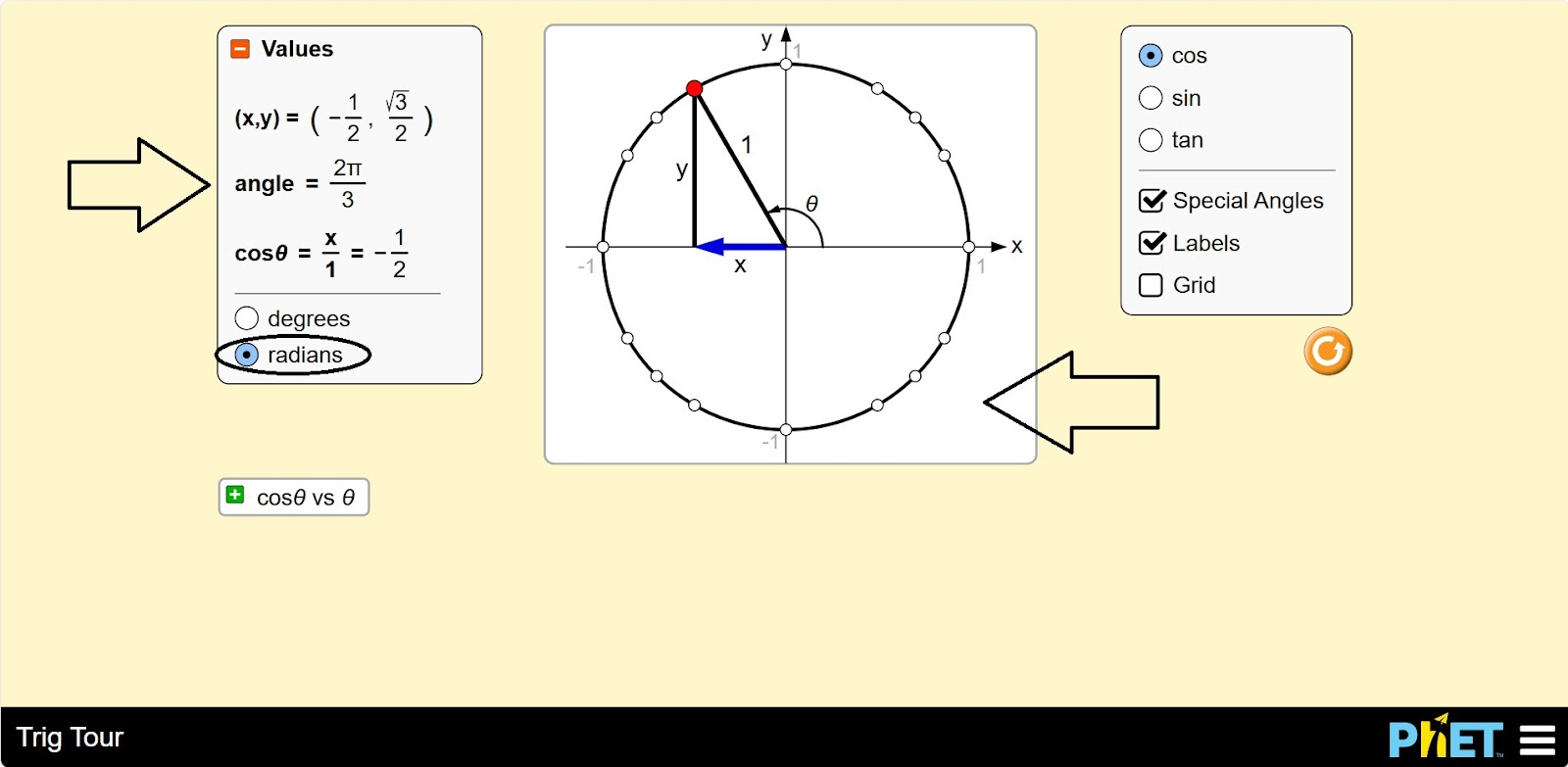
Step 4. Change the degrees of the angle to special angles and explore cos θ. Try changing the degrees to radians.
Step 5. Change the trigonometric function to sine. Sine (sin θ): the ratio of the length of the opposite leg to the length of the hypotenuse.
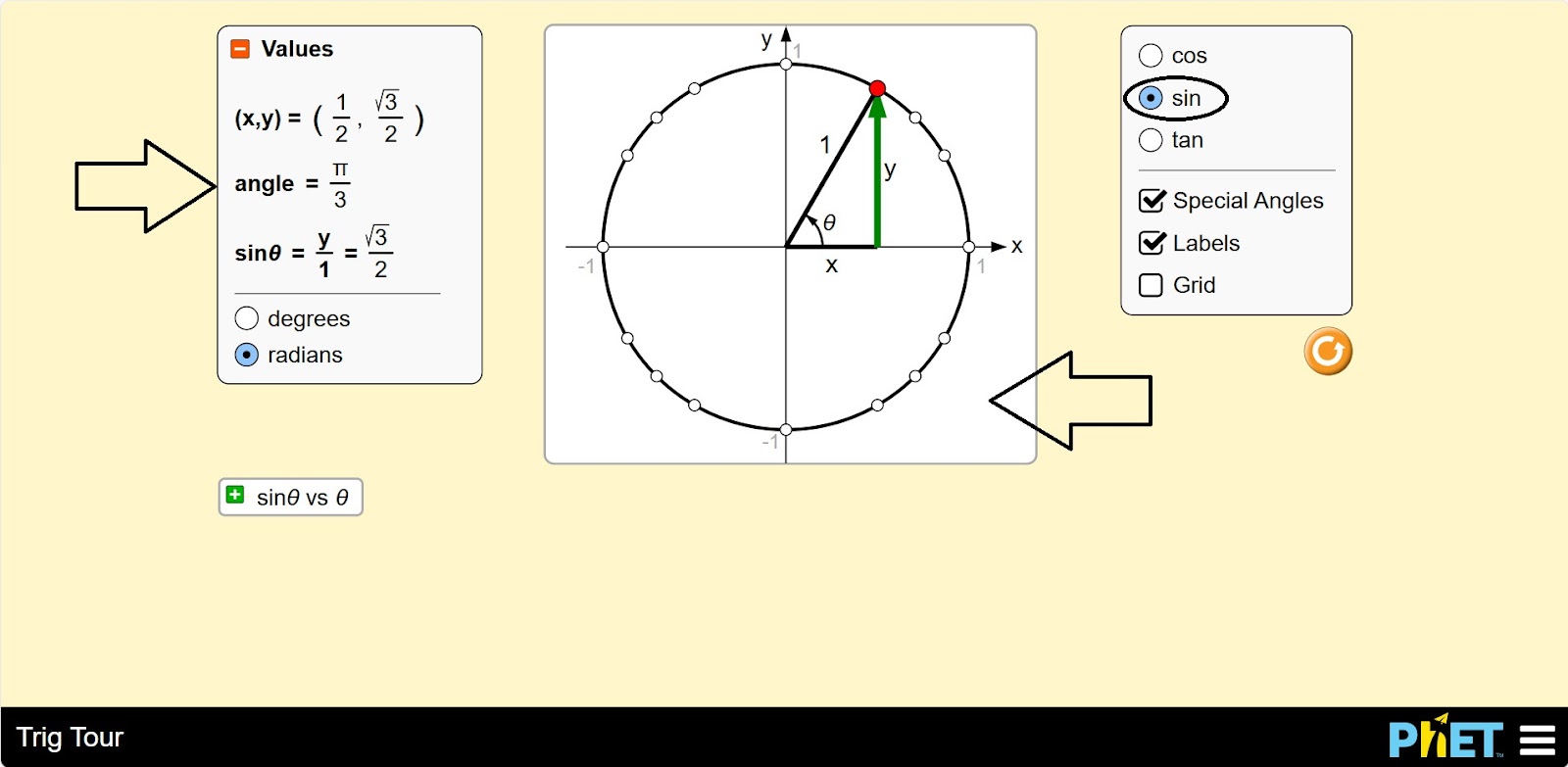
Step 6. Switch to special angles and examine sin θ.
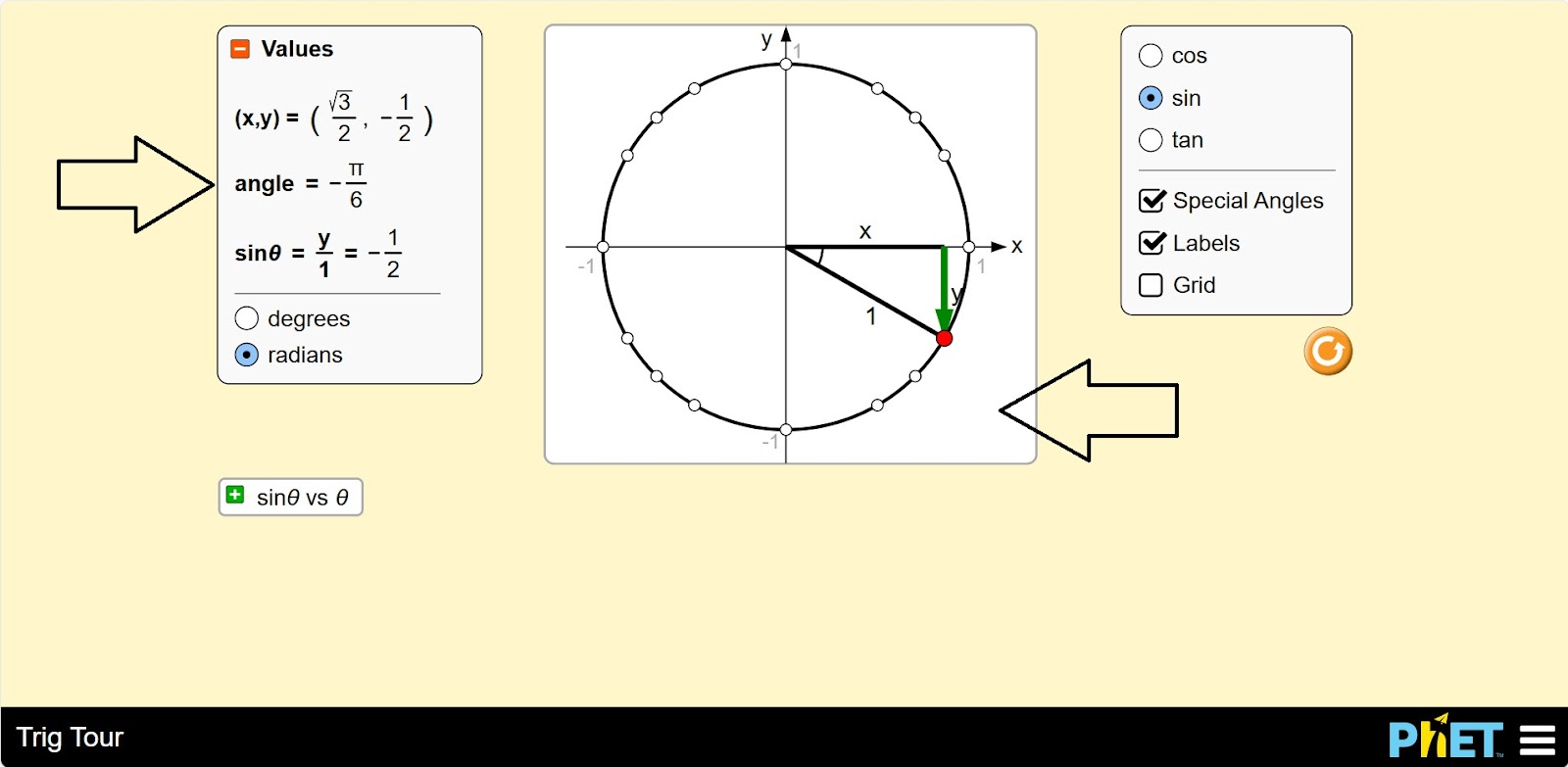
Step 7. Change the trigonometric function to tangent. Tangent (tg θ): the ratio of the length of the opposite leg to the length of the adjacent leg.
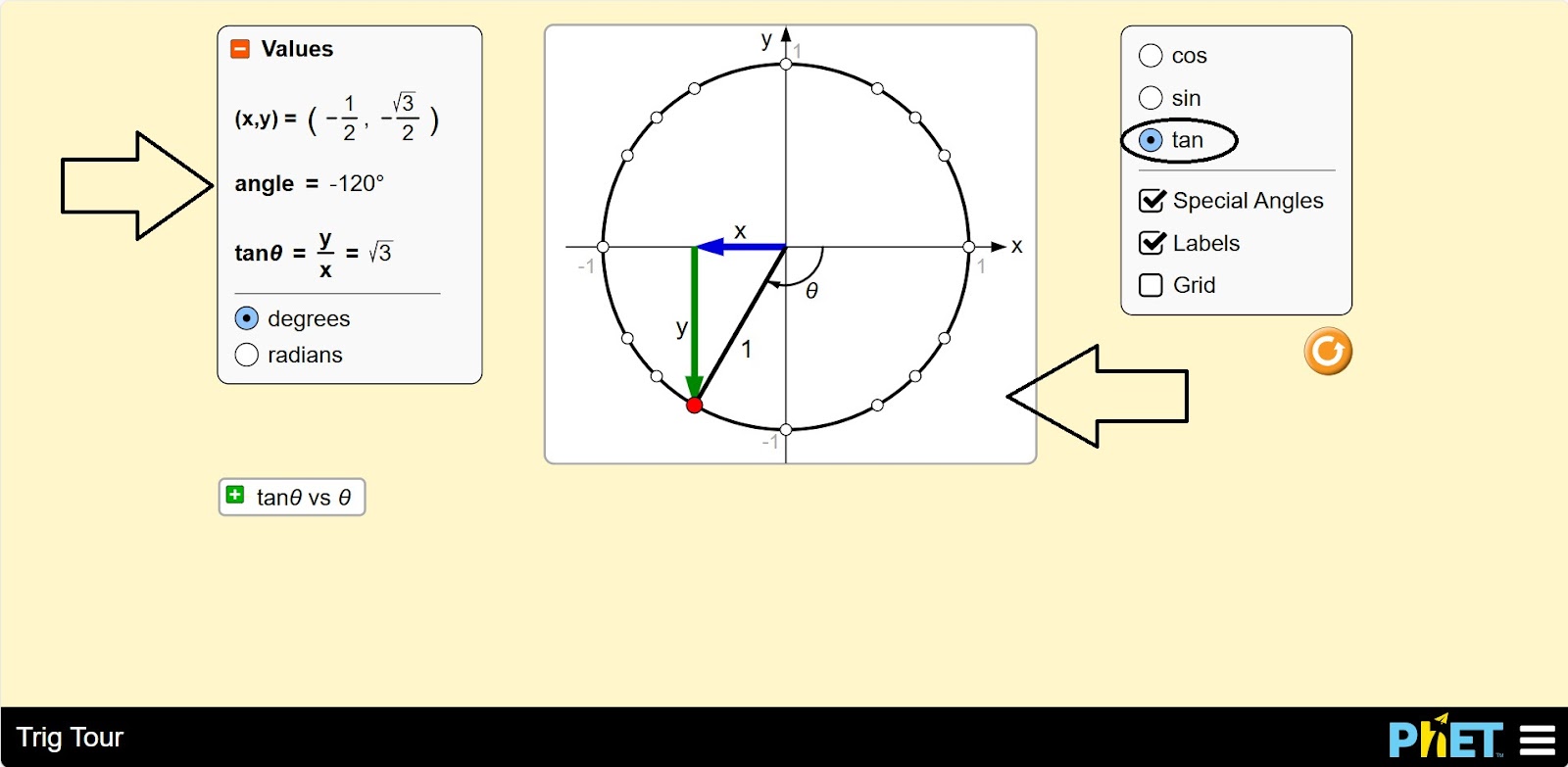
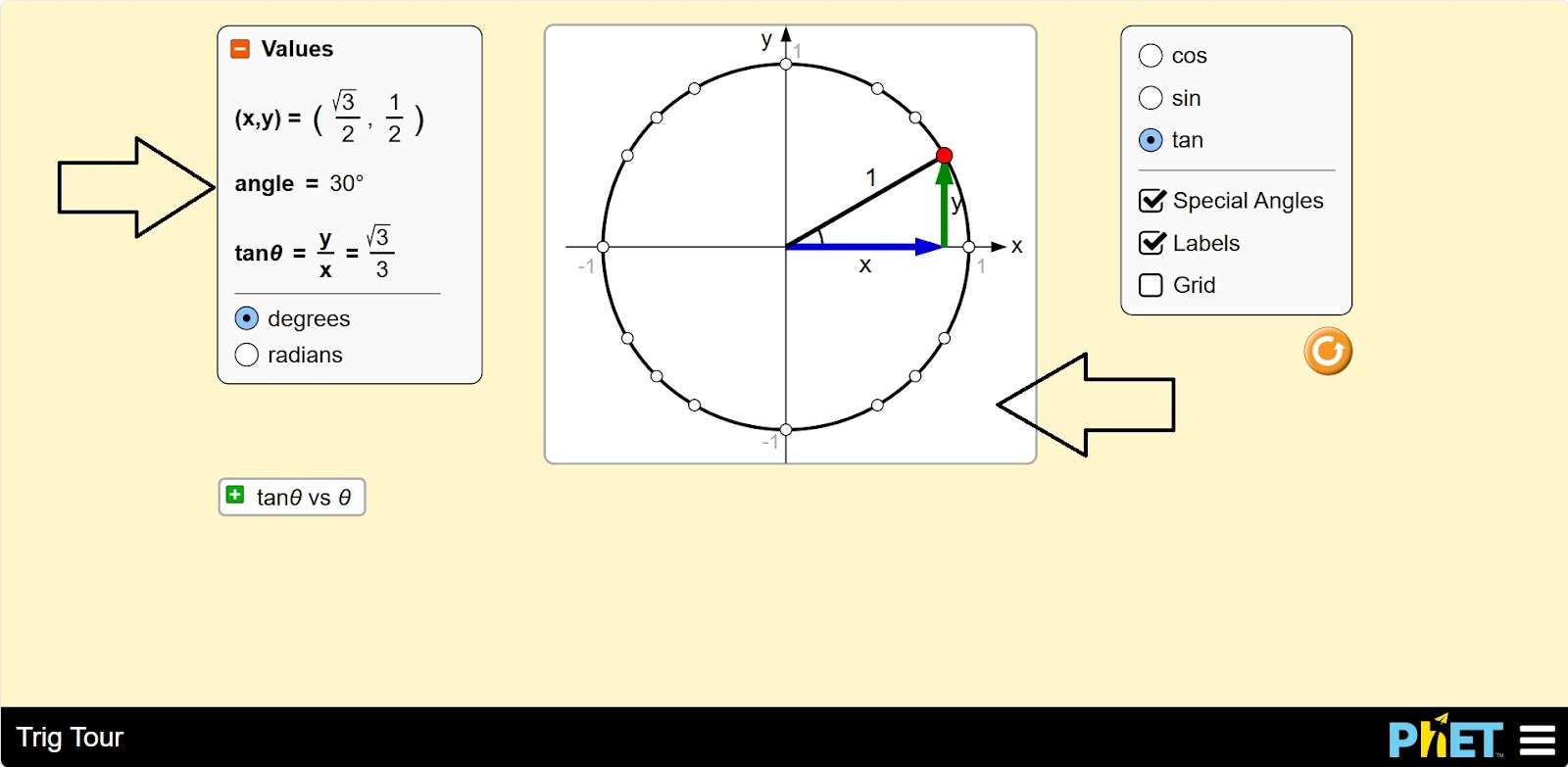
Step 8. Switch to special angles and study tg θ.
Conclusion
Students used the simulator to calculate the values of trigonometric functions of angles given in degrees (radians), which are often used in practice. Learning trigonometric functions by sight in a unified structure can be a good aid to understanding the subject.