
Lesson
Project objective
– List the planets of the solar system;
– Identify the locations of the planets;
– Determine the distance between the planets.
Teacher’s guide
– In the practical part of the project, the students work in a group of 3-4 students.
– The students should be introduced to topics like the solar system .
– Before beginning the experimental part, introduce and provide the students with all the necessary materials.
– Give brief instructions on how to work with scissors and plasticine.
– Explain the PBL (project based learning) rubric to the students at the beginning of the lesson. Skills 4K (critical thinking, collaboration, creativity, presentation)
Safety in Steam lessons
Before we begin the lesson, teachers are advised to familiarise themselves with the safety procedures. If necessary (if using items specified in the PPE), brief the students. Go to Safety in Steam lessons
Theoretical part
The solar system is made up of eight major planets and five dwarf planets orbiting in approximately the same plane. The planets are divided into the Earth group and the giant planets according to their physical properties.The Earth group planets are relatively small and dense, made up of metals and minerals. These include:
- Mercury
- Venus
- Earth
- Mars
The giant planets are many times larger than the other planets and are made up of gases and ice. These are:
- Jupiter
- Saturn
- Uranus
- Neptune

The Solar System, formed almost 5 billion years ago, consists not only of 9 planets orbiting the Sun, but also of smaller objects: planetary satellites, asteroids, comets and others.
The distance from the Sun even to the nearest Mercury is about 58 million km, to Venus – 108 million km, the Earth – 150 million km, Mars – 228 million km, Jupiter – 778 million km, Saturn – 1429 million km, Uranus – 2875 million km, Neptune – 4497 million km. Pluto is the farthest from the Sun – it is about 5913 million km away.

Practical part
To make the planets look like real planets, we need to make them out of plasticine. To do this, let’s first look at a picture of the solar system. Look at this picture and make planets.

Step 1. Take plasticine and make a colour-matched planet

Step 2. First make the sun. Make sun completely out of yellow plasticine, make a circle but not like a ball
.jpg?resize=575%2C766&ssl=1)
Step 3. After we finish making the sun, we make the Earth. To do this we cut out pieces so that it is like in the picture and then join them together. In the same way we make 6 other planets. Just a different shaped planet Saturn, which we showed in the next step
.jpg)
Step 4. Make the planet Saturn into a ball shape and make a ring that surrounds it. So, the planets of our solar system have been prepared. In order you should have a sun and 8 planets
.jpg)
Step 5. After creating the planets, each of our students creates a spaceship (spacecraft) that flies through space
.jpg)
Step 6. Imagine that after you have created a model of the solar system, you compress the solar system so that the distance from the Earth to the Sun is 10 cm. When the solar system is compressed hard, all the planets get compressed, so they become very small. You add signs to help you remember where the planet is going. In the next steps you will find out how far away from the sun each of the eight planets left in the small model can be.
Write the name of all the planets, like Earth, on the card.
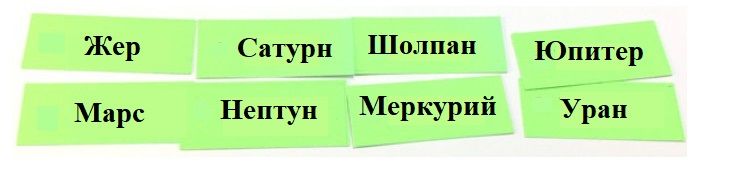
Step 7. Attach planet names to our planets using the button

Step 8. The planets should be the same as in the picture
.jpg)
Step 9. The table below shows the eight planets that show the orbital distance. Orbital distance is the average distance from a planet to the Sun around the Sun. This is often shown in astronomical units (AU). One AU is equal to the distance from the Sun to the Earth. The last column of the table shows the distances at which the orbital distances in your model are reduced


Step 10. Using the distances (cm) given in the table. Calculate the distances of the eight planets from the sun. Send a string separately to each planet

Step 11. Tie one head of thread to the planet and the other to the sun
.jpg)
Step 12. So our planets are ready
.jpg)
To the teacher: Ask the students to list the names of the planets.
Now imagine. The spaceship we created will fly to all the planets over and over again, starting from the sun. Tell the children to perform this action, i.e. each student will fly through the spaceship they created to all the planets, starting from the Sun.
Then ask the children the following question:
- Which planet will the spaceship reach first when flying from the Sun, and why will it reach it first?
- Which planet will be the last to be reached by the spacecraft flying from the Sun, and why will it be the last to reach it?
- What is the name of our inhabited planet
- Where is Our Planet located, you must have noticed when flying?
- A spaceship can only land on the sun in our imagination, why in real life can’t a spaceship land on the sun?
Conclusion
In this lesson the students learned about the distance between the planets. They also listed the planets in the solar system.

On this project, each student is awarded a STEAM title, by category:
– You independently, explored the solar system You are a true scientist – an astronomer!
– You have developed teamwork skills by working in groups. In the practical work you have shown your creativity and cohesion.
Evaluation

