
Week 1
Goal
1. Designing a working model of the kidneys, bladder and circulatory system;
2. Study of possible problems related to kidney function, chronic kidney disease;
3. Make an artificial kidney machine, in other words, a hemodialysis machine, as a solution to problems associated with kidney failure.
Expected results
After studying the project, students:
– will be able to acquire skills of cooperation with a teacher and work in a group, in pairs
– will be able to analyze and summarize the information received
– a responsible attitude to the teaching will be formed
– communicative competence will be formed in the process of educational activity
– learn how to conduct a questionnaire (survey), research statistical data
– based on the survey data received, they will learn how to make graphs (charts, etc.)
– they will be able to independently build logical reasoning and draw conclusions
– they will be able to form a valuable attitude of students to their health
– studies the structure of organs: kidneys, bladder, circulatory system
– independently create a kidney model
– independently construct an artificial kidney apparatus (hemodialysis)
Interdisciplinary communication:
– Chemistry (chemical reactions occurring during hemodialysis, preparation of dialysis solution)
– Biology (human body, model of kidneys, bladder, circulatory system, diseases associated with renal insufficiency)
– Artistic work (construction of the human body, kidney models and design)
– Physics /engineering (the design of the model of the artificial kidney apparatus, the study of the principle of operation, the principle of operation of the pump)
– Mathematics (collection and analysis of information, statistics)
Teacher’s Guide
At the beginning of the lesson, it is recommended:
1. to encourage interest in the project, ask a few “leading questions”, such as:
What is health in your understanding?
What are kidneys for? Describe the function, the principle of operation?
What diseases do you know related to kidney and bladder?
What solutions can you offer? (hemodialysis, transplantation, etc.)
2. Before starting the experimental part, explain to the students the description of the project, all the terms that will be used
3. Provide all the necessary materials to the students
4. To evaluate the project, in the first week, provide this material (PBLrubrics) to students in order to:
– the students previously understood by what criteria they needed to prepare,
– the students were able to independently give an appropriate assessment to their colleagues.
Attention!
Warn students that the apparatus of artificial kidneys, which they themselves will make, is not suitable for use in real life, and that this is just a mock-up for studying the principle. And also, in this apparatus of artificial kidneys, repeated filtration is used, selective membranes are used, and special attention is paid to strict observance of sterility and hygiene rules, in addition, the procedure is carried out only at the behest of the attending physician.
Project Description
Anatomy of the human urinary system
1. Human urinary system:
2. kidney
3. renal pelvis
4. ureter
5. bladder
6. the urethra.
7. the adrenal gland
Vessels:
8. renal artery and vein
9. inferior vena cava
10. abdominal aorta
11. common iliac artery and vein
Other: 12. liver 13. colon 14. pelvis
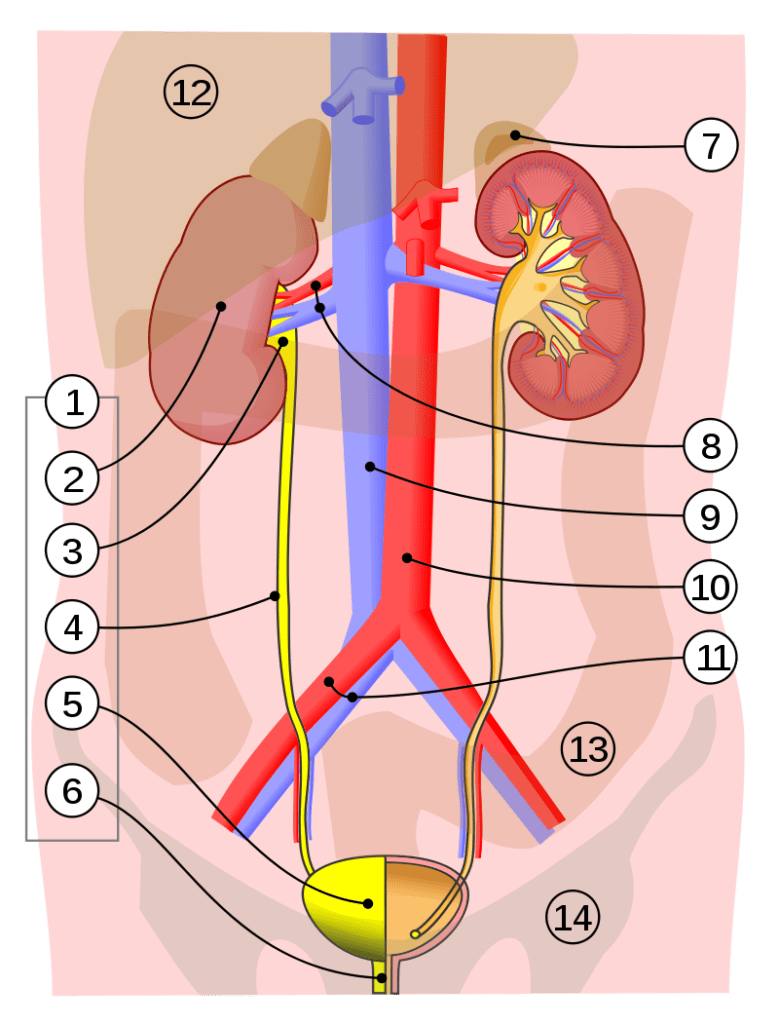
Anatomy of the kidneys
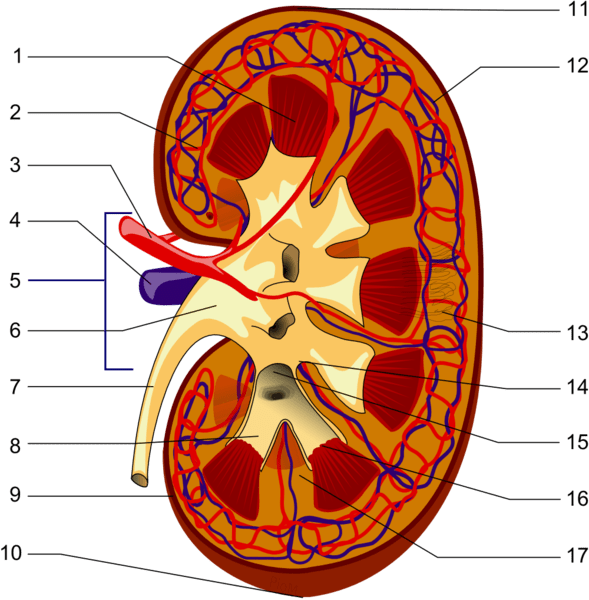
The kidney is a paired bean-shaped organ that cleanses the blood, performing the regulation of chemical homeostasis of the body through the function of urination. It is part of the urinary system (urinary system). They are usually found in the back of a person.
1.Renal pyramid
2.Interlobular artery
3.Renal artery
4.Renal vein
5.Renal hilum
6.Renal pelvis
7.Ureter
8.Minor calyx
9.Renal capsule
10.Inferior renal capsule
11.Superior renal capsule
12.Interlobar vein
13.Nephron
14.Minor calyx
15.Major calyx
16.Renal papilla
17.Renal column
Watch this video:

How to determine if your kidneys are healthy?
Every 30 minutes, our kidneys pass through all the blood (considering that the nephrons – the elementary structural unit of the kidney work by a third, because 1/3 is working, 1/3 is preparing for work, 1/3 is resting), which is contained in our body, filter out urine and everything that needs to be removed from it. After performing urine and blood tests, we will determine whether our kidneys are working well.
One of the indicators of the effectiveness of the kidneys is the analysis of the glomerular filtration rate (GFR) – the rate at which blood is able to be filtered by kidney lumps. Normally, it is 80-120 ml per minute, and the lower this indicator, the greater the likelihood of kidney failure and the need for artificial blood filtration (hemodialysis). For example: GFR – 90 ml/min or more is the norm, 60-89 ml/min is a risk group, less than 60 ml/min is the presence of the disease. If the GFR is 15 ml / min or less, then hemodialysis is performed.
Also, kidney tests – creatinine, urea, uric acid – will tell about the work of the kidneys. If the kidneys suffer from the disease, the ability to remove these substances decreases, which leads to their accumulation, which is reproduced in the test results.
Another important analysis is a general urinalysis. It shows exactly what is excreted by the kidneys and in what quantity. The most significant indicator is protein (protein).
The practical part
Designing a working model of the kidneys, bladder and circulatory system

Step 1. Prepare the work area. Familiarize yourself with all the necessary materials and tools:
– foam 90*60
– red dye – 1up
– silicone hoses – 2m
– infusion system – 5 pcs
– pump – 1 piece
– battery compartment – 1 pc
– AA batteries – 3 pcs
– filter paper – 2 pcs
– containers (bottles) – 3 pcs
– paper clips – 1 pack
– markers – 1 pack
– gouache yellow – 1 piece
– stationery knife – 1 pc
– hot glue – 1 piece
– rod – 1 piece
Step 2. Take the foam. Cut the required size, about 60*90. Draw a silhouette of a person. One arm should be up to the elbow.
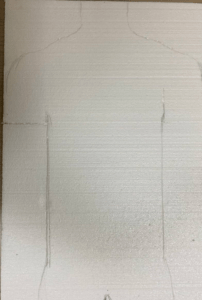
Step 3. Cut out with a stationery knife.
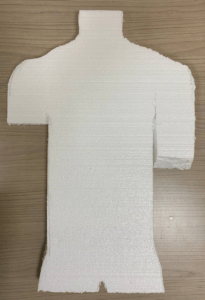
Step 4. Then, draw an oval and cut out.
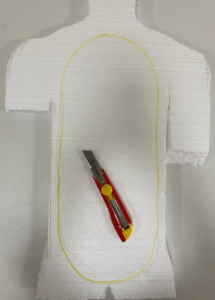
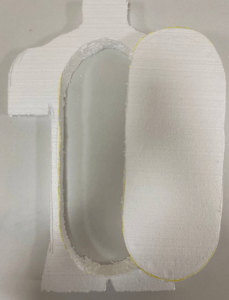
Step 5. Next, on the oval foam, draw:
– the human urinary system, namely the kidneys, ureter, bladder
– heart (aorta and vessels)
– circulatory system (artery and vein)
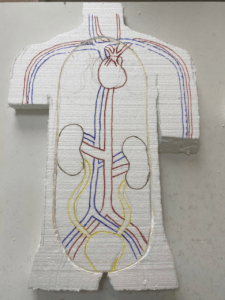
Step 6. Then cut out the extra space.
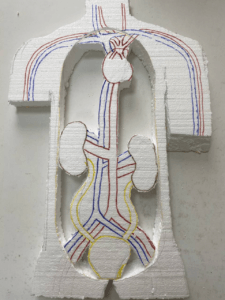
Step 7. Here are infusion systems and silicone hoses. Prepare the circulatory system.
Silicone hose (thicker than the system) – will be considered as an artery.
And the system (thinner than the hose) – as a vein.
To do this, cut out the Dropper (or filter unit-the cylindrical tip of the system). Then remove the roller clamp. And throw the needles in the trash. Total – 4 pcs of the system.
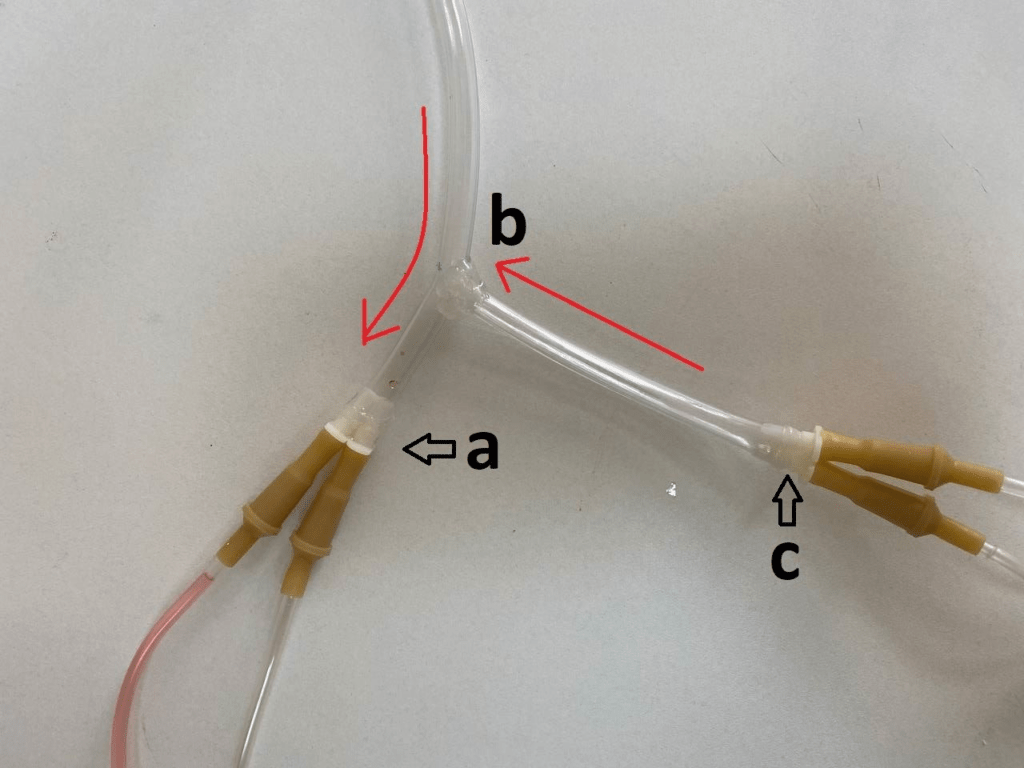
a) 2 systems with infusion nodes connection to the silicone hose – indicated in the figure with black arrows. Treat the hole with hot glue, for sealing – step by step – process / let dry / process and so on several times.
b) Then cut out about 8-10 cm, a piece of silicone hose (from another one) and connect to the second one – as indicated by the red arrows. Treat the hole with hot glue, for sealing – step by step – process / let dry / process and so on several times.
c) Then connect 2 systems with infusion nodes to it. Treat the hole with hot glue, for sealing – step by step – process / let dry / process and so on several times.
After all the treatments, check the entire system for sealing. To do this, pour water into the hose and check the nodes, if water passes, then treat it with hot glue again.
!!!Water should not leak
Step 8. If the length of the silicone hose does not allow you to cover the entire circulatory system (artery), then you can extend it by connecting another hose (inside the tube) and also treat the hole with hot glue, for sealing – in stages – process / let dry / process and so on several times.
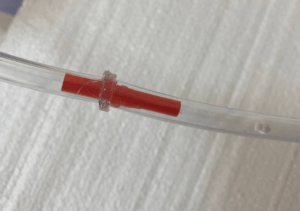
Step 9. Prepare the paper clips. Divide into 2 parts.
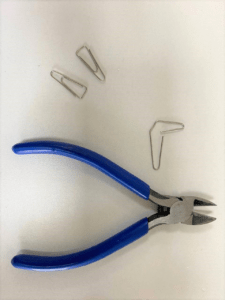
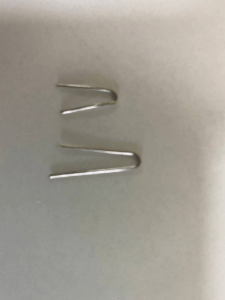
Step 10. Then connect the system as shown in the figure and secure it with paper clips – be careful not to pierce the system and hoses.
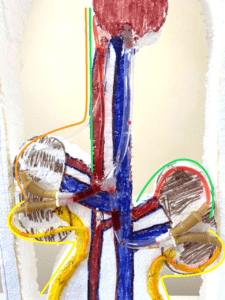
Step 11. Then guide the ureter to the bladder. Then pass 2 rollers (clips) to the systems and fasten all this with paper clips. Substitute the bottom of the bottle.
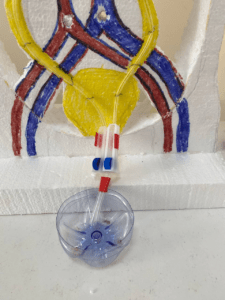
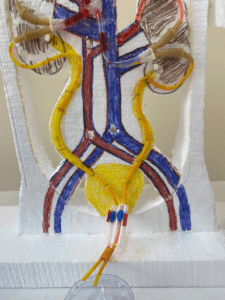
Step 12. Using gouache (yellow), paint the ureter (hoses on both sides). This means that yellow urine is excreted.
Homework
1. Study the statistics on the topic: Statistics on renal insufficiency of citizens of the Republic of Kazakhstan.
2. Build diagrams based on official statistical data.
3. Before the next lesson, study kidney-related diseases.