Week 3
Conclusion
Now you clearly know what exactly is harmful to fast food. Fast food should not replace healthy food for you, become the only kind of salvation from hunger, the price for craving such food is too high – your own health. Take care of him!
In conclusion, fill out the table yourself using:
– experimental and research data that you completed last week;
– statistical data (questionnaire);
– scientifically proven facts, follow the link:
3. Harmful effects on the brain
| Facts and Fictions about Fast Food | Myth or Reality | Facts and Fictions about Fast Food | Myth or Reality |
| Fast food is only “burgers and fries” | Sugar in a milkshake exceeds the daily norm by 2-3 times | ||
| Food in fast food establishments is cooked on some particularly harmful fat | Eating with your hands is tastier, for example pizza / burger | ||
| The cause of obesity is related to their love of “fast food” | Soda machines are a terribly dirty place | ||
| Fast food food contains some narcotic substances that make us go back there again and again. | Fast food can cause memory and Learning problems | ||
| Hamburger + cola is much more harmful than they are, but separately | Fast food increases the risk of dementia | ||
| “Fast food” also has a negative effect on the condition of the skin, hair and in general on how a person looks. | Fast food can cause Chemical changes that can lead to Depression | ||
| Fast food is especially dangerous for children. | Fast food makes you impatient and can cause uncontrollable cravings | ||
| Hot sauce can clean a coin, a rusty nail to shine. | If you leave a small piece of sausage in a bottle with Coca-Cola or fanta overnight, the sausage will dissolve in the morning | ||
| Coca-Cola is used for cleaning sewers, rusty bolts and stains, batteries and the engine in the car, electric kettles from scale | Farmers use Coca-Cola to destroy pests, because it is cheaper than chemicals, and the effect is the same | ||
| Fast food causes gastritis, ulcers and other stomach diseases | To clean clothes from stains, pour a can of Coca-Cola on dirty clothes, add washing powder and wash in the car as usual | ||
| * | * | ||
| * | * |
* Additionally, you can add your data.
Presentation of projects
This week, students should present their finished project on the following points:
1. Model of the digestive system:
– presenting and showing the model, the group demonstrates knowledge in the field of biology, chemistry and skills;
– demonstrate the function of the digestive system and describe the structure, chemical composition of the main nutrients;
– describe fast food: harm/benefit;
– illustrate statistical data (questionnaires) in the form of diagrams (graphs).
2. Laboratory tests:
– differences between fast food and homemade food (based on experiments on cutlets)
– research of burger components
– the effect of carbonated drinks on teeth
– the presence of orthophosphoric acid in carbonated drinks and the effect on the body
– the presence of sugar in carbonated drinks and the effect on the body
– the presence of carbon dioxide and the effect on the body
Assessment
PBL evaluation criteria:
Problem based learning (problem-oriented learning) is a learning method in which students acquire knowledge and skills by working on one project for 3 or 4 weeks to research and find an answer to a genuine, interesting and complex question, problem or challenge (then follow the PBL Rubrics link to the Rubrics).
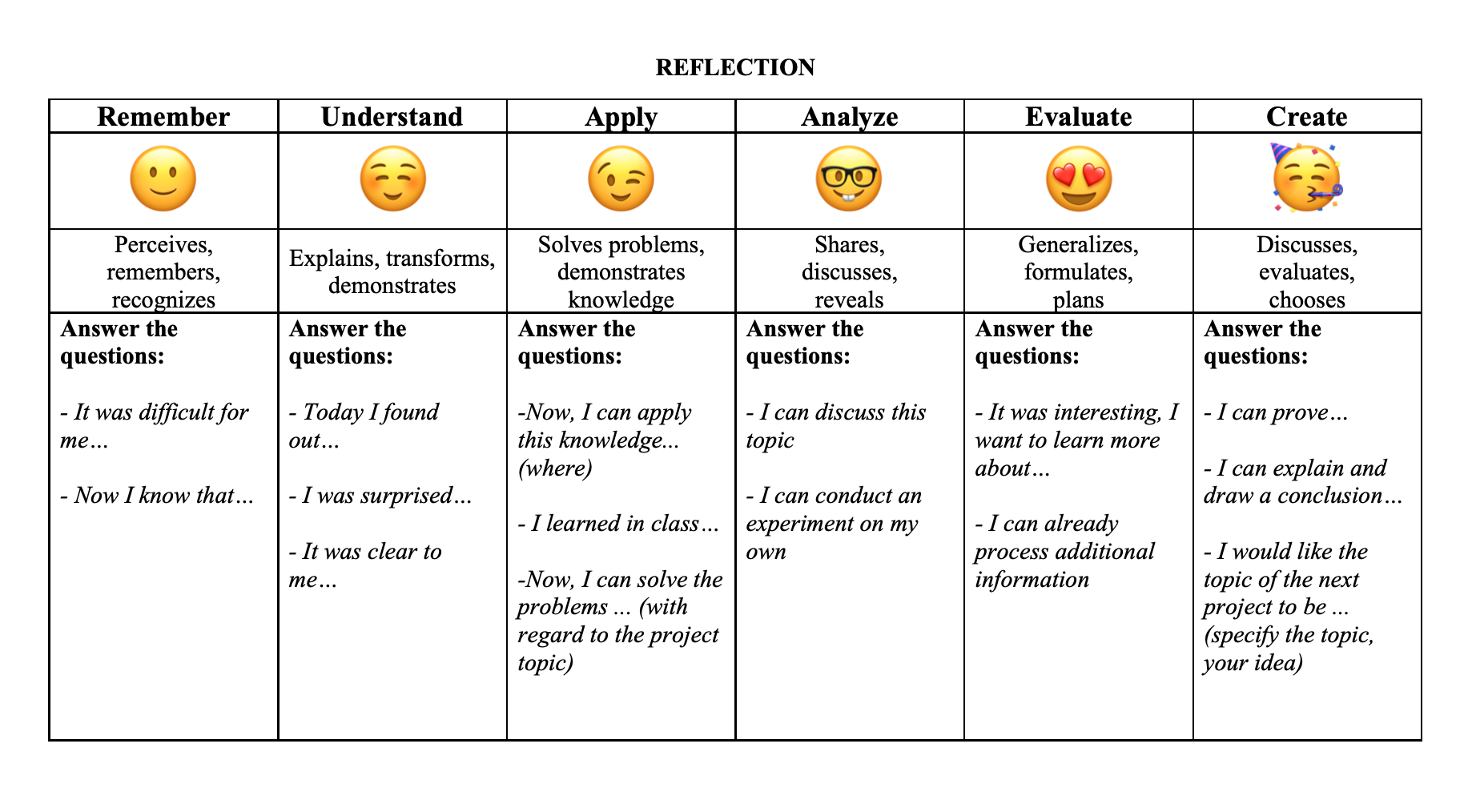
Reflection