Lesson 1
Objectives.
- Development of engineering skills through practical construction of a functional automatic trash bin.
- Enhancement of programming skills through coding and programming microcontrollers to control the trash bin.
- Popularization of environmental awareness through emphasis on proper waste management methods and sustainability principles.
Teacher’s Guide
Divide the students into groups of 3-4 people;
Provide a brief instruction on working with scissors and cardboard products;
Safety precautions in Steam lessons
Before starting the lesson, the teacher is recommended to familiarize himself with safety precautions. If necessary (in the case of using the subjects specified in the SP), conduct a brief briefing of students. Follow the link safety precautions in Steam lessons
Interdisciplinary Connection:
- Mathematics: In this project, students apply mathematical concepts such as measurement and geometry to design and construct physical components of an automatic garbage bin. Calculations may be needed to ensure precise dimensions and angles for proper functionality, enhancing the understanding and application of mathematical principles in the real world.
- Computer Science: Students engage in coding and programming using Arduino microcontrollers to control the servo motor and respond to input signals from sensors. Through programming, they explore algorithms, data processing, and problem-solving, developing important computer science skills that are increasingly relevant in our technology-driven world.
- Physics: Physics concepts are necessary for designing the mechanism that opens the lid of the garbage bin. Students apply principles of force, motion, and energy transfer to create an efficient and effective mechanism, deepening their understanding of physics and its practical applications in engineering and technological projects like this one.
- Geography: Geographic understanding plays a crucial role in assessing the environmental impact of waste management. Students analyze waste distribution patterns, considering factors such as population density and urbanization. They study the consequences of waste accumulation, including pollution and habitat degradation. Understanding these spatial dynamics helps students develop informed strategies for sustainable waste management, promoting ecological health and resilience.
Examples of lesson plans.
The theoretical part
1. Geography Lesson: Investigating the Impact of Waste on the Environment
Goal: To understand the impact of waste management on the environment and public health, as well as to develop strategies for sustainable resource use.
Lesson Steps:
Introduction:
Discussing the importance of waste management for preserving the environment.
Emphasizing the role of geography in studying the distribution and consequences of improper waste disposal.
“In the world, billions of tons of waste are produced every year, some of which ends up in the oceans, leading to the pollution of aquatic ecosystems and the death of marine life. This creates serious problems for biodiversity and human health. Waste management plays a crucial role in minimizing the negative impact of our activities on the environment.”
“Geographical factors such as climate, geology, and demographics determine how garbage is distributed in nature. Understanding these factors helps us identify the most vulnerable areas and develop strategies to protect them. Geography also helps us analyze the consequences of improper waste handling on landscapes, water resources, and biodiversity, which is important for the development of effective waste management methods.”
Analysis of waste distribution:
Studying waste location maps to identify primary waste accumulation points.
Discussing factors influencing waste distribution, such as population density, land use types, and socio-economic factors.
Example of discussion:
“Let’s take a look at the waste distribution map of our district. We can see that a large amount of waste is concentrated in the city center, near major commercial and industrial facilities. This is explained by the fact that these areas are home to a large part of our population, and also because major shopping centers and enterprises are located here, where there is a significant accumulation of waste. We also see that on the outskirts of the city and in the suburbs, there is substantially less waste, which is related to lower population density and less active industrial activity.”
Consequences of waste on the environment:
Analysis of the impact of improper waste management on biodiversity, water resources, and land.
Discussion of the consequences of waste on human health and society.
Example:
Impact analysis on biodiversity, water resources, and land use:
Biodiversity: Improper waste disposal can lead to pollution and destruction of ecosystems, thereby threatening species diversity and disrupting the balance in nature.
Water resources: Trash dumped into rivers and oceans pollutes the water, endangering animals and plants, as well as deteriorating the quality of drinking water for humans.
Land use: Areas littered with garbage lead to loss of soil fertility, which can negatively affect agriculture and ecosystems, including a potential threat to food security.
Discussion of implications for human health and society:
Human health: Garbage is a source of microorganisms, toxins, and harmful chemicals that can pollute the air and water, leading to an increase in respiratory, skin, and digestive diseases in humans.
Social consequences: A littered environment can lower the quality of life in society, creating a negative impression of the living environment, attracting harmful insects and rodents, and increasing the risk of emergencies such as fires and floods.
Strategies for Sustainable Resource Utilization:
1. Studying Best Practices in Waste Management, including recycling, reusing, and waste sorting.
Developing strategies for sustainable resource utilization to reduce the negative impact of waste on the environment.
Studying Best Practices in Waste Management:
- Conducting research on modern waste management methods used in other regions or countries.
- Analyzing the effectiveness of various approaches to waste treatment and disposal, including recycling, incineration, and landfilling.
2. Implementation of recycling and reusing:
- Development of programs for waste collection and recycling aimed at minimizing the volume of waste sent to landfills.
- Popularization and encouragement of practices for the reuse of goods and packaging to reduce the volume of waste generated.
3. Organization of waste sorting and disposal:
- Implementation of waste sorting systems at locations that allow for the separation of waste into recyclable and non-recyclable materials.
- Development of mechanisms for organizing the disposal of various types of waste, including organic, plastic, glass, and paper materials.
Example: As part of our project, we studied advanced waste processing technologies used in various countries around the world. We found that on-site waste sorting and processing systems are an effective way to reduce the volume of waste sent to landfills. Based on this, we have developed a strategy to implement a similar sorting system in our region, which will allow us to reduce the negative impact of waste on the environment and utilize resources more efficiently.
Practical tasks:
Group work on researching and analyzing local waste disposal and its impact on the environment.
Developing recommendations for improving waste management based on the conducted analysis.
Discussion and feedback:
Discussing the results of group work and presenting recommendations for improving waste management.
Providing feedback and constructive comments on the quality of the analysis conducted and suggestions for further improving waste management strategies.
Conclusion:
Summarizing the lesson and emphasizing the importance of sustainable resource utilization for environmental conservation. Reminding of the main goal of the project and the subsequent steps to achieve it.
“Today we have discussed the importance of waste management for the preservation of our environment. We have studied how waste affects biodiversity, water resources, and human health. Our research will help us develop strategies for sustainable resource utilization and improve waste management in our region.”
2. Mathematics lesson: Applying Mathematical Concepts in Trash Bin Design
Objective: To master the application of mathematical concepts such as measurement and geometry in designing and constructing physical components of an automated trash bin.
Lesson steps:
2.1. Introduction.
Discussion on the role of mathematics in the design and construction of a trash bin.
Emphasizing the importance of accurate measurements and calculations to ensure the proper functionality of the trash bin.
“Today we will begin our math lesson, which will focus on the application of mathematical concepts in the design and construction of a trash bin. Mathematics plays a crucial role in creating functional and efficient devices, including automatic trash bins. Throughout this project, we will explore how correct measurements and calculations help ensure the functionality and reliability of our device. Proper mathematical calculations and measurements are key components for the successful completion of our project. Let’s start exploring how we can apply our mathematical knowledge in practice to create an automatic trash bin.”
2.2. Fundamentals of Measurement and Geometry.
Review of basic concepts of measurement and geometry, such as length, width, height, angles, etc.
Conducting practical exercises on measuring objects and calculating their dimensions.
2.3. Designing a Trash Bin Enclosure.
Discussion of the fundamental requirements for the design of a trash bin enclosure and its components.
Calculating the necessary dimensions and angles for the trash bin enclosure, considering functional requirements.
1. Main design requirements:
• Ease of use: The trash bin should be easy to use, with a minimal number of moving parts.
• Capacity and dimensions: The bin should provide sufficient space for storing various types of waste, while not taking up too much space in the room.
• Strength and durability: The construction should be strong enough to withstand the load of filled waste and durable to ensure a long service life.
2. Calculation of dimensions and angles:
• Body dimensions: Measure the space where the garbage bin will be placed and determine the optimal dimensions of the body, taking into account its capacity and accessibility for users.
• Lid tilt angles: Calculate the tilt angles of the lid to ensure convenient access to the trash receptacle, while preventing potential injuries and providing an aesthetically pleasing appearance.
Body dimensions:
Let’s assume that the space for placing the garbage bin has the following dimensions: length – 80 cm, width – 60 cm, height – 100 cm. We determine the optimal dimensions of the body, taking into account its capacity and accessibility for users. For example, the body can have dimensions of 70 cm in length, 50 cm in width, and 80 cm in height to provide sufficient space for storing garbage and easy access to the container.
Lid tilt angles:
We calculate the tilt angles of the lid to ensure convenient access to the container for waste removal and prevent potential injuries. For example, we can choose a lid tilt angle of 45 degrees to provide convenience for users when opening and closing the lid. At the same time, an aesthetically pleasing appearance is achieved through the combination of angles and geometric proportions of the body and lid.
2.4. Practical Assignments
Dividing students into groups and providing tasks for designing various components of a trash bin (for example, walls, bottom, lid).
Working in groups to solve problems and conducting calculations to ensure correct dimensions and angles.
2.5. Discussion and Feedback
Discussing the results of group work and presenting the solutions obtained.
Providing feedback on the quality of calculations performed and suggestions for improving the project.
2.6. Conclusion
Summarizing the lesson and emphasizing the importance of applying mathematical concepts in real projects. Reminding of the main project task and the next steps to complete it.
“Today we have discussed how mathematical concepts such as measurement and geometry play a crucial role in designing and constructing a trash bin. We have seen how accurate calculations of dimensions and angles ensure the functionality and efficiency of our device. This is an excellent example of how mathematics is applied in practice and how it is essential for the successful completion of projects in real life.”
“Let’s not forget that our main project is the creation of an automatic trash bin. Our lessons help us develop the necessary skills and knowledge for the successful implementation of this task. In the next lesson, we will move on to the next stage of the project, which will involve programming and creating the control mechanism. We will strive to use our mathematical and engineering knowledge as efficiently as possible to achieve the project’s goal.”
Practical part
1. The outer part of the trash bin.
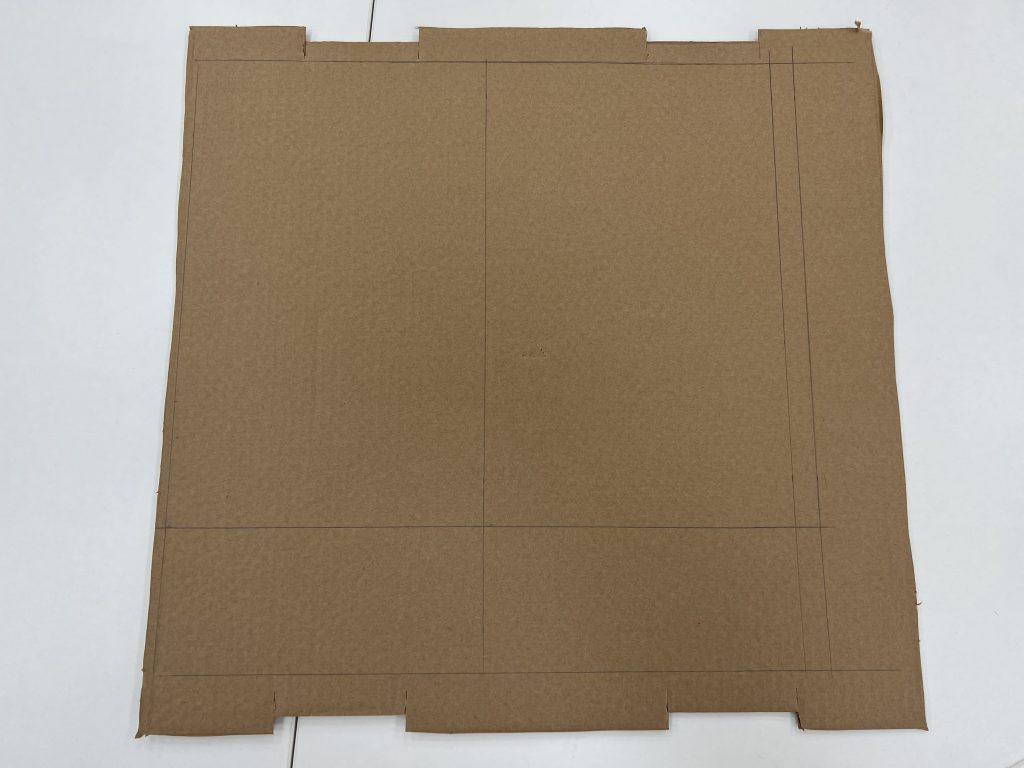
1.1 Take 2 cardboard sheets measuring 60 cm x 45 cm. Using a ruler and a pencil, draw the drawing of the trash bin body on them as shown in the picture below. You need to draw 2 such drawings.
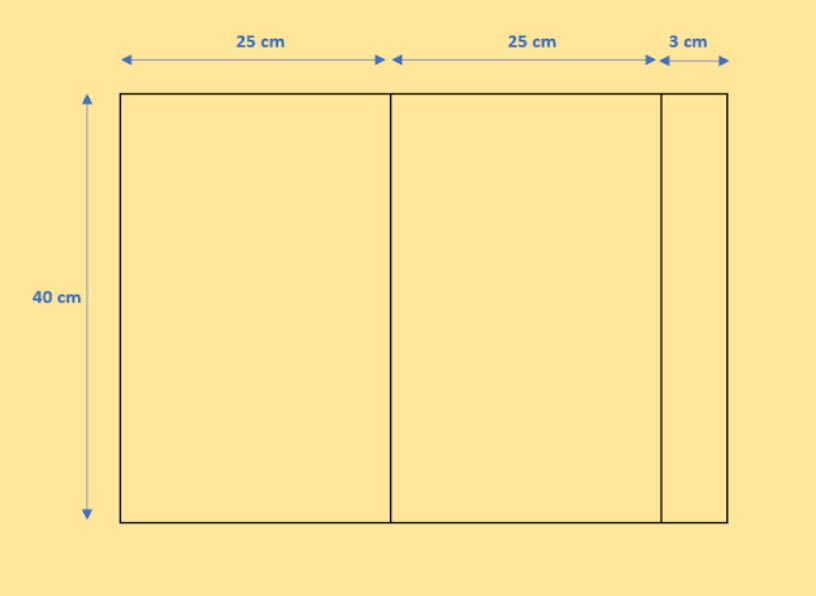
1.2 Cut out the templates you’ve obtained.
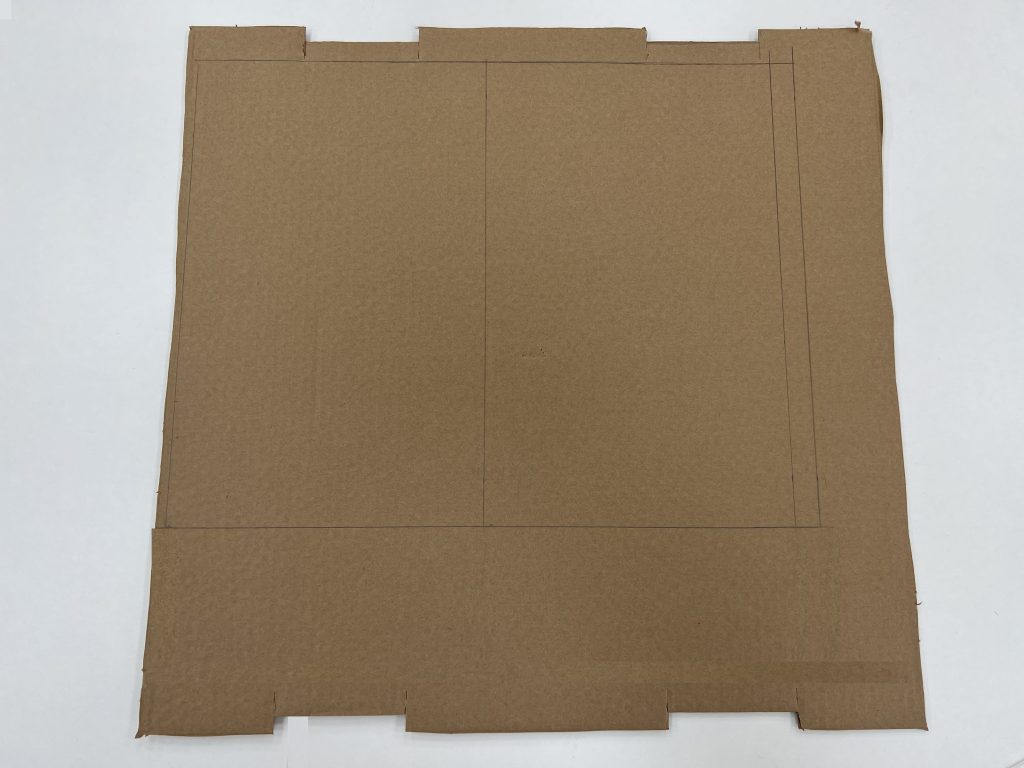
1.3 In the bottom right corner, cut out a rectangle measuring 3 cm by 4 cm.
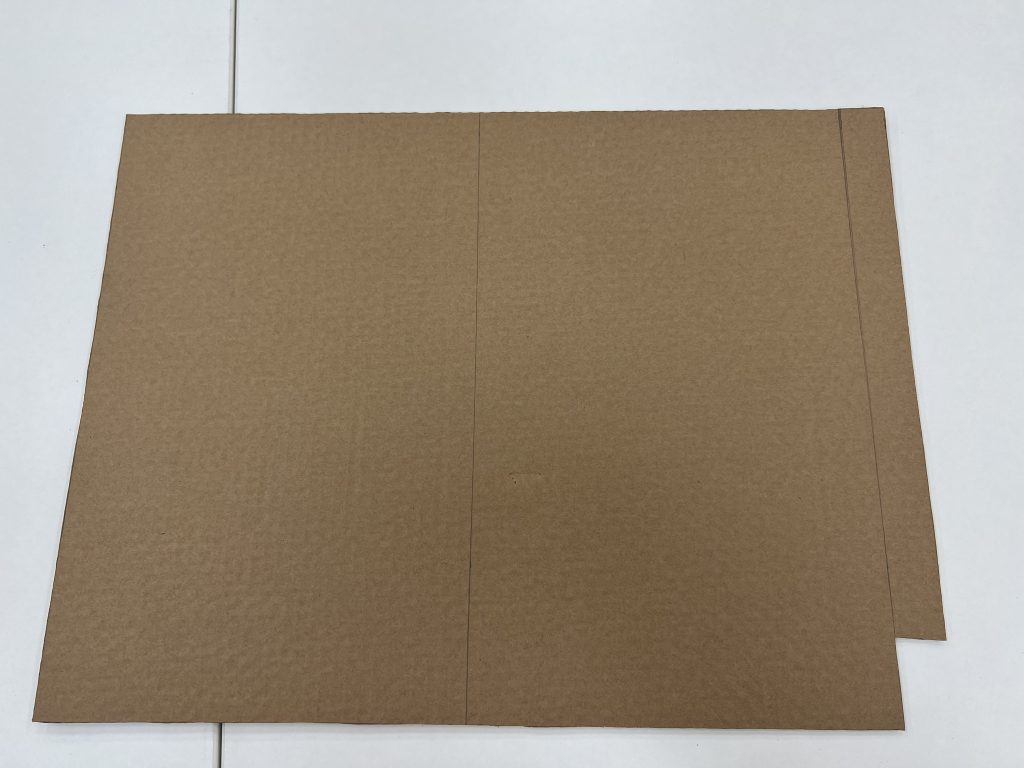
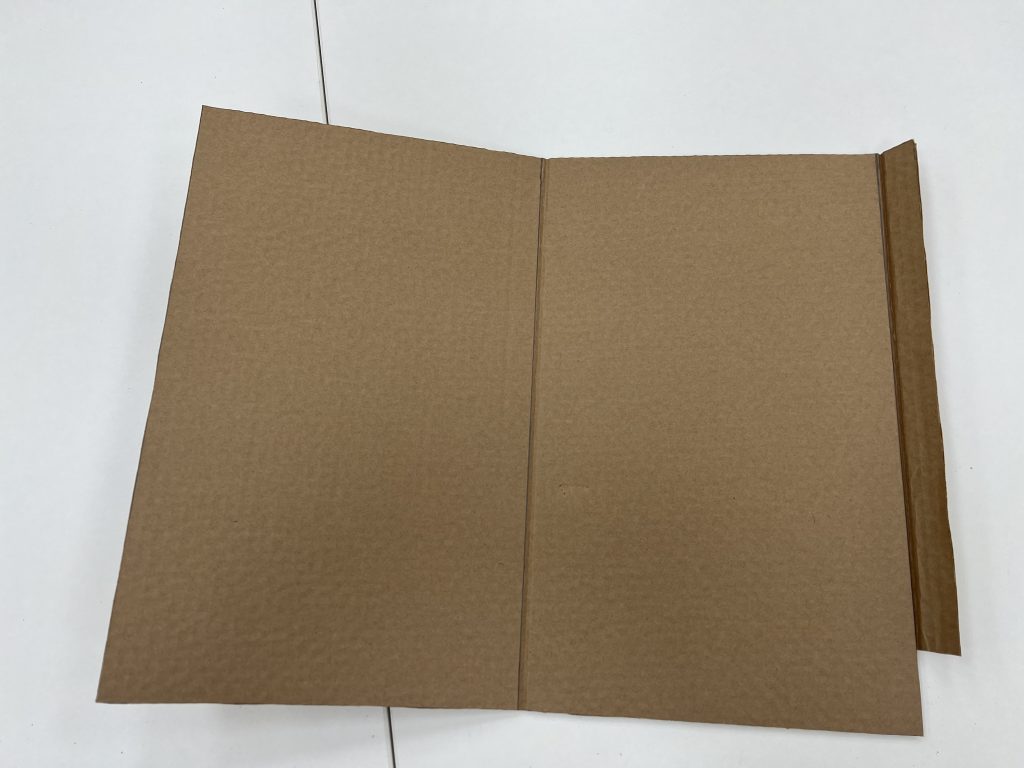
1.4 Using thermoplastic adhesive, glue together 2 parts of the box as shown in the picture below.
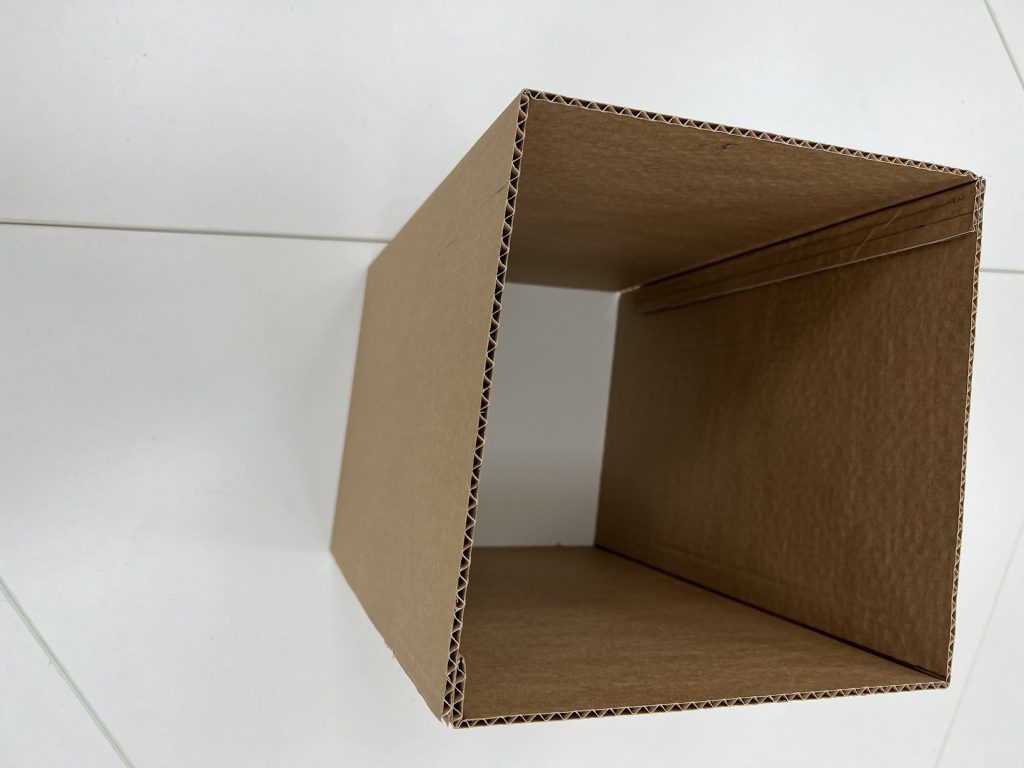
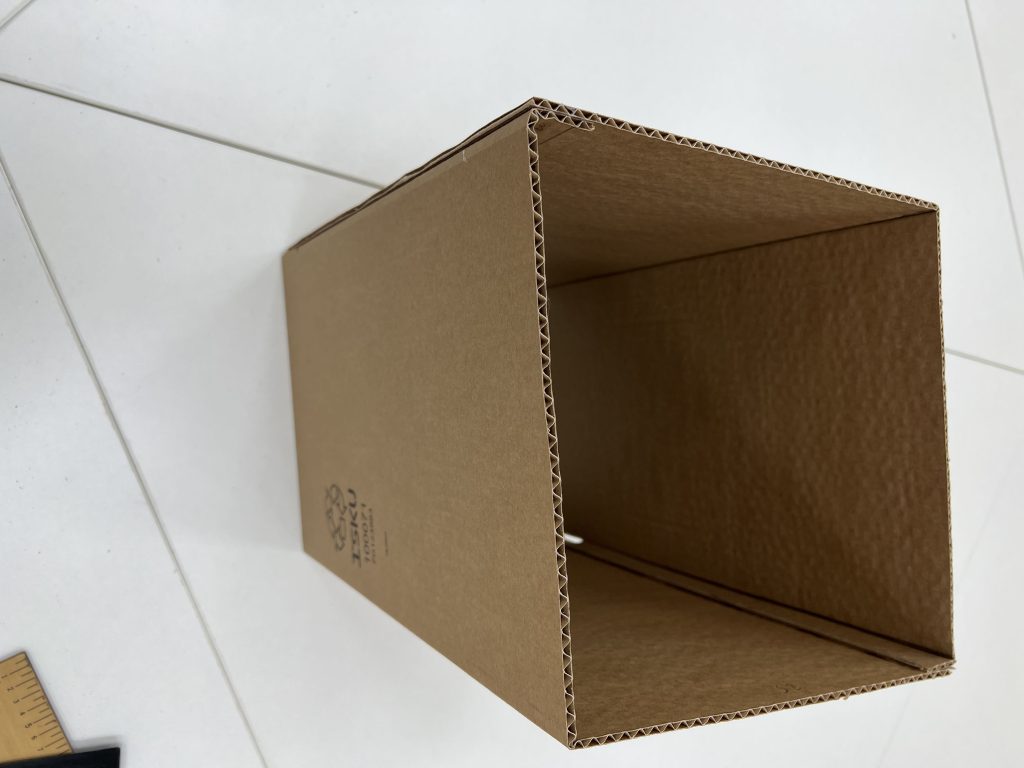
2. The lower part of the trash bin.
2.1 On a cardboard with dimensions of 40 cm by 40 cm, draw a sketch as shown in the picture below.
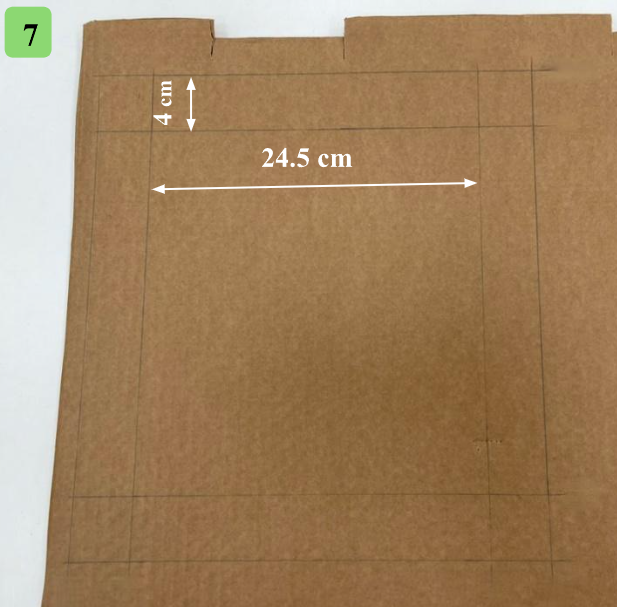
2.2 Cut out the layout.
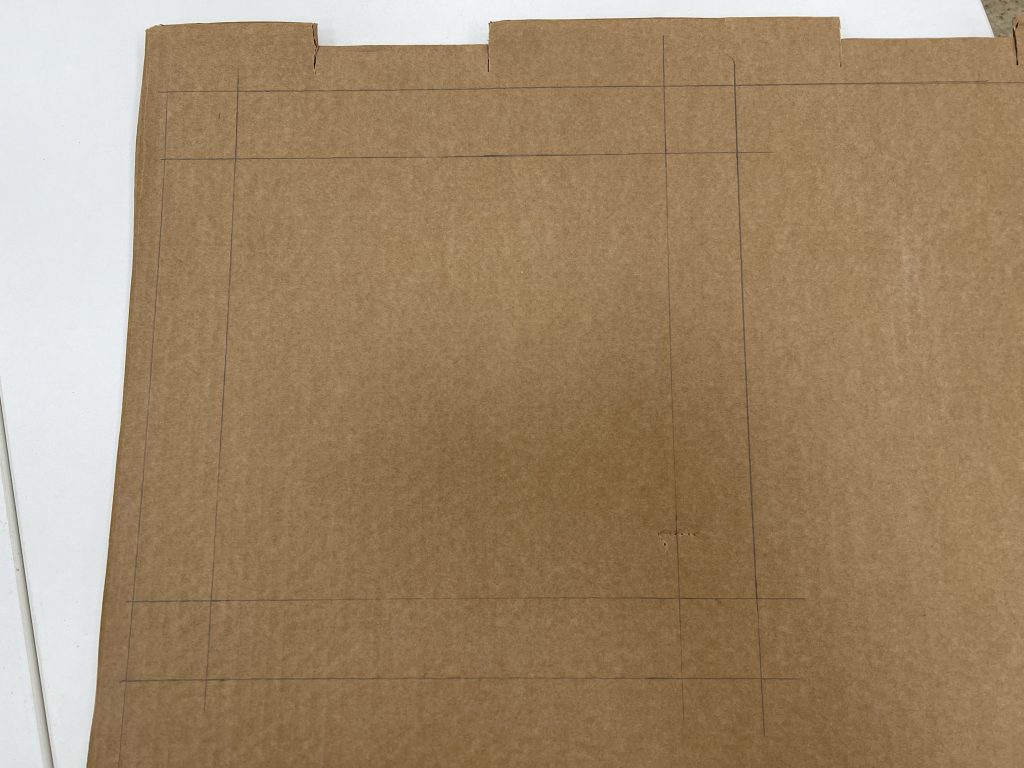
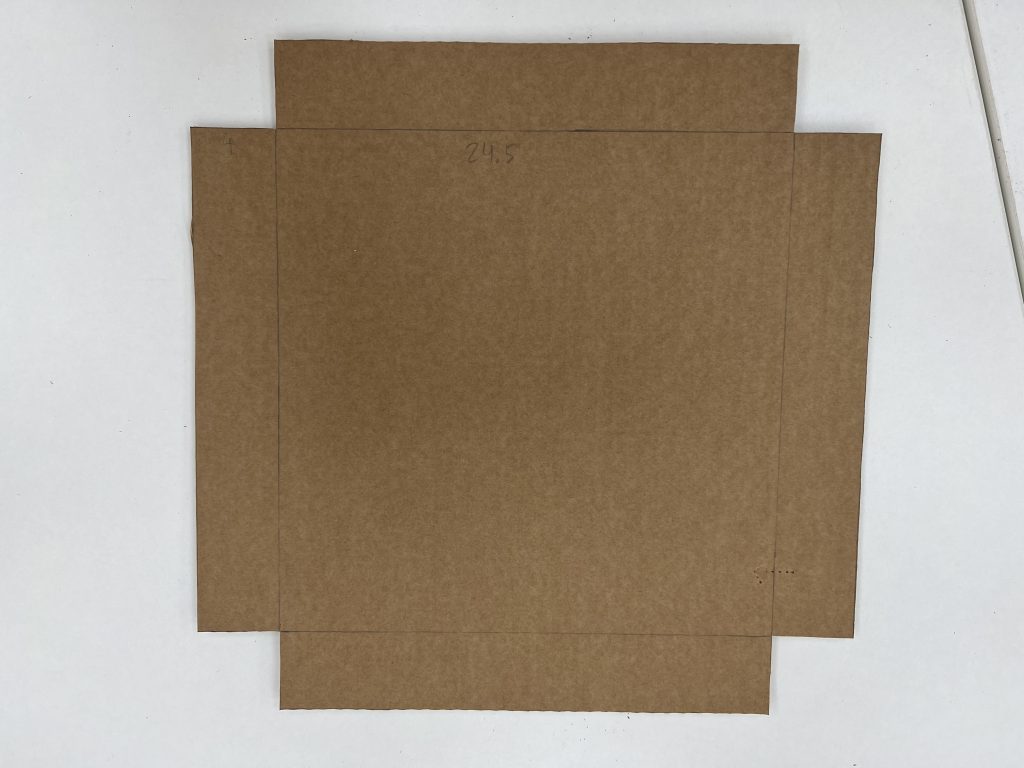
2.3 Bend the layout along the lines as shown in the picture.
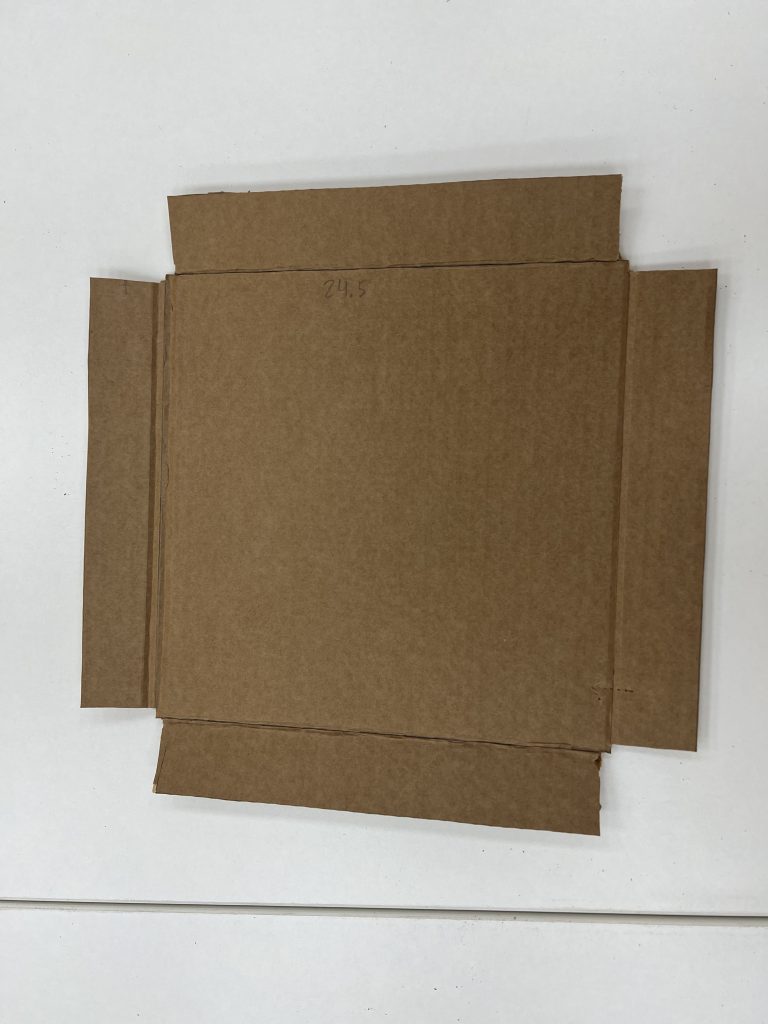
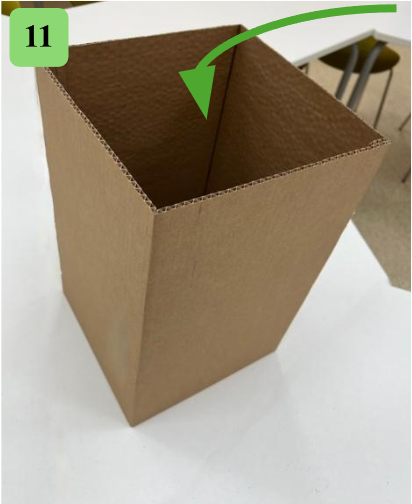
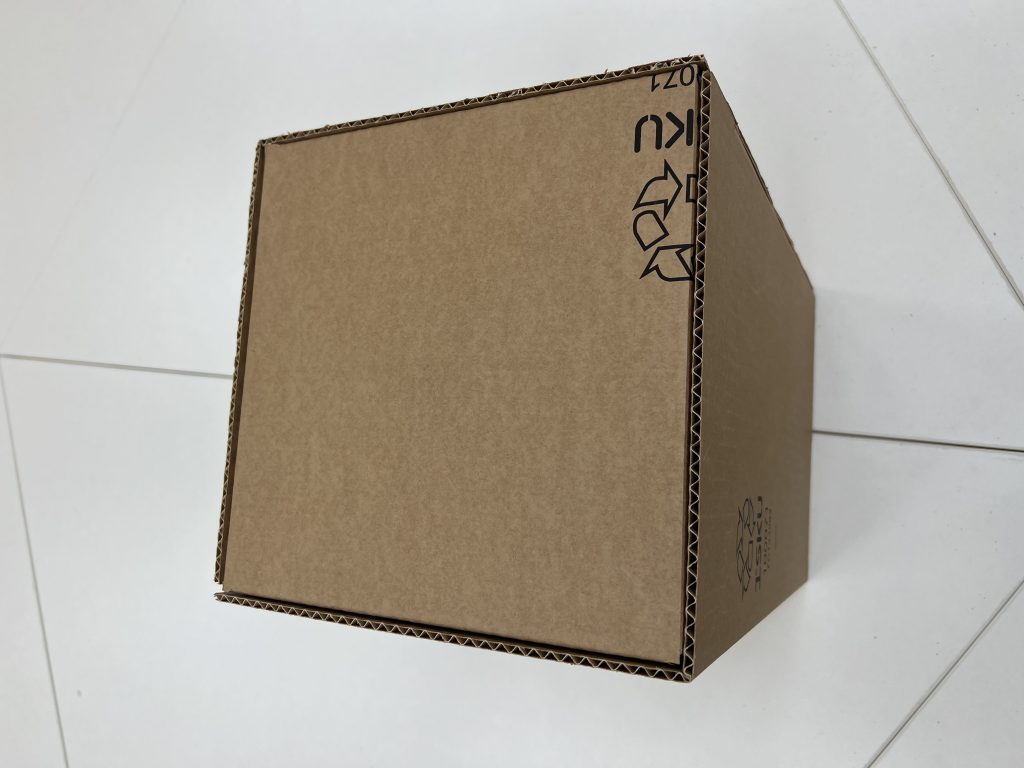
2.4 Fold the edges and place the detail in the bottom part of the box. Glue the side parts using thermoplastic adhesive.
3. Trash can lid.
3.1 On a cardboard with dimensions of 35 cm by 35 cm, draw the lid design as shown in the picture.
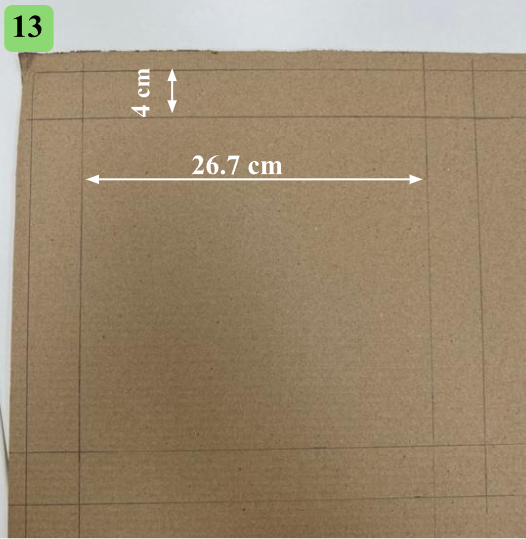
3.2 Make incisions at the specified locations with a width of 0.5 cm.
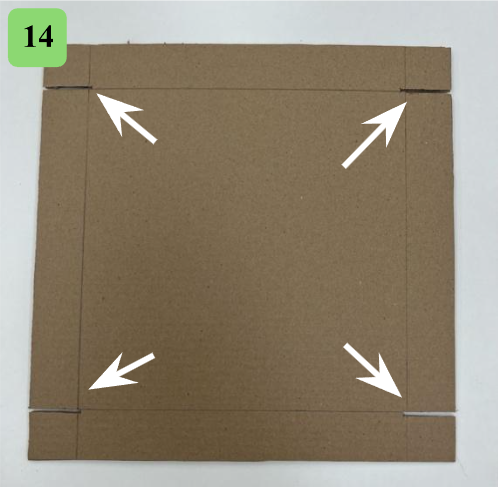
3.3 Step inside by 1.5 cm and draw a square.
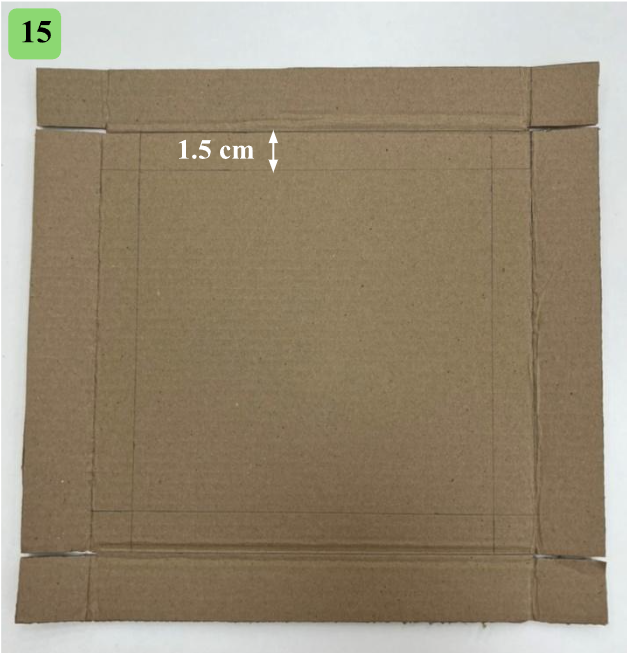
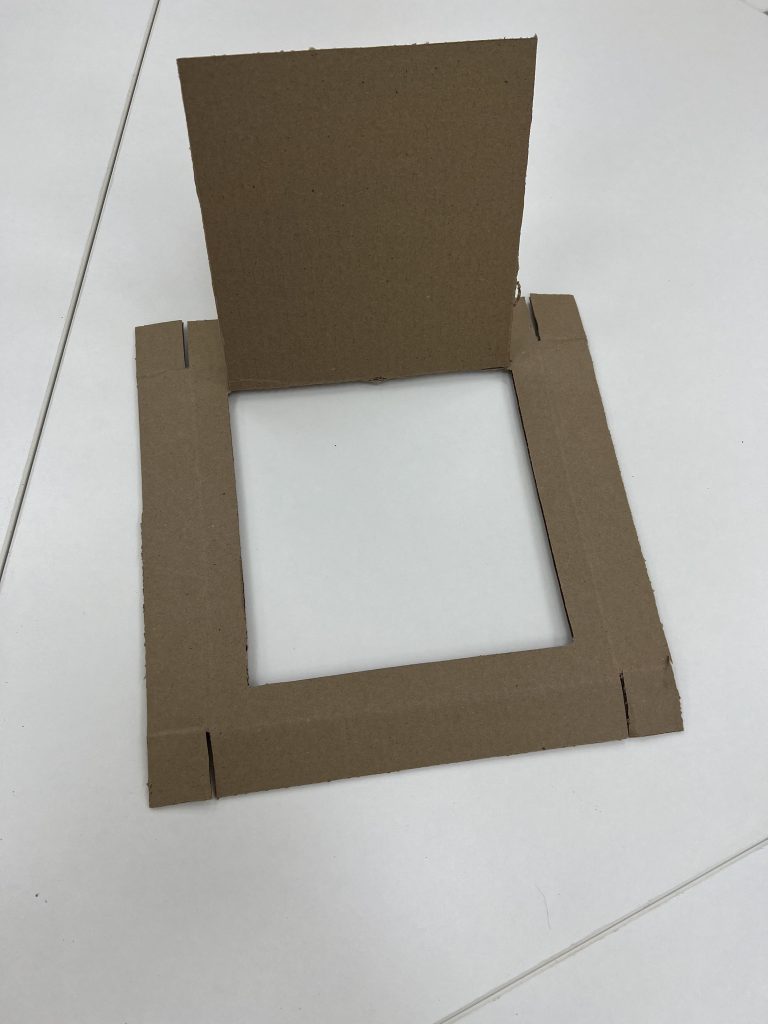
3.4 Make incisions on 3 sides of the obtained square. Along the incision lines, make an additional incision with a thickness of 0.5 cm (this is necessary for the lid to open freely).
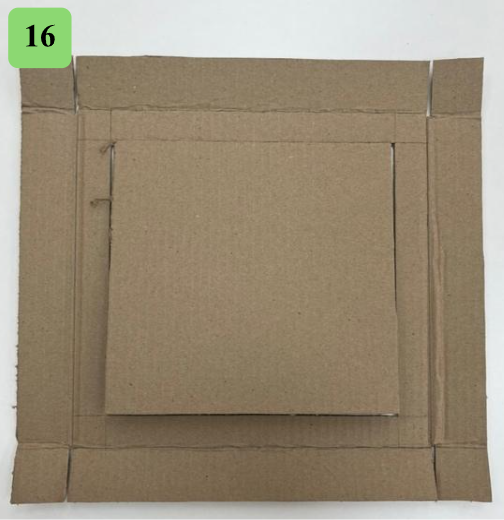
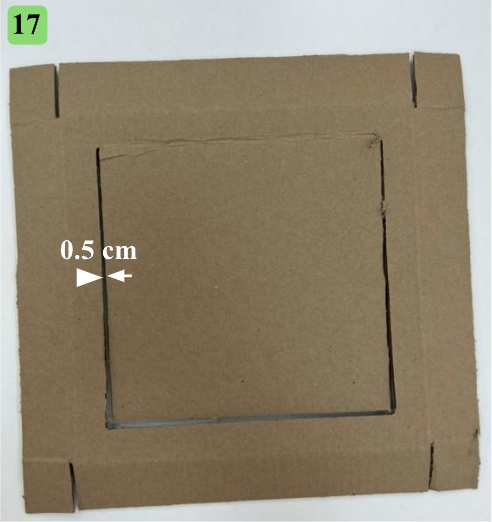
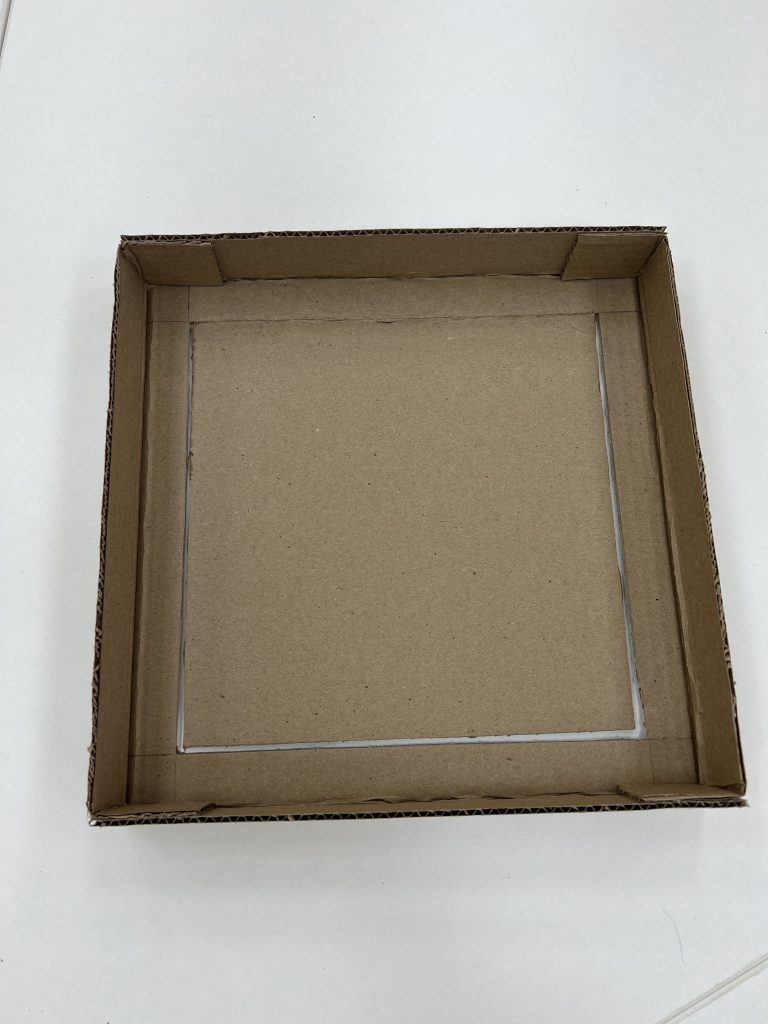
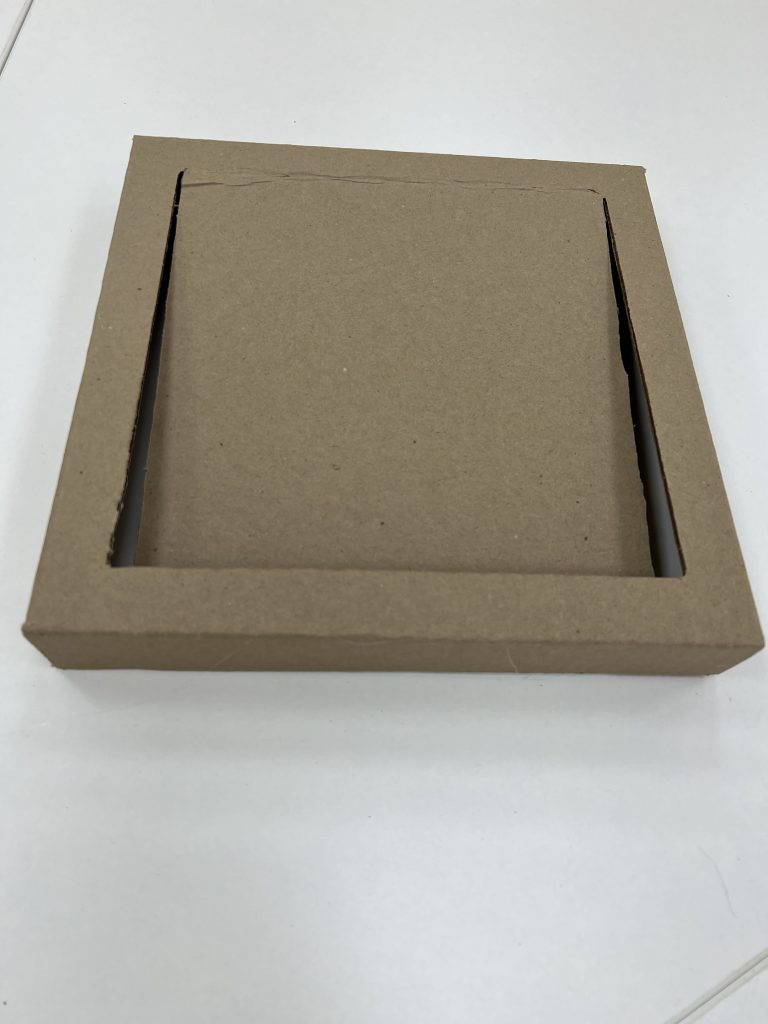
3.5 Fold the lid several times around the remaining side.
4. Installation of servo motor and door opening mechanism.
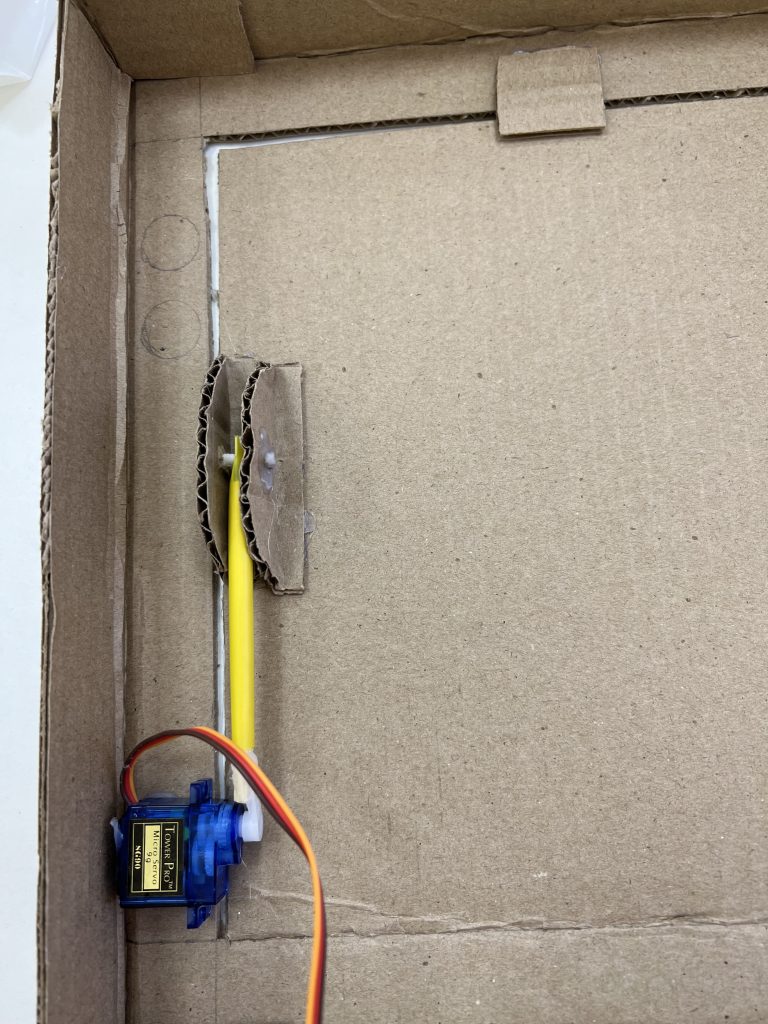
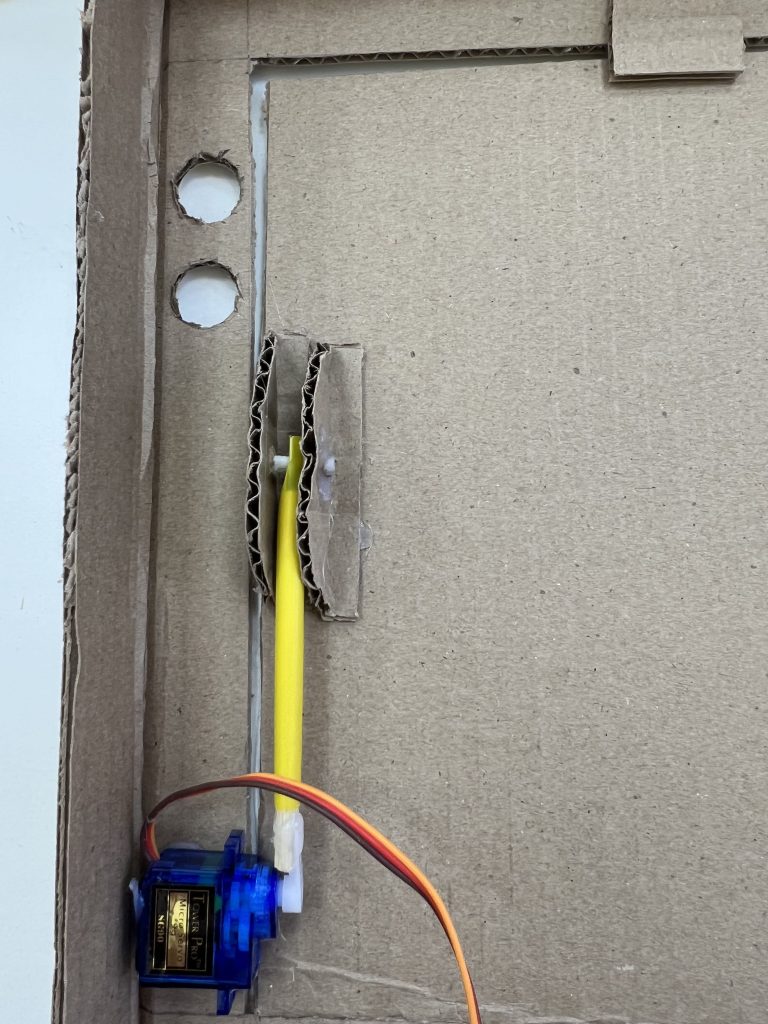
4.1 Place the lid of the box as shown in the picture below. Leave a 3 cm gap from the side of the lid that is not cut out (the folding area) and attach the servo motor using thermoplastic adhesive.
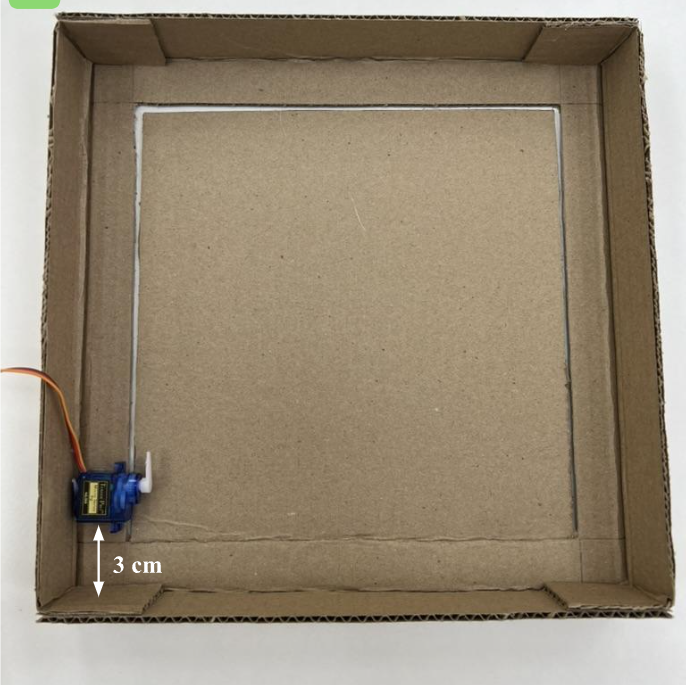
4.2 Cut out a circle with a diameter of 6 cm from cardboard.
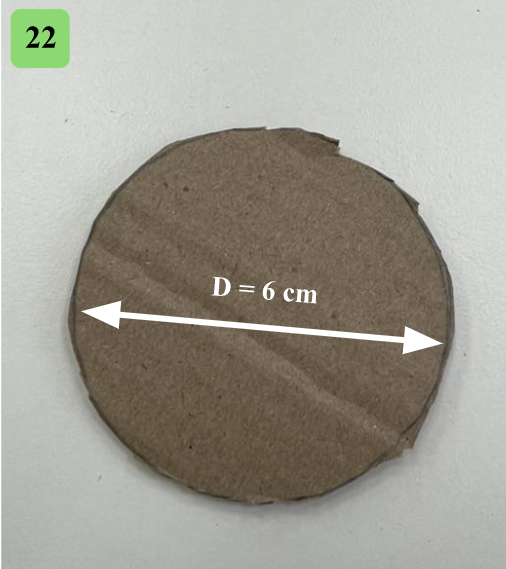
4.3 Divide the circle into two equal parts along the middle. Make holes using a pen in the center of the parts closer to the top as shown in the picture.
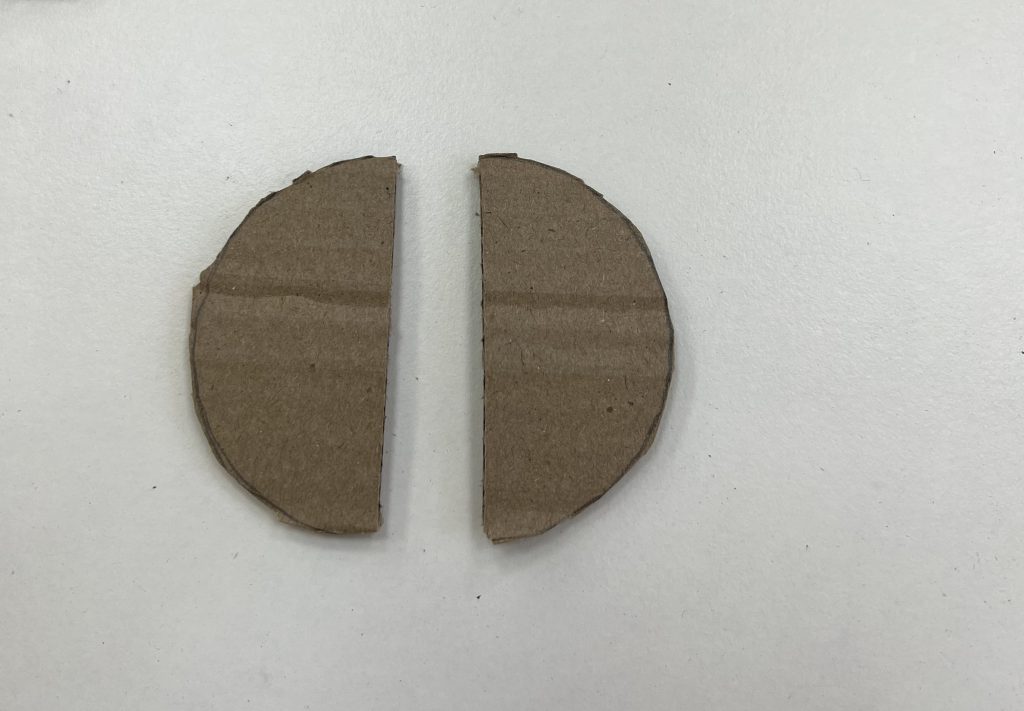
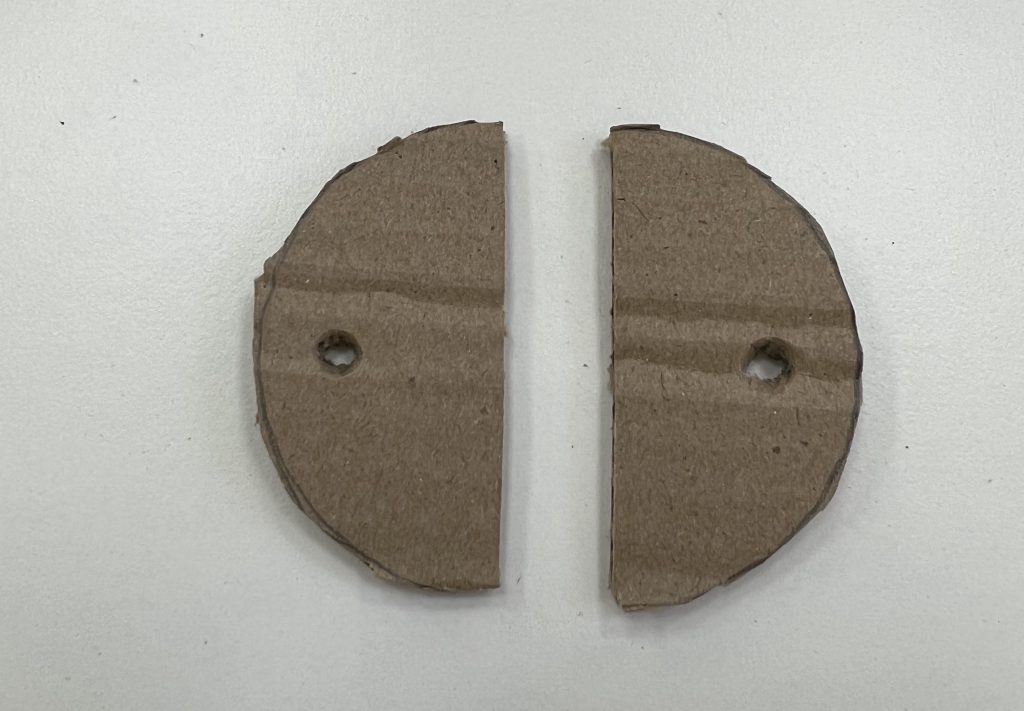
4.4 Fold the details at the bottom (fold width 0.5 cm).
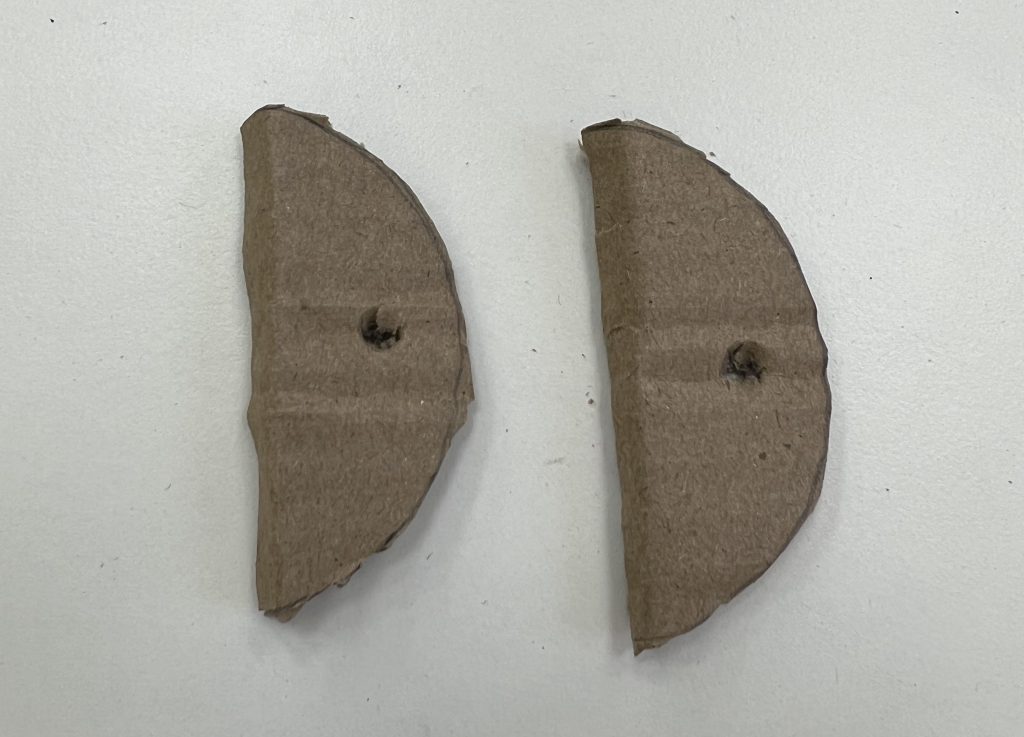
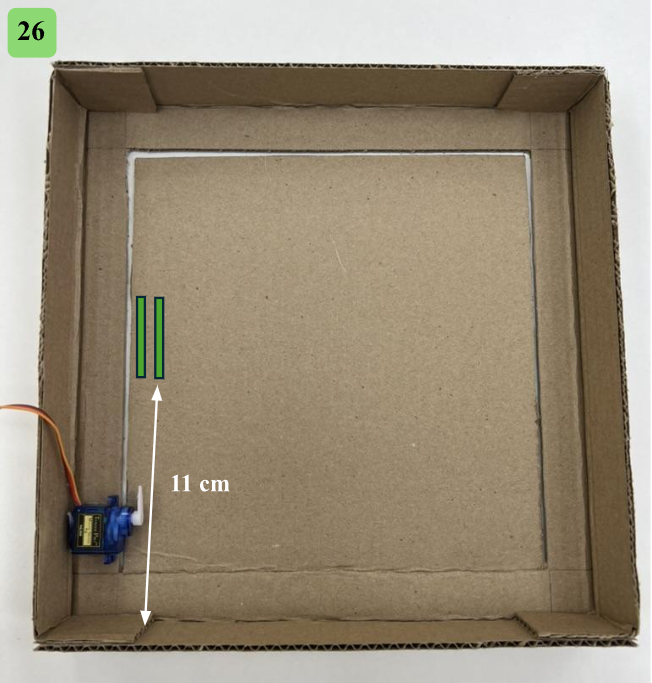
4.5 Step back 11 cm from the uncut part of the lid (the bending area) and glue the parts together using thermoplastic adhesive (the area is marked in green).
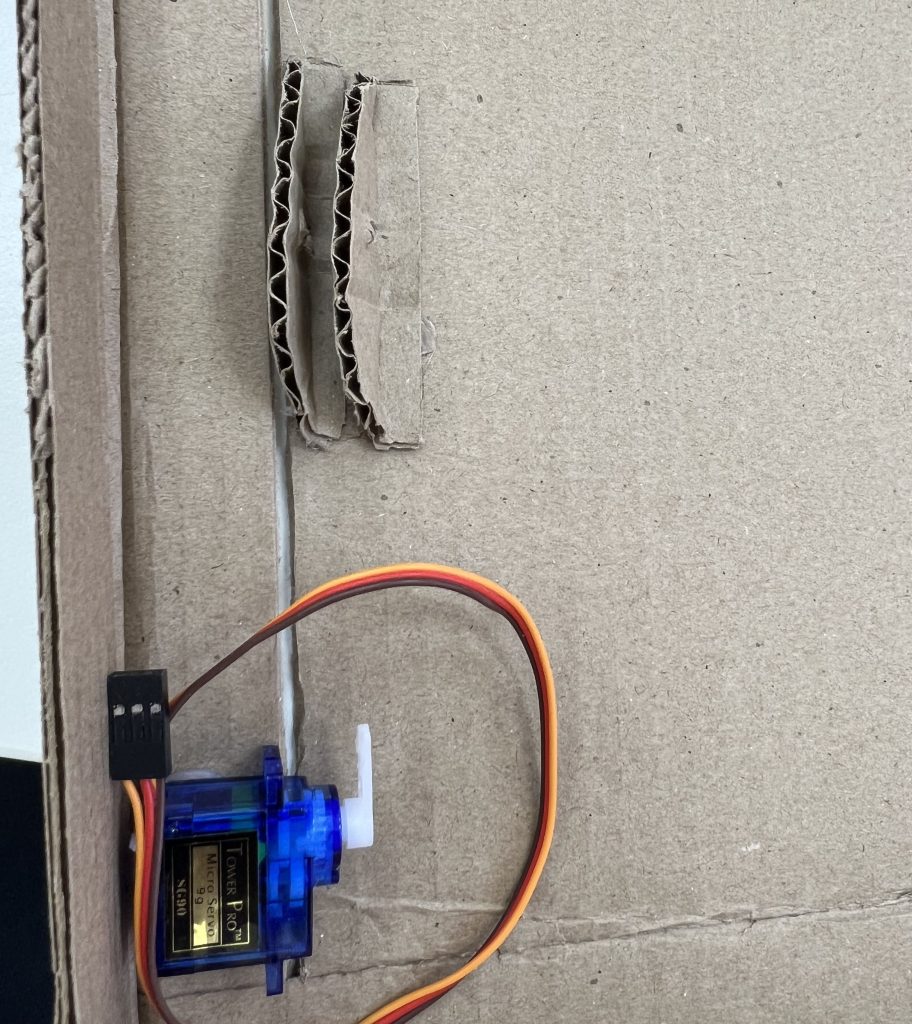
4.6 Cut a piece from the cotton swab measuring 2 cm.
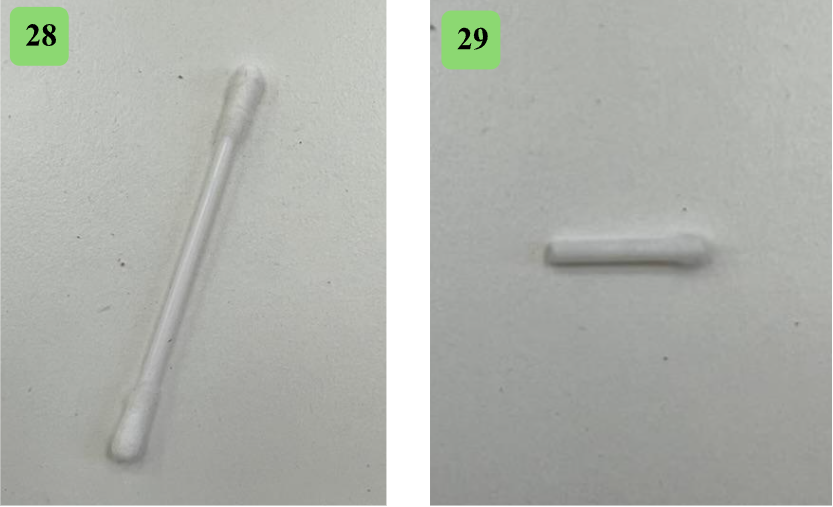
4.7 Cut a piece from the juice straw measuring 8.5 cm. Make a hole in one part of the obtained piece using a pen. Insert the piece from a cotton swab into the hole.
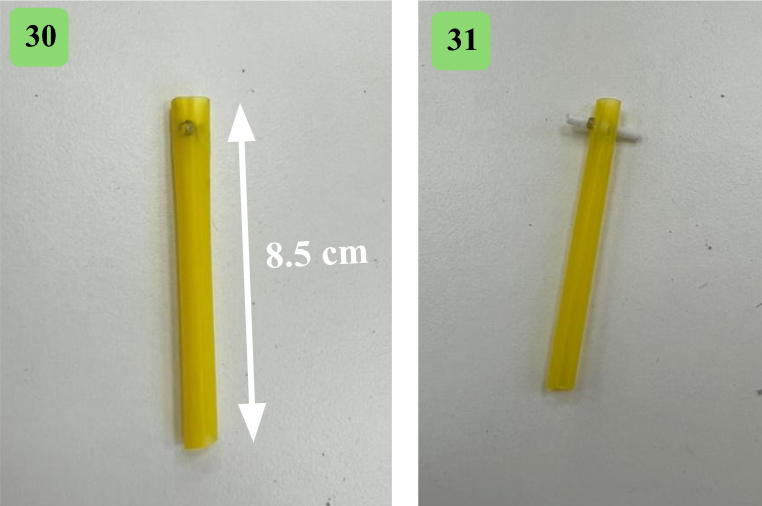
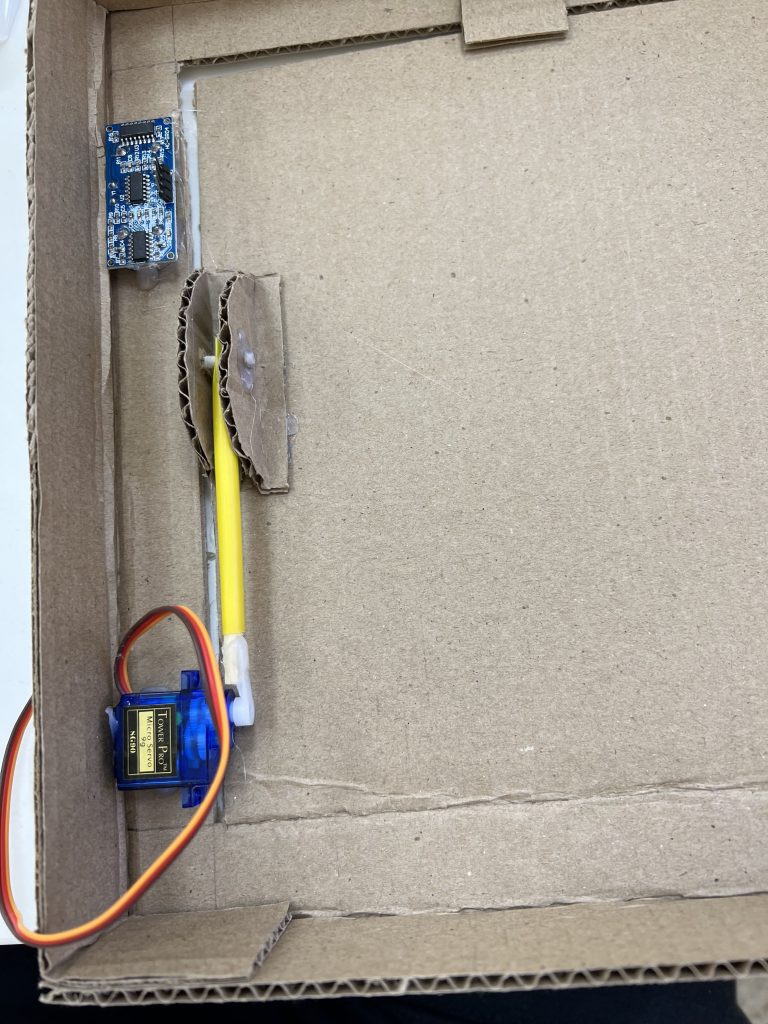
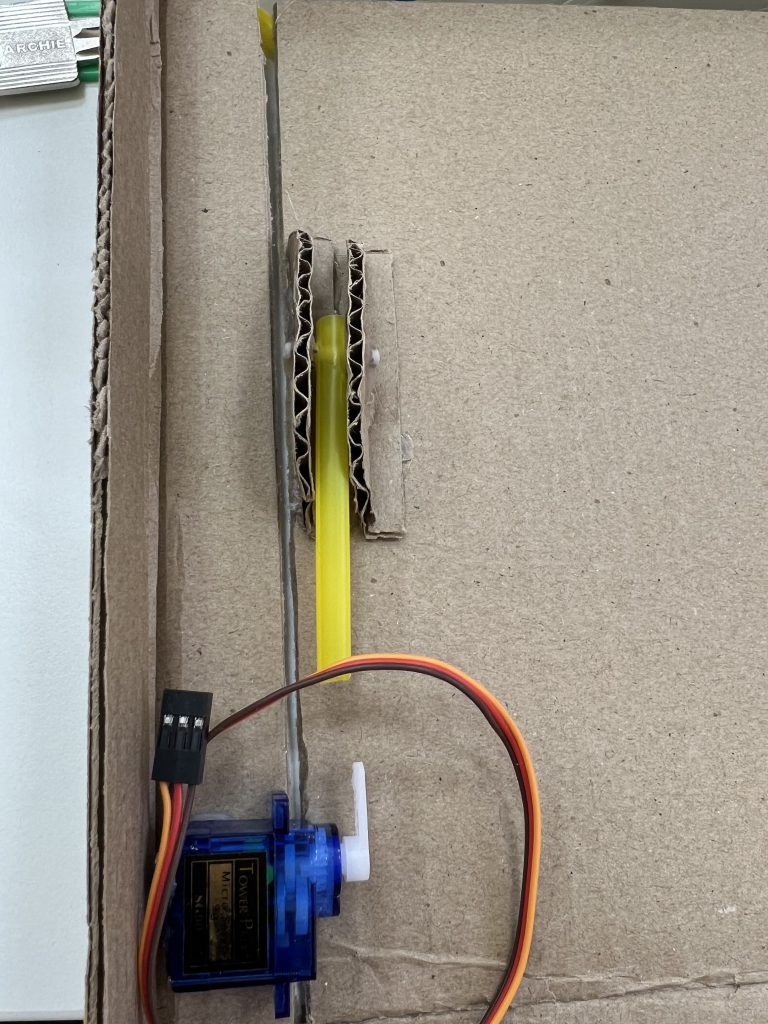
4.8 Insert a piece of cotton swab into the semicircular cardboard cutouts as shown in the picture. Glue the edges using hot glue.
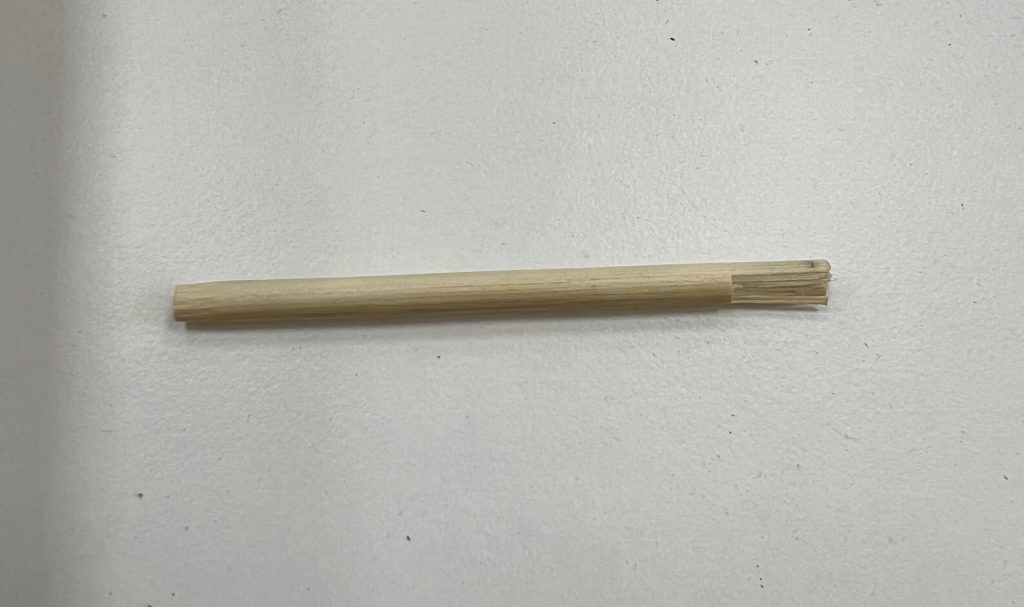
4.9 Cut out a portion of the wooden skewer measuring 7.5 cm. Make an incision in one part of the resulting piece as shown in the picture.
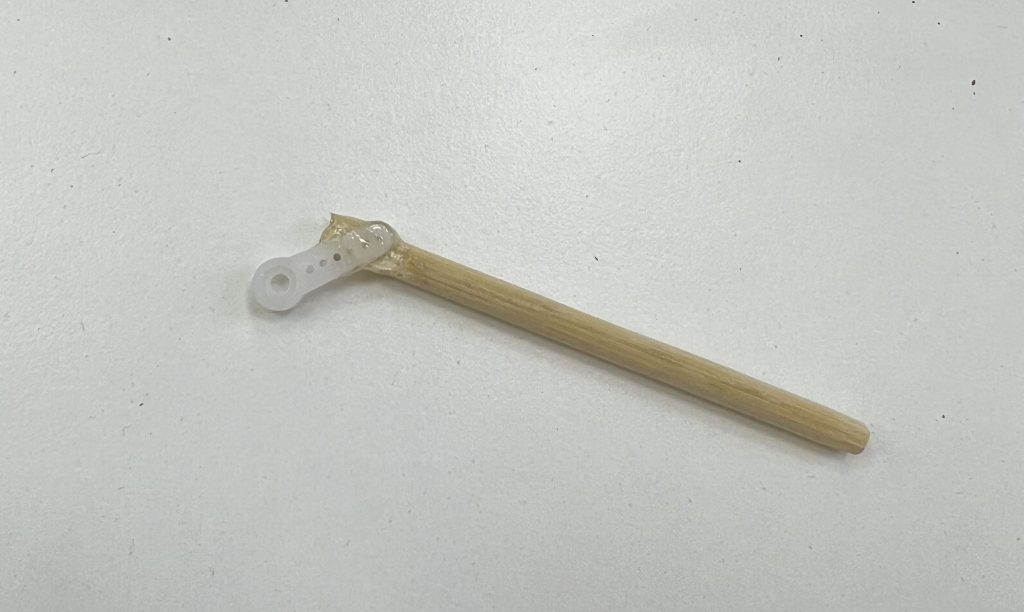
4.10 Glue the plastic part from the servo motor to the piece of wooden skewer at a 135-degree angle (use thermoplastic glue).
4.11 Put the received part on the servo motor and tube.
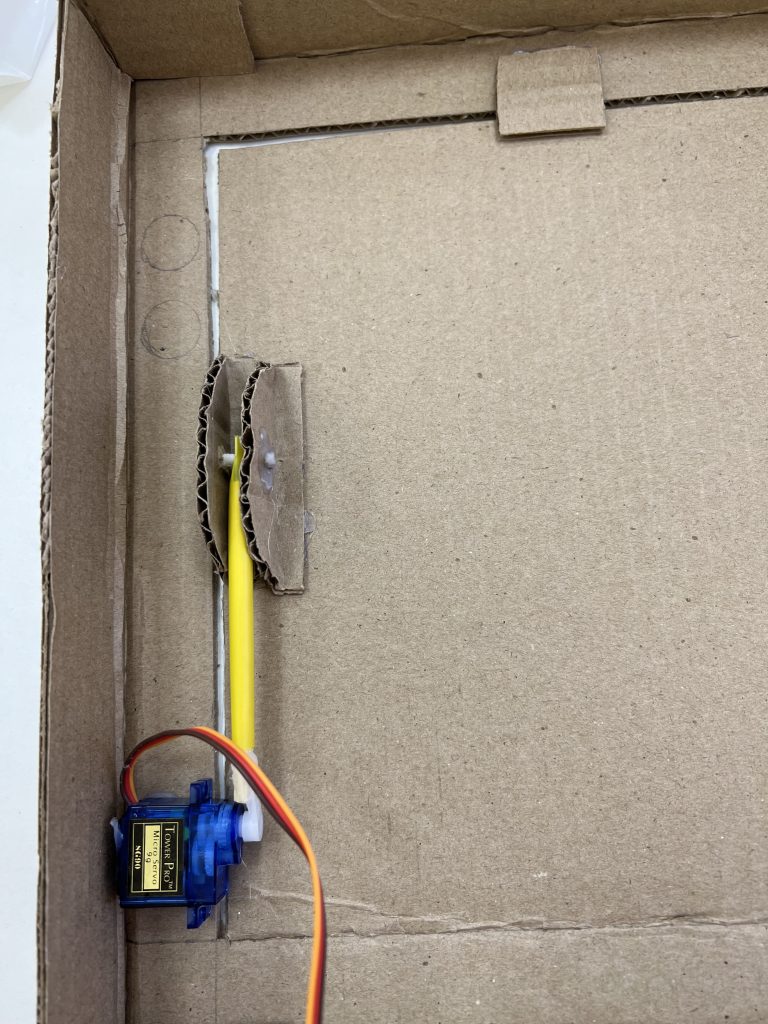
4.12 Step back 4.5 cm from the top of the cover. Position the ultrasonic module with the circles facing downwards and make marks with a pencil.
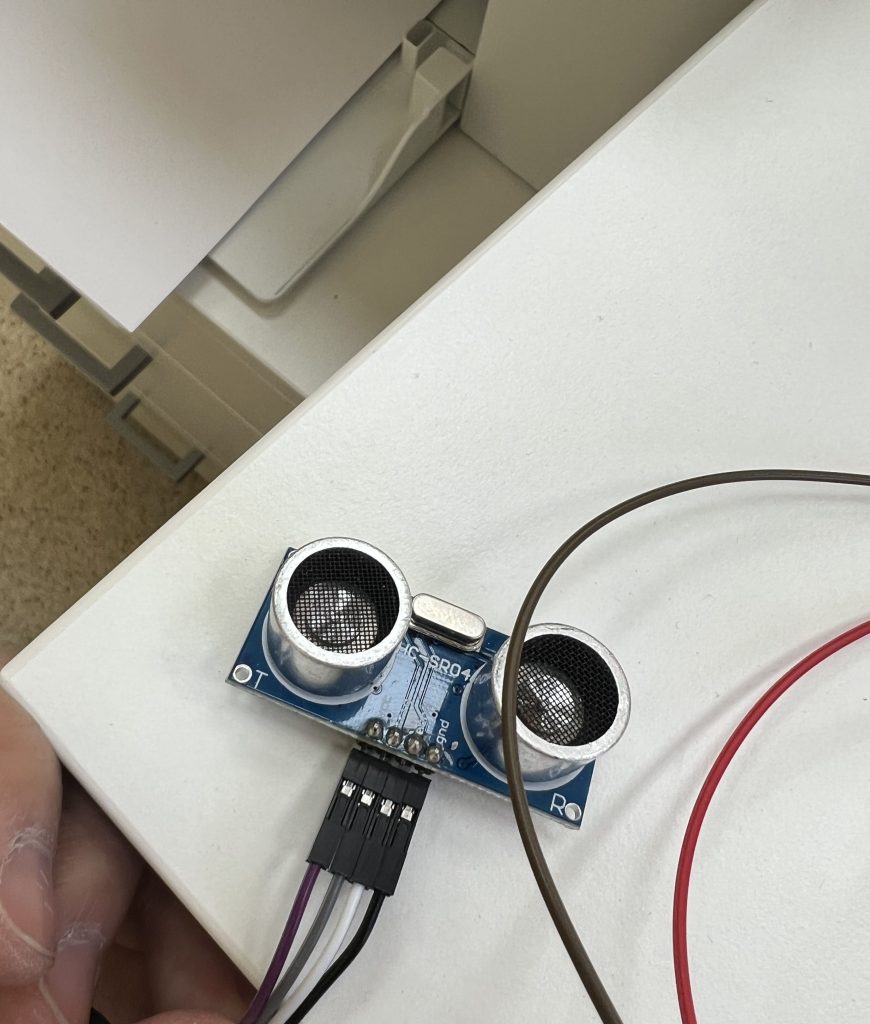
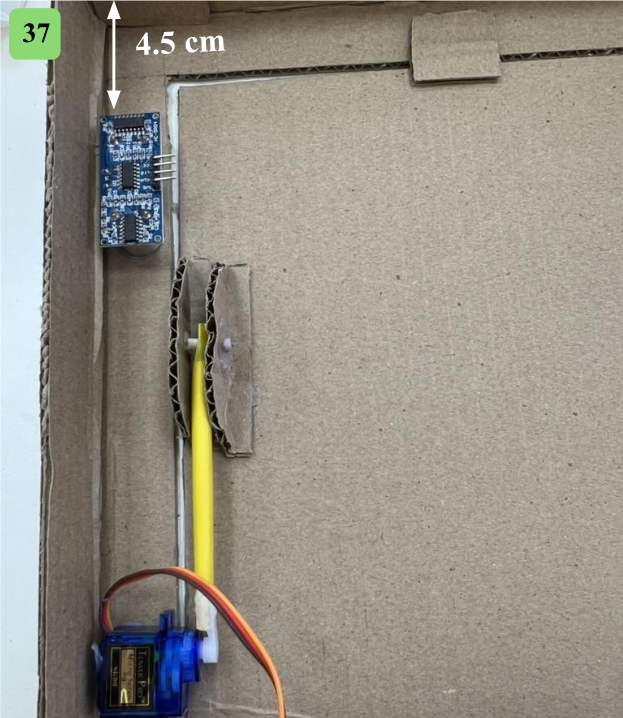
4.13 Cut out circles and place ultrasound modules on them. Glue the edges together using thermoplastic adhesive.