Lesson 2
Theoretical part
When you go out in nature, you immediately sense how easy it is to breathe among the trees and around the small wooden houses. But man is the environment’s biggest enemy, and his activities can lead to irreversible consequences. But we’ve grown accustomed to civilization – we need broadband internet, a steady supply of water and electricity, and the chance to buy a host of goods from a nearby convenience store. This means a lot of industrial activity, mining, cutting down forests, and a lot of non-degradable rubbish that we leave behind.
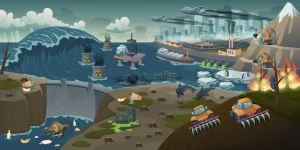
The factories that make everything we need, the plants that make our homes warm and bright, and even the cars that drive on the road emit a lot of pollutants into the atmosphere, creating a kind of giant gas blanket that causes our planet to lose less heat and gradually warm up. Scientists have called this effect a greenhouse effect and have been sounding the alarm for decades. What’s wrong with getting a little warmer outdoors? But the melting of glaciers will raise the ocean’s water level, which will lead to the extinction of many species and even flooding some cities. To control this process, we need ecologists, specialists who constantly monitor the environment, or, for example, dosimetrists – those who measure the level of pollution with instruments. Environmental engineers sample the wastewater from large chemical plants and, if the results are unsatisfactory, they will demand the purchase of better filters and, in the meantime, may even close down the plant.
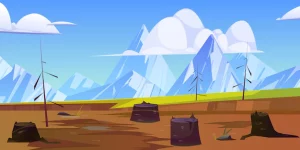
Deforestation is another serious threat to nature. Apart from the fact that forests are the green lungs of the planet, producing oxygen and absorbing carbon dioxide, their roots retain moisture. So, when a human being cuts down a large forest, he not only deprives himself of fresh air, but also swamps a huge area. Fortunately, a forest can regenerate! But for this to happen, forest engineers, arborists and forest rangers have to look after it.
Do you know how much rubbish an average family leaves behind?
One and a half tonnes a year! Scientists have long ago discovered tiny particles of plastic in the oceans that accumulate in the tissues of living organisms. That means that our dinner table is stuffed with plastic in the truest sense of the word. The trouble is that we’ve grown accustomed to conveniently packing a box of chocolates with an inedible tab inside, and each candy individually wrapped in a square of foil. The transition to biodegradable packaging and to reusable items instead of disposable ones should certainly help. But in order for that to happen, we need technologists and experts in new materials – already working on packaging made from corn, potatoes, soybeans and cellulose. The decay time of these materials is a hundred times shorter than the plastic bags we are used to. But not all materials can be replaced with environmentally friendly alternatives – some need to be recycled, and what cannot be recycled can be disposed of in special plants that can also generate electricity. But to build and operate such plants, again, good professionals are needed!
Not only will specialists be needed who will prevent new pollution, but also those who will carefully restore the areas and districts that have been damaged by man in the past. So the city dwellers who can’t get away from their concrete jungles will need those who can green the mega-cities and provide these gardens with quality fertilizers and water in time automatically. There will also be a need for those who can filter the exhaust from factory chimneys and create powerful and quickly rechargeable batteries for cars without internal combustion engines. But don’t forget – a lot depends on you! There are things you can do right now, such as start picking up trash separately, or at least stop throwing it away (if you are still doing it, of course).
Practical part
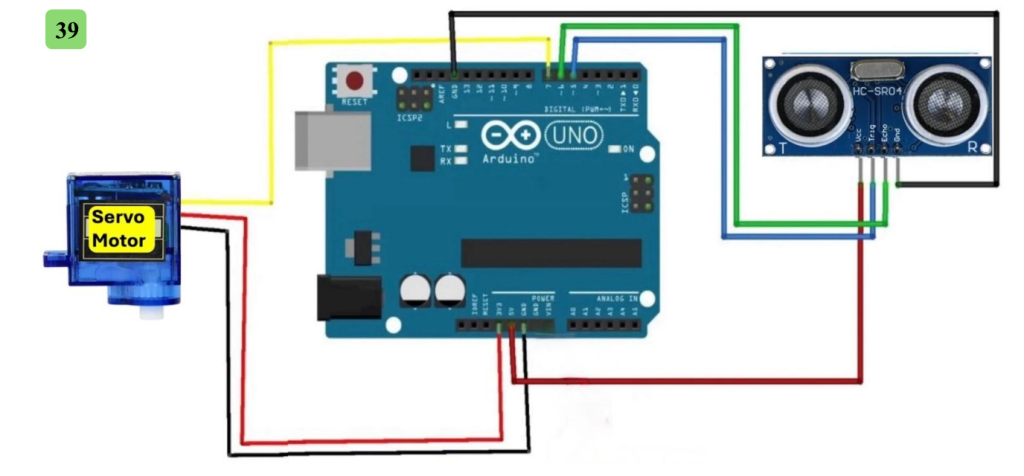
4.14 Connect the Arduino to the other components according to the scheme indicated in the picture.
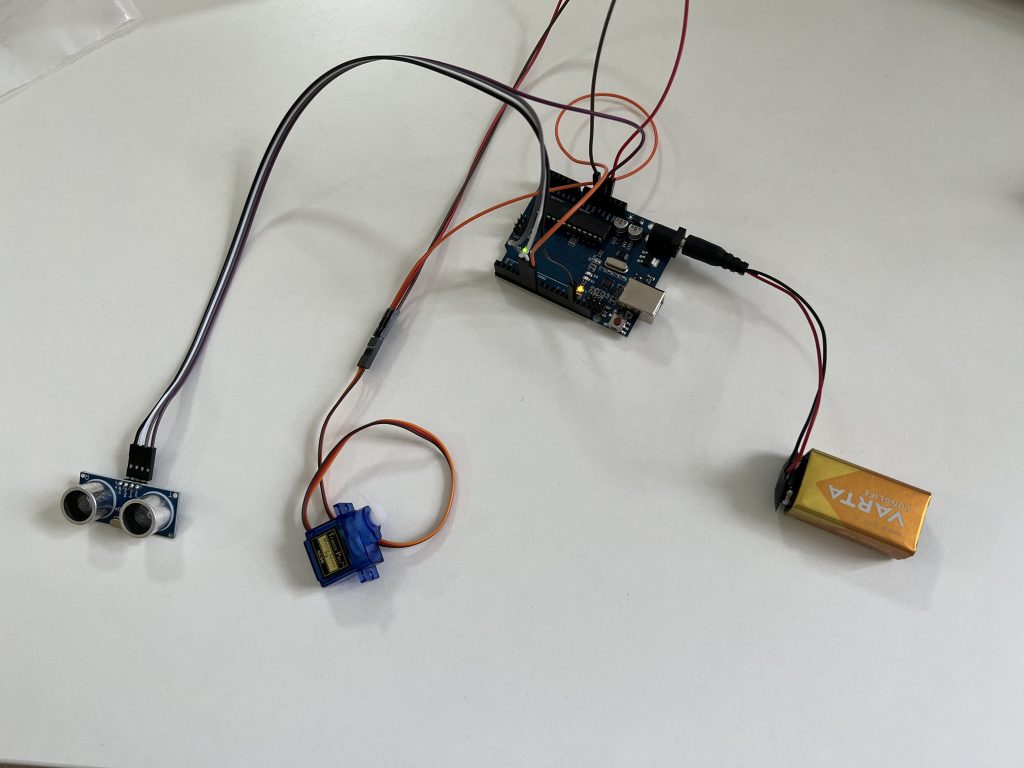
4.15 Upload the code to Arduino.
#include <Servo.h>
Servo servo;
int trigPin = 5;
int echoPin = 6;
int servoPin = 7;
int led= 10;
long duration, dist, average;
long aver[3];   //array for average


void setup() {
    Serial.begin(9600);
    servo.attach(servoPin);
    pinMode(trigPin, OUTPUT);
    pinMode(echoPin, INPUT);
    servo.write(0);         //close cap on power on
    delay(100);
    servo.detach();
}

void measure() {
 digitalWrite(10,HIGH);
digitalWrite(trigPin, LOW);
delayMicroseconds(5);
digitalWrite(trigPin, HIGH);
delayMicroseconds(15);
digitalWrite(trigPin, LOW);
pinMode(echoPin, INPUT);
duration = pulseIn(echoPin, HIGH);
dist = (duration/2) / 29.1;    //obtain distance
}
void loop() {
  for (int i=0;i<=2;i++) {   //average distance
    measure();
   aver[i]=dist;
    delay(10);              //delay between measurements
  }
 dist=(aver[0]+aver[1]+aver[2])/3;

if ( dist<50 ) {
//Change distance as per your need
 servo.attach(servoPin);
  delay(1);
 servo.write(0);
 delay(3000);
 servo.write(150);
 delay(1000);
 servo.detach();
}
Serial.print(dist);
}
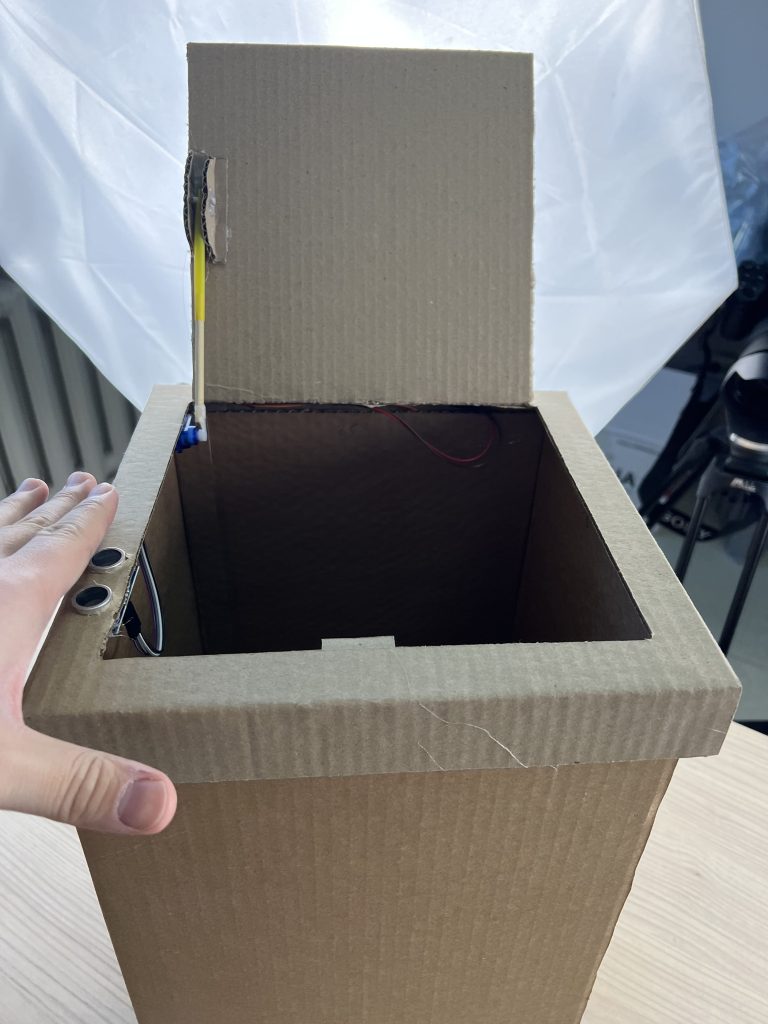
4.16 Place the Arduino and the battery in the back part of the lid using double-sided adhesive tape. Make a hole for the wires in the left part of the lid using a ballpoint pen.
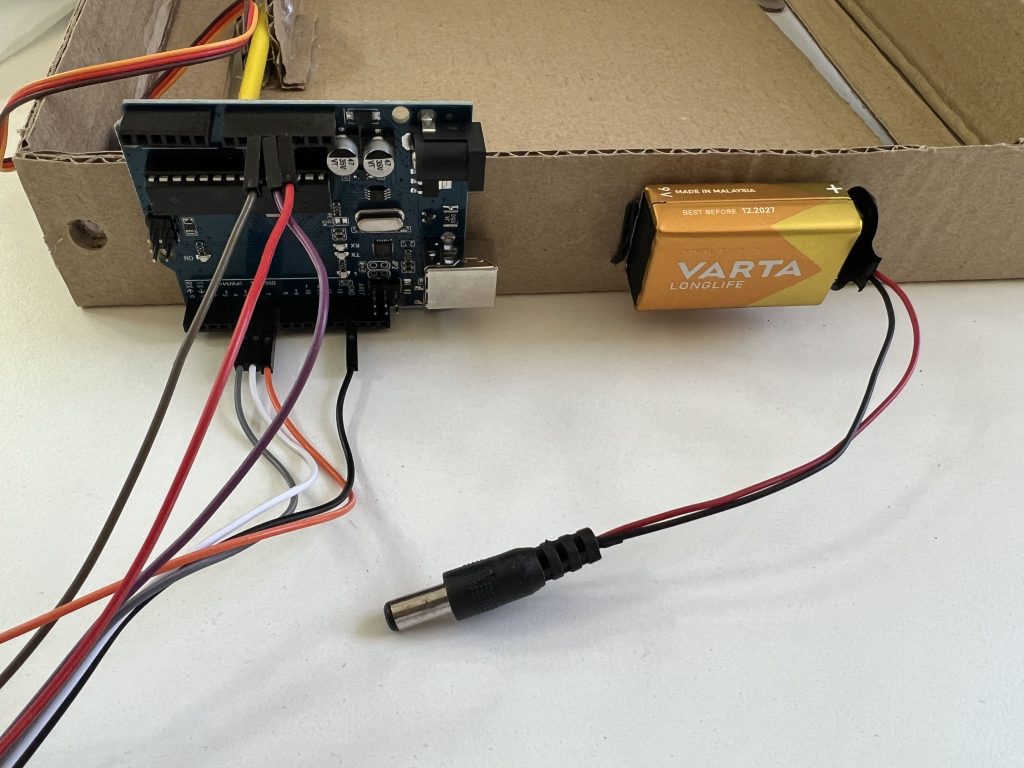
4.17 Attach the wires to the cover housing using adhesive tape as shown in the picture.
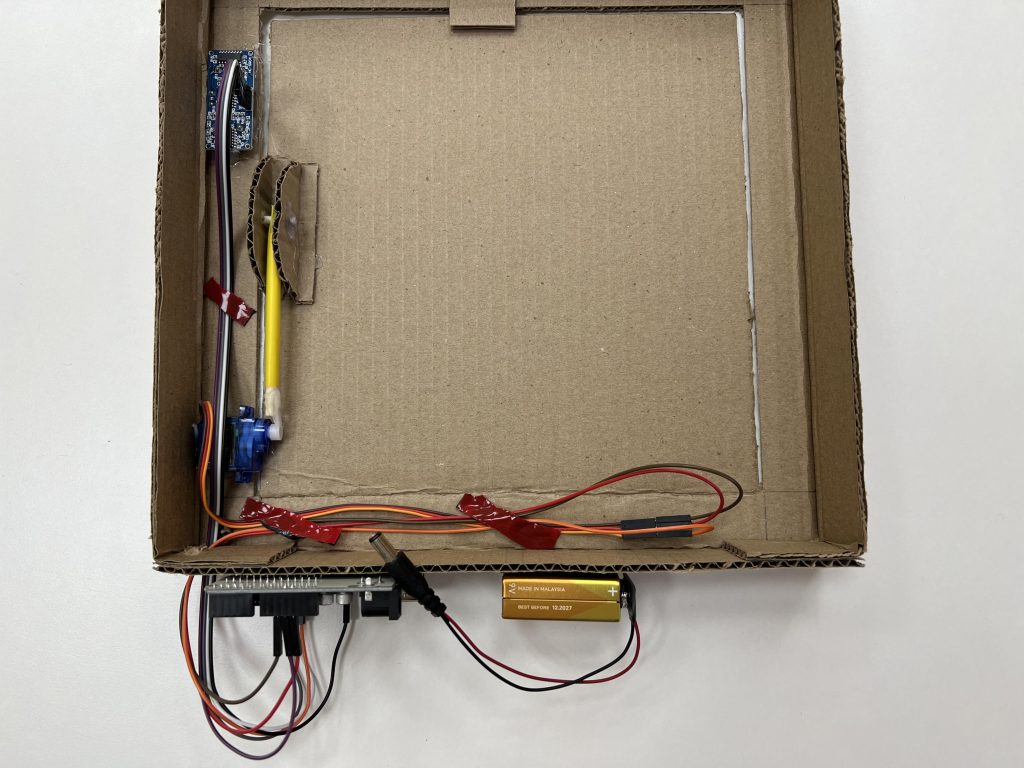
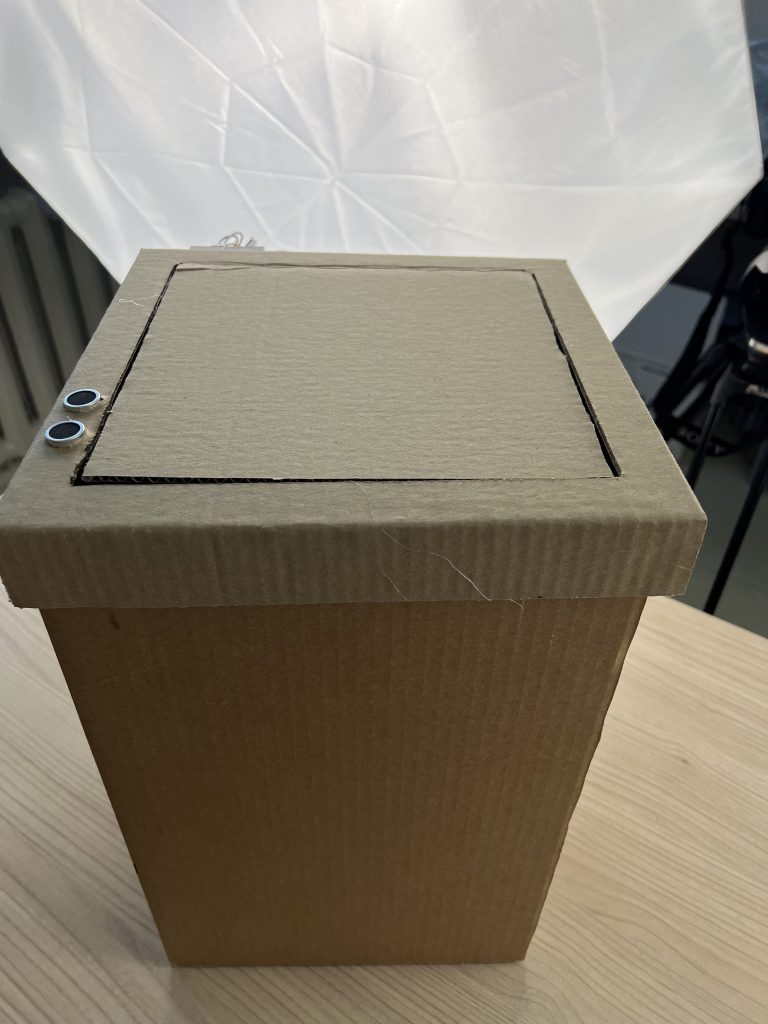
4.18 Put the cover on the box and connect the battery to the Arduino.
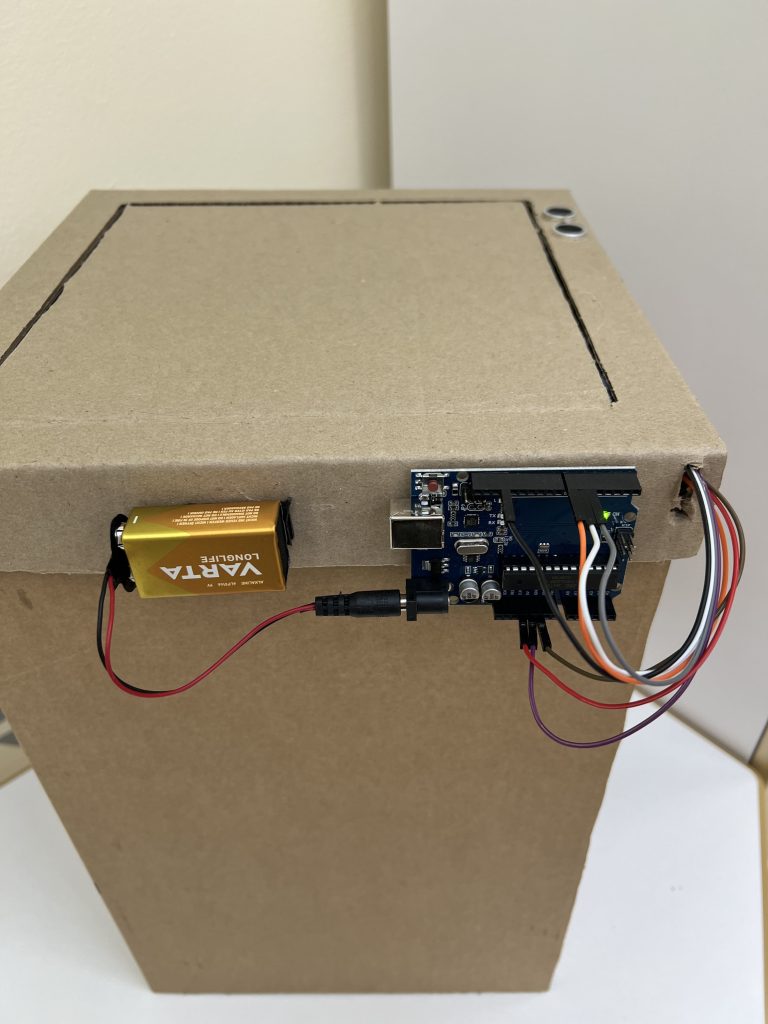

Presentation
Having completed the project work in this lesson, ask the groups to present the design and results of the project to their classmates. The students can use videos, interactive whiteboards, blogs and other multimedia. A variety of creative presentation methods can be used.
Each team should present their eco-boxes that they have made according to their design.
Conclusion
In this project, the students learned more about Arduino programming, and how important it is to keep nature clean. How much damage is caused by untidy rubbish. Made a smart eco-box with an Arduino sensor
Evaluation
PBL assessment criteria:
Project based learning is a method of learning in which students acquire knowledge and skills by working on a single project over a 3- or 4-week period to explore and find the answer to a genuine, interesting and challenging question, problem or challenge (follow the PBL Rubrics link below for rubrics).