
Week 1
Goals:
- Introduction to securities
- To learn how to calculate income from securities
Expected results:
After learning the project, students will:
– be able to communicate well with the teacher
– analyze and summarize information
– form a responsible attitude to learning
– accustomed to working independently
– independent logical reasoning and conclusion
– ability to work in Microsoft Excel
– an idea of the types of passive income is formed
– ability to calculate securities
Interdisciplinary Connections:
- Algebra
- Computer Science
Teacher’s guide:
- For the evaluation of the project, in the first week, provide this material (PBL rubrics) to students so that
– students understand in advance what criteria they need to prepare for,
– Students are able to independently assess their peers.
- At the beginning of the lesson it is recommended:
- To stimulate interest in the project, ask a few “leading questions”, such as:
– what are securities?
– what types of securities exist?
– do you know how to calculate income from securities?

A security is a document that confirms various rights of the owner. Mainly, it is the right to fulfill property obligations – to receive part of the company’s profits, the return of borrowed money, etc.
Types of securities
Securities are classified according to several characteristics. The most basic is the basic division into:
- Equity securities, that is, those securities that certify the right to a share of something, such as a company and its profits in the form of dividends. In addition, equity securities give the right to vote in the management of the company, but this right corresponds to the size of the share. Equity securities include stocks – ordinary or preferred, and shares.
- Debt securities confirm the right of the owner to repay the debt within a certain period and pay interest on it. In fact, by buying a debt security, the owner gives his money to the company in debt, the company, in turn, undertakes to repay the money and regularly pay interest (coupons or discount). Such debt securities can be bonds or bills of exchange, promissory notes.
Stock
The profitability of stocks on the stock market is formed by two components. The first is the growth of the value of security. The second is dividends. If the company is doing well, its financial performance increases, dividends increase and, as a consequence, the stock price also increases.
Dividends are a percentage of the profits that a company pays out every quarter, six months or a year. To earn on the exchange rate difference, you need to buy shares cheaper and sell them at a higher price. To calculate the total return on a stock, you need to take into account both the dividends and the gain on the sale.
How do you calculate a stock’s dividend yield?
Typically, to predict their potential return, investors calculate the dividend yield based on historical data. This is the ratio of the dividend amount to the value of the stock.
The dividend yield can be obtained using a simple formula:
d = D/p*100%
where D is the dividend and p is the price of the stock.
A stock bought today may be worth several times as much in a few years. Or it may be a few percent more expensive in a few days. In any case the increase in the market price (price) gives an investor the opportunity to make money on reselling his securities.
The formula for the market return on a stock:
Rm=(p2-p1)/p*100%
where p2 – selling price, p1 – buying price.
For a more objective picture, both market and dividend yields are taken into account.
Aggregate yield:
Y = D+( p2–p1)
The total return is calculated by the formula:
Rt=Y/p1*100%
Resources:
Как рассчитывать доходность акции с учетом дивидендов и роста курса (alfainvestor.ru)
Как рассчитать доходность акций | Freedom24
Practical part
In the practical part, each student will work individually. The first week you will make various reports related to stocks. You will manually output the calculations in the first notebook and then do them on the computer in Microsoft Excel.
Assignment №1.
An investor bought shares for ₸ 1,500 and sold them a year later at a market value of ₸ 2,000. The dividend declared was 10% per annum. Determine the total return of the stock and the percentage yield on the stock.
| Given: | Formula: | Solution: |
| d =10% p1 =1500 ₸ p2 = 2000 ₸ | 1) d = D/p*100% → D=d*p1 /100% 2) Y = D+( p2–p1) 3) Rm =(p2–p1)/p1*100% 4) Rt = Y/p1* 100% | 1) D = 1500*10% / 100% = 150 ₸ 2) Y=150+(2000-1500)=650 ₸ 3) Rm =(2000 –1500)/1500*100% = 33,33% 4) Rt = Y/p1* 100% =650/1500*100%=43,33%. |
| Answer: D =150 ₸, Y =650 ₸, Rm =33,33%, Rt =43,33%. | ||
Step 2.
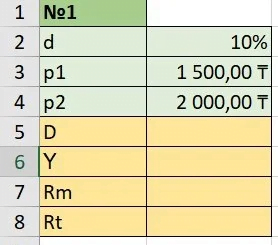
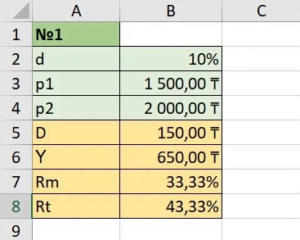
Now you can calculate the report in Microsoft Excel. Open Excel and enter the information as in the picture. to insert the symbol “₸” p1 and p2, select “Home” → “Numeric Format” → “Monetary”.
Step 3.
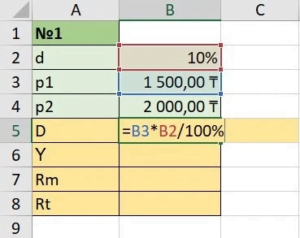
To calculate the D-dividend, enter the formula B3*B2/100% in cell B5. You should have a calculation value of 150₸.
Step 4.
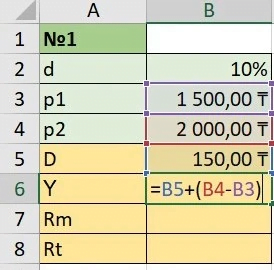
To calculate the total income Y, enter the formula B5+(B4 – B3) in cell B6. The calculation value is 650 ₸.
Step 5.
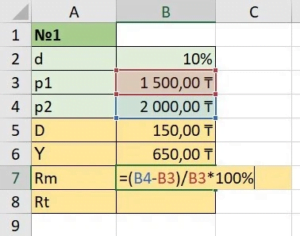
Rm – enter the formula B7 (B4-B3)/B3*100% to calculate the market return on the stock. The calculation value is 33.33%.
To change the cell format to percent: Home→ Numeric Format→ Percentage.
Step 6.
Rt – Enter the formula B6/B3*100% in cell B8 to calculate the total return. The report value is 43.33%.
To change the cell format to percent: Home→ Numeric Format→ Percentage.
Step 7.
Compare the answer you calculated manually and the answer you calculated in Excel.
To summarize the report, the investor received a return of 150 ₸ through the dividend and 650 ₸ through the total return for the year by buying one share. The market return on the stock was 33.33% and the total return was 43.33%.
Assignment №2.
The shares were bought at a price of ₸ 2,000 and sold after two years at ₸ 3,000. The dividends on the stock were: in year 1, 20%; in year 2, 10%. Determine the stock’s total return and the stock’s yield as a percentage.
Step 1.
Have students first do the math on their own. Then check by looking at the correct answer in the table.
| Given: | Formula: | Solution: |
| d1=20% d2=10% p1=2000 ₸ p2=3000 ₸ Т= 2 years | 1) D1=d1*p1 /100% D2=d2*p1 /100% 2) Y = D1+D2+(p2–p1) 3) Rm =(p2–p1)/p1*100% 4) Rt = Y/p1* 100% | 1) 1 year: D1=2000*20% / 100% = 400 ₸ 2 years: D2=2000*10% / 100% = 200 ₸ 2) Y=400+200+(3000-2000)=1600 ₸ 3) Rm =(3000 –2000)/2000*100% = 50% 4) Rt = Y/p1* 100% =1600/2000*100%=80% |
| Answer: D =400 ₸, Y =1600 ₸, Rm =50%, Rt =80% | ||
Step 2.
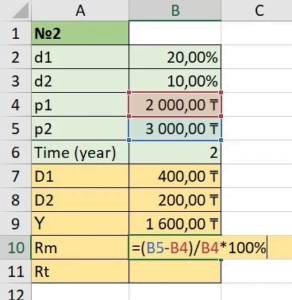
Now you can calculate the report in Microsoft Excel. Open Excel and add a new sheet. Enter the information on the new page, as in the picture.
To insert the symbol “₸” p1 and p2, select Home → Numerical Format → Money Format.
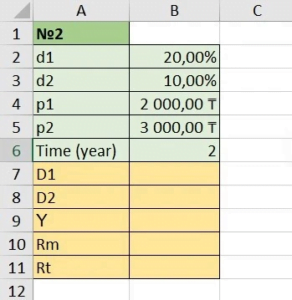
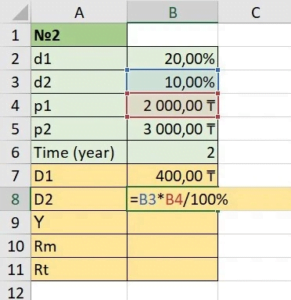
Step 3.
To calculate D – dividends, enter the formulas B2*B4/100% in cell B7 and B3*B4/100% in cell B8. You should have calculation values of 400 ₸, 200₸.
Step 4.
To calculate total income Y, enter the formula B7+B8+(B5 – B4) in cell B9. Calculation value – 1600 ₸.
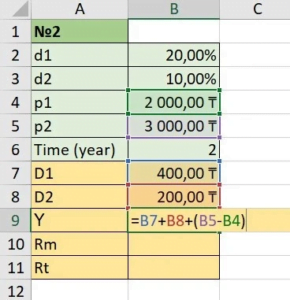
Step 5.
Rm – Enter the formula (B5-B4)/B4*100% in cell B10 to calculate the market return on the stock. The calculation value is 50%.
To change the cell format to percentage: Home→ Numeric Format→ Percentage.
tep 6.
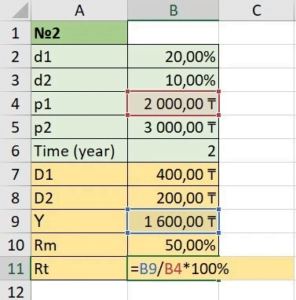
Rt – Enter the formula B9/B4*100% in cell B11 to calculate the total return. The calculation value is 80%.
To change the cell format to percent: Home→ Numeric Format→ Percentage.
Step 7.
Compare the answer you calculated manually and the answer you calculated in Excel.
To summarize the report, the investor earned 600 ₸ dividends over two years by buying one share, which means that the income he earns by holding the share for a long time is increasing. 1600 ₸ earnings through total return. The market return on the stock was 50% and the total return was 80%.
Assignment №3.
Shares of 500 ₸ par value were purchased at a price of 600 ₸ in 100 shares and sold after 3 years at 700 ₸ per share. The dividends on the shares were 10% in year 1, 15% in year 2, and 20% in year 3. Determine the stock’s total return and the stock’s yield as a percentage.
Step 1.
Have students first do the math on their own. Then check by looking at the correct answer in the table.
| Given: | Formula: | Solution: |
| d1=10% d2=15% d3=20% N=500 ₸ p1=600 ₸ p2=700 ₸ pc=100 Т= 3 years | 1) D1=d1*N*pc /100% D2=d2*N*pc /100% D3=d3*N *pc/100% 2) Y =D1+D2+D3+(p2–p1) 3) Rm =(p2–p1)/p1*100% 4) Rt = Y/(pc*p1)* 100% | 1) 1 year: D1=500*100*10% / 100% = 5000 ₸ 2 years: D2=500*100*15% / 100% = 7500 ₸ 3 years: D3=500*100*20% / 100% = 10000 ₸ 2) Y=5000+7500+10000+(700-600)=32500 ₸ 3) Rm =(700 –600)/600*100% = 16,67% 4) Rt = Y/(100*p1)* 100% =32500/(100*600)*100%=54,17%. |
| Answer: D =22500 ₸, Y =32500 ₸, Rm =16,67%, Rt =54,17%. | ||
Step 2.
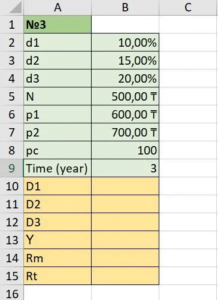
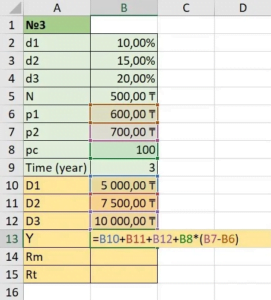
You can now calculate the report in Microsoft Excel. Open Excel and add a new sheet. Enter the information on the new page as in the picture.
Step 3.
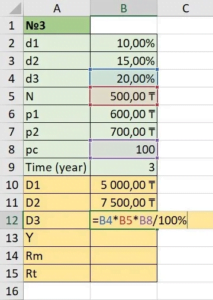
To calculate the D – dividend, enter the formulas B2*B5*B8/100% in cell B10, B3*B5*B8/100% in cell B11 and B4*B5*B8/100% in cell B12. You should have dividend values of 5000 ₸, 7500 ₸, 10000₸.
Step 4.
To calculate total income Y, enter the formula B10+B11+B12+B8*(B7-B6) in cell B13. The report value is 32500 ₸.
Step 5.
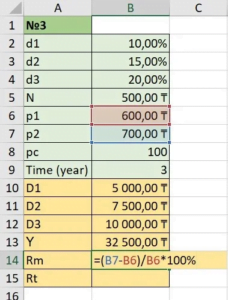
Rm – Enter the formula B14 (B7-B6)/B6*100% to calculate the market return on the shares. The report value is 16.67%.
Step 6.
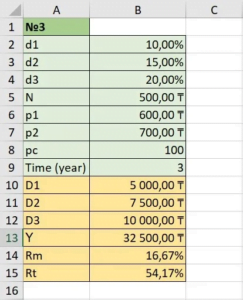
To calculate the total return Rt, enter the formula B13/(B8*B6)*100% in cell B11. The report value is 54.17%.
Step 7.
Compare the answer you calculated manually with the answer you calculated in Excel.
To summarize the report, the investor through the purchase of 100 units of shares had a total return of 32500₸ over three years. The market return on the shares was 16.67% and the total return was 54.17%.
You have now mastered the material on the subject of shares and have developed a general understanding of shares. Next week you will familiarize yourself with the subject of bonds, and you will write reports.