
Week 2
The Bond
Bonds are debt securities that are issued by the government or companies to raise money for business development. In simple terms, the buyer of such an asset becomes a creditor of the issuer. Bonds have a fixed nominal value. This is the amount of principal that an investor receives at maturity.
Coupon on a bond is the percentage of the face value that the issuer of the bond pays to the investor for the use of the funds. The coupon can be paid on a semi-annual, annual, quarterly or monthly basis.
Advantages of bonds:
Receipt of income through the payment of interest (coupons);
repayment of the principal amount invested by holding the bond until maturity;
additional profit if you resell the bond at a higher price than you bought it.
Cons of bonds:
a bond has a yield limit compared to equities, which can appreciate significantly and rapidly;
companies can default on bonds.
The par value of a bond is the amount that will be paid to the borrower once the bond matures.
The par value for RK is set at 1,000₸.
The actual market price of a bond, which a private investor sees in brokers’ applications or on stock exchanges’ websites, may be either below or above par.
The current yield on a bond
Shows the ratio of coupon payments for the year to the current price of the bond.
r=C/P*100%
- С is the sum of coupon payments during a year
- P – current price of a bond
When you purchase a bond, you also purchase its coupon accrued since the last payment date together with the bond itself. The coupon is refilled every day. Therefore, you will receive coupon income only for the period when you own the bond. The amount of coupons on fixed-rate bonds is known when the paper is issued and remains unchanged during the whole circulation term. Therefore, the formula for calculating accumulated coupon income (ACI) on such bonds is as follows
ACI=N*i/100%*D/365
- N- nominal value, ₸
- I- coupon rate, %
- D = Settlement date – Date of the last coupon payment, days. The settlement date is the coupon purchase date, and the last coupon payment date is the date of the last payment before the purchase, depending on the coupon. That is, the number of days between these dates must be.
Coupon yield
Coupon yield is the coupon payment that an investor receives.
C=P*i/T
- C – coupon income
- T – number of payments per year
Resources:
Облигации (бонды): что это такое, как работают, как заработать | РБК Инвестиции (rbc.ru)
Максимально доступно объясняем, что такое облигации и как на них заработать (bcs-express.ru)
Practical part
Step 1.
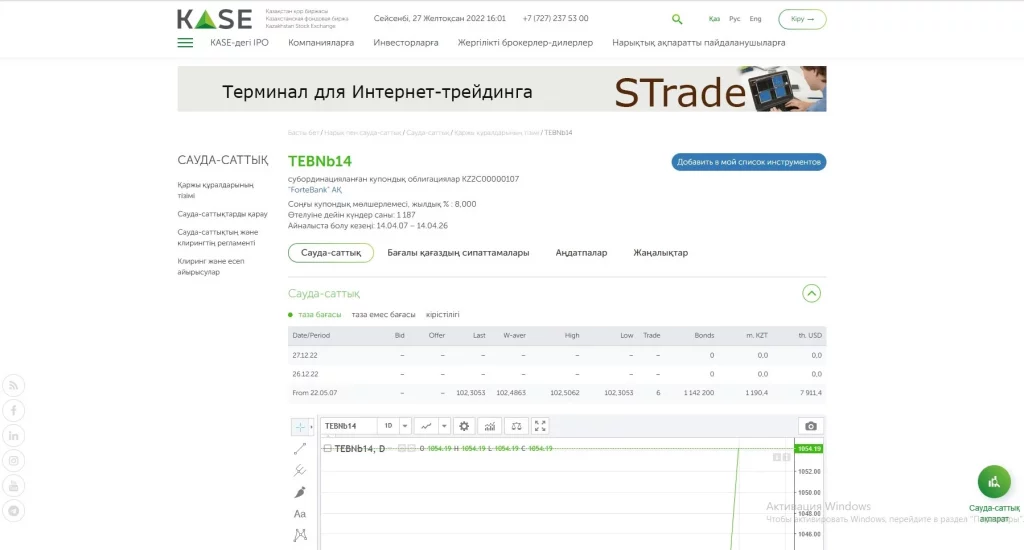
Via Internet Kazakhstan Stock Exchange – KASE.KZ go to the website. Select “corporate bonds” in the menu. Through the Website you will get data on bonds and perform analysis.
Step 2.
Go to Corporate Bonds section, select the bond type and review several bonds. In the overview: look at the annual coupon rate, circulation period, number of days to maturity and price.
Step 3.
Select one bond among the bonds. In the following steps, you will study this bond and calculate its yield.
Step 4.
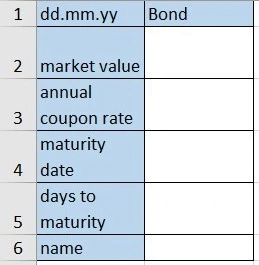
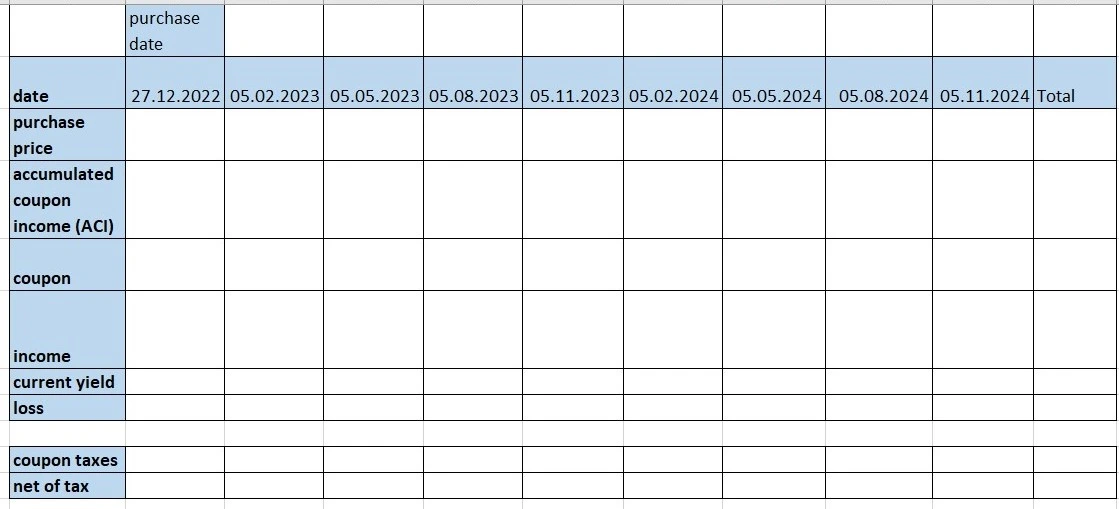
Create a new file in Microsoft Excel. Create a table for it as shown in the figure.
Step 5.
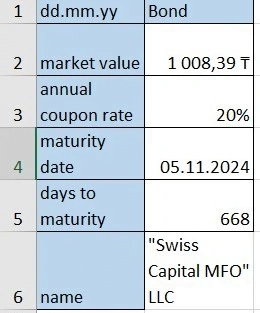
Fill in the table with the data associated with the bond you have selected.
The information in the figure is shown as a template.
Step 6.
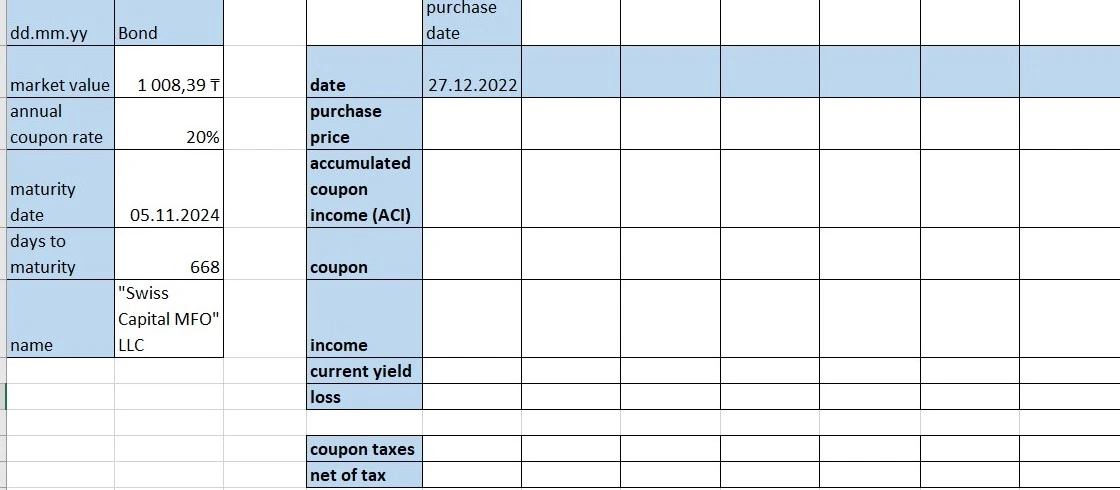
Next to the table, create the following table as shown.
Step 7.
Go to “Characteristics of the securities“ and look at the schedule from “Coupon Payment Schedule”. Fill in the “Coupon Payment Commencement Date” there as shown. When filling in the dates, bear in mind that you are calculating from the purchase date of the bond. The cell number dates will depend on the number of coupon payments you receive. It can be paid once a year, once every six months or once a quarter.
Step 8.
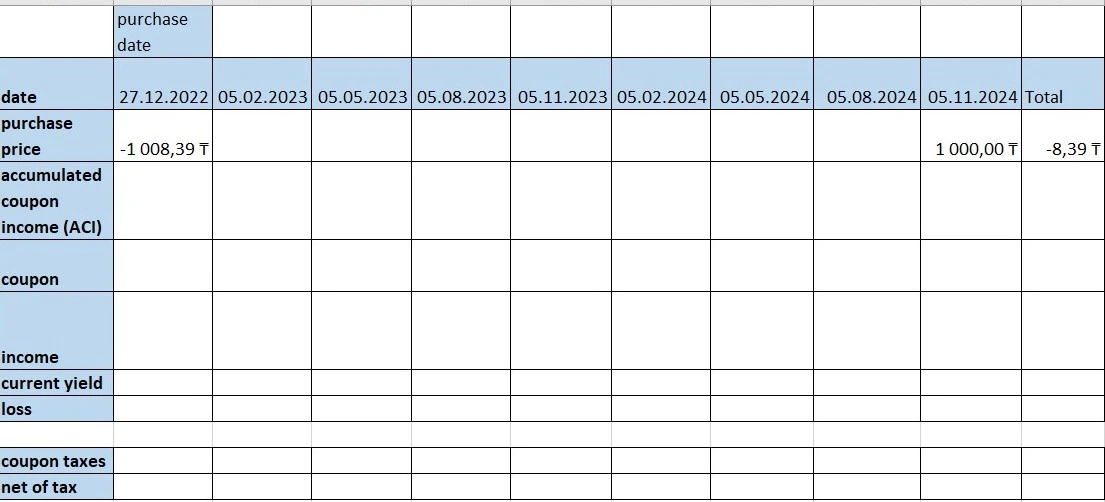
In the purchase price you enter the market value with the symbol ‘-‘. Because you lost money buying it.
Enter the face value of the bond of ₸ 1,000 on the last payment date. Because on the last day you will get back the amount of face value.
Add the nominal amount and the amount of the purchase price to the ‘total’ box.
Step 9.
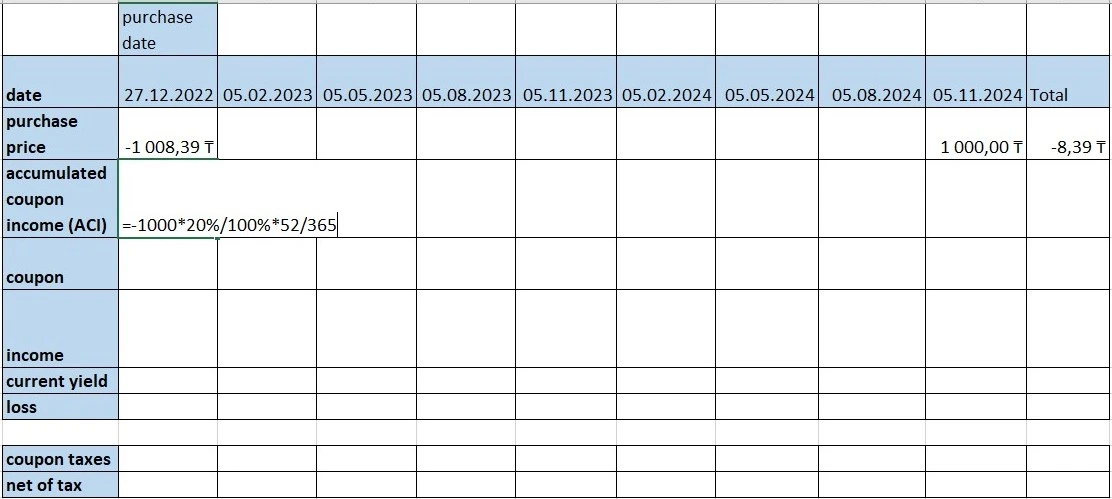
Calculate the accumulated coupon income (ACI). To do this, you will use the formula given in the theoretical part.
You will have a “-” symbol in this amount. This is because you are refunding the coupon payment before purchase to the former bondholder, which is also a loss from you.
Step 10.
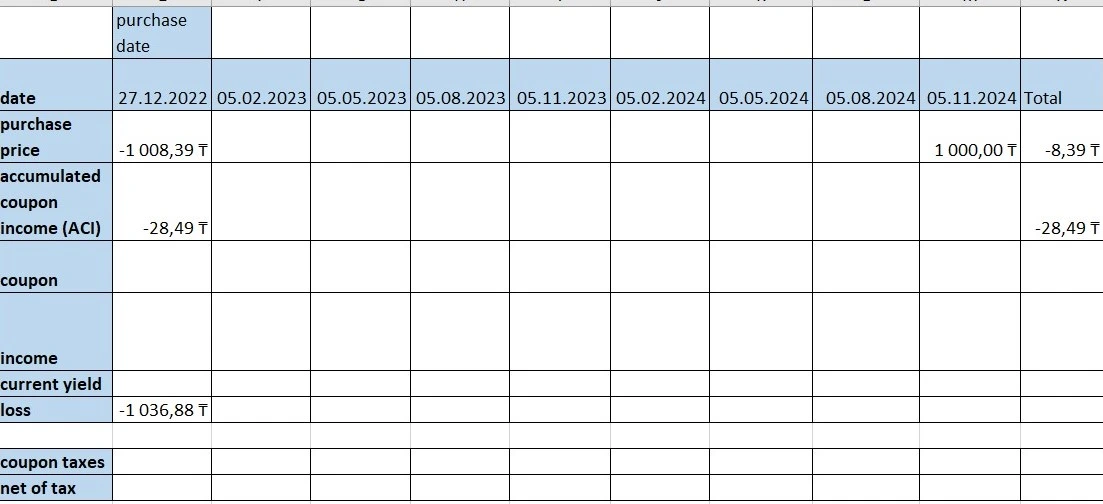
Enter the amount of the ICD at the intersection of the ‘ICD’ cell and the ‘total’ cell.
At the intersection of the ‘date of purchase’ cell and the ‘loss’ cell, enter the sum of the purchase price and the ICD.
Step 11.
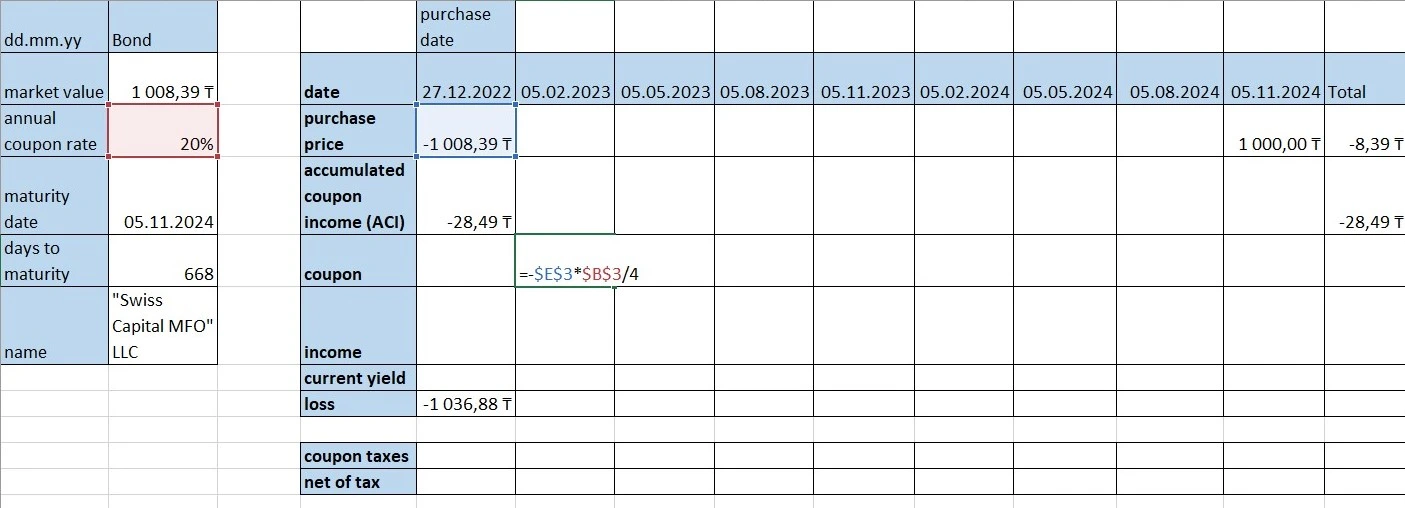
Calculate the coupon payments. C=P*i/T – calculated using this formula. T to my account equals four, as the bond I have has a coupon payment every quarter.
We fix the purchase price and the annual coupon rate using the F4 button, as shown in the figure.
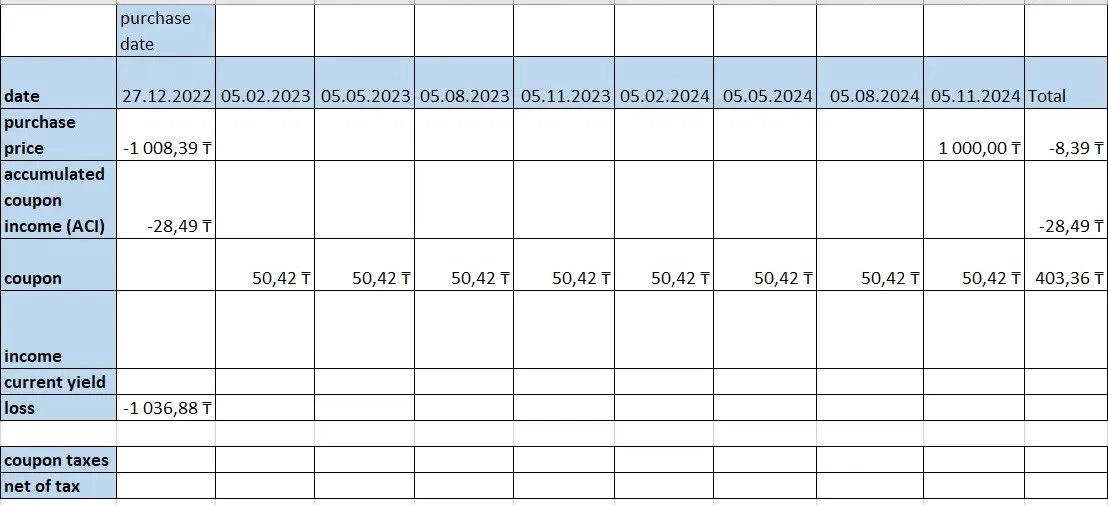
We then copy this formula for the other coupon payment days.
Step 12.
Calculate the sum of all coupons at the intersection of the “total” cell and the “coupon” cell.
Step 13.
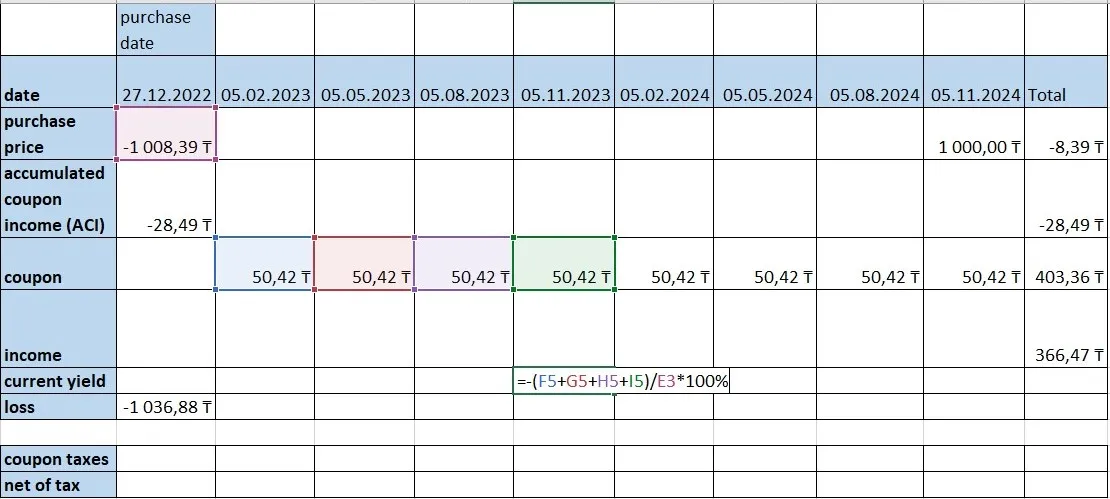
To calculate the revenue: “coupon payment + ICD + purchase price – face value”.
That is, this is the revenue you earn through the bond.
Step 14.
Calculate the current yield of the bond. To do this, you divide the amount of coupons paid per year by the purchase price and multiply by 100%. And you calculate the number of years your bond has been outstanding.
I have a 2-year bond, so I calculate the current yield of the bond twice.
Step 15.
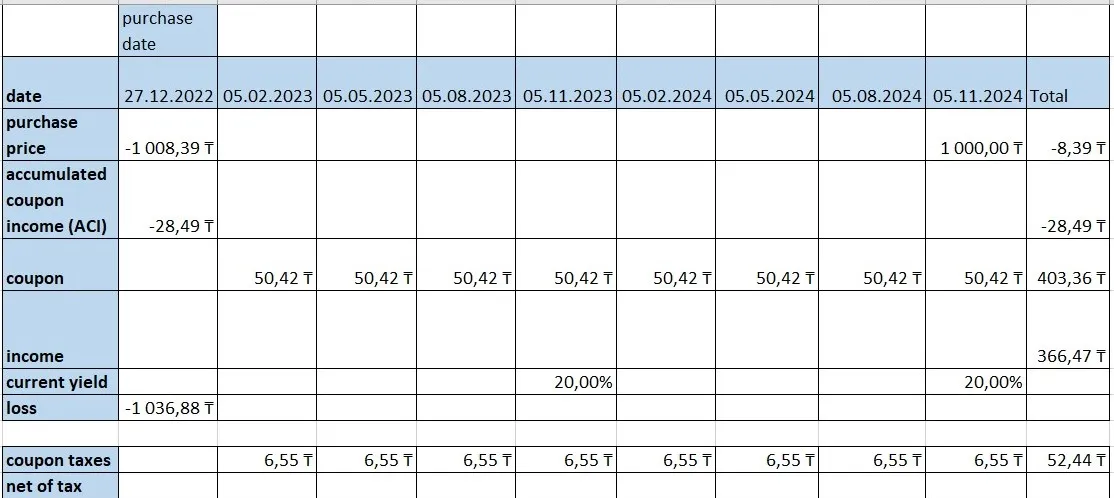
Because you earn through the bond, you pay taxes to the state. The amount of coupon tax is 13% of the coupon income. To calculate the coupon tax, you multiply the income from each coupon by 13% and divide by 100%. This is how you calculate the amount of tax for the days on which each coupon payment was made.
Once you have calculated each coupon tax, calculate their amount in the ‘total’ box.
Step 16.
Calculate the income minus taxes. To do this, you reduce the total coupon amount from the amount of income earned by the coupons.
This amount is considered to be the net profit you earn by buying the bond.
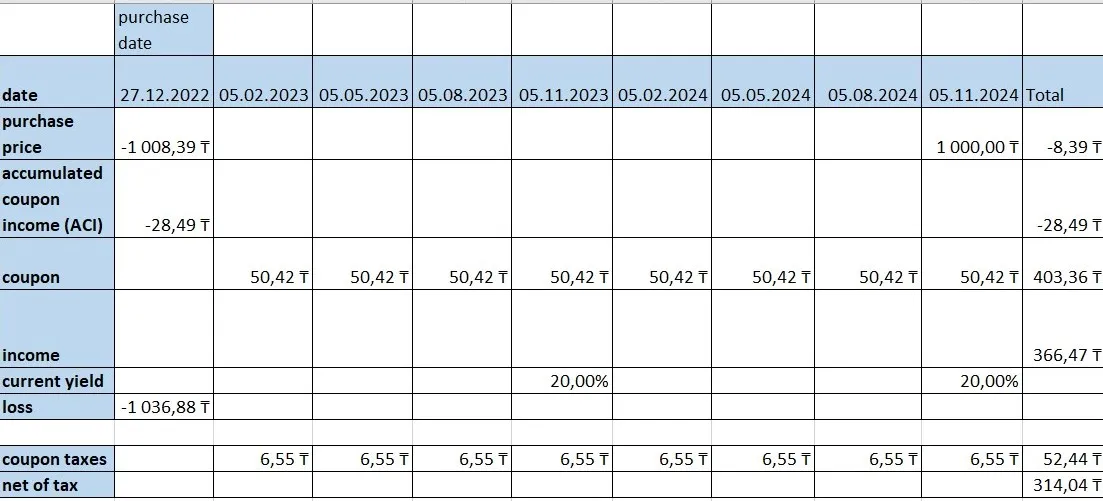
So you have calculated the coupon payments, taxes and net income you will receive by buying one piece of bond.
Step 17. Calculate the profit when you buy 10 and 50 pieces of this bond. To do this, multiply the amounts in the “total” column by 10 for the “10 pieces” column and by 50 for the “50 pieces” column.
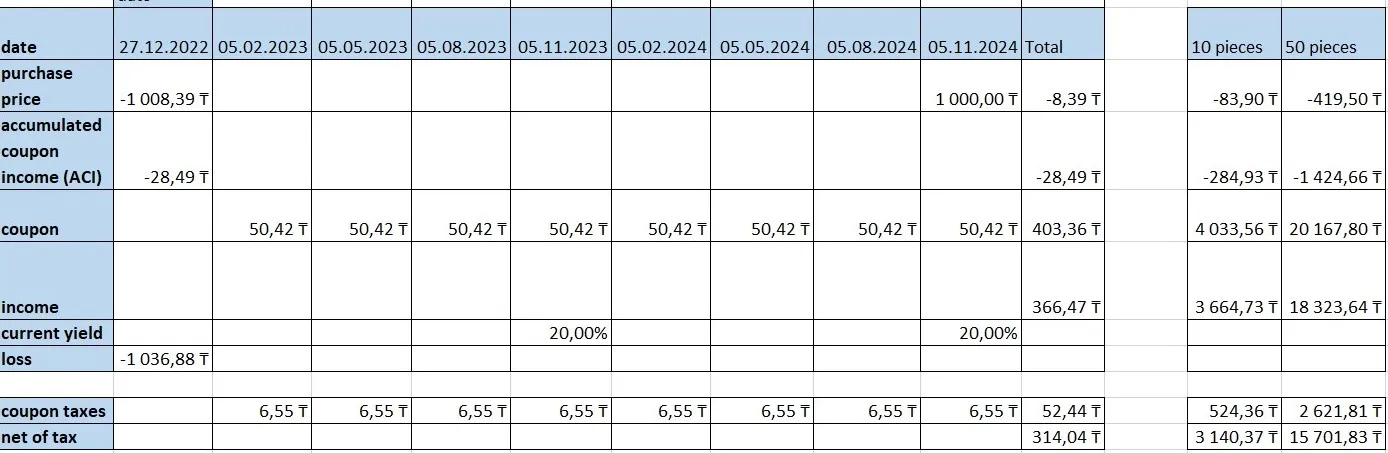
A bond is bought in several pieces, not just one piece. You may notice that the more you buy a bond, the more you profit.